

TL;DR:
- Adopting Fortune 500 engineering standards improves product quality, speeds delivery, and reduces operational costs.
- Teams that implement shared practices and peer-led adoption can achieve over 2x faster delivery and cut cloud expenses by 30%.
Fortune 500 engineering standards are defined frameworks for quality, security, and delivery that large enterprises use to build software at scale without accumulating crippling technical debt. Engineering leaders in B2B SaaS ask why use Fortune 500 engineering standards when their teams are small and moving fast. The answer is concrete: teams that adopt disciplined, platform-centered engineering practices can double delivery speed and cut cloud costs by over 30%. These are not abstract ideals from organizations like ISO, IEEE, or ANSI. They are operational levers that translate directly into fewer production failures, faster release cycles, and cleaner compliance audits under frameworks like ISO 27001 and the EU AI Act.
Why use Fortune 500 engineering standards for quality and risk reduction
The most direct benefit of Fortune 500 engineering standards is a shared technical language across your entire team. When every engineer follows the same naming conventions, API contracts, and security baselines, miscommunication drops sharply. Standards replace costly negotiations between stakeholders with shared expectations, which matters especially in geographically dispersed DACH and EU teams where async coordination is the norm.

Standards also embed compliance and security into the development workflow from day one. Fortune 500 organizations use what practitioners call "golden paths": self-service templates that make the correct approach the lowest-friction option for any developer. Golden path templates increase developer productivity while keeping security and compliance baked in rather than bolted on at the end of a sprint.
The risk reduction argument is equally strong on the compliance side. B2B SaaS companies operating in the EU face GDPR, the EU AI Act, and sector-specific regulations that carry real financial penalties. Embedding standards early means your codebase is audit-ready before an auditor arrives, not after a scramble that costs weeks of engineering time.
Key mechanisms that reduce risk through engineering standards:
- Shared API contracts prevent integration failures between services and third-party vendors.
- Security baselines enforce authentication, encryption, and access control consistently across all services.
- Code review checklists tied to ISO 27001 controls catch vulnerabilities before they reach production.
- Incident response runbooks reduce mean time to recovery when failures do occur.
"Standards at enterprise scale transcend individual preference, replacing costly negotiations with shared expectations and a common technical language that accelerates engineering processes across complex, distributed teams."
How engineering standards accelerate delivery speed and cut operational costs
The efficiency case for Fortune 500 engineering practices is grounded in measurable outcomes, not theory. Teams that shift from fragmented, outsourced models to insourced, platform-centered engineering with enforced internal standards achieve over 2x delivery speed and reduce cloud costs by more than 30%. That is not a marginal gain. For a B2B SaaS team burning €50,000 per month on infrastructure, a 30% reduction is €15,000 back in the budget every month.
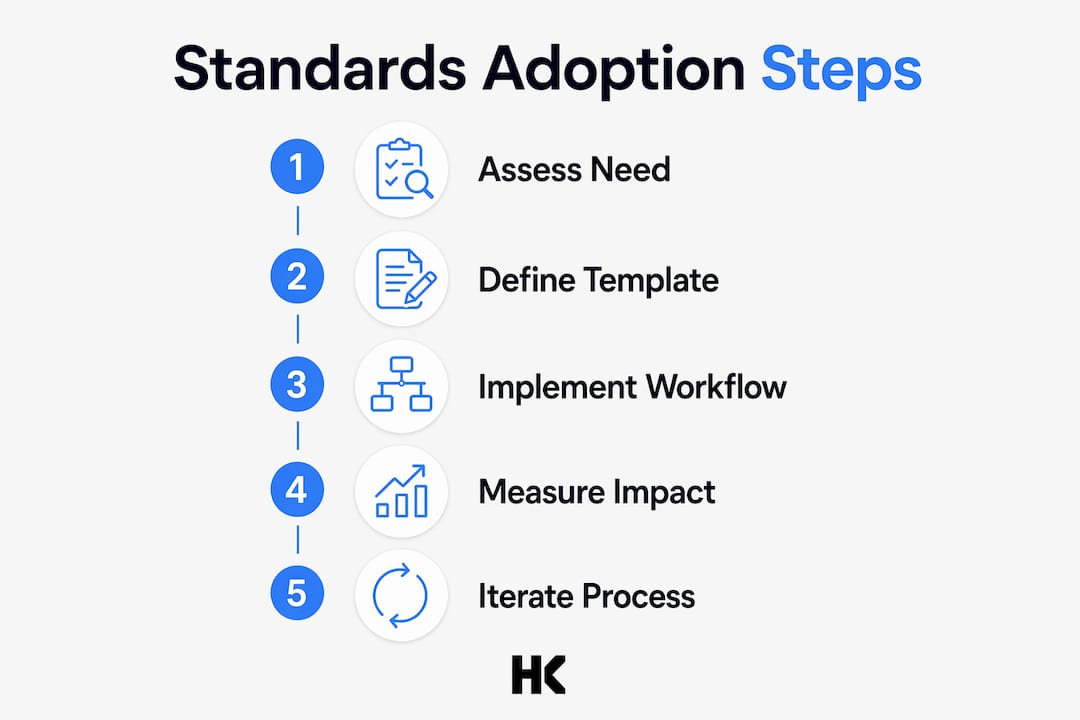
The mechanism is straightforward. Standards reduce work-in-progress by eliminating the constant re-evaluation of how to approach common problems. When your team has a documented, approved pattern for database migrations, feature flags, or LLM integration, engineers stop debating and start building. The fastest engineering teams embed compliance as a foundational capability rather than a final gate, using automated testing, trunk-based development, and chaos engineering to ship with confidence.
How standards drive faster delivery in practice:
- Automated CI/CD pipelines enforce standards at every commit, catching regressions before they reach staging.
- Platform engineering templates give new engineers a working, compliant environment on day one instead of week three.
- Reduced coordination overhead means fewer cross-team meetings to resolve architectural disagreements.
- Reusable infrastructure modules cut the time to provision new services from days to hours.
- Standardized monitoring and alerting reduce the time engineers spend diagnosing production issues.
The time-to-market gains from this kind of discipline compound over time. A team that ships features 20% faster in Q1 is not just 20% ahead. It is building a structural advantage that widens every quarter as competitors struggle with coordination debt.
Pro Tip: Start with one golden path template for your most common workflow, such as a new microservice or a GDPR-compliant data pipeline. Prove the time savings internally before rolling out standards across the entire codebase.
What organizational factors determine whether standards adoption succeeds
The technical case for adopting engineering standards is clear. The organizational case is harder. The most common failure mode is a top-down mandate that generates resistance and architectural sprawl. Successful adoption requires a middle-out approach: engaging peer leaders who already have credibility with the engineering team, not just issuing directives from the CTO level.
Conway's Law predicts that your system architecture will mirror your communication structure. If your standards adoption process is siloed in a platform team that has no relationship with product engineers, the standards will be ignored or worked around. The teams that get this right treat standards as a living knowledge base, not a static document stored in a forgotten Confluence page.
Practical factors that determine adoption success:
- Peer-led champions who use the standards themselves and can answer questions in real time.
- Dynamic, searchable documentation that engineers can query without filing a ticket or waiting for a meeting.
- Feedback loops that let engineers propose changes to standards when they encounter friction.
- Credentialing and professional development tied to standards mastery, which signals that the organization values engineering maturity.
Culture is the variable that most engineering leaders underestimate. A team that treats engineering best practices as a source of pride rather than a compliance burden will adopt standards faster and maintain them longer. That culture does not emerge from a policy document. It emerges from leadership behavior and visible investment in the craft.
Pro Tip: Treat your internal standards wiki as a product. Assign an owner, track usage metrics, and run quarterly reviews to retire outdated guidance. Static documentation is a liability, not an asset.
What happens when B2B SaaS teams ignore engineering standards
The cost of ignoring engineering standards is not hypothetical. Manual, fragmented standards research causes engineering teams of 10 to lose the equivalent of one full-time engineer annually. That is one person's entire productive output consumed by guessing, searching, and debating how to approach problems that already have solved answers.
The longer-term costs are worse. Technical debt accumulates silently until it becomes a tax on every new feature. Onboarding new engineers takes weeks instead of days because there is no documented baseline for how the system works. Production failures increase as each engineer applies their own interpretation of what "secure" or "reliable" means.
| Cost category | Without standards | With Fortune 500 standards |
|---|---|---|
| Onboarding time | 3–6 weeks to productivity | 1–2 weeks with documented golden paths |
| Standards research overhead | 1 FTE lost per 10 engineers annually | Negligible with a searchable knowledge base |
| Compliance audit preparation | Weeks of reactive scrambling | Days with embedded compliance controls |
| Production incident rate | Higher due to inconsistent practices | Lower with shared baselines and runbooks |
The technical debt problem is especially acute in B2B SaaS environments where speed-to-market pressure encourages shortcuts. Those shortcuts feel fast in the moment. They are not fast when a security audit reveals that three different teams implemented authentication three different ways, and all three need to be refactored before a major enterprise customer will sign.
"Ignoring standards initially feels faster but yields long-term delays and operational costs due to technical debt and onboarding bottlenecks that compound with every new hire and every new feature."
Key Takeaways
Fortune 500 engineering standards deliver measurable gains in quality, speed, and compliance when adopted with the right organizational approach.
| Point | Details |
|---|---|
| Standards reduce risk | Shared baselines and golden path templates prevent security gaps and compliance failures before audits arrive. |
| Delivery speed doubles | Platform-centered engineering with enforced standards can achieve over 2x delivery speed and cut cloud costs by 30%. |
| Adoption requires peer leadership | Top-down mandates fail. Middle-out adoption with peer champions drives lasting organizational change. |
| Ignoring standards is expensive | Teams of 10 lose one FTE annually to fragmented standards research and the downstream costs of technical debt. |
| Compliance embeds early | Treating compliance as a foundational capability rather than a final gate reduces audit preparation from weeks to days. |
The real reason engineering leaders resist standards (and why they are wrong)
I spent years working inside organizations like BMW, Deutsche Bahn, and Bundesrechenzentrum Austria before building my own SaaS products. The pattern I saw in every one of those environments was the same: the teams that resisted formal standards always believed they were moving faster. They were not. They were spending that speed on rework, incident response, and onboarding friction that never showed up in a sprint velocity chart.
The uncomfortable truth is that most engineering leaders in B2B SaaS resist Fortune 500 engineering practices because they associate them with bureaucracy. That association is not wrong. Badly implemented standards are bureaucracy. But well-implemented standards are the opposite. They are decisions you make once and never have to make again. Every hour your team spends debating whether to use JWT or session tokens is an hour not spent on the feature your customers are waiting for.
The EU AI Act and GDPR have changed the calculus for DACH and EU SaaS teams specifically. Compliance is no longer optional, and the cost of retrofitting it is far higher than the cost of embedding it from the start. I have seen teams spend more on a single compliance remediation project than they would have spent on three years of disciplined standards work. The math is not close.
My recommendation for engineering leaders is to start with the highest-risk surface area in your product. Pick one domain, document the standard, build the golden path template, and measure the time savings. The results will make the case for the rest of the organization better than any argument I could make in a meeting.
— Hanad
How Hanadkubat applies Fortune 500 standards to B2B SaaS builds

Hanadkubat brings the same engineering discipline from BMW, Deutsche Bahn, and Bundesrechenzentrum Austria directly to B2B SaaS teams in the DACH region and beyond. Every engagement, whether a 2-week AI sprint or a full MVP build, ships with embedded compliance controls, documented architecture decisions, and golden path patterns your team can maintain after the engagement ends. There are no project managers between you and the engineer writing the code. Pricing is fixed, timelines are in weeks, and the standards are built in from day one. Engineering leaders and compliance officers who want to see what this looks like in practice can review service details and pricing at hanadkubat.com.
FAQ
What are Fortune 500 engineering standards?
Fortune 500 engineering standards are documented frameworks for quality, security, and delivery that large enterprises use to build software consistently at scale. They include practices like golden path templates, automated compliance controls, and shared API contracts aligned with standards bodies such as ISO, IEEE, and ANSI.
How do engineering standards improve product quality?
Standards create a shared technical language that prevents miscommunication and enforce security and compliance controls at the code level. Embedded compliance makes the correct approach the easiest path for every developer on the team.
What is the cost of ignoring engineering standards in B2B SaaS?
Teams of 10 engineers lose the equivalent of one full-time engineer annually to fragmented standards research alone. The downstream costs include technical debt, slower onboarding, and higher production incident rates that compound with every new hire.
How should engineering teams adopt Fortune 500 standards without slowing down?
Start with one golden path template for your most common workflow and measure the time savings before expanding. Peer-led adoption with dynamic, searchable documentation drives faster uptake than top-down mandates.
Do Fortune 500 engineering practices apply to small B2B SaaS teams?
A 20-engineer team applying Fortune 500 platform engineering discipline can deliver at enterprise scale with over 2x delivery speed compared to fragmented approaches. Team size does not determine whether standards apply. Complexity and compliance requirements do.