

TL;DR:
- High-quality engineering involves building reliable and maintainable products from the start, not after launch. It significantly reduces costs related to incidents, rework, and customer trust loss. Implementing prevention-focused practices enhances both product quality and delivery speed for competitive advantage.
High-quality engineering is the disciplined practice of building products that are reliable, maintainable, and built to last from the first line of code, not patched into shape after launch. For tech leaders, understanding why high-quality engineering matters is a financial and strategic question, not a technical one. Poor engineering quality costs money in incident response, rework, and lost customer trust. The good news: quality and speed are not a trade-off. The research is clear that teams who invest in prevention consistently outperform those who rely on detection.
Why high-quality engineering matters for modern product development
Quality engineering is defined as the systemic discipline of embedding quality throughout the entire product development lifecycle, not just at the end as a gate before release. The traditional model, where a separate QA team tests a finished product, detects defects but does not prevent them. Modern quality engineering shifts that effort left, catching problems during design, code review, and automated testing before they reach production.
The practices that constitute quality engineering today include:
- Automated testing at every layer. Unit tests, integration tests, and end-to-end tests run continuously, giving teams immediate feedback on every code change.
- Observability and monitoring. Production systems emit signals that teams use to detect degradation before customers notice. Real-time alerting is a core part of this loop, not an optional add-on.
- Code reviews and pair programming. These practices catch logic errors and design flaws at the cheapest possible moment, before they compound.
- Shared ownership. Quality is not the QA team's job alone. Developers, product managers, and operations teams all carry responsibility for the outcome.
The cost argument for this approach is direct. Moving testing earlier saves between 10 and 50 hours of downstream cost for every hour invested, because production defects require incident response, hotfixes, and often customer communication. That ratio makes shift-left testing one of the highest-return investments in software development.
Pro Tip: Treat your automated test suite as a product asset, not a maintenance burden. A test suite that runs in under 10 minutes gives developers the confidence to ship daily. One that takes 2 hours becomes an obstacle teams route around.
How does engineering quality affect business outcomes?
Engineering quality connects directly to revenue, not just code cleanliness. A 2025 survey of senior cloud leaders found that 100% reported revenue loss from outages, with the average incident costing $495,000. That figure does not include SLA penalties, customer churn, or the engineering hours spent on recovery instead of new features.
Quality engineering must be designed around business flows and risk, not simply test cases. The formula for software risk is: probability of failure multiplied by impact, multiplied by detection time, multiplied by recovery time. Reducing any one of those variables cuts total business exposure. Reducing all four is the goal of a mature quality engineering program.
The business consequences of poor engineering quality cluster into three categories:
- Revenue leakage. Outages and degraded performance drive customers to competitors. In B2B SaaS, a single enterprise client lost to a reliability failure can represent months of revenue.
- Delivery paralysis. Teams with fragile codebases slow down over time. Every new feature requires more testing, more caution, and more coordination. Startups that fail at technical delivery almost always trace the root cause to accumulated quality debt, not a single bad decision.
- Brand trust erosion. Enterprise buyers in the DACH market run formal vendor assessments. A history of incidents shows up in those reviews and directly affects contract renewals and new sales cycles.
Risk-based testing addresses this by aligning quality investment with business impact. Critical payment flows, authentication systems, and data export functions get the most rigorous coverage. Lower-risk internal tools get proportionally less. This is not cutting corners. It is applying engineering judgment to where quality failures hurt most.
Is quality a trade-off against speed?
The belief that quality slows delivery is the most expensive misconception in software engineering. DORA research across 30,000 professionals proves that high-performing teams deploy more frequently and have lower failure rates simultaneously. Quality and speed move together when quality is built into the process, not bolted on at the end.
The mechanism is straightforward. Teams with high test coverage and clear observability make changes with confidence. Teams without it hesitate. They double-check manually, they delay releases, and they spend engineering cycles on uncertainty rather than progress. That hesitation is invisible on a sprint board but very visible in quarterly delivery output.
High-performing engineering teams also invert the typical effort ratio. Average teams spend 80% of quality effort on detection and 20% on prevention. Top teams reverse that ratio, spending 60% on prevention through code reviews, design reviews, and static analysis. They achieve better quality with less total effort because they stop the same class of defects from recurring.
The path from reactive to preventive quality follows a clear sequence:
- Audit your defect escape rate. Top organizations maintain a defect escape rate below 3%. A rate above 10% signals structural gaps in your development process, not just individual mistakes.
- Invest in automation infrastructure first. Automated diagnostics and feedback loops reduce the manual overhead that slows teams down. Automation pays for itself when it catches a production-bound defect at 2 AM without waking anyone up.
- Remove quality gates that create bottlenecks. A single QA sign-off before every release is a chokepoint. Distributed quality checks throughout the development cycle remove that bottleneck without reducing rigor.
- Measure deployment confidence, not just defect counts. Teams that track whether engineers feel confident shipping on any given day get an early warning signal before defect rates rise.
Pro Tip: If your team treats a release as a stressful event requiring all-hands monitoring, that is a quality signal, not a scheduling problem. Releases should be boring. Boring releases mean the quality system is working.
What can business leaders do to build quality engineering culture?
Business leaders set the conditions for quality engineering. They do not write the code, but they design the system in which code gets written. The most effective actions are structural and measurable.

Define ownership clearly. Assign a named owner for engineering quality outcomes, whether that is a VP of Engineering, a Head of Platform, or a senior technical lead. Diffuse ownership produces diffuse results. Quality without a named owner becomes everyone's lowest priority.
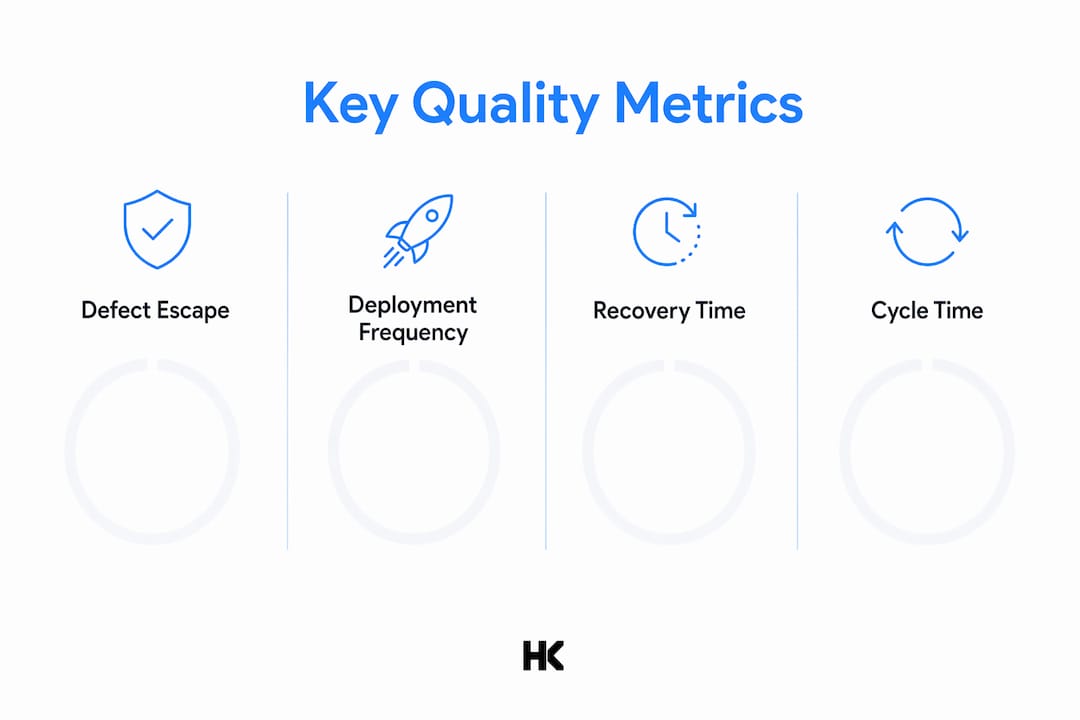
Establish metrics that connect to business outcomes. The right quality metrics for a tech leader are not lines of test coverage. They are:
| Metric | What it measures |
|---|---|
| Defect escape rate | Percentage of defects found in production vs. pre-production |
| Deployment frequency | How often the team ships to production |
| Mean time to recovery | How fast the team restores service after an incident |
| Cycle time | Time from code commit to production deployment |
These four metrics, drawn from DORA research, tell you whether your engineering system is healthy. Investing strategically in quality engineering can yield 3–5x ROI within 18 months when automation and defect prevention are the primary levers.
Fund prevention, not just response. Most engineering budgets allocate heavily to incident response tooling and on-call rotations. Redirecting a portion of that budget to code review tooling, automated testing infrastructure, and developer experience improvements produces compounding returns. The engineering best practices that reduce rework costs are well understood. The barrier is usually organizational will, not technical knowledge.
Create psychological safety around quality issues. Teams that hide defects to avoid blame accumulate hidden risk. Teams that surface problems early fix them cheaply. The cultural condition for quality engineering is an environment where raising a concern is rewarded, not penalized.
Key Takeaways
High-quality engineering is the single most reliable way to reduce delivery risk, cut long-term costs, and sustain product velocity in a competitive market.
| Point | Details |
|---|---|
| Shift quality left | Moving testing earlier saves 10–50 hours of downstream cost per hour invested. |
| Prevention beats detection | Top teams spend 60% on prevention; average teams spend 80% on detection after the fact. |
| Quality enables speed | DORA research shows high performers deploy more frequently and have lower failure rates simultaneously. |
| Measure what matters | Track defect escape rate, deployment frequency, mean time to recovery, and cycle time. |
| Leadership sets the system | Named ownership, funded automation, and psychological safety are the conditions quality engineering requires. |
The uncomfortable truth about quality I've learned from the field
Most quality problems I see in B2B SaaS products are not technical failures. They are organizational ones. The codebase is fragile because leadership treated quality as a phase to compress when deadlines moved. The test suite is thin because no one funded the time to write it. The team ships with anxiety because the system was never designed to give them confidence.
I built production systems at BMW, Deutsche Bahn, and Bundesrechenzentrum Austria, where a defect in a payment or infrastructure system is not a sprint retrospective item. It is a regulatory event. That context changes how you think about quality. You stop treating it as a cost and start treating it as the structure that makes everything else possible.
The leaders I respect most do not ask "can we skip testing this sprint?" They ask "what does our defect escape rate tell us about our process?" That reframe is the difference between a team that ships with confidence and one that ships with fingers crossed.
Quality engineering is not about perfection. It is about building a system where imperfections are caught early, fixed cheaply, and learned from systematically. That system is a competitive asset. It is also the reason some teams can ship a new feature in two weeks while others spend those same two weeks in incident response.
— Hanad
How Hanadkubat approaches engineering quality for B2B SaaS teams
The principles in this article are not abstract. They show up in every engagement Hanadkubat runs, whether that is a 2-week AI integration sprint or a full MVP build for a non-technical founder.

Hanadkubat works directly with CTOs, technical founders, and IT directors across the DACH region and EU, building products with quality embedded from day one, not retrofitted after launch. Every project ships with automated testing, clear observability, and architecture decisions that hold up under production load. If your team is dealing with a fragile codebase, a rising defect escape rate, or delivery that has slowed to a crawl, the starting point is a direct conversation. Pricing, service tracks, and past work are available at hanadkubat.com.
FAQ
What is quality engineering in software development?
Quality engineering is the practice of embedding quality throughout the entire development lifecycle through automation, code reviews, and shared team ownership, rather than testing only at the end. It shifts the focus from detecting defects to preventing them.
How does poor engineering quality affect revenue?
A 2025 survey found that senior cloud leaders reported an average revenue loss of $495,000 per outage incident. Beyond direct losses, poor quality causes SLA penalties, customer churn, and slower delivery that compounds over time.
Does investing in quality slow down development?
No. DORA research across 30,000 professionals shows that high-performing teams deploy more frequently and have lower failure rates at the same time. Quality practices reduce the hesitation and rework that actually slow teams down.
What metrics should tech leaders track for engineering quality?
The four most useful metrics are defect escape rate, deployment frequency, mean time to recovery, and cycle time. A defect escape rate above 10% signals structural process gaps that require attention.
What is the ROI of quality engineering investment?
Strategic investment in quality engineering, focused on automation and defect prevention, can yield 3–5x ROI within 18 months. The return comes from reduced rework, fewer incidents, and faster delivery cycles.