
TL;DR:
- Enterprise-grade engineering encompasses governance, compliance, security, and operational discipline vital for AI-enabled systems, not just handling high traffic or Kubernetes deployment. Implementing centralized control planes, embedding SRE principles, and prioritizing compliance from day one prevent costly rearchitecture and foster trust with enterprise buyers. Building these practices early ensures reliability, regulatory adherence, and faster deployment, avoiding common pitfalls of delaying governance decisions.
Most CTOs assume enterprise-grade engineering explained means handling high traffic or deploying on Kubernetes. That framing misses the point by a wide margin. Enterprise-grade engineering explained properly covers governance, compliance, security, operational discipline, and auditability. These dimensions matter even more when AI is embedded in your product. A misconfigured authorization layer on an LLM agent, a missing audit trail during a GDPR inquiry, or a deploy pipeline that bypasses policy controls: these are the failure modes that end careers and kill deals with enterprise buyers. This article walks you through the principles that actually define enterprise-grade engineering, and why they belong in your architecture from day one.
Table of Contents
- Key Takeaways
- Enterprise-grade engineering explained: what it actually covers
- Centralized control planes and governance layers
- SRE principles for enterprise reliability
- Compliance-first DevOps in regulated cloud architectures
- Applying enterprise engineering in practice
- My perspective on where enterprise engineering actually fails
- How Hanadkubat can help you ship enterprise-grade AI products
- FAQ
Key Takeaways
| Point | Details |
|---|---|
| Enterprise-grade is not just scale | It covers governance, compliance, reliability, security, and operational discipline, especially for AI workloads. |
| Control planes prevent costly rework | Embedding authentication, authorization, and audit logging upfront avoids expensive rearchitectures later. |
| SRE makes reliability measurable | SLIs, SLOs, and error budgets replace gut-feel operations with engineering-grade accountability. |
| Compliance must be built in | Audit trails, policy-as-code, and immutable artifacts cannot be bolted on after the fact. |
| Platform thinking beats feature thinking | Treating AI integration as infrastructure, not individual features, produces systems enterprise buyers trust. |
Enterprise-grade engineering explained: what it actually covers
The term "enterprise-grade" gets applied to everything from spreadsheets to databases, which has diluted its meaning. For B2B SaaS, the definition needs to be precise.
Enterprise-grade engineering is a set of system design, operational, security, and compliance practices that make software dependable enough for organizations where failure carries real consequences. Think regulated industries, multi-team environments, or deployments where a 30-minute outage triggers contractual penalties.
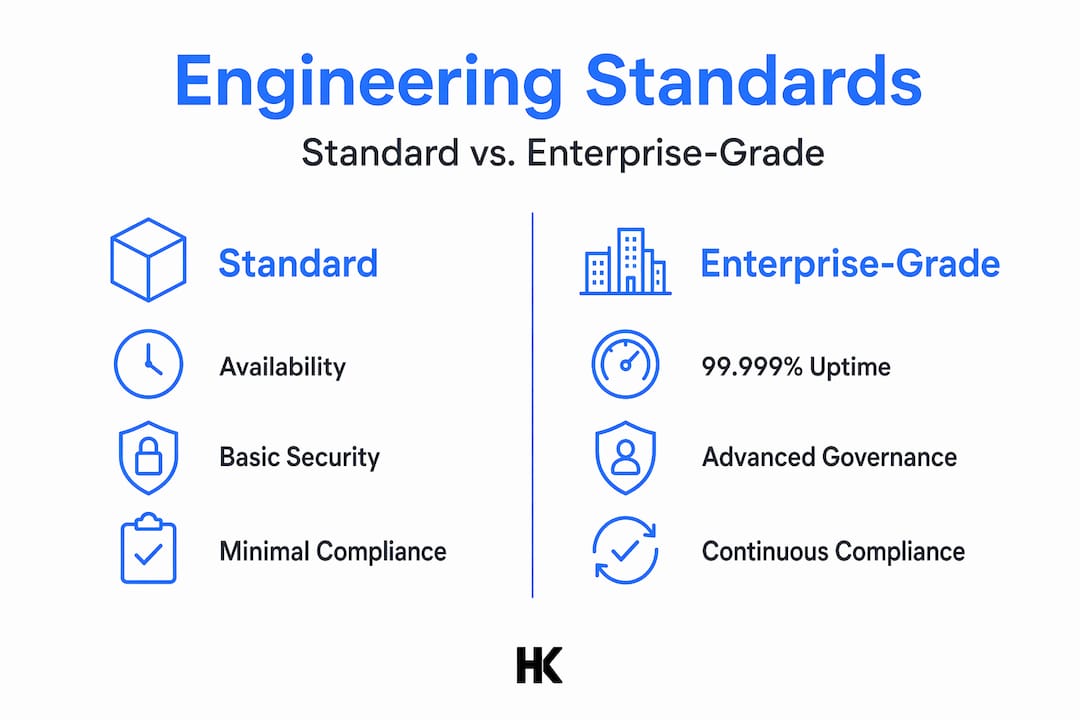
The benchmarks are concrete. Five Nines availability (99.999% uptime) is frequently cited for mission-critical systems. Beyond uptime, enterprise-grade systems produce auditable evidence of every significant action, enforce access controls at architectural boundaries, and handle failure gracefully rather than catastrophically.
Here is how enterprise-grade differs from standard software engineering in practice:
| Dimension | Standard engineering | Enterprise-grade engineering |
|---|---|---|
| Availability target | Best-effort or 99.9% | 99.99% to 99.999% with SLOs |
| Access control | Per-endpoint checks | Centralized enforcement, fail-closed |
| Audit logging | Optional or manual | Machine-generated, immutable, queryable |
| Compliance | Reviewed periodically | Embedded in every deploy pipeline |
| AI governance | Per-model configuration | Control plane managing all model calls |
| Incident management | Ad hoc firefighting | Blameless postmortems, tracked SLIs |
For AI-infused SaaS products, the governance column matters most. Every model call, tool invocation, and data flow needs traceability. Enterprise buyers ask for it before signing. Regulators ask for it after incidents. The architecture either supports it natively or it does not.
Centralized control planes and governance layers
The cleanest architectural pattern for enterprise AI governance is the separation of the control plane from the data plane. The data plane handles the actual work: inference calls, vector lookups, database writes. The control plane enforces the rules: who can call what, under what conditions, at what cost, and with what logged evidence.

Without this separation, governance logic gets scattered across individual services. One team logs token usage. Another skips it. A third team writes their own auth check. The result is authorization drift and security gaps that compound over time.
A mature control plane for enterprise AI performs several functions:
- Authentication and authorization for every agent call or model invocation, enforced centrally
- Cost controls including rate limits and budget thresholds per tenant, team, or feature
- Audit logging with structured, immutable records tied to request identifiers
- Policy evaluation deciding whether an action is permitted before it executes
- Usage monitoring to detect anomalies and cost spikes before they become incidents
Tools like Databricks Unity AI Gateway implement this pattern for MCP servers and AI endpoints, providing authentication, permissions, usage monitoring, rate limits, and audit logging in a single layer. The Overwatch control plane design follows a similar model, treating the structured tool or function call as the unit of governance rather than natural language prompts. This makes policy enforcement precise rather than probabilistic.
The critical lesson is timing. Building governance in from day one costs a fraction of rearchitecting it in at scale. A proof-of-concept that skips the control plane tends to become a production system before anyone notices.
Pro Tip: If your AI PoC does not route through a central gateway with auth and logging, treat it as untested infrastructure. Before moving to production, define the control plane contract first, then build features on top of it.
SRE principles for enterprise reliability
Site Reliability Engineering replaces the informal practice of "keeping things running" with actual software engineering. The 2026 SRE framework defines mathematical reliability targets and operationalizes incident response to eliminate manual toil and prevent missed goals.
The core principles relevant to enterprise SaaS engineering are:
- Embrace risk deliberately. Not all services need Five Nines. Define the right reliability target for each service based on user impact, then defend that target explicitly.
- Define SLIs and SLOs. A Service Level Indicator is a specific measurement: request latency at the 99th percentile, or LLM response time for a RAG query. A Service Level Objective is the target: 95% of requests complete under 2 seconds. Without these, reliability is a feeling, not an engineering property.
- Use error budgets. The error budget is the gap between 100% and your SLO. Error budgets govern release decisions: if the budget is exhausted, risky deployments freeze until reliability recovers.
- Eliminate toil. Any manual, repetitive operational task that scales with traffic volume is toil. SRE practice treats toil reduction as engineering work, not overhead.
- Monitor symptoms, not just causes. Alert on user-facing impact first. An AI inference service returning 500 errors matters more than a CPU spike on one node.
- Manage postmortems without blame. Blameless incident reviews produce actionable system improvements. Blame produces cover-ups and repeated failures.
For AI services, SLIs need to capture more than latency. Useful metrics include LLM cost per request, retrieval accuracy drift, and agent task completion rate. These feed SLOs that protect both the user experience and the infrastructure budget.
Pro Tip: Set your AI service SLOs before you instrument, not after. Deciding what "good" looks like upfront shapes which metrics you build logging around. Retrofitting SLOs onto an existing system is significantly harder.
Compliance-first DevOps in regulated cloud architectures
Regulatory compliance in enterprise environments cannot be treated as a documentation exercise or a post-release checkpoint. GDPR, the EU AI Act, and sector-specific regulations like those in financial services or healthcare require evidence that your system behaved correctly, not just assurances that it was designed to.
That evidence must be machine-generated. Compliance-first architectures produce signed, versioned artifacts and immutable, queryable evidence planes to meet regulatory requirements. Screenshots and manual changelogs do not satisfy auditors in 2026.
The evidence types a regulated enterprise architecture needs to capture include:
- Deployment approvals with timestamps and identity records tied to the artifact deployed
- Policy evaluations showing which rules were checked and what they returned
- Test results proving security and functional gates passed before promotion
- Configuration snapshots capturing the exact state of infrastructure at any point in time
- Data processing records tied to GDPR lawful basis and EU AI Act risk classifications
Here is how compliance controls map to architecture layers:
| Architecture layer | Compliance control | Implementation |
|---|---|---|
| CI/CD pipeline | Artifact signing, gate enforcement | Policy-as-code in pipeline steps |
| Infrastructure | Immutable logs, encryption | Cloud-native audit log services |
| Application | Request tracing, access records | Structured logging with trace IDs |
| AI layer | Model call audit, prompt records | Control plane logging per invocation |
| Data layer | Lineage tracking, retention policies | Cataloging tools with GDPR controls |
The evidence plane for incident response needs to be reconstructable. Given a specific deploy identifier, you should be able to trace back: who approved it, what tests ran, what policy evaluations passed, and what data was in scope. This is the standard that EU AI Act compliance expects for high-risk AI systems.
Technical validation for EU compliance is most effective when it is built into the platform, not bolted on before an audit. Policy-as-code tools that run in every pipeline execution eliminate the drift between documented policy and actual system behavior.
Applying enterprise engineering in practice
Principles are only useful when they translate into organizational and architectural decisions. Here is how the thinking applies to a SaaS team shipping AI-powered features.
The platform mindset is the most important shift. Treat AI integration as infrastructure that every product feature runs on, not as a feature itself. This means your RAG pipeline, your LLM gateway, your cost monitoring, and your audit logging are platform concerns owned by a platform team or equivalent responsibility. Individual features consume the platform rather than reinventing it.
Common pitfalls to avoid:
- Late-stage governance. Adding access controls and audit logging after a product ships to an enterprise pilot creates double the work and introduces risk during a critical commercial phase.
- Authorization drift. Without centralized enforcement at architectural boundaries, individual endpoints accumulate inconsistent access rules over time.
- Missing audit trails. An enterprise buyer's security team will ask for logs of every AI action taken on their data. If those logs do not exist, the deal stalls.
- Toil-driven operations. Manual deployment steps and human-dependent monitoring do not scale. They also fail at 3am on a Friday.
For multi-tenant SaaS products, cloud infrastructure cost governance at the operating layer becomes a serious engineering concern. AI workloads amplify cost unpredictability. Separating tenant environments into distinct accounts or namespaces with independent budget controls is not over-engineering. It is the difference between a cost anomaly affecting one tenant versus all of them.
Pro Tip: When scoping your first enterprise pilot, audit the top five governance requirements your target buyer's security team will ask for. Build those into your platform before the pilot starts, not in response to their review.
My perspective on where enterprise engineering actually fails
I have worked on engineering systems at BMW, Deutsche Bahn, and Bundesrechenzentrum Austria. I have also built SaaS products from scratch and shipped AI integrations for B2B clients across the DACH region. The pattern I see most often is not technical ignorance. It is deliberate deferral of the hard architecture decisions.
Teams tell themselves the governance layer is something they will add "once we prove the concept." What they are actually saying is: "We will rearchitect the entire system once it has customers depending on it." That is a worse trade than building it right the first time.
The other thing I have noticed is that enterprise AI delivery requires safety policies as infrastructure, not as an afterthought. The teams that treat compliance and observability as platform engineering from day one ship faster in the long run. They skip the rework cycles. They close enterprise deals without emergency security reviews. They handle incidents without scrambling for evidence.
Compliance-first DevOps is not a constraint. For EU-based SaaS products operating under GDPR and the EU AI Act, it is a commercial advantage. Enterprise buyers in DACH are not looking for the cheapest AI feature. They are looking for the one they can trust.
— Hanad
How Hanadkubat can help you ship enterprise-grade AI products
If the principles in this article describe problems you are currently building around or trying to fix retroactively, that is exactly where Hanadkubat works.
Hanadkubat brings Fortune 500 engineering experience from BMW, Deutsche Bahn, and Bundesrechenzentrum Austria directly to B2B SaaS founders and CTOs. The two service tracks are fixed-price and scoped tightly: AI integration projects shipped in 2-week sprints from €4,500, and enterprise-grade MVP development built for GDPR-aware, EU AI Act compliant architectures from €18,000. Every engagement is a direct working relationship with the engineer writing the code. No project managers, no junior teams. If you are building an AI-powered SaaS product and need production-grade architecture from day one, the starting point is a conversation at hanadkubat.com.
FAQ
What is enterprise-grade engineering?
Enterprise-grade engineering is the practice of designing software systems to meet strict requirements for availability, security, auditability, compliance, and operational reliability. It goes well beyond scale, covering governance controls, incident management, and regulatory evidence production.
Why does enterprise-grade engineering matter for AI integration?
AI workloads introduce model calls, data flows, and agent actions that all require traceability and policy enforcement. Without a governance control plane, AI features in enterprise products cannot satisfy security reviews or regulatory audits.
What are SLOs and why do they matter?
A Service Level Objective is a measurable reliability target, such as 99.9% of requests completing under two seconds. SLOs and error budgets align engineering teams on what "good enough reliability" means and govern when risky changes can proceed.
What does compliance-first DevOps mean in practice?
Compliance-first DevOps means embedding policy enforcement, artifact signing, and immutable audit logging directly into the CI/CD pipeline and infrastructure layer, so every deployment produces machine-readable evidence automatically.
When should a SaaS team start building enterprise controls?
Before the first enterprise pilot, not after. Adding governance after a PoC requires rearchitecting systems that already have users depending on them, which is slower and riskier than designing for it from the start.