
TL;DR:
- Most early-stage SaaS startups can accelerate MVP development by hiring a skilled product design engineer instead of separate specialists or co-founders. This role combines product sense, design, and coding, enabling faster iterations, lower costs, and zero equity dilution. Implementing this approach shortens feedback loops, improves decision-making, and increases the chances of quick market validation.
Most non-technical founders assume they face a binary choice: give up equity to bring on a technical co-founder, or burn months managing a fragmented team of a PM, a designer, and a developer who barely talk to each other. Neither path is fast, and neither is cheap. There is a third option that most startup advice ignores entirely. A skilled product design engineer collapses three roles into one, ships production-ready code, and does it without taking a slice of your company. Senior product designer salaries range from $148K to $370K in total comp in the US, but remote EU talent delivers the same output for a fraction of that cost and zero equity.
Table of Contents
- What is a product design engineer and why they matter in SaaS startups
- How product design engineers fast-track MVP validation and iteration
- Salary, equity, and value: Making the numbers work for founders
- Practical steps to hire and collaborate with a product design engineer
- Why most startup advice steers founders away from product design engineers and what you miss if you follow
- Ready to accelerate your SaaS MVP with senior product design engineering?
- Frequently asked questions
Key Takeaways
| Point | Details |
|---|---|
| Product design engineer value | Combining technical and product skills simplifies rapid MVP development and reduces founder stress. |
| Founder equity protection | Paying salary, not equity, lets you maintain ownership while benefiting from expert MVP execution. |
| Fast MVP validation | Validation cycles can cost as little as $1,000 and complete in two weeks with the right engineering partner. |
| Hiring made practical | Simple workflow helps non-technical founders hire and collaborate with senior product design engineers for better outcomes. |
What is a product design engineer and why they matter in SaaS startups
The title sounds like a buzzword, but the role is genuinely distinct. A product design engineer is not a designer who codes a little, and not a developer who sketches wireframes on the side. They hold both disciplines at a professional level and add a third layer: product sense. They understand why a feature exists, whether it should exist at all, and how to build it in a way that users will actually adopt.
Traditional teams split this across three people. A product manager owns the roadmap. A designer owns the interface. A developer owns the code. Each handoff creates delay, misinterpretation, and rework. In an early-stage SaaS startup, that overhead is lethal. You do not have six months to run a proper sprint cycle. You have weeks.
Companies like PostHog, Linear, and Ashby have built their reputations on exactly this model. They hire product design engineers specifically because B2B tools demand fast iteration without the overhead of a full product org. These are not scrappy startups cutting corners. They are well-funded companies that have made a deliberate architectural choice about how product gets built.
Here is how the roles compare:
| Role | Designs UI | Writes code | Owns product decisions | Typical headcount needed |
|---|---|---|---|---|
| Product manager | No | No | Yes | 1 |
| UI/UX designer | Yes | No | Partially | 1 |
| Frontend developer | No | Yes | No | 1 |
| Product design engineer | Yes | Yes | Yes | 1 |
The table makes the math obvious. You replace three specialists with one generalist who operates at a senior level across all three domains. For a founder who wants to preserve equity and move fast, this is not a compromise. It is a structural advantage.
Key reasons this role matters specifically for early-stage SaaS:
- No handoff delays. The same person who sketches the flow writes the component. Feedback loops shrink from days to hours.
- Scope discipline. A product design engineer who owns the full stack will kill features that add complexity without adding value. They have skin in the build, so they think like a founder.
- Lower burn rate. Paying one senior person a competitive salary costs far less than three mid-level specialists plus the coordination overhead between them.
- Zero equity dilution. A co-founder with technical skills typically takes 10 to 30 percent equity. A salaried product design engineer takes none.
Following product development best practices for non-technical founders almost always points back to this model: reduce the number of people involved in early product decisions, and make sure every person involved can both think and execute.
Pro Tip: When you are evaluating candidates, ask them to walk you through a product decision they made that resulted in removing a feature. If they cannot name one, they are probably a specialist in disguise, not a true product design engineer.
How product design engineers fast-track MVP validation and iteration
Understanding the role is one thing. Seeing how it changes your timeline is another. The typical founder-led MVP process looks like this: you write a spec, hand it to a designer, wait for mockups, hand those to a developer, wait for a build, discover the design does not work in code, go back to the designer, and repeat. Six to twelve weeks of calendar time to ship something users might not even want.
A product design engineer collapses that loop. Here is the workflow in practice:
- Product discovery sprint (Days 1 to 3). Map the core user problem, identify the one workflow that solves it, and define what "done" looks like for the MVP. No feature lists. No roadmaps. One job to be done.
- Rapid prototyping (Days 4 to 7). Build a clickable prototype or a lightweight coded version. Not a Figma file that lives in a browser tab. An actual interface users can touch.
- User validation (Days 8 to 10). Put it in front of five to ten target users. Gather qualitative feedback. Not surveys. Conversations.
- Iteration sprint (Days 11 to 14). Revise based on what you heard. Cut what did not land. Sharpen what did.
- MVP launch (Week 3 onward). Ship the production build with the validated core workflow. Everything else goes on a backlog that you revisit only after you have paying users.
This is not theoretical. The MVP validation checklist for product-market fit consistently shows that founders who run tight, two-week validation cycles outperform those who spend months building before talking to users.
The data on cost and time is equally compelling:
| Approach | Time to first user feedback | Estimated cost | Equity cost |
|---|---|---|---|
| Concierge MVP (manual) | 1 to 2 weeks | $1,000 to $5,000 | None |
| Product design engineer (solo) | 2 to 4 weeks | $15,000 to $40,000 | None |
| Traditional team (PM + designer + dev) | 8 to 16 weeks | $60,000 to $150,000 | None to low |
| Technical co-founder | 4 to 12 weeks | Deferred salary | 15 to 30% equity |
"The fastest path to product-market fit is not the most features. It is the shortest distance between a user problem and a working solution that someone will pay for. A product design engineer closes that distance faster than any other single hire."
According to Level.FYI salary benchmarks, senior product design engineers in the US command $148K to $370K in total compensation. That sounds expensive until you compare it to the equity cost of a co-founder or the coordination cost of three specialists. Remote EU talent, as the market shows, delivers comparable output for $75K to $130K annually with zero equity.
Learning how to validate startup ideas through minimal viable products is the single most important skill a non-technical founder can develop. A product design engineer is the fastest vehicle for doing that validation without burning cash or equity on infrastructure you do not need yet.
The speed advantage compounds over time. Because one person owns the full product surface, context never gets lost between handoffs. When a user says "this button is confusing," the product design engineer knows exactly what the button does, why it was placed there, and what changing it will break downstream. That kind of holistic context is impossible to maintain across a three-person specialist team in the early stages.

Reviewing startup MVP best practices for fast validation consistently surfaces the same finding: the bottleneck is almost never technical complexity. It is decision latency, the time between identifying a problem and shipping a fix.
Salary, equity, and value: Making the numbers work for founders
Let us be direct about the money, because this is where most founders make their worst decisions.
The instinct to offer equity instead of salary comes from a real constraint: cash is tight in the early stages. But equity is not free. Every percentage point you give away today is a percentage point of your exit, your fundraising leverage, and your control. Founders who give away 20 to 30 percent to a technical co-founder in year one often spend years trying to buy it back or living with a cap table that makes institutional investors nervous.
The salary benchmarks for senior product design engineers tell a clear story. In the US, total compensation for senior roles ranges from $148K to $370K depending on location and company stage. That is a real number. But remote EU talent, as documented in product engineer job postings for B2B SaaS companies, lands in the $75K to $130K range with no equity required. For a pre-seed or seed-stage founder, that is a manageable burn against the alternative.
Here is what the salary-first approach protects:
- Full ownership of your cap table. No dilution means your Series A valuation is not already discounted by a messy early equity structure.
- Clean exit math. When you sell or raise, every point of equity you retained is real money. A 1% difference on a $10M exit is $100,000.
- Easier termination if the fit is wrong. Ending a salary relationship is a business decision. Ending an equity partnership is a legal event.
- Motivated execution without entitlement. Salaried engineers who are well-compensated and given meaningful work deliver. Equity holders sometimes coast on the assumption that the company will figure it out.
The risks of the salary approach are real too. You need enough runway to sustain the burn. You need to be clear about scope so the engagement does not expand indefinitely. And you need to hire someone senior enough to work autonomously, because a junior hire at any price is a liability without a PM to manage them.
Early-stage equity for founding or product engineers typically sits at 0.5 to 2 percent. If you are considering an equity grant, stay in that range. Do not let a candidate negotiate you into co-founder territory unless they are genuinely co-founding the company with you, sharing risk, and working without salary.
A solid startup product strategy accounts for compensation structure from day one. The founders who get this right treat equity like the scarce, irreplaceable resource it is.
Pro Tip: Before you negotiate compensation with a product design engineer, define the exact deliverable and timeline. "Build our MVP" is not a scope. "Ship a working onboarding flow and core dashboard in six weeks" is. Vague scope leads to scope creep, which leads to either overpaying or under-delivering.
Knowing how to avoid MVP pitfalls means treating compensation structure as a product decision, not just an HR one. The wrong structure creates misaligned incentives that slow you down just as much as bad code.
Practical steps to hire and collaborate with a product design engineer
Knowing the theory is one thing. Here is the actual process for finding and working with a product design engineer who will move your SaaS MVP forward without creating new problems.
Step 1: Define your scope before you post a job or reach out to anyone. Write down the one core workflow your MVP needs to support. Not a feature list. One workflow. "A user can sign up, connect their data source, and see a dashboard in under five minutes." That is a scope. Everything else is negotiable.
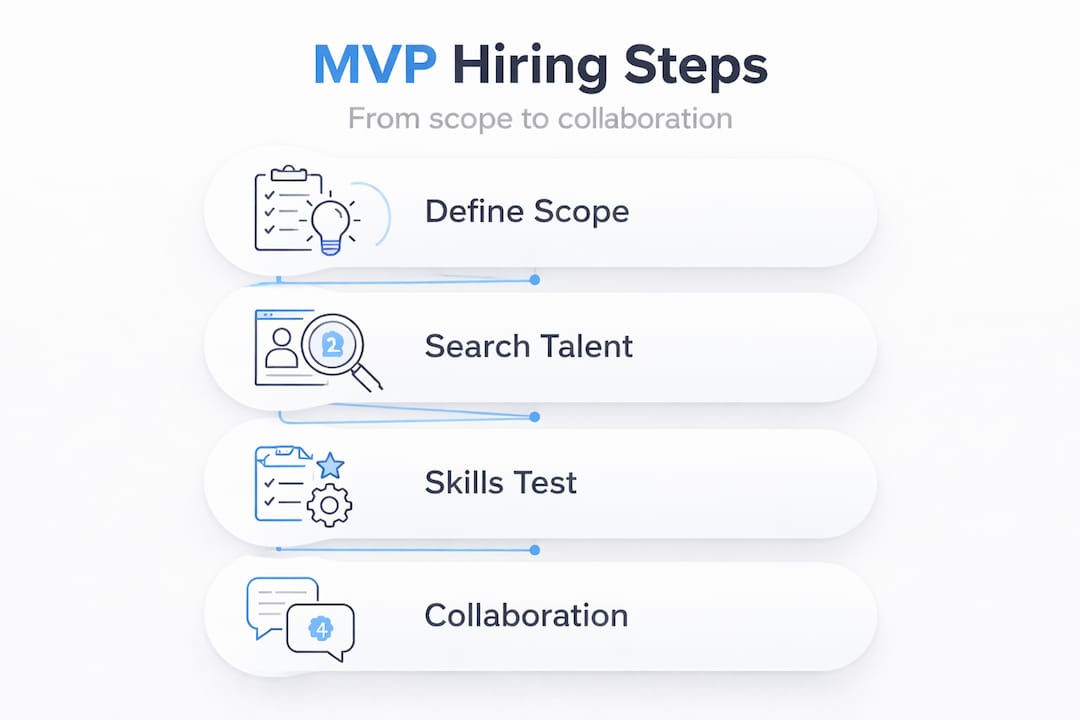
Step 2: Search for the right profile. Look for candidates who have shipped products, not just contributed to them. GitHub profiles with real side projects, portfolio sites showing end-to-end product work, and previous roles at early-stage B2B SaaS companies are strong signals. Companies like PostHog and Linear have made their hiring approach for product engineers public, and their job descriptions are worth studying as a template.
Step 3: Run a paid skills test. Do not hire on portfolio alone. Give candidates a small, paid test project that mirrors your actual problem. Two to four hours of work, compensated at their hourly rate. You are looking for three things: how they scope the problem, what they choose to cut, and whether the output is shippable.
Step 4: Structure the collaboration. Weekly async updates work better than daily standups for senior engineers. Define the output cadence: what gets shipped each week, what the review process looks like, and who has final say on product decisions. If you are non-technical, your job is to define the problem and validate the solution. Their job is everything in between.
Step 5: Protect the scope. Every week, review what is on the build list and ask what can be cut. Not what can be added. What can be cut. The fastest MVPs are built by people who are ruthless about removing features that do not serve the core workflow.
Tips for effective collaboration once you have hired:
- Share user feedback directly and immediately. Do not filter it through your interpretation.
- Give access to real users for testing. The engineer should talk to users, not just receive secondhand reports.
- Avoid adding features mid-sprint. Write them down, review them at the end of the sprint, and evaluate them against the core scope.
- Celebrate shipped code, not planned features. Progress is measured in working software, not slide decks.
- Be honest about constraints. Budget, timeline, and user feedback should all be visible to the engineer. Hidden constraints create bad decisions.
The non-technical founder SaaS launch guide covers the full journey from idea to first paying customer. The hiring process above is one chapter in that story, but it is the chapter that determines whether the rest of the story moves fast or slow.
Why most startup advice steers founders away from product design engineers and what you miss if you follow
Here is the uncomfortable truth: most startup advice is written by people who built companies in a different era, with different tools, and different market conditions. The canonical advice to "find a technical co-founder" made sense in 2010 when the cost of building software was high, the talent pool was thin, and the only way to get a senior engineer to work on your idea was to give them a stake in it.
That world no longer exists. Remote work has globalized the talent market. Modern frameworks like React and Next.js have collapsed the time it takes to build production-quality software. And the rise of the product design engineer as a distinct professional archetype means you can now hire someone who thinks like a co-founder but works like an employee.
The advice to hire a PM, a designer, and a developer separately is also outdated for early-stage SaaS. That model was designed for companies that already had product-market fit and needed to scale execution across a large surface area. It is completely wrong for the validation stage, where speed and coherence matter more than specialization.
What most articles miss is the leverage question. As a founder, your highest-leverage activity is deciding what to build and why. A product design engineer amplifies that leverage by executing on your decisions without adding coordination overhead. You think, they build, users respond, you adjust. That loop runs in days, not months.
The founder product strategy that actually works at the early stage is not about having the best team structure. It is about having the shortest feedback loop between a founder insight and a user-tested product change. A single product design engineer, working directly with a founder, is the shortest loop that exists.
I have seen founders spend six months interviewing technical co-founders, give away 25 percent of their company, and still not ship a product because the co-founder relationship was misaligned. I have also seen founders hire a senior product design engineer on a fixed-scope contract, ship an MVP in eight weeks, get their first ten paying customers, and raise a seed round with a clean cap table. The second path is not lucky. It is a structural choice.
Ready to accelerate your SaaS MVP with senior product design engineering?
If this guide has clarified anything, it is that you do not need to choose between speed and equity preservation. You need the right technical partner, someone who combines product thinking with engineering execution and works directly with you without layers of overhead.
At hanadkubat.com, that is exactly what I offer. I am a senior full-stack engineer and SaaS founder who has worked with BMW, Deutsche Bahn, and IBM, and I bring that same engineering discipline to early-stage product builds. No agency markup. No project manager in the middle. You work directly with the person writing the code. MVP builds start at €15K and ship in 4 to 12 weeks. If you are done planning and ready to ship, let's talk.
Frequently asked questions
What makes a product design engineer different from a traditional developer or designer?
A product design engineer combines technical development skills with product strategy, allowing startups to iterate faster without needing separate PMs or designers. Unlike specialists, they own the full product surface from interface to infrastructure, which is why companies like PostHog and Linear hire them specifically for B2B SaaS tools.
How much should founders budget for MVP validation with a product design engineer?
Typical MVP validation costs range from $1,000 to $5,000 for concierge-style processes completed in roughly two weeks, while a full production MVP with a senior engineer runs $15,000 to $40,000. Level.FYI benchmarks confirm that remote EU talent delivers comparable output to US senior engineers at significantly lower total compensation.
Do I need to give up equity to hire a product design engineer for my SaaS MVP?
No. Hiring a skilled product design engineer on a salary avoids the heavy equity dilution that comes with co-founder arrangements. Remote EU product engineers typically earn $75K to $130K annually with no equity required, which is a fraction of what a technical co-founder would cost in ownership.
What results can I expect from collaborating with a senior product design engineer?
Expect a working MVP in two to eight weeks, faster product iteration cycles, and direct user validation that shortens your path to product-market fit. Senior-level benchmarks consistently show that solo product design engineers outperform fragmented specialist teams on speed and coherence at the early validation stage.