
TL;DR:
- Less than 20% of shipping a product involves writing code, as most effort is spent on integration, monitoring, and support. Non-technical founders often overlook operational readiness, which leads to post-launch failure despite a polished demo. Ensuring full code visibility, real-world testing, and proper operational planning is crucial for successful MVP delivery.
Less than 20% of what it takes to ship a working product is actually writing code. That number sounds wrong until you've watched a well-funded startup collapse three months after their "launch" because nobody planned for real-world integration, production monitoring, or support handover. The founder postmortem that surfaced this reality after a seven-year health AI shutdown is one of the most honest accounts of technical delivery failure you'll find. Most non-technical founders walk into their first build thinking code quality is the game. It isn't. This article breaks down exactly what the game actually is and how to stop losing it.
Table of Contents
- The invisible 80%: More than just code shipping
- The delivery model trap: Black-box handoffs and agency pitfalls
- Rethinking technical debt: The speed-quality paradox
- Building an MVP ready for scale and real-world demands
- Why fixing technical delivery means changing founder habits
- Get expert help ensuring your MVP launch succeeds
- Frequently asked questions
Key Takeaways
| Point | Details |
|---|---|
| Delivery is more than code | Most failures come from missing integration and operational steps, not just coding mistakes. |
| Avoid black-box models | Lack of code visibility and ownership in agency handovers creates long-term risk. |
| Speed isn’t about perfect code | Research shows technical debt has little impact on early MVP delivery speed. |
| Plan for real-world use | Your MVP must be designed for integration and daily workflow adoption from day one. |
| Founder habits matter most | Changing how you manage, question, and own technical delivery beats focusing on code alone. |
The invisible 80%: More than just code shipping
To understand why MVPs stall or collapse post-launch, it's crucial to see what technical delivery really involves beyond development.
When you hire a developer or agency, you're paying for code. But what makes that code useful in the real world is a completely different stack of work that rarely appears on any project timeline. Production readiness, integration with third-party systems, operational dependencies, error handling in live environments, monitoring, user support infrastructure, and legal code ownership all fall into that invisible 80%. Most founders never ask about any of this until something breaks.
The health AI startup failure analysis makes it painfully clear: the majority of technical effort sits in production readiness, integration, and operational fit, not in the actual shipping of code. The product worked in demos. It fell apart in the real clinical workflow because nobody mapped what that workflow actually required at the infrastructure level.

Here's a rough breakdown of how time and effort actually gets distributed in a typical MVP build:
| Delivery area | Typical time allocation | Founder visibility |
|---|---|---|
| Writing core features | 15–20% | High |
| Automated testing and QA | 10–15% | Low |
| Third-party integration | 15–20% | Very low |
| Production setup and DevOps | 10–15% | Very low |
| Real-environment testing | 10–15% | Low |
| Documentation and handover | 5–10% | Rare |
| Monitoring and error handling | 10–15% | Very low |
If you're only tracking feature progress, you're watching maybe a fifth of the actual delivery work. The rest is happening (or not happening) off your radar.
The elements that consistently trip up MVP launches include:
- Integration with external systems: Payment providers, APIs, CRMs, email infrastructure, and analytics tools all need to be wired up correctly and tested under real conditions, not just mocked in development.
- Production monitoring: Who gets notified when something breaks at 2am? Is there a monitoring setup in place, or are you waiting for angry user emails?
- Real-environment testing: Code that works on a developer's laptop fails in production for a dozen reasons: environment variables, database connection limits, network latency, third-party rate limits.
- Support and maintenance infrastructure: Who handles bug reports after launch? Is the codebase structured so someone other than the original developer can work on it?
- Legal ownership and transfer: Is the code actually yours? Are all dependencies open-source licensed? Can you hand this to a new developer without legal complications?
- Documentation: Not fancy docs, just enough that the next developer doesn't have to reverse-engineer every decision.
"The product looked great in a demo. But it had never been validated inside the actual workflow it was supposed to replace. That gap cost seven years."
That quote captures the core lesson. Build for the workflow, not the demo. Reading about MVP validation best practices before your build starts is the difference between shipping something that works in real life and shipping something that works in a meeting room. And understanding the most common MVP pitfalls means you stop treating demo-readiness as the finish line.
The delivery model trap: Black-box handoffs and agency pitfalls
Recognizing what goes into technical delivery, let's explore why popular build models can create avoidable risk.
A "black-box delivery" model is when a developer or agency builds your product in a way that's completely opaque to you. You hand over requirements, money, and trust. You get back a product you can't inspect, don't fully own, and can't easily transfer. This is the default mode for most outsourced MVP builds, and it creates four compounding risks.
Agencies often restrict visibility, making it genuinely hard for founders to evaluate code quality, transfer ownership, or assess ongoing risk. By the time you realize there's a problem, you're already dependent on that agency for every future change.
Here's how black-box delivery compares to what you actually need:
| Delivery characteristic | Black-box agency model | Transparent partner model |
|---|---|---|
| Code access during build | Restricted or delayed | Continuous, from day one |
| Ability to get independent review | Blocked or discouraged | Actively supported |
| Documentation quality | Minimal, if any | Built into the process |
| Maintenance continuity | Agency-dependent | Team-agnostic |
| Decision visibility | Hidden | Explained and recorded |
| Post-launch ownership | Murky | Clear and legally transferred |
The risks of black-box delivery compound over time in a very specific sequence:
- Lack of visibility: You can't tell if the build is on track, cutting corners, or accumulating problems that will surface after launch. There's no way to course-correct what you can't see.
- Code lock-in: The agency uses frameworks, hosting setups, or proprietary tools that are difficult or expensive to migrate away from. This gives them leverage and limits your options.
- Maintenance chaos: After delivery, bugs surface and the original developer is the only one who understands the system. Handover documentation is either missing or useless.
- Decision fatigue after delivery: You're suddenly responsible for a product you don't understand. Every technical decision becomes stressful because you have no baseline to evaluate answers against.
When finding the right mobile developer or any technical partner, the single most important thing to establish upfront is visibility. Not just progress updates, but actual access. Code repository access from day one. The right to bring in a third party for a code review at any point. Written documentation of architectural decisions. Staging environments that you control.
Pro Tip: Before signing any development contract, include three non-negotiable clauses: 1) you have full read access to the code repository from day one, 2) you can commission an independent third-party code review at any stage, and 3) all code, assets, and infrastructure credentials transfer fully to you on final payment.
The value of a technical co-founder model is precisely this transparency. When someone has skin in the game alongside you, they don't hide problems. They surface them early because they're solving them for the same business they care about.
Rethinking technical debt: The speed-quality paradox
Beyond who builds your MVP, many founders worry about the messiness of first code. Let's clarify what actually matters for launch.
"Technical debt" is a term developers use to describe shortcuts, imperfect decisions, and code that works now but will become painful to maintain or extend later. Non-technical founders often hear this term and panic. They ask for clean code, perfect architecture, and zero shortcuts. That instinct, while understandable, is often wrong for early-stage MVPs.
Here's the data that changes how you should think about this: technical debt has near-zero correlation with development velocity in startup codebases. The correlation figure measured in research is r = 0.056. Effectively nothing. The startups that shipped fastest weren't the ones with the cleanest code. They were the ones that managed debt strategically while protecting the things that actually determine velocity.
What actually determines whether your MVP ships on time and works in production isn't code cleanliness. It's a set of structural decisions that enable your team to keep moving without stepping on landmines:
- Automated deployment pipelines: If pushing a code update takes an hour of manual steps, your team slows down. If it takes one command, they move fast. This is worth prioritizing over almost any cosmetic code quality improvement.
- A clear, lightweight test strategy: You don't need 100% test coverage on an MVP. You need tests on the things that will hurt you most if they break: payment flows, authentication, core data logic. Everything else can wait.
- Boundary-focused architecture: Keep your core business logic separate from your infrastructure and UI layers. This single decision is what makes it possible to swap out a database, change a payment provider, or refactor a feature without rewriting the whole product.
- Readable commit history: Not glamorous. Absolutely essential when the developer who built a feature leaves and someone else needs to understand why a decision was made.
- Documented environment setup: Any developer should be able to clone your repo and run the application locally in under 30 minutes. If it takes longer, you have a team-scaling problem waiting to happen.
Pro Tip: Stop asking your developer "is the code clean?" and start asking "can someone else pick this up in three months without you?" That question tells you everything about the actual quality of the delivery.
Good MVP architecture decisions are not about perfection. They're about protecting the things that let you keep shipping. And for non-technical founders navigating development, the key insight is this: debt in user-facing features is manageable. Debt in deployment infrastructure, security, or core data models is what kills you.
Building an MVP ready for scale and real-world demands
Having covered debt myths, let's focus on how you can guide delivery for MVPs that work beyond the demo stage.
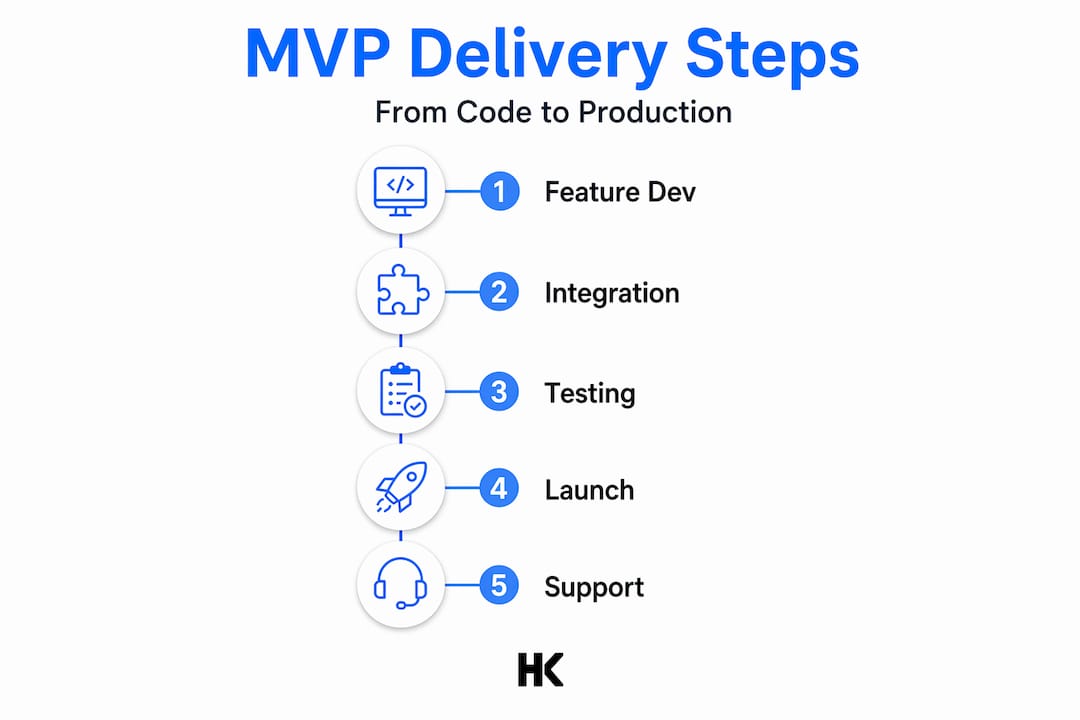
The most expensive mistake you can make as a non-technical founder is accepting a demo as proof of delivery. A demo proves the happy path works under ideal conditions. Production is not ideal conditions. Production is users doing unexpected things, third-party APIs going down, database connections timing out, and email providers flagging your transactional emails as spam.
Successful MVPs require explicit workflow and integration planning in their scope documents from the start, not as an afterthought. Your scope must include the full path a user takes through a real workflow, including every external system they touch along the way.
Here's a practical checklist you can use to push your technical delivery toward production-readiness:
- Document real environment touchpoints: List every external system your MVP must connect to. Payment providers, authentication services, email infrastructure, analytics, CRMs, third-party APIs. Each one needs to be tested in a staging environment that mirrors production.
- Plan handover for support and maintenance: Before development ends, write down who handles bug reports, who has access to the server, who controls the domain, and who can push hotfixes. These are operational questions with technical answers.
- Monitor and test in production: Set up basic error monitoring before launch, not after. Tools like error tracking services and uptime monitors cost almost nothing and tell you immediately when something breaks.
- Secure legal code and asset transfer: All code, design files, domain names, API keys, and cloud infrastructure accounts must transfer to you on delivery. Never accept a product that lives inside a contractor's accounts.
Beyond the checklist, there are specific MVP features that must be validated in real user workflows before you can call them done:
- User registration and authentication: Does it work on mobile devices, across different browsers, and with real email addresses (not test inboxes)?
- Payment or subscription flows: Has a real transaction been processed and refunded? Have failed payment scenarios been tested?
- Notification and communication systems: Do emails land in inboxes or spam? Do push notifications fire on real devices?
- Data persistence and recovery: What happens to user data if the server restarts? Is there a backup strategy?
- Error states and edge cases: What does the user see when something fails? Is it a blank screen or a clear, actionable message?
When you're talking to developers, stop asking "is this feature done?" and start asking "has this been tested in a live environment with a real user scenario?" That single shift in how you ask questions changes what gets prioritized.
Strong founder-developer alignment is what makes these conversations possible. When both parties understand the actual definition of "done," delivery stops being a source of surprise and starts being a predictable process. Pairing that with agile delivery frameworks gives you regular checkpoints to catch operational gaps before they become launch blockers.
Why fixing technical delivery means changing founder habits
Here's the uncomfortable truth that most articles on this topic dance around: the majority of technical delivery failures aren't caused by bad developers. They're caused by founder habits that were formed before a single line of code was written.
The pattern looks like this. A founder has a product idea. They find a developer or agency. They hand over a requirements document, agree on a price, and then step back because they don't want to "micromanage." The developer builds something. A demo gets delivered. The founder accepts it. Launch happens. Three months later, the product is broken, unmaintainable, or abandoned because it never actually fit the real workflow it was supposed to serve.
This isn't a developer problem. It's a founder visibility problem. The habit of stepping back from technical delivery because you "don't understand the code" is the single most destructive pattern I see in early-stage startup execution. You don't need to understand the code. You need to understand the workflow, the operational requirements, and the definition of done. That's completely within reach for any non-technical founder who asks the right questions.
The questions you should have asked before development started:
- Who owns every account and credential at the end of this engagement?
- How will I know if something breaks in production?
- Who can fix it, and how fast?
- Can I get an independent code review at any stage?
- What happens to this product if you're unavailable for a month?
Most founders don't ask these because they don't want to seem difficult, or because they assume the developer has it covered. They don't. Not because developers are dishonest, but because developers optimize for what they're asked to deliver. If you only ask for a working demo, that's exactly what you'll get.
The most valuable technical decision you can make isn't about frameworks or architecture. It's insisting on post-demo ownership and full visibility from day one. Not as a trust issue with your developer, but as a basic operational requirement for running a startup. Reading the custom app development guide for founders surfaces exactly these kinds of questions, and working through them before you sign a contract changes the entire trajectory of a build.
The contrarian take here is that "trusting your developer" is overrated as startup advice. Trust is great. Verification and structure are better. The best technical relationships I've seen between founders and developers are the ones with the most visibility, the clearest contracts, and the most honest conversations about what's not working. Blind trust is how you end up locked out of your own product.
Get expert help ensuring your MVP launch succeeds
If anything in this article made you realize there are gaps in how your current MVP is being built or planned, that's the signal to act before launch, not after.
At hanadkubat.com, the work is straightforward: production-ready MVPs and SaaS products built with full visibility, clear ownership, and zero agency overhead. You work directly with a senior engineer who has shipped products for BMW, Deutsche Bahn, and IBM, and who has also built and launched his own SaaS products. That combination means you get Fortune 500 engineering discipline applied at founder speed. Whether you need a fresh MVP build, a rescue of a stalled or broken product, or a technical strategy session to get clarity before you commit to a build, the engagement is direct and the deliverables are real. No project managers. No telephone chains. No demo-only finishes. Builds start at €15K and take 4 to 12 weeks.
Frequently asked questions
What is the biggest reason startups fail at technical delivery?
Startups most often fail at technical delivery because they overlook integration, production fit, and ongoing support needs. 80% of delivery work sits in operational readiness, not code shipping.
Does technical debt always mean slower startup launches?
No. Correlation between technical debt and development velocity is nearly zero in early-stage startup codebases, so managed debt paired with delivery discipline matters far more than code perfection.
Is it risky to outsource MVP development to an agency?
It can be if you lack code visibility, operational handover, and clear ownership. Black-box handoffs can lock founders out of code quality assessment and make post-launch support unnecessarily difficult.
How can non-technical founders make sure the MVP is production-ready?
Demand workflow integration testing, process documentation, and live environment validation. Successful MVPs require explicit workflow and integration planning in scope, not just a polished demo.