

TL;DR:
- Reducing time to market saves potential profits and minimizes delays caused by coordination and approval processes. Automating workflows, using infrastructure as code, and deploying with feature flags help SaaS teams accelerate delivery without compromising quality. Proper planning, quick decision cycles, and focusing on coordination improvements are essential for faster, more reliable releases.
Reducing time to market is defined as the practice of shortening the span between a product idea and its first revenue-generating release. For B2B SaaS founders, a six-month delay costs approximately 33% of potential after-tax profit, far exceeding the 3.5% loss from a 50% budget overrun. That single fact reframes every resourcing decision you make. Speed is not a nice-to-have. It is the highest-leverage financial variable in your product roadmap. This guide covers the causes of delay, the tools that remove friction, and the step-by-step methods that B2B SaaS teams use to ship faster without breaking production.
What are the main causes of time to market delays in B2B SaaS?
Most SaaS founders assume slow shipping is an engineering problem. The data says otherwise.
Coordination overhead consumes 45–60% of total product development time, while active engineering accounts for only 40–55%. That means your engineers could write code twice as fast and you would still lose half your timeline to meetings, approvals, and waiting. The implication is direct: fixing coordination yields more speed than hiring more engineers.
The specific friction points break down into three categories:
- Gate approvals and regulatory reviews. Sequential sign-off processes force work to pause while decision-makers review outputs they could have shaped earlier. In EU-regulated SaaS products, GDPR compliance reviews and EU AI Act categorization add structured review steps that, when not planned for, become last-minute blockers.
- Supplier and integration qualifications. Third-party API vendors, cloud infrastructure providers, and data partners each require onboarding cycles. Starting these late in the development process creates hard stops that no amount of engineering speed can bypass.
- Engineering environment inconsistencies. When staging, testing, and production environments differ, bugs appear only at the final deployment stage. Teams then spend days reproducing issues that should never have existed.
- Manual release processes. Human-triggered deployments introduce scheduling delays, error-prone steps, and dependency on specific team members being available.
Replacing static gate meetings with automated workflow-based approvals reduces delays more effectively than simply running those meetings faster. The structural fix outperforms the behavioral one every time.
What tools and prerequisites enable faster delivery?
The right infrastructure removes the recurring friction that slows every sprint. Three categories matter most.

Infrastructure as code and CI/CD pipelines are the non-negotiable foundation. Using infrastructure as code tools like Terraform and CI/CD pipelines removes environment drift and eliminates manual release bottlenecks. When every environment is defined in version-controlled code, the "works on my machine" problem disappears. Automated pipelines then carry tested code from commit to production without human intervention at each step.
AI-powered development tools have moved from optional to core. AI tools for test generation, automated code reviews, and operational triage are now standard competencies for teams that ship fast. Test generation alone can cut the time engineers spend writing unit and integration tests by a significant margin, freeing them for feature work. At Hanadkubat, production AI features ship in 14-day sprints precisely because automated testing and review are built into the pipeline from day one.
Clear decision frameworks eliminate the coordination drag that kills momentum. A RACI chart (Responsible, Accountable, Consulted, Informed) assigns ownership to every decision before work starts. Without it, every ambiguous call becomes a meeting, and every meeting becomes a delay.
Pro Tip: Set up your CI/CD pipeline before writing the first line of feature code. Retrofitting automation into an existing codebase costs three to five times more effort than building it in from the start.
The table below shows how each tool category maps to the delay it removes:
| Tool category | Delay it removes |
|---|---|
| Infrastructure as code (Terraform) | Environment drift and manual environment setup |
| CI/CD pipelines | Manual deployment steps and release scheduling |
| AI test generation | Time engineers spend writing repetitive test cases |
| Automated code review | Bottleneck at senior engineer review queues |
| RACI decision framework | Ambiguous ownership and repeated approval loops |
How can SaaS teams apply step-by-step strategies to reduce time to market?
The fastest teams do not just move faster. They sequence work differently.
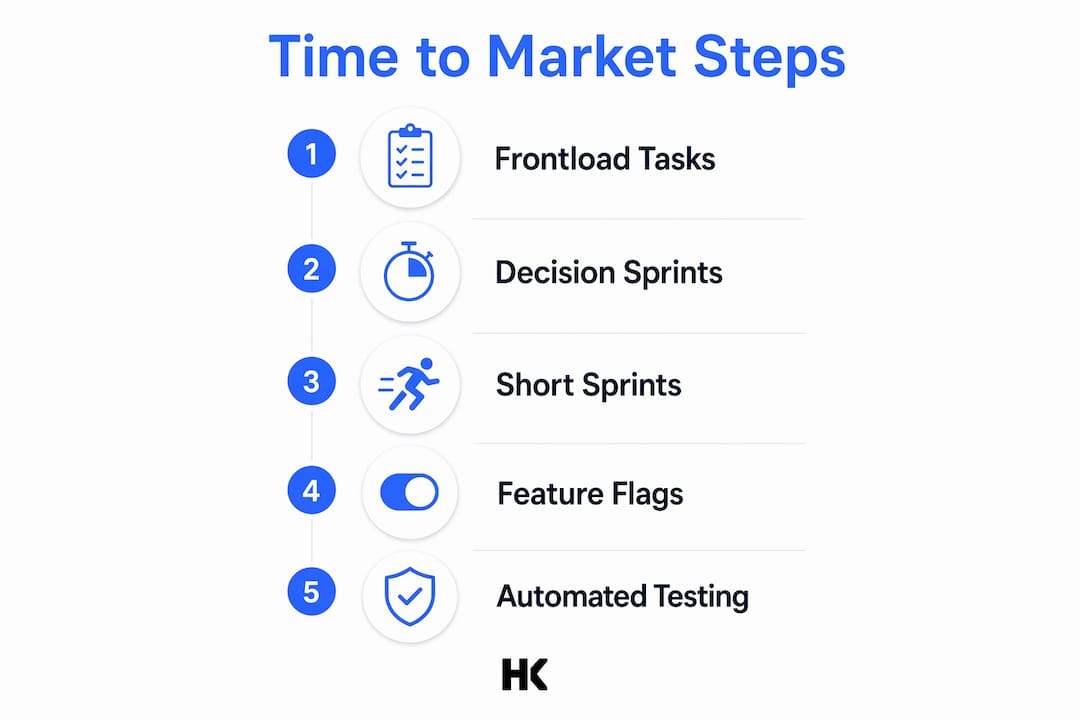
Frontload coordination tasks
Start regulatory reviews, supplier onboarding, and stakeholder alignment during the concept phase, not after the first build. Engaging key suppliers early during concept sketches prevents the long delays caused by late qualification cycles. For a GDPR-sensitive B2B SaaS product, this means looping in your data protection officer and any third-party data processors before the architecture is finalized, not after.
Run one-week decision sprints
High-velocity teams use a one-week decision sprint to validate market assumptions quickly, cutting debate and accelerating data-driven choices. The format is simple: define the assumption, assign one owner, set a seven-day deadline, and present findings to decision-makers at the end of the week. No assumption survives longer than one sprint without validation or rejection.
Use short sprint cycles with clear acceptance criteria
Short sprint cycles with clear acceptance criteria and a definition of done reduce delays caused by unclear expectations. When every story has a testable acceptance criterion written before development starts, engineers do not need to guess what "done" means. QA cycles shrink because the criteria are already encoded in the tests.
Deploy with feature flags and canary releases
Feature flags and canary releases decouple deployment from release, enabling safe, incremental rollouts to subsets of users. This means your code reaches production continuously, but only a controlled percentage of users see the new behavior. If something breaks, you roll back the flag, not the entire deployment. The feedback loop from real users starts weeks before a full public launch.
Pro Tip: Use feature flags not just for risk management, but for A/B testing pricing pages, onboarding flows, and feature discoverability. The same infrastructure that protects you from bad releases also generates product data.
The numbered sequence below captures the full process from planning to feedback:
- Define the feature scope and acceptance criteria before any code is written.
- Frontload all regulatory, compliance, and supplier coordination tasks.
- Set up or verify CI/CD pipelines and infrastructure as code before the sprint starts.
- Run a one-week decision sprint to validate the core market assumption.
- Build in short sprints with automated testing at every commit.
- Deploy behind a feature flag to a canary group of users.
- Monitor production metrics and user behavior for 48–72 hours.
- Expand the rollout incrementally or roll back based on data.
Check the agile product launch guide for a deeper breakdown of how to structure each sprint phase for SaaS products specifically.
What pitfalls should SaaS founders watch for when accelerating delivery?
Speed without structure creates a different kind of delay. Here are the failure modes that appear most often.
Fixing engineering speed while ignoring coordination. Teams that invest in faster developers but leave approval processes unchanged see minimal improvement. The coordination overhead still consumes 45–60% of the timeline. Adding engineers to a coordination-bottlenecked process adds cost without adding speed.
Skipping automated testing to ship faster. Removing quality gates to hit a deadline is the most common self-inflicted wound in SaaS development. A bug that reaches production in a B2B context can trigger contract reviews, SLA penalties, and customer churn. The time lost to incident response and reputation repair far exceeds the time saved by skipping tests.
Letting stakeholder alignment drift. When product, engineering, and commercial teams operate on different assumptions about scope, the reconciliation happens at the worst possible moment: during final review or after launch. Weekly written alignment updates, not just stand-up calls, keep everyone on the same version of the plan.
Decision paralysis at the leadership level. Fast teams make reversible decisions quickly and reserve deliberation for irreversible ones. When every architectural choice requires full leadership consensus, the process slows to the pace of the most cautious person in the room.
Speed without coordination discipline does not reduce time to market. It relocates the delay from the planning phase to the production incident queue. The teams that ship fastest treat coordination as an engineering problem, not a management problem. They automate it, assign it, and measure it the same way they measure code quality.
For a practical view of how these principles apply to real SaaS launches, the startup launch tips guide covers specific examples from early-stage teams that moved from idea to paying customers in under 12 weeks.
Key takeaways
Reducing time to market in B2B SaaS requires fixing coordination overhead first, then automating the engineering pipeline, and finally deploying incrementally with feature flags.
| Point | Details |
|---|---|
| Coordination is the primary bottleneck | Up to 60% of development time goes to approvals and overhead, not engineering. |
| Automate approvals, not just code | Replacing gate meetings with workflow-based systems yields more speed than hiring engineers. |
| Infrastructure as code is non-negotiable | Terraform and CI/CD pipelines eliminate environment drift and manual release delays. |
| Feature flags reduce launch risk | Decoupling deployment from release lets teams ship continuously and roll back safely. |
| Speed is a leadership priority | Treating time to market as equal to cost and quality sustains competitive advantage long-term. |
Where I've seen teams lose the most time
The teams I work with at Hanadkubat, mostly B2B SaaS founders and CTOs across the DACH region and the EU, almost never have a pure engineering speed problem. They have a coordination architecture problem dressed up as an engineering problem.
The pattern is consistent. A founder hires strong engineers, sets up a reasonable sprint cadence, and still ships six to eight weeks late on every major feature. When I map the actual timeline, the engineering work is done in week three. Weeks four through eight are approval cycles, environment fixes, and stakeholder realignment. The code was ready. The process was not.
The fix I reach for first is always structural. Automate the approval workflow. Define the RACI before the sprint starts. Bring compliance and data protection into the architecture conversation at the concept stage, not the review stage. For EU-regulated products, this is especially true. GDPR and EU AI Act requirements are not surprises if you plan for them. They become surprises only when you treat them as post-build checklists.
Speed as a strategic priority equal to cost and quality is the cultural shift that makes everything else work. Without it, every acceleration tactic gets overridden by the next "urgent" meeting or the next scope addition. With it, teams protect their timelines the same way they protect their budgets.
AI tools have genuinely changed what is possible here. At Hanadkubat, shipping a production AI feature in 14 days is repeatable because automated testing, code review, and deployment are not afterthoughts. They are the first things built. The lean product development approach I use treats the pipeline as a product in itself, one that gets maintained, measured, and improved across every engagement.
— Hanad
Hanadkubat's approach to faster SaaS delivery
B2B SaaS teams that want to ship production-ready features in weeks, not quarters, need more than a methodology. They need an engineer who has done it before.
Hanadkubat works directly with SaaS founders and CTOs across the DACH region and EU, delivering fixed-price AI integration sprints in 14 days (from €4,500) and full MVP builds in 4–12 weeks (from €18,000). Every engagement includes CI/CD setup, infrastructure as code, and GDPR-aware architecture from day one. There are no project managers between you and the engineer writing the code. If your team is stuck on a fragile codebase or needs a production AI feature shipped fast, the full service overview at hanadkubat.com covers pricing, process, and past work in detail.
FAQ
Why does a late launch cost more than a budget overrun?
A six-month delay costs approximately 33% of potential after-tax profit, while a 50% budget overrun costs only 3.5%. Lost revenue from missing the market window compounds over the entire product lifetime.
What is the fastest way to reduce time to market in SaaS?
Fix coordination overhead before optimizing engineering speed. Automating approval workflows and frontloading compliance tasks removes the 45–60% of development time lost to non-engineering delays.
What are feature flags and why do they speed up launches?
Feature flags let teams deploy code to production without exposing it to all users. This decouples deployment from release, enabling continuous shipping and safe rollback without full redeployment.
How does infrastructure as code reduce delivery time?
Infrastructure as code tools like Terraform define every environment in version-controlled files, eliminating environment drift. Combined with CI/CD pipelines, they remove manual deployment steps that delay every release cycle.
What is a one-week decision sprint?
A one-week decision sprint assigns one owner to validate a single market assumption within seven days. It replaces open-ended debate with a time-boxed process that produces a data-backed decision at the end of the week.