
TL;DR:
- An agile product launch combines iterative development with deliberate market activation, emphasizing cross-functional coordination. Key practices involve planning 4 to 6 months in advance, separating release from launch, and using evidence-backed go/no-go gates to ensure readiness. Proper execution and continuous post-launch iteration depend on clear ownership, comprehensive checklists, and real behavioral data to drive future improvements.
An agile product launch is a structured process that aligns iterative development cycles with deliberate market activation to deliver customer value at the right moment. The term is widely used in product circles, but the recognized industry practice behind it combines agile product development with formal launch operations: sprint planning, release gates, and cross-functional coordination. Atlassian draws a clear line between a product release (technical deployment) and a product launch (messaging, customer education, and adoption tracking). Confusing the two is one of the most common reasons SaaS teams ship working software that nobody uses. This guide covers the full operational picture, from timeline planning with tools like Jira to go/no-go decision gates, so you can execute a launch that actually converts.
How to plan an agile product launch timeline
A phased timeline is the single most important structural decision you make before launch day. Starting 4 to 6 months before your target date gives cross-functional teams enough runway to surface dependencies that engineering alone will never catch. Sales needs collateral. Support needs documentation. Marketing needs positioning. None of that happens in the final sprint.
The three phases to build around are pre-launch, launch day, and post-launch. Each phase has a different owner profile and a different definition of "done."
- Pre-launch (months 1 through 4 before launch): Scope the feature set, assign owners across product, engineering, marketing, and support. Use Jira's Plans feature to map cross-team dependencies on a shared timeline. Run bi-weekly stakeholder reviews to surface blockers early, not the week before go-live.
- Launch day (T-0): Coordinate deployment, communications, and support activation in a single sequenced runbook. Every action has a named owner and a time stamp.
- Post-launch (weeks 1 through 4 after launch): Monitor adoption metrics, collect user feedback, and feed findings into the next sprint cycle.
Build deliberate buffer into the pre-launch phase. Two weeks of buffer before the final go/no-go meeting is not pessimism. It is the difference between a controlled launch and a crisis. Teams that skip buffer consistently discover late-breaking QA issues, missing analytics instrumentation, or incomplete sales training in the 72 hours before launch.
Pro Tip: Set a hard "feature freeze" date at least three weeks before launch. Any feature that misses the freeze goes into the next release. This single rule prevents the scope creep that collapses timelines.

Release planning vs. sprint planning: what is the difference?
Sprint planning and release planning solve different problems, and treating them as interchangeable is a reliable path to missed commitments. Sprint planning is tactical: it covers a two-week window, assigns specific stories, and produces a sprint goal. Release planning operates at a 2 to 4 month horizon above that, producing a shared target for what ships and when, without locking every detail prematurely.
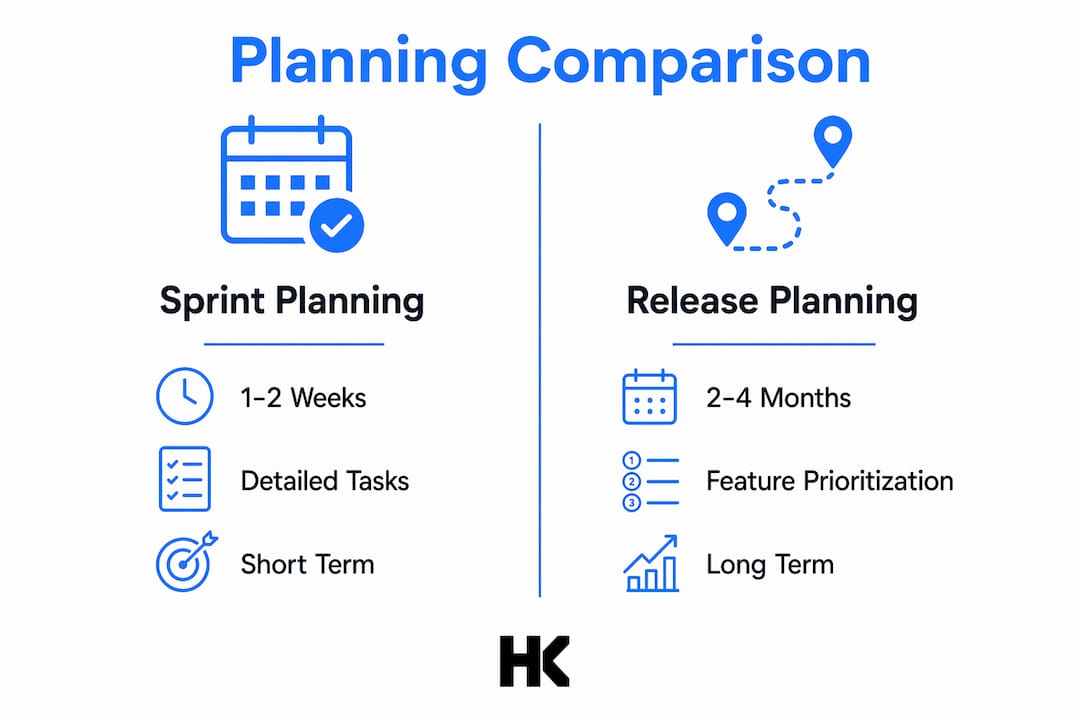
| Dimension | Sprint planning | Release planning |
|---|---|---|
| Time horizon | 1 to 2 weeks | 2 to 4 months |
| Output | Sprint backlog, sprint goal | Release scope, ship date estimate |
| Fidelity | Story points per task | Approximate sizing by theme |
| Flexibility | Low (committed sprint) | High (scope adjusts as knowledge grows) |
| Primary audience | Engineering team | Stakeholders, GTM teams |
The Now/Next/Later model is the most practical framework for managing this. "Now" holds detailed, story-pointed work for the current sprint. "Next" holds approximate sizing for the following one to two sprints. "Later" holds broad themes without estimates. This replaces false precision with a dynamic plan that updates as the team learns more. A roadmap that shows "Q3: AI-powered search" is more honest and more useful than a Gantt chart that locks 47 stories to specific dates four months out.
Prioritization within release planning works best with the MoSCoW method. Must-have features are non-negotiable for launch. Should-have features ship if capacity allows. Could-have features move to the next release without apology. This framing forces the hard conversations with stakeholders before sprint work begins, not after.
One critical failure mode: release plans that go stale after the first sprint. A release plan that is not updated after every sprint loses team confidence fast. Schedule a 30-minute release plan review at the end of each sprint retrospective. If a sprint misses its target, update the release forecast the same day and communicate the change to stakeholders immediately. Transparency about misses builds more trust than silence followed by a late surprise.
What does a launch readiness checklist cover?
A launch readiness checklist is the operational document that converts "we think we're ready" into "we have evidence we're ready." The difference matters because most launch failures trace back to implicit coordination assumptions. Someone assumed support was briefed. Someone assumed analytics was instrumented. Nobody checked.
A production-grade checklist covers six areas:
- QA sign-off: All critical and high-severity bugs resolved or explicitly accepted with a named owner.
- Documentation: User-facing docs, release notes, and internal support runbooks published and reviewed.
- Sales and marketing collateral: Messaging, one-pagers, and demo scripts finalized and distributed.
- Analytics instrumentation: Key events tracked, dashboards live, and baseline metrics recorded before launch.
- Rollback plan: A named rollback owner, a documented trigger condition, and a tested rollback procedure.
- Support readiness: Support team briefed on new behavior, known issues logged, and escalation path defined.
The go/no-go meeting happens 72 hours before launch. Each functional lead attends, presents their sign-off status, and either confirms readiness or escalates a risk explicitly. Evidence-backed sign-offs are the rule: not "I think we're good" but "QA closed 100% of P1 bugs, here is the report." The meeting ends with a recorded vote: go, no-go, or conditional go with named remediation steps.
- Send the checklist to all functional leads 5 days before the go/no-go meeting.
- Require written status updates 24 hours before the meeting.
- Run the meeting with a facilitator who has authority to call a no-go without political pressure.
- Document the outcome and distribute it within one hour of the meeting.
Pro Tip: Assign a single "launch DRI" (directly responsible individual) who owns the go/no-go outcome. Shared ownership of a launch decision is no ownership at all.
How to execute launch day and iterate after it
Launch day execution follows a sequenced runbook, not improvisation. The runbook lists every action in order, with a named owner, a scheduled time, and a completion checkbox. Deployment happens first. Customer communications go out only after deployment is confirmed stable. Support activation follows immediately after communications.
Monitoring during the first 24 hours covers four signals:
- Error rates and latency in your observability stack (Datadog, Grafana, or equivalent)
- Activation metrics: did new users complete the core workflow?
- Support ticket volume and category: what are users confused about?
- Rollback trigger conditions: has any pre-defined threshold been breached?
Atlassian's model explicitly separates go-live from launch for this reason. Go-live is the technical deployment with rollback monitoring active. Launch is the market activation with messaging and support. Running them as one event means a deployment issue can force you to pull back customer communications mid-flight, which creates confusion and erodes trust.
Post-launch, the agile feedback loop is your primary asset. Collect user data from the first two weeks and bring it into the next sprint planning session as a first-class input. A SaaS team that ships a minimum viable product launch and then ignores the first 200 user sessions is wasting the most valuable signal it will ever get. Iterative product release only works if the iteration is driven by real behavior, not internal assumptions.
Pro Tip: Schedule a post-launch retrospective for day 14, not day 3. Day 3 is too early to separate noise from signal. Day 14 gives you enough behavioral data to make decisions that actually improve the product.
Key takeaways
A successful agile product launch requires separating technical deployment from market activation, planning 4 to 6 months ahead, and using evidence-backed go/no-go gates to prevent coordination failures.
| Point | Details |
|---|---|
| Separate release from launch | Technical go-live and market activation are distinct events with different owners and timelines. |
| Plan 4 to 6 months out | Starting early surfaces cross-functional dependencies that engineering sprints alone will never catch. |
| Use Now/Next/Later planning | This model keeps near-term work detailed while holding longer-term scope loosely and adaptably. |
| Run a 72-hour go/no-go gate | Require evidence-backed sign-offs from every functional lead before authorizing launch. |
| Iterate from real user data | Feed post-launch behavioral signals into the next sprint cycle, not internal assumptions. |
Why I think most agile launches fail at the handoff
I have worked on product launches across BMW, Deutsche Bahn, and my own SaaS products, and the failure pattern is almost always the same. Engineering ships on time. The go-live is clean. Then support gets flooded because nobody told them what changed, or marketing sends the announcement before the feature is stable, or the analytics dashboard is empty because instrumentation was "on the list."
The fix is not more process. It is clearer ownership. Separating go-live responsibility from launch responsibility sounds bureaucratic until you have lived through a deployment issue that forces you to retract a customer email at 2 AM. Once you split those two gates, the whole operation gets calmer.
I also push back on the idea that agile means you cannot commit to a date. You can commit to a date. You just need to be honest about what scope is locked versus what is flexible. The MoSCoW method is not a planning tool. It is a communication tool. It tells your stakeholders, in plain language, what they are getting and what they might not get. That transparency is what makes replanning feel like professionalism rather than failure.
For founders building their first SaaS product, I recommend reading the lean product development principles before locking your first release plan. The instinct to ship everything at once is strong. Resisting it is the skill.
— Hanad
Ship your MVP with a launch plan built in from day one
Most MVP builds treat the launch as something that happens after the product is done. At Hanadkubat, the launch readiness checklist, go/no-go gate, and post-launch monitoring plan are part of the build from week one. Fixed-price MVP builds start at €18,000 and ship in 4 to 12 weeks, with a direct line to the engineer writing the code, not a project manager relaying messages. If you are a non-technical founder or an early-stage team that needs a production-ready MVP with an agile launch strategy already embedded, the service page has the full scope and pricing. For teams that want to validate before building, a €1,500 strategy sprint scopes the idea and the launch plan together.
FAQ
What is the difference between a product release and a product launch?
A product release is the technical deployment that makes new functionality available. A product launch is the market activation that includes messaging, customer education, and adoption tracking. Atlassian defines these as distinct activities with different scopes and team profiles.
How early should you start planning an agile product launch?
Atlassian recommends starting 4 to 6 months before the target launch date. This runway allows cross-functional teams in product, marketing, sales, and support to align on scope, dependencies, and readiness criteria before the final sprint.
What is a go/no-go meeting in a product launch?
A go/no-go meeting is a structured decision gate held 72 hours before launch. Each functional lead presents evidence of readiness and either signs off or escalates a risk. The meeting ends with a recorded decision: go, no-go, or conditional go with named remediation steps.
How does the Now/Next/Later model support agile release planning?
The Now/Next/Later model assigns high-fidelity story points to current sprint work, approximate sizing to the next one or two sprints, and broad themes without estimates to later horizons. This approach, documented by Figr Design, replaces false precision with a plan that updates as the team learns.
What should a minimum viable product launch include at a minimum?
A minimum viable product launch requires QA sign-off on critical bugs, published user documentation, analytics instrumentation for core events, a tested rollback plan, and a briefed support team. These six elements prevent the most common day-zero failures in SaaS launches.