
TL;DR:
- Most SaaS launch failures result from misalignment across teams rather than product quality issues.
- Implementing disciplined, coordinated processes and clear tiering significantly reduces delays, rework, and burnout.
Most SaaS founders treat launch day like a finish line. It isn't. It's a coordination test that most teams fail quietly. Why streamline product launch processes? Because up to 95% of new products fail not because the product is bad, but because the teams telling the story are saying five different things. Product, marketing, sales, and customer success each go live with their own narrative. No single tool fixes that. A disciplined, repeatable launch process does.
Table of Contents
- Key Takeaways
- Why streamline product launch processes
- Core strategies to simplify your launch process
- Tools that support efficient SaaS launches
- Common pitfalls that undermine launch efficiency
- Measuring and iterating after launch
- What I have actually learned about launch failures
- How Hanad Kubat helps founders launch faster
- FAQ
Key Takeaways
| Point | Details |
|---|---|
| Coordination beats features | Most launches fail due to misalignment across teams, not product quality gaps. |
| Launch tiering saves resources | Calibrating effort to strategic impact prevents burnout on lower-priority releases. |
| Pre-launch metrics definition | Setting success thresholds before launch day stops post-launch debates cold. |
| Post-launch retrospectives compound | Teams that review and update playbooks cut prep time on subsequent launches. |
| Interactive demos over static assets | Demo completion analytics give real adoption signals that page views cannot. |
Why streamline product launch processes
The core argument is simple. A poorly coordinated launch does not just feel chaotic. It has a measurable cost. Each day of delay in high-stakes launches can cost up to $16 million. Most SaaS companies are not operating at that revenue scale, but the underlying logic transfers directly. Every week a launch drags past its target date is a week your competition is talking to the same buyers.
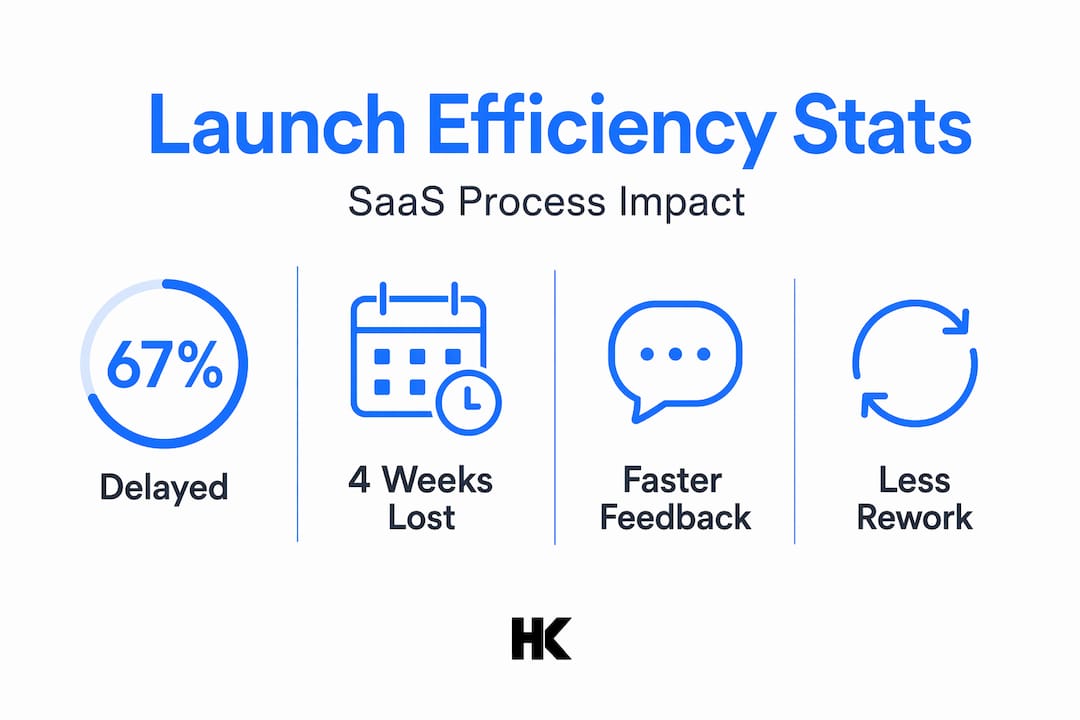
The operational drag is just as real as the financial hit. 67% of marketing campaigns experience delays of four weeks or more because of internal revision cycles. Employees spend 20% of their working time searching for information they should already have. That is one full day per week per person, spent on retrieval instead of execution.
For SaaS specifically, the problem compounds. Rapid iteration cycles mean you may be running two or three launches simultaneously across different feature tiers. Cross-functional teams in growth-stage companies often have no formal authority structure tying them together. The product marketing manager coordinates without sign-off power. Engineering ships on one timeline, sales enablement runs on another. Without a structure that connects these tracks, every launch becomes a negotiation.
The benefits of a more efficient process are concrete. Faster time to market means earlier user feedback. Reduced rework means engineering and marketing cycles go to new work, not corrections. Better alignment with customer needs comes from forcing the team to agree on messaging before assets get built, not after. These are not theoretical advantages. They are the direct output of treating launch as a coordination problem worth solving.

Pro Tip: Standard SaaS launch preparation runs 8 to 12 weeks. If your current timeline is shorter and you are skipping alignment steps to hit the date, you are not moving faster. You are just deferring the rework cost.
Core strategies to simplify your launch process
The strategies that consistently separate clean launches from chaotic ones are not complicated. They are just unpopular because they require discipline before the fun work starts.
Start with a single positioning brief. Before a single asset gets written, every stakeholder signs off on one document: who the product is for, what problem it solves, and why the company is the right source. The launch coordination layer where most teams fail is not the individual task layer. It is the cross-functional narrative layer. Five teams telling five different stories is the root cause of most launch chaos, and a signed brief is the simplest fix.
Assign launch tiers and hold them. Not every feature deserves a full go-to-market. Assigning launch tiers prevents scope creep and burnout by calibrating effort to strategic impact. A Tier 1 launch gets a full press push, sales enablement, and dedicated landing pages. A Tier 3 launch gets a changelog entry and a customer email. The discipline is refusing to upgrade a Tier 3 to a Tier 1 mid-cycle because someone in leadership gets excited.
Build a centralized, searchable knowledge base. Centralizing knowledge in searchable databases reduces the time your team wastes tracking down the latest version of the positioning doc, the current pricing, or the updated feature list. When this information lives in one place with clear ownership, teams stop cc'ing everyone on every email and start making faster decisions.
Two more practices that consistently pay off:
- Integrate roadmaps so engineering milestones and marketing milestones are visible to both teams in the same view, not separate documents that drift apart.
- Replace long weekly status meetings with daily 15-minute syncs with fixed agendas that cover blockers, decisions needed, and status updates. Anything that takes longer than 15 minutes gets a separate meeting with only the people who need to be in the room.
Pro Tip: Set your hard launch date first, then work backward to assign tasks. Setting hard launch dates and working backward forces prioritization and ends the "almost ready" cycle that delays more launches than any technical problem.
Tools that support efficient SaaS launches
No single platform solves a coordination problem. But the right set of tools reduces friction enough that the process has a real chance of working. Here is a practical comparison of tool categories and their specific contribution to launch efficiency.
| Tool category | Primary function | Launch-specific value |
|---|---|---|
| Project management platforms | Centralized task tracking and timelines | Keeps engineering and marketing milestones in one shared view |
| Interactive demo tools | Replace static screenshots with guided walkthroughs | Demo completion analytics show actual adoption signals |
| Knowledge management systems | Searchable single source of truth for positioning, pricing, and specs | Eliminates version confusion and reduces information retrieval time |
| Launch orchestration platforms | Coordinate cross-functional launch workflows | Creates accountability across teams without requiring formal authority |
| Analytics and adoption trackers | Track feature adoption rates, conversion, and milestone actions | Grounds post-launch decisions in user behavior, not internal opinion |
Interactive demos embedded in launch assets deserve particular attention. When you replace a static PDF or slide deck with a guided demo, sales teams stop relying on walkthroughs for every prospect, and you get analytics on which parts of the product story actually land. That data is more useful than page view counts when deciding whether your messaging is working.
Embedding enablement materials directly into sales workflows matters too. A sales rep who has to leave their CRM, open a separate portal, find the right one-pager, and then paste it into an email will skip that step under pressure. Put the asset where the work happens.
Common pitfalls that undermine launch efficiency
Most launch failures follow recognizable patterns. Knowing them in advance is the cheapest form of preparation.
-
Treating launch as a checklist. The mistake is thinking launch is an execution problem. It is a coordination problem. Completing every item on the checklist while teams tell different stories to the market still produces a failed launch.
-
Skipping launch tiering. When every release gets the same level of effort regardless of strategic importance, teams burn out on minor updates and have nothing left for the launches that actually move revenue. Tiering is not about doing less. It is about doing the right amount.
-
Defining success after launch. Without pre-defined success thresholds, every post-launch meeting turns into an opinion contest. Predefining success criteria and pivot points before the launch date is the only way to make post-launch decisions quickly and without internal politics.
-
Overloading sales enablement. A sales rep given 14 assets before a launch will use one, maybe two. Focus on fewer, better materials that directly address the top three objections your sales team hears.
-
Skipping the retrospective. Post-launch retrospectives that update playbooks can reduce prep time on subsequent launches by up to 30% by the third cycle. Skipping this step means repeating the same coordination failures at the same cost every time.
Pro Tip: Assign one person explicit ownership of the retrospective document. Without a named owner, it never gets written, and the learnings stay in people's heads until those people leave the company.
Measuring and iterating after launch
The most important question after a launch is not "Did it go well?" That question invites subjective answers and protected positions. The right question is "Did we hit the thresholds we set before launch?"
Focus your measurement on metrics that reflect actual product adoption, not activity:
- Feature adoption rate: What percentage of activated users reached the core value action within the first 14 days?
- Conversion impact: Did the launch move the trial-to-paid conversion rate, and by how much compared to your pre-launch baseline?
- Revenue attribution: Can you tie new ARR within 60 days to this specific launch, separated from baseline growth?
- "Aha!" moment tracking: Tracking specific user milestone actions post-launch is the clearest signal that your product is delivering on its launch promise.
Page views, social impressions, and press mentions are not measurements of launch success. They are measurements of launch activity. The distinction matters because teams that optimize for activity convince themselves of wins while churn ticks upward and adoption stalls.
Most launch success or failure is decided well before launch day. If you have not understood the market problem deeply, no amount of post-launch optimization recovers that gap. The data you collect after launch validates or disproves a thesis you should have built before writing a single line of code or copy.
Schedule a 30-day review and a 90-day review as calendar events before launch day. Assign owners to each metric at the same time you define them. When the review arrives, the team already knows what they are measuring and who is responsible. That structure turns retrospectives from awkward post-mortems into predictable process improvements that compound across launches.
What I have actually learned about launch failures
I have worked on product launches across Fortune 500 contexts at BMW and Deutsche Bahn, and I have built and shipped my own SaaS products from zero. The pattern I keep seeing is the same regardless of company size.
The alignment problem is always the root cause. I have watched teams with genuinely excellent products fail their launches because the sales team was pitching a different use case than the product team built for. No coordination structure means no shared story, and buyers feel that confusion immediately.
The "almost ready" trap is real and expensive. In my experience, the last 10% of polish before a launch extends the timeline by 30% while adding almost no market value. Shipping fast and iterating on real user behavior beats internal refinement every time.
Tiering launches saved my teams from burnout more than once. When you protect Tier 1 effort for Tier 1 releases, people bring their full attention to the launches that matter. For non-technical founders I work with through SaaS MVP development, this framing is often the single most clarifying concept in the whole launch conversation.
Interactive demos changed the sales dynamic on every product I have launched since adopting them. Giving buyers a way to self-navigate the product story removes the dependency on sales availability and surfaces the objections earlier, where they are easier to address.
The compounding benefit of retrospectives surprised me even knowing it in theory. By the third launch cycle with a disciplined retrospective process, prep time dropped measurably and the number of cross-functional surprises went to near zero. That is not luck. It is process memory.
— Hanad
How Hanad Kubat helps founders launch faster
If the patterns above describe your current situation, working with someone who has built SaaS products end-to-end makes the launch process shorter and less expensive.
Hanadkubat brings an engineering pedigree from BMW, Deutsche Bahn, and Bundesrechenzentrum Austria into fixed-price MVP builds designed for founders who need to reach the market without burning six months on internal coordination problems. The direct model means you work with the person writing the code, not a project manager relaying messages to a junior team. Fixed timelines of 4 to 12 weeks, starting at €18,000, include the scoping, architecture, and launch-ready delivery that most founders spend months trying to coordinate across multiple vendors. For teams that need to validate before building, a €1,500 strategy sprint scopes and stress-tests the product idea before a single line of code is written. That is how an efficient product launch starts.
FAQ
Why do most SaaS product launches fail?
Most launch failures stem from lack of cross-functional alignment rather than missing checklist items. Teams ship a good product while telling inconsistent stories across sales, marketing, and customer success.
How long should a SaaS product launch take to prepare?
Standard SaaS product launches require 8 to 12 weeks of preparation when done correctly. Cutting that window without eliminating steps typically moves the cost into rework rather than eliminating it.
What metrics actually measure launch success?
Feature adoption rate, trial-to-paid conversion change, and revenue attribution within 60 days are the metrics that reflect real launch impact. Page views and social engagement measure activity, not outcomes.
What is launch tiering and why does it matter?
Launch tiering assigns a level of effort and resources to each release based on strategic importance. Tiering prevents burnout by reserving full go-to-market execution for releases that justify it, rather than applying maximum effort to every changelog update.
When should success criteria be defined for a product launch?
Success criteria and pivot thresholds should be defined before launch day, not after. Setting them in advance eliminates post-launch opinion debates and lets teams make data-driven decisions quickly.