
TL;DR:
- Rapid market validation is a fast, evidence-based process that tests true demand for a B2B SaaS idea before development begins. It involves structured experiments like smoke tests, customer interviews, and pretotyping to disprove risky assumptions quickly and cheaply.
Rapid market validation is a structured, evidence-based process that tests whether real demand exists for a B2B SaaS idea before any significant development begins. The industry term is market validation, and the "rapid" qualifier signals a specific constraint: compress the learning cycle to weeks, not quarters. Typical timelines run from 48-hour sprints to 6-week cycles, with costs often near zero using lean pretotyping methods. The goal is not to build confidence in your idea. The goal is to disprove your riskiest assumptions as cheaply as possible, then decide whether to proceed with real evidence in hand.
What is rapid market validation in B2B SaaS?
Rapid market validation is the practice of running structured experiments to confirm that a defined customer segment has a real problem, wants a solution, and will pay for it before you write production code. It replaces assumption-driven roadmaps with behavioral data. A founder who skips this step and builds for 12 months on gut instinct is not being bold. Skipping validation wastes 12–18 months and millions in development costs. That is the core reason the market validation process exists.

The distinction from general market research matters. Traditional research asks people what they think. Rapid validation asks what they actually do when given a chance to act. A potential customer saying "yes, I'd use that" costs you nothing to hear and means almost nothing. A potential customer signing a Letter of Intent or paying a deposit is a different signal entirely.
What are the core steps of the rapid validation process?
A structured rapid validation process follows a clear sequence. Skipping steps or reordering them is where most B2B SaaS founders lose time and money.
-
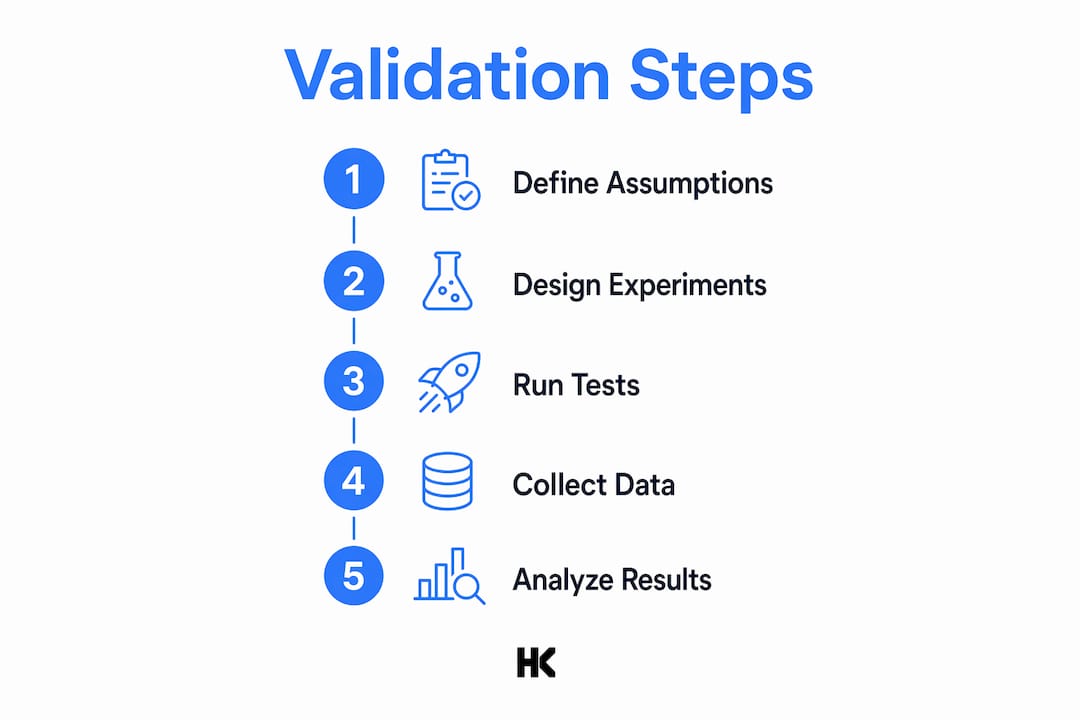
Define your riskiest assumption. Every idea rests on assumptions. The riskiest assumptions should be prioritized first, focusing on whether the problem exists at scale and whether the target buyer will pay to solve it. Write this assumption down as a falsifiable statement before you do anything else.
-
Run customer discovery interviews. The industry standard requires 15–20 high-quality customer discovery interviews before proceeding. These are not sales calls. You are listening for pain, current workarounds, and budget. Ask about the last time they faced the problem, not whether they would hypothetically buy your solution.
-
Build a smoke test. A smoke test is a landing page that describes your product as if it exists, with a clear call to action such as "Request early access" or "Join the waitlist." Drive targeted traffic to it using LinkedIn ads or Google Ads. Measure click-through rate and sign-up rate against a pre-set threshold.
-
Pre-define your pass/fail criteria. A conversion rate under 2% or fewer than 3 paid Letters of Intent should mean killing the project. Set these numbers before you run the test. If you set them after, you will rationalize whatever result you get.
-
Collect behavioral evidence, then decide. Aggregate your interview findings, smoke test data, and any willingness-to-pay signals. Make a binary go/no-go decision. Do not move to prototyping until this decision is made.
The full cycle fits inside 2–6 weeks for most B2B SaaS ideas. A 48-hour sprint works for the earliest vetting stage, where you are simply checking whether the problem is real before investing in a landing page.
Which rapid validation techniques and tools work best?
The most effective quick market testing methods share one property: they generate behavioral data, not stated preferences.
- Fake door tests. A fake door test presents a feature or product that does not yet exist. When a user clicks "Buy" or "Sign up," they see a message explaining the product is in development. The click rate is your signal. This method costs almost nothing and can run in under 48 hours.
- Pretotyping methods. Pretotyping, a term coined by Alberto Savoia at Google, covers techniques like the Mechanical Turk prototype, where a human manually performs what software would eventually automate. It proves demand before a single line of code exists. Pretotyping differs from prototyping by emphasizing minimum viable evidence of demand versus building a working product.
- AI-assisted research. AI tools accelerate competitor mapping, sentiment mining from forums like Reddit or G2, and analysis of customer interview transcripts. AI compresses research phases but cannot replace deep human customer interviews. The willingness-to-pay conversation still requires a human on both ends.
- Paid traffic smoke tests. A landing page with €200–€500 in LinkedIn or Google Ads spend generates real behavioral data within days. This is faster and more honest than any focus group.
- Letters of Intent and deposits. These are the highest-fidelity signals available. Top teams run over 1,000 validation tests per year using these methods at scale, treating validation as a continuous practice rather than a one-time gate.
Pro Tip: Run your smoke test with paid traffic before you show the landing page to anyone in your network. Friends and colleagues click out of politeness. Strangers click because they want what you are offering.
How do you set meaningful metrics for validation success?
Metrics without pre-set thresholds are not metrics. They are data points you will interpret to confirm whatever you already believe.
The standard benchmarks for B2B SaaS validation are specific. A landing page needs a conversion rate above 2% CTR to signal real interest. You need at least 3 paying customers or signed Letters of Intent before treating demand as confirmed. Willingness to pay is the only high-fidelity commercial signal in B2B SaaS validation. Everything else is noise with a nice dashboard.
| Signal type | Fidelity | What it actually proves |
|---|---|---|
| Email signup or waitlist | Low | Mild curiosity, not commercial intent |
| Booked demo call | Medium | Problem awareness, possible fit |
| Signed Letter of Intent | High | Stated commitment to buy |
| Paid deposit | Highest | Confirmed willingness to pay |
The table above shows why most founders mistake email signups for validation. A waitlist of 500 people who paid nothing tells you almost nothing about whether your B2B SaaS product will generate revenue.
Evaluating the market's competitive structure matters as much as customer enthusiasm. If three well-funded competitors already own the segment, customer interviews will still show pain. That pain does not mean your entry is viable. Factor competitive density into your go/no-go criteria from the start.
Pro Tip: Write your kill criteria on a shared document before the test begins. If you hit the threshold, you kill the project. No exceptions, no "but the interviews felt so positive." Pre-commitment is the only reliable defense against confirmation bias.
How does rapid validation differ from traditional market research?
Traditional market research and rapid market validation solve different problems. Knowing the difference prevents you from doing the wrong one at the wrong time.
- Traditional market research maps a market over months. It uses surveys, analyst reports, and focus groups to understand size, trends, and buyer behavior. It is useful for strategic planning. It is not useful for deciding whether to build a specific product.
- Rapid validation tests a specific assumption in days or weeks. It asks: does this exact customer segment have this exact problem, and will they pay this exact price to solve it?
- A/B testing is also not rapid validation. Rapid experimentation validates whether a product should exist at all, before any code is written. A/B testing optimizes a product that already exists. These are different phases with different questions.
- Rapid validation sits before Lean Startup, Agile, and Design Thinking in the product development sequence. You validate the idea, then you apply Lean or Agile to build it. Running Agile sprints on an unvalidated idea is expensive iteration on a wrong assumption.
- Validation is meant to disprove assumptions cheaply, not to build confidence in an idea. This framing matters. Teams that use validation to confirm what they already believe skip the steps that would prove them wrong.
The practical benefit is time and money. Killing a bad idea after two weeks of smoke tests costs almost nothing. Killing it after 14 months of development costs a team, a budget, and often a company.
Key takeaways
Rapid market validation works because it forces a binary decision based on behavioral evidence before development costs accumulate.
| Point | Details |
|---|---|
| Define the riskiest assumption first | Write it as a falsifiable statement before running any experiment. |
| Run 15–20 discovery interviews | Fewer interviews produce patterns that reflect your own biases, not the market. |
| Set pass/fail thresholds before testing | A 2% CTR minimum and 3 paid LOIs are the standard benchmarks for B2B SaaS. |
| Treat willingness to pay as the only real signal | Email signups and demo bookings do not confirm commercial intent. |
| Validate before you prototype | Pretotyping proves demand exists. Prototyping proves you can build the solution. |
What I have learned from watching founders skip this step
The most common mistake I see from B2B SaaS founders is not skipping validation entirely. It is running a version of validation designed to confirm the idea rather than challenge it. They interview five people who already like the concept. They count LinkedIn post likes as demand signals. They build a landing page but never drive paid traffic to it because "the product isn't ready to show yet."
The second mistake is treating AI tools as a shortcut around customer conversations. I use AI to compress competitor research and analyze interview transcripts. It saves real time. But I have never seen an AI tool replace the moment in a customer call when someone says "we've been trying to solve this for two years and nothing works." That sentence, said with that frustration, is worth more than any sentiment analysis output.
The third mistake is not having a kill criterion. Defining a kill criterion upfront protects teams from wishful thinking and emotional attachment. I have watched founders collect 400 email signups, zero paying customers, and declare the idea validated. They then spend €80,000 building something nobody buys. Pre-commitment to a threshold is not pessimism. It is the only way to make the process honest.
Willingness-to-pay testing should happen as early as possible, even before any prototype exists. Ask for a deposit. Ask for a signed LOI. The discomfort of that conversation is the point. If you cannot have it before building, you will not be able to have it after.
— Hanad
Validation support for B2B SaaS founders
Hanadkubat runs a €1,500 strategy sprint specifically designed to scope and validate SaaS ideas before any development begins. The sprint produces a clear go/no-go recommendation grounded in customer discovery, competitive analysis, and a defined experiment plan.
Founders who want a structured process before committing to a full build can review the SaaS validation approach Hanadkubat uses with clients across DACH and the EU. For a complete step-by-step framework, the startup validation guide for 2026 covers current methods including AI-assisted research and pretotyping techniques. All engagements are fixed price, direct, and shipped in weeks.
FAQ
What is rapid market validation?
Rapid market validation is a structured process that tests real demand for a B2B SaaS idea before development begins, typically within 48 hours to 6 weeks using smoke tests, customer interviews, and pretotyping methods.
How many customer interviews do you need for validation?
The industry standard is 15–20 high-quality customer discovery interviews. Fewer than that produces patterns shaped by your own selection bias rather than actual market signals.
What counts as a valid signal in B2B SaaS validation?
Signed Letters of Intent and paid deposits are the highest-fidelity signals. Email signups and waitlist registrations indicate mild curiosity but do not confirm willingness to pay.
How is rapid validation different from A/B testing?
A/B testing optimizes a product that already exists. Rapid validation determines whether a product should be built at all, before any code is written.
What does a smoke test cost?
A basic smoke test using a landing page and paid traffic on LinkedIn or Google Ads typically costs between €200 and €500 and produces usable behavioral data within days.