
TL;DR:
- Startup product validation confirms that an idea addresses a real problem and has genuine market demand before significant development. It involves structured market research, low-cost experiments, and behavioral commitment signals, with pre-defined thresholds to guide decisions. Continuous validation and iterative testing prevent wasteful overbuilding and support evidence-based scaling.
Startup product validation is the systematic process of confirming that your idea solves a real problem and meets genuine market demand before you commit significant development resources. The industry term for this discipline is validated learning, a concept central to the Lean Startup methodology popularized by Eric Ries. A solid startup product validation guide covers market research, hypothesis testing, low-cost experiments like fake door tests and MVPs, and commitment signals such as pre-orders or calendar bookings. Skipping this process is the single fastest way to build a product nobody wants. The frameworks and tools available in 2026 make rigorous validation faster and cheaper than ever before.
What does a startup product validation guide actually cover?
Startup product validation involves researching the target market, testing hypotheses through low-cost experiments, collecting real customer feedback, and tracking traction metrics such as engagement and customer acquisition costs. This is not a single step. It is a structured sequence of decisions, each designed to reduce the risk of building something the market does not want. The three questions every validation process must answer are: Is the problem real? Does a market exist? Will customers pay? Answering all three with behavioral evidence, not verbal interest, is what separates validated learning from wishful thinking.
Most founders underestimate how much damage skipping validation causes. Many founders mistakenly validate the solution before confirming the problem is real, leading to wasted resources and misguided product builds. This means you can spend months building a technically excellent product that solves a problem nobody cares enough about to pay for. The Lean Startup framework, combined with tools like GoNoGo.team, Typeform, and Notion, gives you a repeatable system to avoid that outcome.
How to research your target market and problem space
Market research in validation splits into two tracks: qualitative and quantitative. Qualitative methods, including one-on-one interviews and focus groups, reveal the why behind customer behavior. Quantitative methods, including surveys, web analytics, and cohort analysis, reveal the how many and how often. Both are necessary. Qualitative research without numbers produces compelling stories with no scale. Quantitative data without context produces numbers with no meaning.

For secondary research, use sources like Statista, industry reports from Gartner or IDC, and social listening tools like Brandwatch or SparkToro. Competitor analysis on G2, Capterra, and App Store reviews surfaces the exact language customers use to describe their frustrations. That language belongs in your landing page copy, your interview scripts, and your hypothesis statements.
Identifying your total addressable market (TAM) matters, but problem urgency matters more at the early stage. A market of 50,000 companies with a painful, expensive problem beats a market of 5 million companies with a mild inconvenience. AI-assisted persona simulation tools, including those built on GPT-4o and Claude 3.5, can accelerate early hypothesis generation, but they are a starting point, not a substitute for real interviews.
- Conduct at least 10 to 15 problem-focused interviews before writing a single line of product code
- Use open-ended questions: "Tell me about the last time you dealt with this problem" beats "Would you use a tool that does X?"
- Cross-reference interview findings with quantitative signals from Google Trends, Reddit threads, or LinkedIn polls
- Download a market research report to benchmark your TAM assumptions against verified industry data
Pro Tip: Record every interview with the participant's consent and use a transcription tool like Otter.ai or Fireflies.ai to extract recurring phrases. Patterns across 10 interviews are far more reliable than your memory of them.
How do you design low-cost validation experiments?
The foundation of any validation experiment is a clearly stated hypothesis: "We believe [customer segment] experiences [problem] and will [commit behavior] to solve it." The riskiest part of that statement, the leap-of-faith assumption, is what your first experiment must test. Lean validation demands experiments designed to potentially fail cleanly, so you can falsify assumptions quickly rather than collect noise.
The four most common experiment types, ranked by cost and evidence quality, are:
| Method | Cost | Speed | Evidence quality |
|---|---|---|---|
| Fake door / smoke test | Very low | Days | Medium (intent signal) |
| Landing page + waitlist | Low | 1 to 2 weeks | Medium-high (email commitment) |
| Explainer video (Dropbox-style) | Low to medium | 1 to 2 weeks | High (engagement + sign-ups) |
| Concierge MVP | Medium | 2 to 4 weeks | Very high (real usage data) |
Landing page and fake door tests should be treated as falsification experiments with clear decision thresholds, not marketing campaigns. No conversions with real traffic means your value proposition failed or your audience targeting was wrong. Low but non-zero conversions warrant further segmentation before drawing conclusions.
Choosing the right experiment depends on what you need to learn. If you are unsure whether the problem is real, start with interviews. If you are unsure whether customers will pay, run a fake door with a pricing page. If you are unsure whether your solution concept resonates, build a landing page with a waitlist and measure conversion rate against a pre-set threshold.
Pro Tip: Before designing any experiment, write down the exact number that would make you stop. "If fewer than 5% of visitors sign up, we kill this hypothesis." Pre-committing to a kill condition removes the temptation to rationalize weak results.
What commitment signals actually predict paying customers?
Validation requires commitment signals, not verbal interest. A customer saying "that sounds useful" is worthless data. A customer entering a credit card for a pre-order, booking a calendar slot for a demo, or paying a deposit is behavioral evidence of real demand. This distinction is the most important concept in the entire validation process.
The signals that predict paying customers, ordered by strength:
- Pre-order with payment: The strongest signal. Real money changes hands.
- Signed letter of intent (LOI): Common in B2B SaaS. Not legally binding, but requires effort and organizational buy-in.
- Calendar booking for a paid pilot: The customer invests time and internal political capital.
- Email sign-up with explicit use case: Stronger than a generic waitlist entry.
- Page view or social share: The weakest signal. Treat as awareness, not demand.
The Sean Ellis 40% Test measures product-market fit by asking active users how disappointed they would be if the product disappeared. A result of 40% or more "very disappointed" responses indicates strong PMF and readiness to scale. This benchmark has been validated across hundreds of startups and remains one of the most reliable PMF indicators available.
Avoid validation theater, the practice of collecting positive feedback that cannot change your decision. If every piece of feedback you gather confirms your hypothesis, your research design is broken. Separating problem validation (qualitative discovery) from solution validation (behavioral commitment tests) prevents overbuilding on weak demand signals and keeps your development budget focused on confirmed demand.
How do you track traction and decide to build, pivot, or stop?
Traction metrics are the quantitative backbone of any startup technical validation guide. The metrics that matter most at the pre-launch stage are conversion rate from experiment to commitment, customer acquisition cost (CAC) from paid or organic channels, retention or re-engagement rate from early users, and the ratio of pre-orders to total leads. Vanity metrics like total page views or social media followers tell you nothing about willingness to pay.
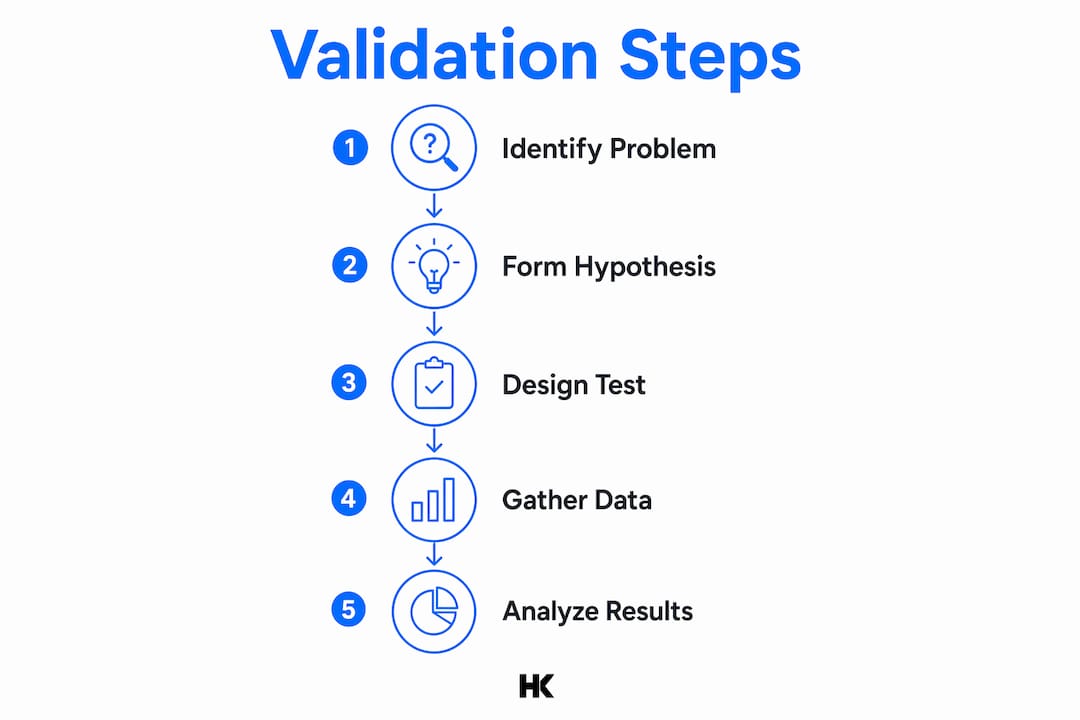
A time-boxed validation plan should start with the riskiest assumption, use the cheapest possible test, and set pre-defined stop/go criteria before the experiment begins. This structure prevents the common founder mistake of extending timelines indefinitely because results are ambiguous. A typical validation cycle runs two to four weeks per experiment, with a clear decision point at the end.
The decision framework is straightforward:
- Keep building: Evidence meets or exceeds your pre-set threshold. Proceed to the next riskiest assumption.
- Pivot: Evidence is directionally positive but points to a different customer segment, problem framing, or pricing model. Restate the hypothesis and run a new experiment.
- Stop: Evidence consistently falls below threshold across multiple experiments with different approaches. The problem or market is not strong enough to justify continued investment.
Common validation mistakes include interviewing only friendly contacts, running experiments without traffic (so you cannot distinguish a bad hypothesis from bad distribution), and treating a single positive signal as proof of market fit. Validation is a sequence of experiments, not a single test.
Pro Tip: Set a maximum of three pivot attempts per core hypothesis. If you have tested three distinct framings of the same problem and none meet your threshold, the evidence is telling you something. Listen to it.
What makes an MVP a learning tool, not a mini-launch?
An MVP is not a stripped-down version of your final product. An MVP is a learning tool designed to test the riskiest assumption via the smallest possible build, using real user behavior rather than guesses or vanity metrics. The distinction matters because founders who treat MVPs as mini-launches optimize for features and polish. Founders who treat MVPs as experiments optimize for speed and falsifiability.
Before writing a single line of code, define the MVP kill condition: the specific metric threshold that would force a pivot or stop decision. For a B2B SaaS MVP, that might be "fewer than 3 of 10 pilot users complete the core workflow in the first week." For a consumer app, it might be "day-7 retention below 20%." Without a pre-defined kill condition, you will rationalize weak results indefinitely.
The MVP checklist for founders focused on fast validation:
- Identify the single riskiest assumption your business depends on
- Build only the feature set required to test that assumption
- Define success and failure thresholds before launch
- Instrument every key action with analytics (Mixpanel, PostHog, or Amplitude)
- Run the MVP with real users who match your ICP, not friends or colleagues
- Review results against thresholds at a fixed date, not when you feel ready
Overbuilding is the most common MVP failure mode. If your MVP takes more than six weeks to build, you are building a product, not an experiment. The goal is to reach a decision point as fast as possible, not to impress early users with a polished interface.
Key takeaways
Effective startup product validation requires behavioral commitment signals, pre-defined kill conditions, and structured iteration cycles to produce decisions, not just data.
| Point | Details |
|---|---|
| Commitment signals over vanity metrics | Pre-orders, LOIs, and calendar bookings predict paying customers. Page views do not. |
| Falsifiable experiments first | Design every test to potentially fail. If it can only confirm your hypothesis, it is not a real experiment. |
| Separate problem from solution validation | Confirm the problem is real with qualitative research before testing your solution with behavioral signals. |
| Pre-define stop/go criteria | Set numeric thresholds before each experiment to prevent rationalization of weak results. |
| MVPs are learning tools | Build only what is needed to test the riskiest assumption, then measure against a pre-set kill condition. |
What I've learned about validation the hard way
Most founders I work with arrive at validation backwards. They have already named the product, designed the UI, and started scoping the database schema. Then they ask me to help them validate. That sequence is expensive. The right order is: confirm the problem exists, confirm people will pay to solve it, then build the smallest thing that tests your core assumption.
The shift I advocate for is treating the first €18,000 of development budget as a research budget, not a build budget. A €1,500 strategy sprint to scope and stress-test your assumptions before committing to an MVP build is not a delay. It is the cheapest insurance you can buy against building the wrong thing.
AI tools like Claude and GPT-4o have made early-stage persona simulation and hypothesis generation faster. But they have also made it easier to generate convincing-sounding validation that is entirely synthetic. Real commitment signals from real users in your ICP still cannot be faked or simulated. The discipline of going back to actual humans, with actual problems, and asking them to put something on the line remains the core of the process.
Post-launch validation is equally important. The Sean Ellis 40% Test is not a one-time measurement. Run it quarterly. Markets shift, competitors enter, and the problem your product solves can become less urgent. Continuous validation is not a sign of insecurity about your product. It is how you stay ahead of the market instead of chasing it.
— Hanad
Validate before you build with Hanadkubat
If you are a non-technical founder or early-stage product manager in the DACH region or EU, Hanadkubat offers a fixed-price €1,500 strategy sprint designed to scope and stress-test your product idea before a single line of code is written. The sprint covers problem and ICP validation, hypothesis framing, experiment design, and a clear go/no-go recommendation. For teams ready to build, SaaS MVP development starts at €18,000 with a 4 to 12 week delivery window. You work directly with Hanad, not a project manager or junior team. Every engagement is grounded in the same validated learning principles this article covers.
FAQ
What is startup product validation?
Startup product validation is the process of confirming that a product idea solves a real problem and has paying customers before significant development investment. It combines qualitative research, low-cost experiments, and behavioral commitment signals to produce evidence-based build decisions.
How do you validate a startup idea without building a product?
Use fake door tests, landing pages with waitlists, or explainer videos to measure commitment signals like sign-ups or pre-orders before writing code. These methods test whether customers will act on your value proposition, not just say they like it.
What is the Sean Ellis 40% Test?
The Sean Ellis 40% Test asks active users how disappointed they would be if your product disappeared. A result of 40% or more "very disappointed" responses indicates strong product-market fit and readiness to scale.
What is the difference between an MVP and a prototype?
A prototype tests design and usability. An MVP tests a core business assumption with real users under real conditions, measuring behavioral outcomes like retention or conversion against pre-defined thresholds.
How long should a validation cycle take?
A single validation experiment should run two to four weeks, with a clear decision point at the end. If you need more than three cycles to confirm or reject a core hypothesis, reexamine your experiment design or the problem framing itself.