
TL;DR:
- A minimum viable product is the smallest live, functional version that tests a critical business hypothesis with real users. It requires full task completion and is used as a falsifiable experiment to validate or reject core assumptions quickly. Treating an MVP as an experiment rather than a product milestone helps optimize resource allocation and reduce failure risks in B2B SaaS development.
A minimum viable product is the smallest live, functional version of your product that tests one critical business hypothesis by letting real users complete a core task and deliver real feedback. The term was formalized by Eric Ries in The Lean Startup, and it remains the most misunderstood concept in product development. Most founders build too much, too early, and call it an MVP. That is not an MVP. That is a version 1.0 with a misleading label, and it costs real money to get wrong.
The MVP definition matters because it changes how you allocate engineering time, how you interpret user feedback, and how quickly you can decide whether to continue, pivot, or stop. For B2B SaaS founders and product managers, those decisions carry direct financial consequences. A four-week build that proves your core assumption wrong is a success. A six-month build that does the same is a failure.

The lean startup methodology treats an MVP not as a product milestone but as a falsifiable experiment. The question is never "can we build this?" The question is "should we?" Every feature you add before answering that question is a bet placed without evidence.
What is a minimum viable product and its defining elements?
A minimum viable product has three components, and each word carries specific meaning. Treat any one of them loosely and you end up building the wrong thing.
"Minimum" means the smallest scope required to test your riskiest assumption. Not the smallest scope you are comfortable shipping. Not the version that covers edge cases or impresses investors. The single feature set that either confirms or kills the hypothesis. A rigid binary filter applied to every proposed feature asks one question: does this test the riskiest assumption? If the answer is no, cut it.
"Viable" is the element most teams skip. A viable MVP allows users to complete an entire core task end-to-end. Not a partial flow. Not a demo with a "coming soon" placeholder. If a B2B SaaS user cannot complete the primary workflow from start to finish, you are not collecting meaningful data. You are collecting frustration.
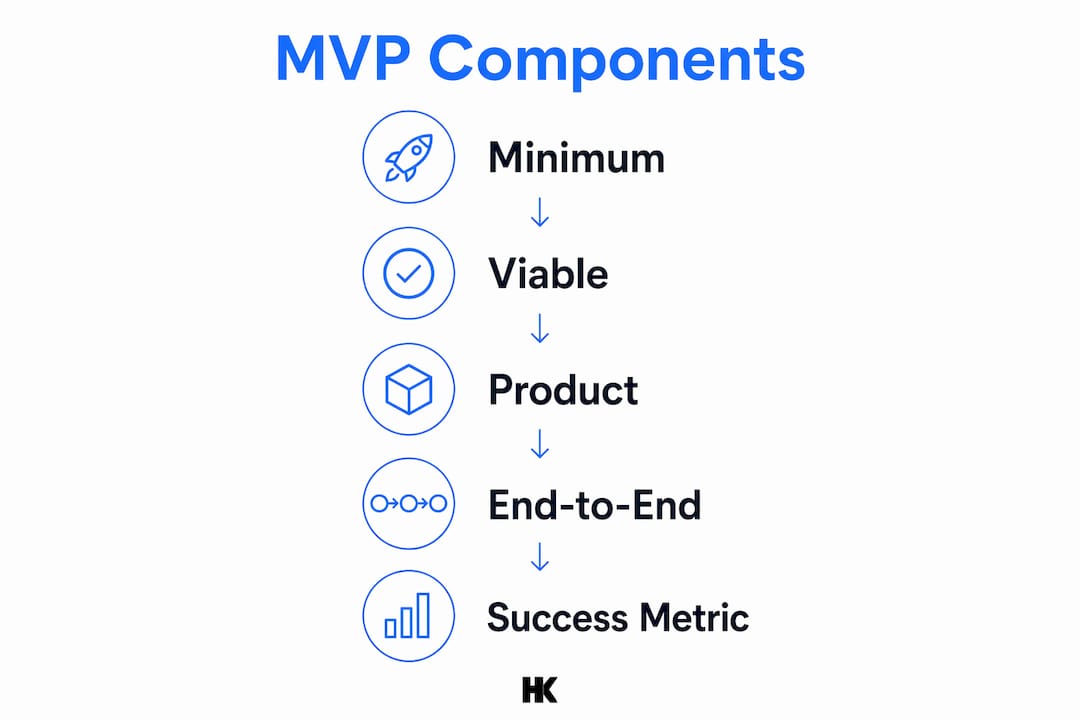
"Product" means it is live, functional, and in the hands of real users. A Figma mockup is not a product. A clickable prototype is not a product. A product delivers actual value to an actual user in an actual context.
These three constraints work together to prevent scope creep. When a team debates adding a feature, the MVP framework gives you a concrete answer: does it help a user complete the core task, and does it test the riskiest assumption? Two questions. Binary answers.
- Does this feature test the riskiest hypothesis? Yes or no.
- Does this feature enable core task completion? Yes or no.
- If both answers are not yes, the feature does not belong in the MVP.
Pro Tip: Define your binary success metric before you write a single line of code. "50 signups in 30 days" or "15% conversion from trial to paid" gives you a clear pass/fail threshold. Without it, teams rationalize ambiguous results and make bad pivot decisions.
How does an MVP differ from a prototype, beta, or full product?
The confusion between these four terms causes more wasted engineering hours than almost any other product management mistake. Each serves a different purpose, and treating them as interchangeable is expensive.
| Stage | Purpose | Users | Data type |
|---|---|---|---|
| Prototype | Test internal concepts and UI flows | Internal team or limited testers | Qualitative, observational |
| MVP | Test a live value hypothesis | Real paying or target users | Behavioral, quantitative |
| Beta | Stabilize a near-complete product | Broader user group pre-launch | Bug reports, usability data |
| Full product | Deliver complete feature set | General market | Usage, retention, revenue |
Prototypes are internal concept validations. They are tested by the team or a controlled group, and they answer design questions, not market questions. An MVP is live-coded and tested in real market conditions. That distinction changes everything about the data you collect.
A prototype tells you whether users understand the interface. An MVP tells you whether users will pay for the solution, return to use it, and recommend it to colleagues. Those are fundamentally different questions. Distinguishing prototypes from MVPs shifts your focus from building a product to sharpening the questions you want to answer.
Consider Dropbox in its early days. The team built a three-minute demo video before writing a single line of backend code. That video was a prototype. When they launched a functional file-sync product to a waitlist of real users, that was the MVP. The video tested comprehension. The product tested demand. Both were necessary, but neither could substitute for the other.
For B2B SaaS specifically, the gap between prototype and MVP is even more significant. Enterprise buyers do not respond to mockups the way consumers do. They need to see a working workflow inside their actual context before they will commit budget or time. A prototype will not surface the integration requirements, security questions, or approval processes that determine whether a B2B deal closes.
Best practices for building an effective MVP in B2B SaaS
The most effective MVP process follows a tight sequence: define the hypothesis, set the success metric, build the minimum scope, ship to real users, and measure behavior. Every step has a practical constraint that keeps the build honest.
-
Define one riskiest hypothesis. Write it as a falsifiable statement. "We believe that [target user] will [take this action] because [this reason]." If you cannot write it in one sentence, you are testing too many things at once.
-
Set a binary success metric before building. Fifty signups, a 20% conversion rate, three paid pilots in 60 days. The number is less important than the commitment. Teams that skip this step misread ambiguous results and make poor pivot decisions.
-
Build for 2 to 4 weeks maximum. An MVP that takes longer than four weeks is almost certainly a version 1.0 product. If your scope requires more time, cut features until it fits. The timeline is a forcing function, not a suggestion.
-
Use manual processes to simulate complex features. The "wizard of oz" technique replaces automated backend logic with human operators running processes manually. A B2B SaaS team testing an AI-powered data extraction feature can have a human analyst perform the extraction manually while the front end looks automated. Manual workflows preserve budget while testing whether users value the output at all.
-
Ship to real users with real stakes. Free users behave differently from paying users. If your B2B SaaS targets mid-market companies, your MVP users should be mid-market contacts, not friends or colleagues who will be polite about a broken product.
-
Measure behavior, not opinions. Post-session surveys and user interviews generate stated preferences. MVP usage data generates actual behavior. The gap between what users say they will do and what they actually do is where most product assumptions collapse.
Pro Tip: For B2B SaaS, consider validating your idea with three to five design partner companies before writing code. A verbal commitment to pilot the product is stronger evidence than any survey result.
Common pitfalls when creating an MVP
Most MVP failures share the same root cause: the team built too much. Scope creep is the primary driver of MVPs that produce poor feedback, and it almost always starts with good intentions.
-
Feature bloat. Every "nice to have" feature added before launch dilutes the signal. If users churn from your MVP, you cannot tell whether they left because the core value was wrong or because a secondary feature was missing. Clean scope produces clean data.
-
Confusing polish with value. Users do not care about an MVP's visual finish if it solves their core problem. Teams that spend weeks on UI refinement before validating the core workflow are optimizing the wrong variable. Building for polish wastes resources when the core problem has not been confirmed.
-
Relying on user interviews instead of usage data. User interviews are useful for generating hypotheses. They are unreliable for confirming them. Behavioral gaps measured through actual MVP usage reveal false assumptions that interviews consistently miss. Users say they will use a feature weekly. Usage data shows monthly at best.
-
Skipping the success metric. Without a defined threshold, every result is open to interpretation. Teams that skip this step tend to declare ambiguous results a success and continue building in the wrong direction.
-
Treating the MVP as a reputation risk. Some founders refuse to ship anything that does not look finished. This is understandable, but it is also the fastest way to spend six months building something nobody wants. The MVP's job is to be right about the problem, not impressive about the solution.
For a structured approach to avoiding these mistakes, the pattern is consistent: define before you build, measure before you iterate, and cut before you add.
Key takeaways
A minimum viable product is a live, scoped experiment that tests one riskiest hypothesis with real users in 2 to 4 weeks, using a binary success metric defined before any code is written.
| Point | Details |
|---|---|
| MVP is an experiment, not a product version | Test one hypothesis with the smallest functional scope before committing to a full build. |
| Viability requires full task completion | Users must complete the core workflow end-to-end, or the feedback data is not reliable. |
| Binary metrics prevent bad decisions | Define a pass/fail threshold before building to avoid rationalizing ambiguous results. |
| Prototypes and MVPs answer different questions | Prototypes test design comprehension; MVPs test market demand with real behavioral data. |
| Scope creep is the primary failure mode | Apply a binary feature filter: if it does not test the riskiest assumption, cut it. |
Why the MVP mindset is harder than it looks
I have worked with founders across DACH and the EU who understood the MVP concept intellectually and still built version 1.0 products. The problem is rarely ignorance. It is the discomfort of shipping something that feels incomplete.
The discipline required to hold scope at "minimum viable" is genuinely difficult when you can see the full product in your head. Every feature you cut feels like a risk. But the real risk is the opposite: building a product that answers questions nobody asked.
From my own SaaS builds, the most valuable thing a strict MVP process does is force you to articulate your riskiest assumption out loud. Most founders have never done this explicitly. When you write it down as a falsifiable statement and attach a binary metric to it, the product decisions that follow become much cleaner. You stop debating features and start debating hypotheses.
The teams I have seen succeed with MVPs share one trait: they treat a failed MVP as a cheap lesson, not a public failure. An MVP that proves your assumption wrong in four weeks and €18,000 is a better outcome than a full product launch that proves the same thing in twelve months and €200,000. The math is straightforward. The mindset shift takes longer.
For B2B SaaS specifically, the MVP also surfaces the organizational complexity of enterprise sales early. Integration requirements, procurement processes, and security reviews do not appear in user interviews. They appear when a real company tries to actually use your product. That is exactly the kind of signal you need before you scale.
— Hanad
Build your MVP with expert support from Hanadkubat
If you are a non-technical founder or early-stage product team ready to move from idea to validated product, Hanadkubat offers fixed-price SaaS MVP builds starting at €18,000, delivered in 4 to 12 weeks. Every engagement starts with a €1,500 strategy sprint to scope and validate the idea before a single line of code is written.
Hanadkubat brings an engineering background from BMW, Deutsche Bahn, and Bundesrechenzentrum Austria to every project. You work directly with the engineer writing the code, not a project manager relaying messages to a junior team. For founders who want to validate fast and build right, that direct model makes a measurable difference. Visit hanadkubat.com to see current service tracks and pricing.
FAQ
What is the MVP definition in product management?
A minimum viable product is the smallest functional version of a product that tests one core business hypothesis with real users. It delivers enough value for users to complete a primary task and provide meaningful behavioral feedback.
Why build a minimum viable product before a full product?
Building an MVP first reduces the cost of being wrong. A 2 to 4 week MVP build that disproves your core assumption costs a fraction of a full product launch that reaches the same conclusion.
How is an MVP different from a product prototype?
Prototypes test internal design concepts with limited or internal users. MVPs are live-coded products tested in real market conditions with actual target users, generating behavioral data rather than observational feedback.
What makes an MVP "viable" in B2B SaaS?
Viability means users can complete the entire core workflow end-to-end. A partial feature set or broken flow does not qualify as viable because it cannot generate reliable feedback on whether the product solves the actual problem.
How do you measure whether an MVP succeeded?
Define a binary success metric before building, such as 50 signups or a 15% trial-to-paid conversion rate. If the metric is met, the hypothesis is confirmed. If not, you have clear grounds to pivot or stop.