
TL;DR:
- Choosing a SaaS platform shifts costs from capital investment to predictable operational expenses, enabling faster deployment and scalable growth. However, vendor lock-in, limited customization, security, and integration challenges require thorough evaluation and strategic planning before adoption. Long-term success depends on architecture with open APIs, data portability, and alignment with future business needs.
A SaaS platform is a cloud-hosted software solution that businesses subscribe to, receiving immediate access without hardware investment, on-site installation, or manual update cycles. Salesforce, Google Workspace, and Microsoft 365 are the most recognized examples, each delivering enterprise-grade functionality through a browser. SaaS made up 43% of the cloud computing market in 2019, larger than IaaS and PaaS combined. That market share reflects a fundamental shift in how businesses buy and operate software. Understanding why to choose a SaaS platform requires looking beyond the subscription model to the architectural and operational decisions that follow.

What are the primary benefits of choosing a SaaS platform?
The core financial argument for SaaS is the shift from capital expenditure to operational expenditure. Traditional on-premise software demands upfront licensing fees, server hardware, and a dedicated IT team to maintain it. SaaS replaces that with a predictable monthly or annual subscription, which makes budgeting straightforward and removes the need for a large initial outlay.
Deployment speed is a concrete, measurable advantage. SaaS deployments complete in hours rather than the months typically required for on-premise rollouts. For a mid-size DACH company evaluating a new CRM or ERP, that difference translates directly into faster time-to-value and reduced project risk.
The advantages of using SaaS extend to scalability and maintenance. Adding or removing users takes minutes in platforms like HubSpot or Zendesk, with no infrastructure changes required. SaaS providers handle security, availability, and updates through service-level agreements, freeing internal IT teams to focus on business-critical work rather than patch management.
Key SaaS platform advantages for B2B operations include:
- Cost efficiency: No upfront hardware or perpetual license costs; pay only for what you use
- Faster deployment: Go live in hours or days, not quarters
- Elastic scaling: Add seats or modules as your team grows without infrastructure changes
- Automatic updates: Vendors ship security patches and feature releases without downtime windows
- Location independence: Any device with internet access connects to the same system
- Reduced IT overhead: Internal teams stop managing servers and start solving business problems
Pro Tip: When calculating SaaS cost savings, include the fully loaded cost of your current on-premise setup: server depreciation, IT staff time for maintenance, and the opportunity cost of delayed upgrades. The comparison almost always favors SaaS for teams under 500 users.
What challenges should decision-makers consider before committing?
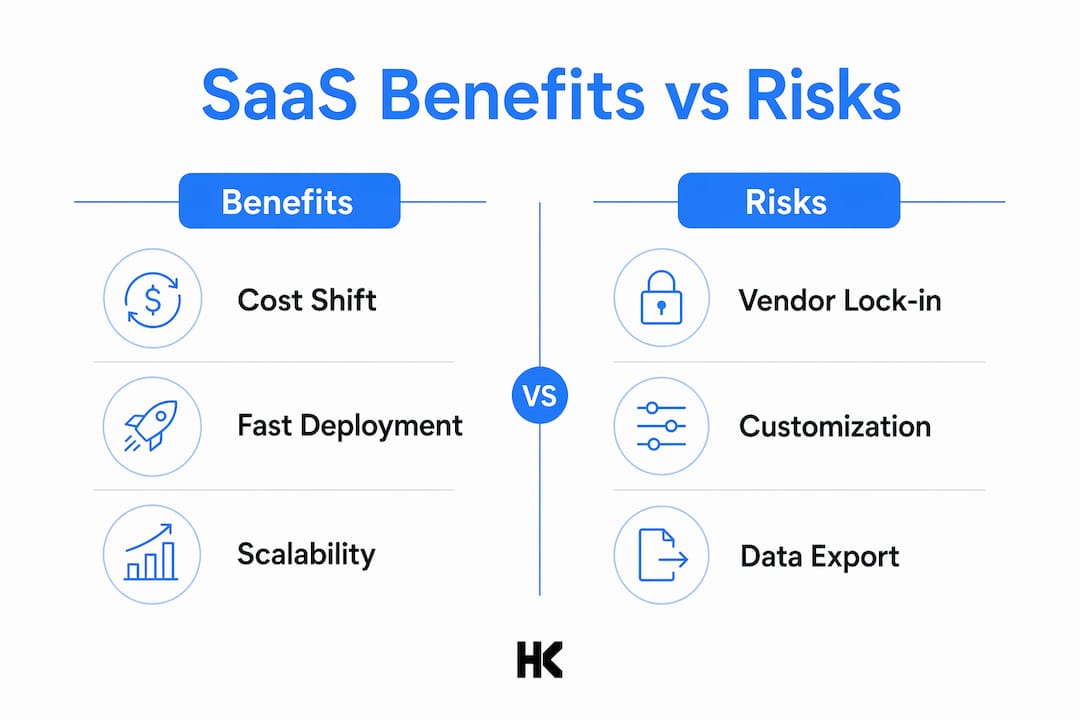
The benefits of SaaS are real, but the risks are equally concrete. Vendor lock-in is the most underestimated. Many SaaS products make data import easy but export difficult, which means switching providers later carries significant migration cost and operational disruption. Signing a three-year contract without reviewing data portability terms is a decision that compounds over time.
Customization limits matter more in regulated industries. A SaaS platform built for the general market may not accommodate the specific workflows of a German Mittelstand manufacturer or an Austrian financial services firm. When deep process customization is required, the gap between what the vendor offers and what the business needs can only be closed through expensive workarounds or integrations.
Security and compliance deserve scrutiny beyond certifications. Security systems must be proactive, using intelligence and automation rather than static checklists. For EU-based organizations, GDPR compliance and data residency requirements add another layer. Knowing where your data physically resides and whether the vendor's infrastructure qualifies as EU-resident is not optional for regulated sectors.
Additional challenges worth mapping before you sign:
- Internet dependency: A SaaS platform with no offline mode creates operational risk during outages
- Integration complexity: Connecting SaaS tools to legacy ERP or custom systems requires API work and ongoing maintenance
- Hidden costs: Training, integration development, and migration fees often exceed the subscription cost in year one
- Architectural sprawl: Adopting too many disconnected SaaS tools creates what practitioners call "Frankenstein systems," where data is fragmented and no single source of truth exists
Pro Tip: Before signing any SaaS contract, request a full data export in a standard format (CSV, JSON, or XML) as part of the proof-of-concept phase. If the vendor resists or cannot deliver it cleanly, treat that as a disqualifying signal.
How does SaaS scalability and architecture affect long-term growth?
Scalability in a SaaS context is not just about adding user seats. It means the platform can handle peak loads without degrading performance, support new product lines or geographies, and integrate with AI-driven workflows as your operations mature. Horizontal scaling distributes load across multiple nodes and avoids single points of failure. This is the architecture pattern preferred in modern cloud environments, and it is the standard you should expect from any enterprise-grade SaaS vendor.
Integration maturity separates good SaaS platforms from great ones. Platforms built with an integration-first approach expose well-documented REST or GraphQL APIs, maintain ecosystem marketplaces, and support event-driven architectures. This reduces technical friction when connecting to your existing stack, whether that is SAP, Salesforce, or a custom-built internal tool. Walled-garden platforms that restrict API access or charge extra for integrations create technical debt from day one. For a deeper look at how architecture choices affect long-term SaaS product health, the B2B SaaS architecture guide at Hanadkubat covers the tradeoffs in detail.
The table below compares the two dominant architectural approaches you will encounter when evaluating SaaS platforms:
| Dimension | Integration-first platform | Walled-garden platform |
|---|---|---|
| API access | Open, well-documented, included in plan | Restricted, add-on cost, or proprietary |
| Data portability | Standard export formats supported | Export limited or requires vendor assistance |
| Ecosystem | Marketplace with third-party connectors | Closed or limited partner integrations |
| Scaling model | Horizontal, multi-tenant, cloud-native | Vertical or single-tenant with manual scaling |
| Long-term risk | Lower switching cost, lower lock-in | Higher migration cost, higher dependency |
SaaS sprawl is a governance problem as much as a technical one. Too many disconnected tools create operational inefficiencies that compound over time, adding costs and data fragmentation despite each tool's individual feature strength. The solution is stakeholder alignment before procurement: IT, finance, and operations must agree on which platforms are core infrastructure and which are point solutions with defined lifespans. For teams planning to scale their SaaS product beyond early growth, architectural governance becomes a prerequisite, not an afterthought.
What practical steps help you evaluate and select the right SaaS platform?
Selecting the right SaaS solution requires a structured process, not a demo-driven decision. The steps below reflect how experienced B2B technology teams approach this decision without creating regret at the 18-month mark.
- Map stakeholder priorities first. IT cares about security and integration. Finance cares about total cost of ownership. End-users care about usability. Leadership cares about vendor stability and roadmap. Collect these requirements before you open a single vendor website.
- Define non-functional requirements explicitly. Peak load capacity, data residency, uptime SLA, and GDPR compliance are not features. They are baseline requirements. Non-functional requirements like peak load and data residency must align with your compliance framework before any functional evaluation begins.
- Run a time-boxed proof of concept. A 30-day pilot with real users and real data reveals integration friction, usability gaps, and performance issues that no demo will surface. Define success criteria before the pilot starts, not after.
- Calculate total cost of ownership, not just subscription cost. The cheapest subscription can become the most expensive option once you add integration development, training, and migration costs. Build a three-year TCO model that includes all operational layers.
- Review the contract for exit terms. Data portability, migration assistance, and contract termination clauses must be negotiated before signing. Contracts should include data portability and migration scenarios to avoid costly lock-in after implementation.
- Assess vendor stability and support quality. A SaaS vendor that ships a strong product today but has a weak support organization or an unclear roadmap is a liability at scale. Request references from customers in your industry and size range.
- Plan for user adoption from day one. A powerful SaaS platform with low adoption is a wasted investment. Build onboarding, training, and change management into the project budget, not as an optional line item.
Pro Tip: Ask every SaaS vendor for their SOC 2 Type II report and their EU data processing agreement before the final evaluation round. Vendors who cannot produce these documents within 48 hours are not ready for enterprise procurement.
Key takeaways
Choosing a SaaS platform delivers the most value when the decision is treated as an architectural commitment, not a procurement transaction, with equal weight given to integration maturity, exit planning, and total cost of ownership.
| Point | Details |
|---|---|
| Cost model shift | SaaS converts CapEx to OpEx, removing upfront hardware and licensing costs. |
| Deployment speed | SaaS goes live in hours versus months for on-premise, accelerating time-to-value. |
| Vendor lock-in risk | Negotiate data portability and exit terms before signing any multi-year contract. |
| Architecture matters | Prefer integration-first platforms with open APIs over walled-garden systems. |
| True cost of ownership | Add training, integration, and migration costs to subscription fees for an accurate TCO. |
SaaS selection is an architectural decision, not a procurement one
Every SaaS evaluation I have seen go wrong shared the same root cause: the decision was made on features and price, with architecture and exit strategy treated as secondary concerns. By the time the integration debt accumulated or the vendor raised prices at renewal, the cost of switching had grown large enough to make the business feel trapped.
The most durable SaaS decisions I have observed, including work I have done with clients in the DACH region and across the EU, start with a clear answer to three questions. First, how does this platform connect to everything else we run? Second, what does it cost to leave if the vendor changes direction? Third, does the vendor's roadmap align with where our business will be in three years, not just today?
Usability is also underweighted in most evaluations. A platform that your team does not actually use becomes shadow IT within six months. The UX quality of a SaaS tool is not a soft consideration. It is a direct driver of adoption, and adoption is the only path to ROI. Fast value delivery after implementation drives momentum. Delays in realizing impact degrade the business case and create internal skepticism that is hard to reverse.
My recommendation: treat the SaaS selection process the same way you would treat a hiring decision for a senior technical role. Check references, stress-test the candidate under real conditions, and think carefully about what happens if the relationship does not work out.
— Hanad
Thinking about building or evaluating a SaaS platform?
If you are a technical founder, CTO, or IT director working through a SaaS platform decision, the architecture and integration questions are often where the real complexity lives. Hanadkubat works directly with B2B SaaS teams across the DACH region and EU on exactly these problems, from scoping and validating product ideas to building production-ready systems with clean integration architecture.
Whether you need a SaaS strategy sprint to validate your direction before committing to development, or you are evaluating the key features every SaaS needs before selecting or building a platform, Hanadkubat delivers fixed-price engagements shipped in weeks. No project managers between you and the engineer writing the code. Details and pricing are at hanadkubat.com.
FAQ
Why choose a SaaS platform over on-premise software?
SaaS eliminates upfront hardware and licensing costs, deploys in hours rather than months, and offloads maintenance to the vendor. For most B2B teams under 500 users, the total cost of ownership favors SaaS over a multi-year horizon.
What is the biggest risk of adopting a SaaS platform?
Vendor lock-in is the most underestimated risk. Many SaaS products make data import easy but export difficult, which raises switching costs significantly. Negotiate data portability terms before signing any contract.
Is SaaS right for regulated industries like finance or healthcare?
SaaS can work in regulated industries, but data residency, GDPR compliance, and security certifications must be verified before procurement. EU-based organizations should confirm that vendor infrastructure qualifies as EU-resident and review the data processing agreement in detail.
How do you calculate the true cost of a SaaS platform?
The true cost includes the subscription fee plus integration development, training, ongoing maintenance, and potential migration costs. The cheapest subscription option frequently becomes the most expensive choice once all operational layers are included in a three-year TCO model.
What makes a SaaS platform architecture-ready for long-term growth?
Platforms built on horizontal scaling, open APIs, and standard data export formats are best positioned for long-term growth. These characteristics reduce integration friction, prevent vendor lock-in, and support AI readiness as your operations evolve.