

TL;DR:
- Scaling SaaS requires validating unit economics, such as LTV/CAC above 3 and CAC payback under 12 months, before growth.
- Improving activation within three days significantly increases user retention, making early product experience critical.
- Effective architecture choices, stage-appropriate sales functions, and AI integration are vital for cost-efficient, scalable growth.
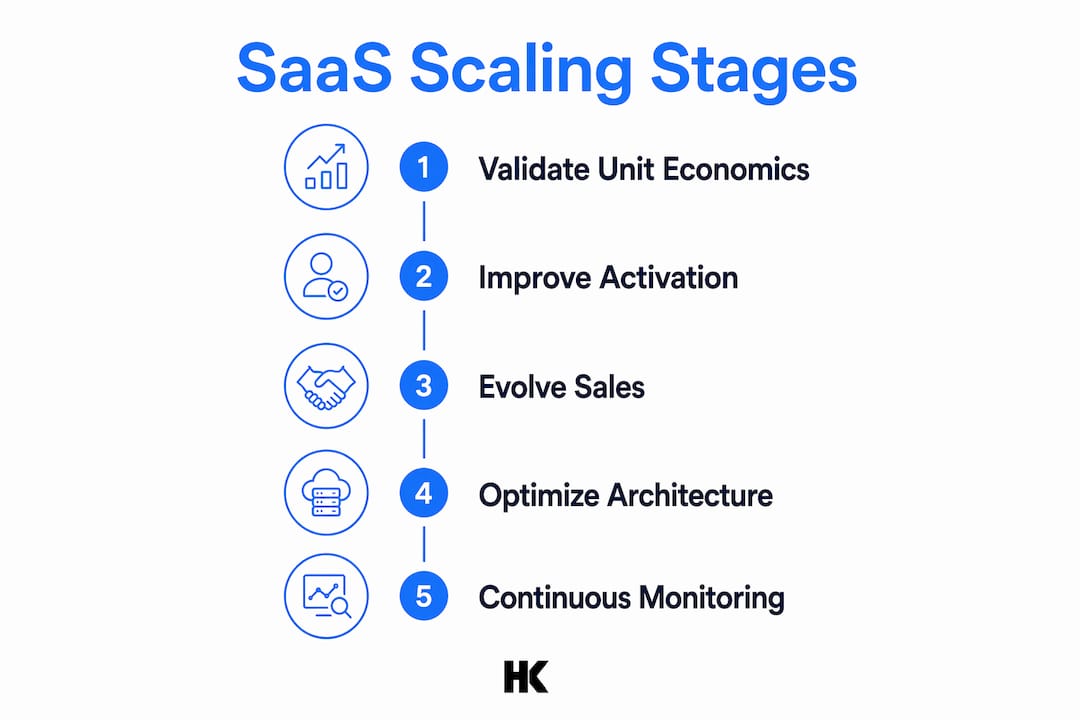
Scaling a SaaS business is defined as growing revenue faster than costs, which requires validated unit economics before any tactical growth effort begins. Most founders skip this step and pay for it. The SaaS CEO playbook frames the single most important quarterly question as: "Do my unit economics support scaling?" If the answer is no, every dollar spent on sales and marketing accelerates losses rather than growth. Three metrics determine scaling readiness: LTV/CAC ratio, CAC payback period, and gross revenue retention. Get these right first, then execute on activation, sales motion, and infrastructure.
How to scale SaaS: the unit economics you must validate first
Scaling on broken unit economics is the most common and most expensive mistake in B2B SaaS. The LTV:CAC ratio benchmark sat at 3.6:1 in 2024, meaning for every euro spent acquiring a customer, the business returns €3.60 in lifetime value. A ratio below 3.0 signals that your acquisition cost is too high, your retention is too low, or both. Scaling at that point multiplies the problem.

CAC payback period tells you how long it takes to recover what you spent to acquire a customer. The median CAC payback period for private B2B SaaS reached 20 months in 2025, up from a historical norm of 12 to 14 months. That 14% rise in new CAC ratio in 2024 means scaling priorities must shift: accelerating payback and protecting retention matter more than simply growing top-of-funnel volume.
Gross revenue retention (GRR) measures how much revenue you keep from existing customers, excluding expansion. A GRR above 90% is the floor for scaling readiness. Below that threshold, you are filling a leaky bucket. Net revenue retention (NRR) above 110% means expansion revenue from existing accounts is actively fueling growth, which is the most capital-efficient growth motion available to a SaaS business.
The Rule of 40 combines revenue growth rate and profit margin. Investors use it to assess whether a SaaS company is balancing growth and efficiency. A score above 40 signals a business worth scaling aggressively. Below 40, the business needs to fix either growth velocity or cost structure before adding fuel.
| Metric | Healthy threshold | What it tells you |
|---|---|---|
| LTV/CAC ratio | Above 3.0 | Acquisition economics are sound |
| CAC payback period | Under 12 months (median: 20 months) | Speed of capital recovery |
| Gross revenue retention | Above 90% | Revenue durability from existing base |
| Net revenue retention | Above 110% | Expansion is driving compounding growth |
| Rule of 40 | Above 40 | Growth and efficiency are balanced |
Pro Tip: Run this unit economics check every quarter, not just at fundraising time. A CAC payback period creeping from 14 to 20 months is a signal to fix acquisition efficiency before it becomes a scaling blocker.
What activation improvements actually do to your retention numbers
Activation is the moment a new user experiences the core value of your product for the first time. This is the "aha moment," and it is the highest-leverage point in your entire growth funnel. Users who hit the week-1 aha moment retain at 60 to 70% at Day 30. Users who miss it retain at 15 to 20%. That is a 3 to 4x retention difference driven entirely by early product experience.
The challenge is that most teams guess at what their activation event is. The correct method is retention-separation testing: run multiple candidate activation actions through cohort analysis and identify which action produces the widest gap in Day-30 retention between users who completed it and those who did not. The action must also have meaningful adoption, around 30% of new users completing it, to qualify as a true activation signal rather than a vanity metric.
Timing is the other critical variable. If a new B2B SaaS user doesn't activate within 3 days, the probability they ever activate drops by 68%. This means onboarding sequences that drip content over two weeks are structurally broken. The goal is to compress time-to-value as aggressively as possible.
Here are the four highest-impact tactics for improving activation rates:
- Pre-built templates. Give new users a working example of the product's core output on day one. A project management tool that shows a populated board beats an empty canvas every time.
- Skip buttons and progressive disclosure. Force users toward the aha moment by hiding non-essential setup steps. Let them skip profile completion, billing details, and integrations until after they have experienced value.
- Behavioral email triggers. Send onboarding nudges based on what users did or did not do, not on calendar days. A user who opened the app but did not complete step two needs a different message than one who never logged in.
- Human-in-loop nudges. For B2B SaaS with ACV above €5,000, a short personal message from a customer success manager at day two or three, triggered by incomplete activation, consistently outperforms automated sequences.
Early warning triggers matter too. Churn prevention starting at day 31 engagement drops, rather than at cancellation, gives you a recovery window. Waiting for a cancellation request is too late.
Pro Tip: Measure median time-to-value in hours, not days. If your median new user takes 72 hours to reach the aha moment, your activation rate will be structurally limited regardless of how good your product is.
How sales motion must evolve as your ARR grows
Sales organization design is not a one-time decision. It is a function of ARR stage, and the right motion at €500k ARR is wrong at €5M ARR. Early-stage SaaS runs on founder-led outbound, where the founder closes every deal and learns what actually resonates. By €1M to €3M ARR, the first sales hire needs a documented playbook, not just shadowing calls. By €5M to €10M ARR, the business needs RevOps, a defined ICP, and a repeatable qualification process.
The most instructive recent example of sales evolution at scale is Anthropic. After rebuilding its sales organization from scratch when demand surged, 54% of new enterprise logos came through a self-serve funnel that included real enterprise contract terms. This is not a product-led growth story for SMB. It is enterprise self-serve at scale, which requires legal, deal desk, RevOps, billing, and compliance workflows baked directly into the funnel infrastructure.
The supporting functions are where most scaling efforts break down. Sales headcount grows, but legal review becomes a bottleneck. Billing cannot handle custom contract structures. Compliance sign-off adds three weeks to every enterprise deal. Scaling these functions in parallel with sales is not optional.
AI tools play a specific and practical role in this evolution:
- Forecasting accuracy. AI-assisted pipeline analysis reduces forecast variance without replacing CRM workflows in tools like Salesforce or HubSpot.
- Rep coaching. Documenting top-performing rep techniques as AI-driven "Skills" accelerates new hire ramp time from months to weeks.
- Competitive intelligence. Real-time battlecard updates based on deal notes and call transcripts keep reps current without manual research.
- Customer follow-up automation. Post-meeting summaries and next-step emails generated from call recordings reduce rep administrative load.
"Don't rip and replace your sales stack to add AI. Use AI as connective tissue inside the systems your team already uses. Anthropic used Claude this way, enhancing existing workflows rather than rebuilding them." — Anthropic's sales org rebuild
Using Slack or Microsoft Teams as the front door for legal, deal desk, and compliance requests cuts deal cycle times by removing email queues. This is a process change, not a technology purchase.
What architecture decisions determine your cost at 10x scale
Product architecture is a scaling decision, not just a technical one. The choice between multi-tenant and single-tenant architecture directly determines your infrastructure cost per customer at scale. Multi-tenant architecture shares compute and database resources across all customers, which means a 10x increase in users does not require a 10x increase in infrastructure spend. Single-tenant architecture provisions separate environments per customer, which is expensive to operate and difficult to automate at volume.
| Architecture | Cost at 10x scale | Best fit |
|---|---|---|
| Multi-tenant | Low. Shared resources scale efficiently | SMB and mid-market SaaS |
| Single-tenant | High. Per-customer provisioning multiplies costs | Enterprise with strict data isolation requirements |
| Hybrid | Moderate. Shared compute, isolated data stores | Enterprise SaaS with GDPR or EU AI Act constraints |
For DACH and EU SaaS companies, the hybrid model is increasingly the default. GDPR and the EU AI Act create data residency and processing requirements that make pure multi-tenant architectures legally complex for certain customer segments. EU-resident inference and GDPR-aware data architecture are not optional features for this market.
Infrastructure budget should be tracked as a percentage of revenue. A common benchmark is 8 to 15% of ARR for infrastructure at growth stage. If cloud costs are consuming 25% or more of revenue, the architecture or the cloud cost management practice needs attention. AWS cost optimization, including reserved instance planning and right-sizing, is a direct lever on gross margin. You can find detailed approaches to AWS cost management that apply directly to SaaS infrastructure at scale.
Continuous monitoring matters as much as initial architecture choices. A SaaS product that runs efficiently at €1M ARR will develop cost inefficiencies at €5M ARR if nobody is actively managing resource utilization. Assign infrastructure cost ownership to an engineer, not just a finance team.
Key takeaways
Scaling SaaS requires validated unit economics, compressed time-to-value, stage-appropriate sales motions, and architecture that keeps gross margin intact as customer count grows.
| Point | Details |
|---|---|
| Validate unit economics first | LTV/CAC above 3.0 and CAC payback under 12 months are prerequisites, not goals. |
| Compress time-to-value | Users who activate within 3 days are 68% more likely to stay. Cut onboarding to hours, not weeks. |
| Scale supporting functions with sales | Legal, RevOps, billing, and compliance bottlenecks kill deal velocity faster than headcount shortages. |
| Use AI inside existing workflows | AI enhances forecasting, coaching, and follow-up without replacing your CRM or sales stack. |
| Match architecture to growth stage | Multi-tenant keeps infrastructure costs low at scale; hybrid is often required for EU compliance. |
What I've learned from building and scaling SaaS products end-to-end
The founders I see struggle most with scaling are not the ones with bad products. They are the ones who start scaling before the math works. They hire two sales reps, run paid acquisition, and then wonder why burn is accelerating without proportional ARR growth. The answer is almost always a CAC payback problem that existed before the scaling effort started.
The activation funnel is consistently underestimated. Most teams spend months on feature development and days on onboarding. That ratio should be closer to equal. A 3 to 4x retention difference between activated and non-activated users means your activation funnel is worth more to your growth rate than most features on your roadmap.
On sales organization evolution: the mistake I see repeatedly is hiring sales leadership too early and giving them too much autonomy before the playbook is documented. The first sales hire should be executing a founder-tested process, not inventing one. Premature delegation of sales strategy is how companies lose the institutional knowledge that made early deals close.
AI integration in sales and marketing workflows is real and practical in 2026, but only when it is specific. "Use AI for sales" is not a strategy. Using Claude or a fine-tuned model to generate post-call summaries, update CRM fields, and flag at-risk accounts based on engagement signals is a strategy. The specificity is what makes it work.
Finally, pricing power and retention are more connected than most founders realize. Customers who got to the aha moment fast, who use the product deeply, and who see measurable ROI will accept price increases. Customers who never fully activated will churn at the first renewal friction. Fix activation, and pricing power follows.
— Hanad
Scale your SaaS with the right technical foundation
If your SaaS product is growing but your infrastructure costs, onboarding flows, or codebase are becoming a drag on that growth, that is an engineering problem with a concrete solution. Hanadkubat works directly with B2B SaaS founders and CTOs in the DACH region and internationally to fix fragile architectures, ship production-ready AI features, and build the technical foundation that makes scaling cost-effective. With engineering experience from BMW, Deutsche Bahn, and Bundesrechenzentrum Austria, and a direct partnership model where you work with the engineer writing the code, the work gets done in weeks. See the scaling and rescue engagements at hanadkubat.com to find the right starting point for your stage.
FAQ
What unit economics must be healthy before scaling SaaS?
LTV/CAC above 3.0, CAC payback under 12 months, and gross revenue retention above 90% are the three prerequisites. Scaling before these thresholds are met increases losses rather than growth.
How does activation rate affect SaaS retention?
Users who reach the product's core value moment in week one retain at 60 to 70% at Day 30, compared to 15 to 20% for those who do not. That gap makes activation the highest-leverage retention lever available.
What is the right sales motion for early-stage SaaS?
Founder-led outbound with a documented close process is the correct motion below €1M to €2M ARR. Hiring sales reps before the playbook is proven and repeatable results in wasted headcount and lost institutional knowledge.
When does multi-tenant architecture become a scaling advantage?
Multi-tenant architecture keeps infrastructure costs low as customer count grows because shared resources do not scale linearly with users. For EU SaaS companies, a hybrid model with isolated data stores is often required to meet GDPR and EU AI Act requirements.
How should AI tools be integrated into a SaaS sales organization?
AI works best as an enhancement to existing CRM and sales workflows, handling forecasting, call summaries, competitive intelligence, and at-risk account flagging. Replacing existing tools is rarely necessary and often counterproductive.