

TL;DR:
- Scalability in SaaS ensures platforms can grow and maintain performance without costly rewrites. Addressing workload, tenant, and organizational dimensions prevents bottlenecks and supports long-term growth. Effective architecture, like stateless design and proper tenant isolation, underpins durable, high-performance SaaS platforms.
Scalability in SaaS is defined as a platform's ability to grow its capacity and performance as demand increases without costly disruptions or degraded user experience. For CTOs and founders, why scalability matters in SaaS comes down to survival: platforms that cannot handle growth either lose customers to downtime or face expensive architectural rewrites. Scalability operates across three distinct dimensions — workload, tenant isolation, and organizational structure — and failing to address all three creates compounding problems as user counts climb. The risks are concrete: performance bottlenecks, noisy neighbor effects between customers, and engineering teams that grind to a halt as codebases grow tightly coupled.
Why scalability matters in SaaS: the three dimensions you must address
Most technical leaders think about scalability as a server capacity problem. It is actually three separate problems that interact.
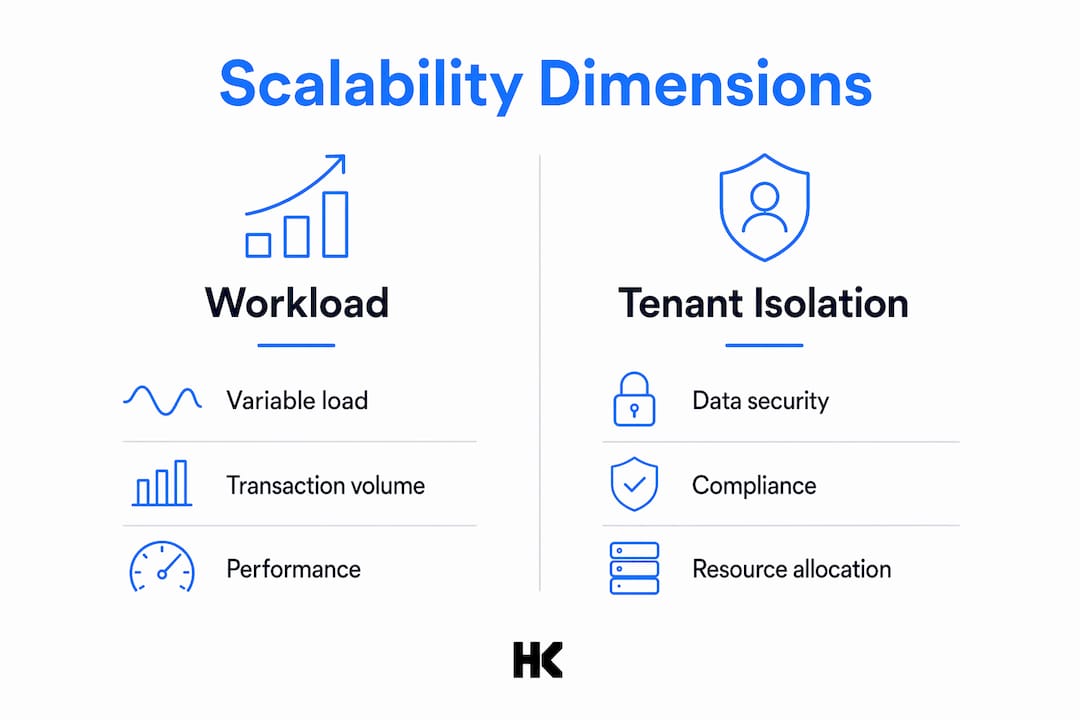
Workload scalability covers the platform's ability to handle variable traffic and transaction volumes without performance degradation. A B2B SaaS product serving 50 customers behaves very differently from one serving 5,000. Database query times, API response latency, and background job throughput all degrade under load if the architecture was not designed to distribute work horizontally.
Tenant scalability addresses how well the platform isolates customers from each other. Noisy neighbor effects occur when one tenant's heavy usage degrades performance for others sharing the same infrastructure. AWS engineering teams discovered this directly when scaling to one million Lambda functions: per-tenant account isolation prevents quota exhaustion and cascading failures that shared architectures cannot avoid.
Organizational scalability is the dimension most founders ignore until it hurts. Tightly coupled codebases create engineering bottlenecks once teams grow beyond 5–10 developers. When every deployment requires coordinating across the full codebase, release velocity drops and feature delivery slows. Architectural choices directly shape how independently teams can build and ship.
- Workload scalability: horizontal distribution of compute and database load
- Tenant scalability: isolation strategies that prevent cross-customer interference
- Organizational scalability: modular design that lets teams deploy without coordination overhead
Pro Tip: Map which of the three dimensions is your current bottleneck before investing in infrastructure. Most teams spend money on compute when the real constraint is schema design or team coordination.
Elasticity and scalability are related but distinct. Elasticity handles short-term load spikes by automatically adjusting resources. Scalability prepares the system for predictable long-term growth. Both are required for cost-effective SaaS operations, but they call for different architectural decisions.
What architectural patterns actually support SaaS growth?
Architecture is where scalability decisions get made or deferred. The patterns below represent the practical toolkit for SaaS platforms in 2026.

Stateless design and the Twelve-Factor App
Stateless application design means each request carries all the context it needs. No session state stored in memory. This single constraint makes horizontal scaling trivial: add more instances and a load balancer distributes traffic without sticky sessions or shared memory complications. The Twelve-Factor App methodology codifies this and related principles into a concrete checklist for production-grade SaaS.
Multi-tenancy models
Three models dominate B2B SaaS:
- Shared schema: All tenants share tables, distinguished by a tenant ID column. Lowest infrastructure cost, highest isolation risk.
- Schema per tenant: Each tenant gets a dedicated schema within a shared database. Moderate isolation, manageable at hundreds of tenants.
- Isolated database per tenant: Full separation. Highest cost, strongest compliance posture. Required for regulated industries under GDPR or sector-specific frameworks.
The right model depends on your customer base size, contract terms, and compliance obligations. DACH enterprise customers frequently require data residency guarantees that push toward isolated databases.
Microservices versus modular monoliths
Industry experts in 2026 caution against defaulting to microservices. Modular monoliths better balance complexity and scalability for most SaaS startups. Split services only when organizational or technical limits are genuinely reached, not because microservices sound architecturally mature.
Database scaling techniques
Most database scalability problems come from improper schema design and missing indexes, not insufficient hardware. A single well-placed index can reduce query time from ten seconds to ten milliseconds. Cloud-managed databases handle failover and provisioning automatically. They do not fix schema design. Read replicas, caching layers, and eventual sharding are tools for later. Get the schema right first.
Infrastructure as Code and container orchestration
Automation and Infrastructure as Code enable consistent, repeatable provisioning and reduce human error during scaling events. Kubernetes facilitates horizontal scaling of service instances and has become the standard orchestration layer for production SaaS on AWS, GCP, and Azure.
Pro Tip: Treat your infrastructure configuration as code from day one. Retrofitting IaC onto a manually provisioned environment costs more than building it correctly at the start.
What are the hardest scalability challenges in SaaS?
Knowing the patterns is not enough. The challenges that actually derail SaaS platforms at scale are worth naming directly.
- Schema debt: Teams ship features fast and skip proper indexing. Query performance degrades gradually, then suddenly. By the time it becomes visible, the fix requires a migration on a live database with paying customers.
- Noisy neighbor effects: Without per-tenant isolation, one customer's batch job can degrade response times for everyone else. This is a support and churn problem, not just a technical one.
- Premature microservices: Splitting a monolith too early adds distributed systems complexity, network latency between services, and operational overhead before the team has the maturity to manage it. The result is slower delivery and higher infrastructure cost with no performance benefit.
- Observability costs: Real-time monitoring is non-negotiable for identifying bottlenecks early. At scale, logging, tracing, and metrics infrastructure becomes expensive. Teams that instrument everything without cost controls end up with bloated observability bills.
- API governance gaps: Without centralized API management, microservice proliferation leads to inconsistent security policies and monitoring blind spots. This is a compliance risk in EU-regulated environments.
- Team coordination overhead: Engineering teams that outgrow their codebase structure spend more time on coordination than on shipping. This is an organizational scalability failure with direct revenue consequences.
Pro Tip: Run a quarterly architecture review focused specifically on where team coordination is slowing delivery. The bottleneck is rarely where engineers assume it is.
How does scalability impact SaaS business growth and customer experience?
Scalability is not a technical concern that sits separate from business outcomes. The connection is direct and measurable.
A platform that degrades under load loses customers. B2B SaaS buyers in the DACH market sign multi-year contracts with SLA expectations. Performance failures trigger support escalations, contract reviews, and churn. Scaling a SaaS platform affects customer support, onboarding, and security compliance simultaneously. Failure to scale internal teams and processes degrades customer experience even when the technical infrastructure holds.
Elasticity reduces infrastructure cost during low-traffic periods. A platform that scales down automatically during off-peak hours pays for compute only when it needs it. This matters for unit economics, particularly for early-stage SaaS companies managing burn rate.
"Scalability is as much an organizational challenge as a technical one. Architectural choices shape how teams can deploy and innovate independently. A platform that cannot scale its engineering process will hit a ceiling regardless of how much infrastructure it adds."
Rapid feature delivery is a competitive advantage that depends on organizational scalability. Teams that can deploy independently ship faster. Faster shipping means earlier customer feedback and shorter iteration cycles. This compounds over time into a meaningful product lead over competitors who are still coordinating deployments across a monolithic codebase.
SaaS platforms that build scalable growth strategies into their operations from the start avoid the expensive replatforming cycles that consume engineering capacity and delay roadmap execution.
Best practices for CTOs and founders building scalable SaaS
The following sequence reflects how a successful scalability strategy balances immediate needs with long-term preparedness without overengineering.
- Design the database schema carefully before writing application code. Index the columns you will query. Model tenant relationships explicitly. This is the highest-leverage decision in the entire stack.
- Start with a modular monolith. Clear module boundaries and well-defined interfaces give you the option to extract services later without rewriting from scratch.
- Implement tenant isolation appropriate to your compliance requirements. GDPR-regulated B2B SaaS in the EU often requires schema or database-level isolation from the first enterprise customer.
- Adopt Infrastructure as Code from day one. Terraform or Pulumi configurations checked into version control make environment replication and scaling events repeatable and auditable.
- Instrument observability early, but set cost budgets. Structured logging, distributed tracing, and key metrics dashboards are non-negotiable. Unconstrained observability spend is avoidable.
- Align team structure with your architecture. Conway's Law is real: the system you build will reflect the communication structure of the team that builds it. Design both together.
- Review your SaaS architecture plan at each growth stage. What works at 100 customers breaks at 1,000. Schedule the review before you hit the wall, not after.
Pro Tip: The best time to address scalability is during the initial architecture phase. The second-best time is before your next major customer acquisition push, not during it.
Key Takeaways
A SaaS platform that cannot scale its workload, tenant isolation, and organizational structure will hit a ceiling that no amount of infrastructure spend can fix.
| Point | Details |
|---|---|
| Scalability has three dimensions | Workload, tenant isolation, and organizational structure must all be addressed for long-term platform health. |
| Schema design beats hardware | Most database performance problems come from missing indexes, not insufficient compute capacity. |
| Modular monoliths first | Start with a well-structured monolith and extract services only when organizational or technical limits require it. |
| Observability needs cost controls | Instrument early, but set spending budgets before observability infrastructure becomes a significant cost center. |
| Organizational scaling is technical | Team structure and architectural choices are inseparable; Conway's Law shapes the system you build. |
The case against premature complexity
The most common mistake I see in SaaS architecture engagements is founders treating scalability as a prestige signal rather than a practical constraint. They adopt Kubernetes before they have ten customers. They split into microservices before the team has five engineers. They instrument every metric before they know which metrics matter.
I have worked on infrastructure at BMW, Deutsche Bahn, and Bundesrechenzentrum Austria. Large-scale systems at those organizations were not complex because complexity was the goal. They were complex because the problem genuinely required it, and that complexity was managed through discipline, not enthusiasm.
The SaaS founders who build the most durable platforms are the ones who treat early technical decisions as constraints to be respected, not problems to be solved with the most sophisticated tool available. Get the schema right. Keep the codebase modular. Isolate tenants appropriately. Add complexity only when the evidence demands it.
Scalability is a discipline, not an architecture style. The teams that internalize that distinction ship faster, spend less on infrastructure, and retain customers longer.
— Hanad
Scalable SaaS architecture, built with engineering discipline
Hanadkubat works directly with B2B SaaS CTOs and founders in the DACH region and internationally to build platforms that handle growth without expensive rewrites. The work covers SaaS MVP development from €18,000, rescue and scale engagements for fragile codebases from €4,500, and AI integration sprints shipped in two weeks. Every engagement is a direct partnership: the engineer writing the code is the person you talk to. If your platform is approaching a scalability ceiling or you are building from scratch and want the architecture done correctly the first time, explore Hanadkubat's services and see how the approach fits your stage.
FAQ
What is scalability in SaaS?
Scalability in SaaS is the ability of a platform to grow its capacity and performance as user demand increases without requiring costly architectural rewrites or causing service degradation. It covers workload handling, tenant isolation, and organizational structure.
Why do SaaS platforms fail to scale?
Most SaaS scalability failures trace back to poor database schema design, missing indexes, and tightly coupled codebases rather than insufficient infrastructure. Organizational bottlenecks and premature microservices adoption also contribute significantly.
What is the difference between scalability and elasticity in SaaS?
Elasticity handles short-term load fluctuations by automatically adjusting resources up or down. Scalability prepares the system for predictable long-term growth. Both are required for reliable and cost-effective SaaS operations.
When should a SaaS startup adopt microservices?
A SaaS startup should adopt microservices only when organizational or technical limits of a modular monolith are genuinely reached. Premature adoption increases operational complexity and cost without delivering performance benefits.
How does tenant isolation affect SaaS performance?
Without proper tenant isolation, one customer's heavy usage degrades performance for all others sharing the same infrastructure. Per-tenant account or database isolation prevents noisy neighbor effects and is particularly important for B2B SaaS serving enterprise customers under GDPR or sector-specific compliance requirements.