

TL;DR:
- Early technical decisions determine a SaaS product’s long-term scalability, costs, and team velocity, with corrections becoming exponentially more expensive over time.
- Documenting architectural choices early using ADRs and conducting regular reviews helps avoid costly rewrites and preserves institutional knowledge.
Early technical decisions are architectural and business choices that define a SaaS product's scaling ceiling, operational costs, and team velocity for years after the initial build. The gap between getting these choices right at month one versus correcting them at month eighteen is not incremental. Late-stage rework costs 10 to 100 times more than making the correct choice upfront. Tools like Auth0 and Algolia feel frictionless on day one, but the vendor contracts you sign and the data models you sketch in week two become the migration projects you fund in year three. Understanding why early technical decisions matter is the difference between a product that scales and one that gets rewritten.
Why early technical decisions matter more than any later choice
Every technical decision in a SaaS product carries a compounding cost structure. The earlier a decision is made, the more code, processes, and team habits grow on top of it. By the time a bad choice surfaces as a real problem, it is load-bearing.

Architectural thinking before you build prevents expensive rewrites years later. A few days spent evaluating database options, auth patterns, or API design before writing production code can eliminate months of refactoring at Series A. That asymmetry is the core argument for investing in architecture early.
The most common example is database selection. A startup that chooses a document store like MongoDB for a product that later requires complex relational queries faces a painful migration. Switching from a document model to PostgreSQL at scale means rewriting data access layers, migrating production data, and retesting every query path. None of that work ships features. All of it burns engineering time that could have been avoided with a two-day evaluation at the start.
Technical debt accumulates silently. Teams add workarounds, then workarounds for the workarounds. What starts as a shortcut in the data model becomes a constraint on every new feature. The impact of initial tech choices on development velocity is not theoretical. It shows up as sprint velocity declining, onboarding time for new engineers increasing, and incident rates rising as the system grows more fragile.
Pro Tip: Track your architecture decisions in the same repository as your code. When a new engineer asks why a choice was made, the answer should be one git blame away, not buried in someone's memory.
How to differentiate strategic technical debt from accidental architectural debt
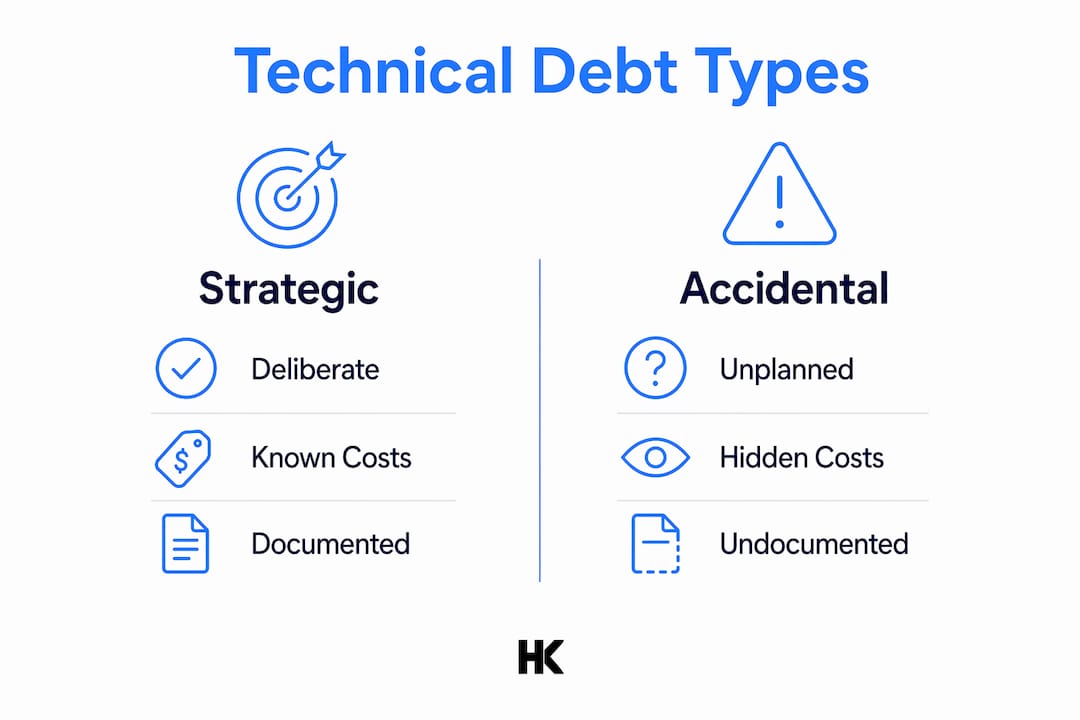
Not all technical debt is equal. The distinction that matters most for B2B SaaS decision-makers is between strategic technical debt and accidental architectural debt.
Strategic technical debt involves deliberate shortcuts with known future costs. You take them consciously, document them, and plan to address them. Accidental architectural debt is different. It is the invisible constraint that accumulates when no one recognized a decision was being made at all.
| Type | Definition | Example | Reversibility |
|---|---|---|---|
| Strategic technical debt | Deliberate shortcut with documented tradeoff | Skipping pagination on an internal admin view | High, if documented |
| Accidental architectural debt | Hidden constraint from an unexamined choice | Storing user permissions in a flat JSON blob | Low, requires data migration |
The clearest example of this distinction is the monolith versus microservices debate. A well-structured monolith with clean modular boundaries outperforms premature microservices for early-stage SaaS. A monolith can be split into services later. Early microservices are nearly impossible to merge back once teams and deployment pipelines are organized around them. Choosing microservices at ten engineers because it "feels more scalable" is accidental architectural debt disguised as ambition.
Certain decisions must be built correctly from day one because reversing them later is prohibitively expensive:
- Data model design. The shape of your core entities determines query performance, reporting capability, and integration complexity. Changing it at scale requires migrations across every environment.
- Auth architecture. For fintech or healthtech SaaS, security architecture built wrong from day one creates devastating risks during due diligence and costly remediations that delay fundraising.
- Multi-tenancy model. Whether you use shared schemas, separate schemas, or separate databases per tenant affects compliance, performance isolation, and pricing model flexibility for the life of the product.
The practical implication for fundraising is direct. Investors at Series A conduct technical due diligence. A codebase with documented, intentional tradeoffs reads as mature engineering judgment. A codebase with undocumented shortcuts and no architectural rationale reads as risk.
What are common pitfalls in early vendor and technology choices?
Vendor selection is where the importance of early tech decisions gets most consistently underestimated. The evaluation criteria at week one are almost always wrong.
Startup engineers prioritize speed and developer experience at launch, ignoring operational and migration costs that compound over time. Auth0 has excellent documentation and a generous free tier. Algolia has a five-minute search integration. Both are legitimate choices. The problem is that neither is evaluated for what happens when you outgrow the entry tier.
Auth0 prices increased 300% on certain plans while usage grew modestly. That is not a pricing anomaly. It is a predictable outcome of vendor lock-in. Once your authentication logic, user management flows, and social login integrations are built around a single provider, switching costs are measured in engineering weeks, not hours.
Before committing to any third-party vendor, work through these four questions:
- What does data export look like? Can you get all your data out in a standard format, or does the vendor own the schema?
- What is the realistic migration cost? Estimate it in person-weeks. If you cannot estimate it, that is your answer.
- What happens to pricing at 10x your current usage? Model the cost at your 18-month growth target before signing.
- Who owns this vendor relationship internally? Every vendor decision needs an owner who reviews it annually.
The exit cost evaluation is the step most teams skip entirely. Documenting the migration cost estimate at the time of selection creates accountability and prevents the "we're too deep to switch" trap from forming silently.
Pro Tip: When evaluating a vendor, write a one-page migration plan before you integrate. If you cannot write it, the lock-in risk is higher than you think.
What best practices help SaaS teams make better early technical choices?
The goal is not to make perfect decisions. It is to make reversible ones where possible and to document irreversible ones clearly.
Architecture Decision Records, known as ADRs, are the most practical tool for this. ADRs stored in code repositories near the affected code document the problem, constraints, alternatives considered, and consequences of each significant choice. They create institutional knowledge that survives team turnover and gives future engineers the context to challenge or extend decisions intelligently.
Time-boxed proof of concepts are the second practice worth building into your process. Before committing to a new technology or architecture pattern, run a focused spike against your riskiest assumption. Not a full implementation. A targeted test that answers one question: does this approach hold under the conditions we actually expect? Two days of spiking a search solution against your real data volume beats two weeks of integration followed by a performance crisis.
"The goal of early architecture work is not to predict the future. It is to preserve your options as long as possible while moving fast enough to learn what actually matters."
Maintaining a technology radar with quarterly architecture reviews prevents two failure modes: reckless adoption of new tools and stagnation with outdated ones. A quarterly review asks whether the decisions and assumptions from the last cycle still hold given actual system performance and current business priorities. It also updates ADRs to reflect what was learned.
The final practice is designing escape hatches into every significant integration. Wrap third-party services behind your own abstraction layer. Keep your core business logic independent of any specific vendor's API shape. This does not eliminate migration cost, but it reduces it from a full rewrite to a targeted swap. For a deeper look at scaling SaaS architecture across growth stages, the stage-by-stage playbook covers how these practices evolve from MVP to post-Series A.
Key takeaways
Early technical decisions function as architectural contracts that constrain or enable every product and business decision that follows.
| Point | Details |
|---|---|
| Cost asymmetry is real | Fixing a foundational choice at month 18 costs 10 to 100 times more than getting it right at month 1. |
| Debt type determines risk | Strategic technical debt is manageable when documented; accidental architectural debt compounds invisibly and slows every sprint. |
| Vendor lock-in starts at week one | Evaluate exit costs and migration effort before integrating any third-party service, not after you are dependent on it. |
| ADRs preserve institutional knowledge | Documenting decisions in the code repository prevents costly context loss when team composition changes. |
| Quarterly reviews prevent drift | Architecture assumptions must be validated against actual system behavior and business priorities every quarter. |
What I have learned building SaaS products from scratch
I have built and shipped SaaS products end-to-end, and the pattern I see most often is not recklessness. It is optimism. Teams make early choices that are perfectly reasonable for the product they have today, without modeling what those choices cost at 10x the current load or 3x the current team size.
The most expensive project I have seen was a B2B SaaS product that chose a flat, denormalized data model to ship fast. It worked fine at 50 customers. At 400 customers with enterprise reporting requirements, every new report required a custom data pipeline because the model could not support joins at the granularity the business needed. The rewrite took four months and delayed two major feature releases. The original decision took about 20 minutes.
What I tell every founder and CTO I work with is this: the decisions that feel small in week two are the ones that define your engineering roadmap in year two. Auth architecture, data model shape, multi-tenancy approach, and core vendor dependencies are not implementation details. They are product strategy. The technical debt that accumulates from treating them as implementation details is the most expensive kind because it was never budgeted.
The fix is not to slow down. It is to spend two focused days on architecture before writing production code, document the tradeoffs you are accepting, and build the habit of revisiting those documents quarterly. That practice, consistently applied, is worth more than any specific technology choice.
— Hanad
Get an expert review of your SaaS architecture
If your product is approaching a growth inflection point or your team is spending more time on workarounds than features, the architecture choices made in the early stages are worth examining now rather than after a painful incident.
Hanadkubat offers fixed-price architecture review and rescue engagements for B2B SaaS teams in the DACH region and internationally. The process is direct: you work with the engineer reviewing your codebase, not a project manager summarizing someone else's findings. A SaaS architecture review identifies the decisions that are limiting your velocity and produces a prioritized plan for addressing them. Engagements start at €4,500 and are scoped before any commitment. See current service tracks and pricing at hanadkubat.com.
FAQ
Why do early technical decisions matter more than later ones?
Early decisions become load-bearing as code, processes, and integrations build on top of them. Changing a foundational choice at month 18 costs 10 to 100 times more than making the right call at month one.
What is the difference between strategic and accidental technical debt?
Strategic technical debt is a deliberate shortcut with a documented tradeoff and a plan to address it. Accidental architectural debt is an invisible constraint that forms when no one recognized a significant decision was being made, and it compounds without a clear remediation path.
How do Architecture Decision Records help SaaS teams?
ADRs document the problem, constraints, alternatives, and consequences of each significant technical choice. Stored in the code repository, they preserve institutional knowledge across team changes and give future engineers the context to challenge or extend decisions.
What should you evaluate before committing to a third-party vendor?
Assess data exportability, realistic migration cost in person-weeks, pricing at 10x current usage, and internal ownership of the vendor relationship. Ignoring exit costs at selection time is the most common cause of costly migrations at the growth stage.
When should a SaaS startup choose a monolith over microservices?
For most early-stage SaaS teams, a well-structured monolith with clean modular boundaries is the better starting point. A monolith can be decomposed into services later; early microservices are operationally expensive and nearly impossible to consolidate once team structure forms around them.