

TL;DR:
- Planning SaaS architecture involves choosing a hybrid tenancy model and separating control and data planes from the start. These decisions ensure scalability, compliance, and AI integration without costly re-platforming. Early architectural choices shape long-term cost, flexibility, and operational efficiency.
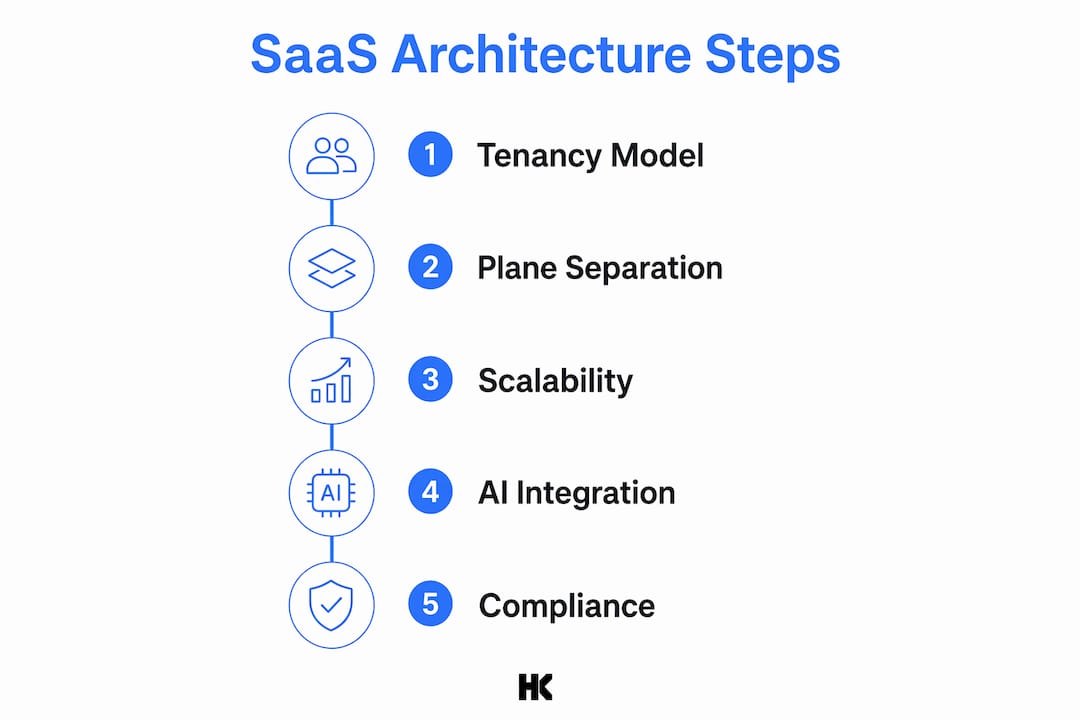
Planning SaaS architecture is the process of designing software and infrastructure to support multi-tenant applications that scale, stay compliant, and integrate AI features without breaking under load. The decisions you make before writing a single line of code determine whether your platform handles 10 tenants or 10,000. In 2026, the industry standard for enterprise-ready SaaS design is the hybrid tenancy model, paired with a strict separation of control plane and data plane. Get these two decisions right early, and every other architectural choice becomes easier. Get them wrong, and you will pay for it in costly re-platforming later.
How to plan SaaS architecture: the foundational decisions
SaaS architecture planning starts with three non-negotiable decisions: your tenancy model, your plane separation strategy, and your scalability approach. These three choices shape every downstream decision, from data partitioning to compliance posture to how you onboard enterprise clients.

The term "SaaS architecture" is sometimes used loosely to mean any cloud-hosted app. The industry standard term is software as a service architecture, which specifically describes multi-tenant platforms where infrastructure is shared across customers but data and access are isolated per tenant. That distinction matters because it drives your entire design.
Most teams underestimate how early these decisions need to be made. A tenancy model chosen at month three is far cheaper to implement than one retrofitted at month eighteen, when you already have paying customers on a shared database.
What is scalable SaaS architecture and how does it affect your design?
Scalable SaaS architecture is not about adding more servers when traffic spikes. True scalability is architectural, embedded in tenant isolation, data distribution, and policy enforcement rather than raw infrastructure resources. Adding compute to a poorly designed system often amplifies existing bottlenecks rather than resolving them.
The Software Architecture Guild draws a clear line between performance and scalability. Performance measures speed for a single operation. Scalability measures whether that speed holds as workload grows. A system can be fast at 100 requests per second and collapse at 1,000. That is a scalability failure, not a performance failure.
Scalability also has an operational dimension that most architecture guides ignore. Operational scalability means your engineering team can build, test, and deploy independently without coordinating every release across the entire codebase. This is as vital as system throughput. A monolith that requires full-team deploys will slow your product velocity long before it hits infrastructure limits.
The architectural pillars that support scalable SaaS design are:
- Multi-tenancy with tenant isolation. Shared infrastructure, separated data. The model you choose determines your compliance ceiling.
- Microservices. Independent services that can be scaled, deployed, and updated without touching the rest of the system.
- Event-driven design. Asynchronous communication between services reduces tight coupling and prevents cascading failures.
- Data partitioning. Distributing data across shards or isolated databases prevents a single tenant's load from degrading everyone else's experience.
Pro Tip: Design for autonomous team deployment from day one. If shipping a feature requires coordinating three teams and a full regression test, your architecture is already working against you.
How to choose the right tenancy model for your SaaS
The tenancy model is the single most consequential SaaS architecture decision. It determines your cost structure, compliance posture, and how much engineering effort enterprise deals will require.
Three models exist in practice:
| Model | Infrastructure | Compliance fit | Cost |
|---|---|---|---|
| Shared (pooled) | Single DB, row-level isolation | Lower, harder to audit | Lowest |
| Isolated (siloed) | Dedicated DB per tenant | Highest, easiest to audit | Highest |
| Hybrid (bridge) | Pooled for mid-market, dedicated for enterprise | High, flexible | Balanced |
Shared databases with row-level segregation are cost-efficient but offer less isolation. Isolated database models improve compliance but multiply infrastructure costs. The hybrid model maintains a single codebase while deploying pooled or dedicated infrastructure per tenant tier, which optimizes cost and compliance at the same time.
As of mid-2026, the hybrid model is the industry standard for enterprise-ready SaaS. It uses deployment stamps or cell-based architecture to scale via independent stack units rather than enlarging a single instance. Each cell is a self-contained unit: compute, database, and networking. When you need to onboard a new enterprise tenant with dedicated data requirements, you spin up a new cell. You do not touch existing tenants.
The control plane manages tenant provisioning, billing, configuration, and policy enforcement. The data plane handles the actual application workload. Keeping these two planes separate from day one is what makes hybrid tenancy possible without re-platforming. Failure to separate them leads to exactly that: costly migrations when your first enterprise client demands a dedicated database.
- Control plane responsibilities: tenant onboarding, authentication, billing, secrets management, audit logging, policy enforcement.
- Data plane responsibilities: application logic, tenant data storage, query execution, AI inference workloads.
Pro Tip: Build your control plane as a standalone service before you have your first paying customer. The cost of doing it later is not just engineering hours. It is downtime, migration risk, and deals you lose because you cannot meet enterprise data isolation requirements.
How to architect for AI feature integration in SaaS platforms
AI features create specific architectural pressure that generic SaaS design does not anticipate. Inference workloads are compute-intensive, latency-sensitive, and often require access to tenant-specific data. Bolting AI onto a monolith or a tightly coupled microservices system produces fragile, expensive results.
Modular microservices and event-driven systems are the right foundation for AI workloads. Isolating AI services means a spike in inference demand does not degrade your core application. It also means you can update your AI models, swap providers, or adjust cost controls without a full system deployment.
Data locality is the compliance constraint that most teams discover too late. Under GDPR, personal data processed by an AI model must stay within the EU unless specific transfer mechanisms are in place. Under the EU AI Act, high-risk AI systems require documentation, human oversight, and audit trails. Both requirements are architectural, not just legal. Your data pipeline, your inference endpoints, and your logging infrastructure all need to reflect these constraints from the start.
Key architectural practices for AI integration:
- Dedicated AI service layer. Run inference in isolated services with their own scaling policies and cost controls.
- Event-driven data pipelines. Feed tenant data to AI services asynchronously to avoid blocking core application flows.
- API governance. Define rate limits, versioning, and access controls for every AI endpoint. This controls both cost and compliance exposure.
- Observability for AI. Log inputs, outputs, latency, and cost per query. Without this, you cannot detect model drift, cost overruns, or compliance violations.
- EU-resident inference. For GDPR-sensitive workloads, run inference on EU-hosted infrastructure. This eliminates the need for data transfer agreements on every AI call.
How to ensure compliance and security in SaaS architecture planning
Compliance is not a feature you add after launch. It is a set of architectural constraints that shape your data model, your tenancy design, and your control plane from the first sprint.
GDPR requires data residency controls, consent management, and the ability to execute a right-to-erasure request across all tenant data stores. If your data is scattered across a shared database with no tenant-level partitioning, erasure becomes a manual, error-prone process. Isolated or hybrid tenancy models make it a scripted, auditable operation.
The SaaS security checklist for B2B teams covers the control plane requirements in detail. The core requirements are tenant isolation, secrets management, lifecycle management, and auditability within the control plane. Every provisioning action, every configuration change, and every access grant should produce an audit log entry.
Security practices that belong in your architecture plan from day one:
- Secrets management. Use a dedicated secrets store (such as HashiCorp Vault or AWS Secrets Manager) rather than environment variables. Rotate credentials automatically.
- Tenant isolation at the network level. Do not rely solely on application-level checks. Use network policies and separate namespaces or VPCs per tenant tier.
- Policy enforcement in the control plane. Centralize authorization logic. Distributing it across microservices creates gaps.
- Lifecycle management. Define what happens when a tenant offboards: data deletion, credential revocation, and audit trail retention.
For teams building under the EU AI Act, add a risk classification step to your architecture review. The Act categorizes AI systems across risk dimensions, and high-risk classifications require specific technical controls baked into your system design.
What are the critical operational practices and common pitfalls?
The most expensive architectural mistakes are not design errors. They are operational omissions that compound over time.
- Skip the control plane separation. This is the most common and most costly mistake. Without a dedicated control plane, every enterprise deal that requires data isolation becomes a custom engineering project. The fix is always more expensive than the original build.
- Ignore CI/CD from the start. Observability, CI/CD pipelines, and automated deployment controls are not optional at scale. Safe progressive rollouts and feedback loops prevent overload and service degradation. Teams that treat CI/CD as a "later" problem ship slower and break more often.
- Couple services too tightly. Synchronous dependencies between microservices create cascading failures. One slow service brings down the services that depend on it. Event-driven communication breaks this chain.
- Neglect capacity planning. Architectural tactics like concurrency, data partitioning, and managed resources prevent bottlenecks. Tight coupling and global locks cause them. Plan your data access patterns before you choose your database technology.
- Treat monitoring as an afterthought. You cannot debug a production incident in a distributed system without distributed tracing, structured logging, and alerting on business metrics, not just infrastructure metrics.
Pro Tip: Run a staging environment that mirrors production tenancy configuration. Testing against a single-tenant staging setup will not surface the multi-tenant bugs that appear when tenant A's workload affects tenant B.
Key takeaways
Effective SaaS architecture planning requires a hybrid tenancy model, strict control and data plane separation, and operational scalability built in from day one.
| Point | Details |
|---|---|
| Hybrid tenancy is the 2026 standard | Use pooled infrastructure for mid-market tiers and dedicated stacks for enterprise tenants. |
| Separate control and data planes early | A dedicated control plane prevents costly re-platforming when enterprise clients require data isolation. |
| Scalability is architectural, not infrastructural | Tenant isolation, data partitioning, and event-driven design sustain performance under load. |
| AI integration requires dedicated service layers | Isolate inference workloads and enforce API governance to control cost and compliance exposure. |
| Compliance is a design constraint, not a feature | GDPR and EU AI Act requirements shape your data model, tenancy design, and audit logging from sprint one. |
What I have learned building SaaS from the ground up
Every SaaS project I have worked on, from government-grade infrastructure at Bundesrechenzentrum Austria to product builds at BMW and Deutsche Bahn, has confirmed the same pattern: teams that defer the hard architectural decisions pay for them twice. Once in the initial build, and again when a major customer or a compliance audit forces a reckoning.
The tenancy model conversation is the one I push hardest in early engagements. Founders want to talk about features. I want to talk about whether their database schema can support a right-to-erasure request without a week of manual work. That conversation is uncomfortable at week two. It is catastrophic at month eighteen.
My honest view on AI integration: most teams are adding AI features to architectures that were not designed to support them. The result is inference costs that are three to five times higher than they need to be, and compliance exposure that nobody has formally assessed. The fix is not a new tool. It is going back to the architecture and asking whether the data plane can actually support isolated, auditable, EU-resident inference. Usually, the answer requires real structural work.
Build the control plane first. Design for hybrid tenancy even if you only have pooled tenants today. Treat GDPR and the EU AI Act as architecture inputs, not legal footnotes. These are not conservative choices. They are the ones that keep your options open as you grow.
— Hanad
SaaS architecture planning support from Hanadkubat
CTOs and technical founders building B2B SaaS products in the DACH region and EU face a specific combination of pressures: enterprise tenancy requirements, GDPR obligations, and the demand to ship AI features on a timeline that does not allow for architectural rework.
Hanadkubat works directly with SaaS teams on architecture reviews, AI feature integration, and compliance-aware design. Services include fixed-price AI integration sprints (€4,500 for a production-ready feature in two weeks), architecture audits with a prioritized roadmap (€1,500), and full SaaS MVP builds from €18,000. Every engagement is direct: you work with the engineer writing the code, not a project manager. Full service details and pricing are at hanadkubat.com.
FAQ
What is the difference between control plane and data plane in SaaS?
The control plane manages tenant provisioning, billing, authentication, and policy enforcement. The data plane handles application logic and tenant data. Separating them from day one prevents costly re-platforming when enterprise clients require dedicated data isolation.
What tenancy model should a B2B SaaS use in 2026?
The hybrid model is the industry standard for enterprise-ready SaaS. It uses pooled infrastructure for mid-market tenants and dedicated stacks for high-value clients, maintaining a single codebase while meeting varied compliance requirements.
How does GDPR affect SaaS architecture design?
GDPR requires data residency controls, consent management, and the ability to execute right-to-erasure requests across all tenant data stores. These requirements directly shape your tenancy model, data partitioning strategy, and audit logging infrastructure.
How should AI features be integrated into a SaaS platform?
AI workloads belong in dedicated, isolated microservices with their own scaling policies, API governance, and observability. For EU-based SaaS, inference should run on EU-resident infrastructure to avoid GDPR data transfer obligations on every AI call.
What is the most common SaaS architecture mistake?
Failing to separate the control plane from the data plane early. Without this separation, every enterprise deal requiring data isolation becomes a custom engineering project, and the re-platforming cost far exceeds what the original build would have required.