

TL;DR:
- Startup architecture encompasses decisions that impact system scalability, failure handling, and evolution along business growth. It influences investor confidence, team velocity, and compliance readiness from the earliest stages and is crucial for handling traffic surges and expansion. Strong, documented design choices and early planning prevent costly refactors and reinforce trust, aiding faster product delivery and successful funding.
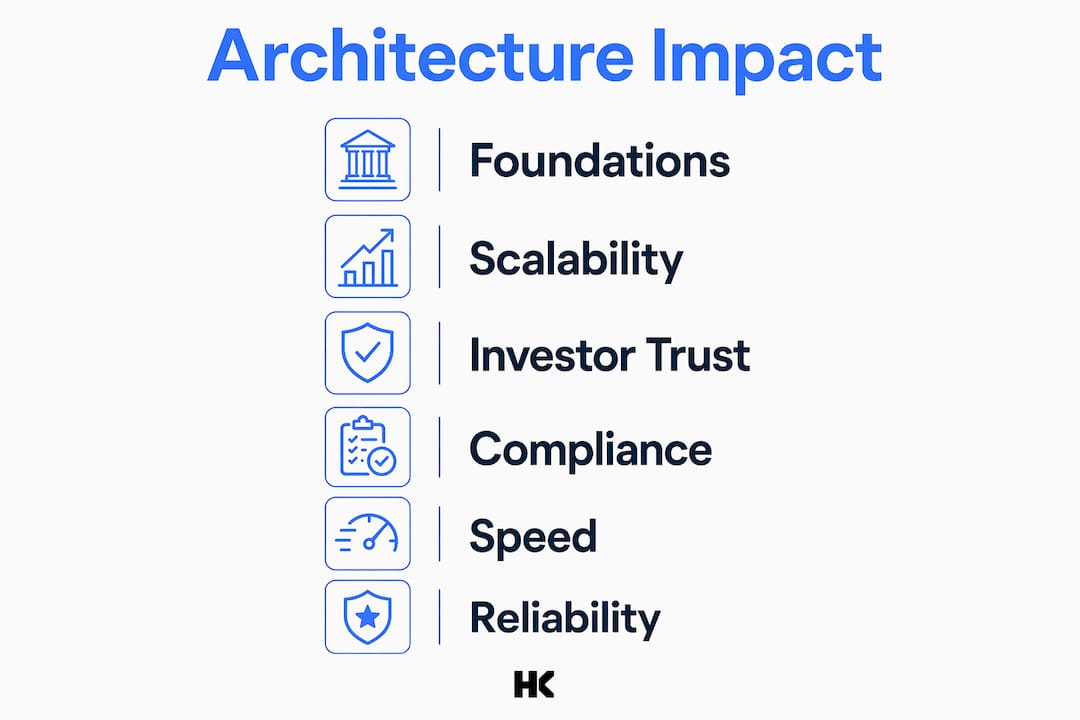
Architecture in startups is defined as the foundational set of decisions that determine how a system scales, fails, and evolves as the business grows. The role of architecture in startups extends far beyond code organization. It shapes investor confidence, team velocity, compliance readiness, and whether a product survives its first real growth spike. Over 70% of Series A and B deals include a formal architectural review as part of technical due diligence. That number tells you architecture is not an engineering concern alone. It is a business concern that founders and technical leaders must treat as seriously as their revenue model.
How does architecture shape startup scalability?
The role of architecture in startups becomes most visible when a product hits its first real traffic surge. Systems built without clear service boundaries or load planning do not just slow down. They break in ways that are expensive and embarrassing to fix under pressure.

The Microsoft Azure Architecture Center describes a practical approach for early-stage teams: extend architecture just in time rather than over-engineering from day one. This means building for the next stage of growth, not the hypothetical tenth stage. The constraint is real. By Series A, investors expect a system that can handle 10x current load and a codebase modular enough to avoid full rewrites. That is a concrete bar, not a vague aspiration.
What makes this hard is the irreversibility of certain decisions. Data models, authentication structures, and service boundaries are the load-bearing walls of a software system. Changing them after scale is exponentially more expensive than getting them right early. A startup that ships a monolithic auth system in week two and hits 50,000 users by month eight faces a painful, multi-sprint refactor at exactly the moment when the team should be shipping features.
Key architectural patterns that support scalability include:
- Modular service boundaries that let teams deploy and scale components independently
- Event-driven communication between services to reduce tight coupling
- Stateless application layers that allow horizontal scaling without session conflicts
- Database sharding or read replicas to distribute query load before it becomes a bottleneck
Pro Tip: Treat your data model as the most permanent decision you make in the first six months. Changing a schema after millions of rows exist is a project in itself. Spend two extra days on it at the start.
For founders building their first SaaS product, understanding MVP architecture decisions early prevents the most common and costly scaling failures.
Why do investors care about your architecture?
Architecture is a trust signal. Investors reviewing a startup's technical stack are not just checking whether the code works. They are reading the judgment of the founding team.
Investors view architecture as a primary indicator of technical maturity and operational discipline. A system that shows clear failure isolation, documented design decisions, and a coherent data model tells a story about how the team thinks. A system that is a tangle of undocumented services and shared databases tells a different story.
"Architecture directly influences perceptions of risk and execution maturity beyond financial metrics." — EaseCloud, What Investors See in Your Tech Architecture
The correlation is direct. Pragmatic, documented designs that isolate failures correlate with valuation premiums and better funding terms. This is not because investors are architecture enthusiasts. It is because a well-structured system signals that the team can execute at the next stage of growth without burning the runway on technical debt.
The practical implication for founders: before a Series A conversation, run an internal architecture review. Document your service boundaries, your data flow, and your failure modes. If you cannot explain how your system handles a database outage, an investor's technical advisor will find that gap and flag it.
Does architecture slow down product development?
The common belief is that investing in architecture slows delivery. The reality is the opposite. The absence of architectural standards is what slows teams down.
Conway's Law states that a system's design mirrors the communication structure of the team that built it. When team ownership is unclear, the architecture reflects that confusion. Two teams building features that touch the same service without clear integration patterns create conflicts, regressions, and coordination overhead that no amount of individual talent can overcome.
The fix is not a lengthy architecture committee. It is establishing lightweight standards early. Architecture and Governance describes this as building "paved roads": preferred tech stacks, clear integration patterns, and lightweight decision records that developers follow by default. Architectural guardrails reduce accidental complexity and accelerate feature delivery without requiring every decision to go through a review board.
Here is a practical sequence for maintaining speed without accumulating structural debt:
- Define ownership boundaries before writing code. Every service or module should have one team or person accountable for it.
- Choose a preferred stack and document it. Decisions about databases, API patterns, and deployment targets should be written down, not held in one engineer's head.
- Write lightweight Architecture Decision Records (ADRs). A one-page document explaining why a key decision was made saves hours of future debate.
- Review architecture at product-market fit inflection points. When your business model shifts, your system design often needs to shift with it.
- Treat technical debt as a line item. Allocate sprint capacity to address structural issues before they compound.
Pro Tip: Agile teams that align sprint planning with architectural ownership boundaries ship features faster. If two squads are constantly blocked by the same shared service, that is an architecture problem, not a planning problem. Fix the boundary, not the calendar.
Understanding how agile frameworks intersect with architecture gives founders a concrete model for keeping both speed and structure in balance.
How does architecture support compliance and reliability?
For B2B SaaS companies operating in the EU, architecture is not just a scalability question. It is a compliance question. GDPR requires data residency controls, audit logging, and the ability to delete or export user data on request. These are not features you bolt on after launch. They are architectural properties that must be designed in from the start.
An evolutionary architectural approach that embeds security and reliability from early growth phases prevents the product stalls that hit startups when an enterprise customer demands a compliance audit and the system cannot produce the required evidence.
The table below maps common compliance and reliability requirements to the architectural decisions that support them:
| Requirement | Architectural Decision | Business Impact |
|---|---|---|
| GDPR data deletion | User data isolated by tenant ID | Avoids regulatory fines, enables enterprise sales |
| Audit logging | Append-only event store per service | Satisfies enterprise security reviews |
| Failure isolation | Circuit breakers between services | Prevents one outage from cascading system-wide |
| EU data residency | EU-resident inference and storage | Required for public sector and regulated clients |
| Uptime SLA compliance | Multi-region deployment with failover | Supports 99.9% uptime commitments to customers |
Failure isolation deserves specific attention. A system where one failing service can bring down the entire product is a liability in investor conversations and in customer contracts. Circuit breakers, bulkheads, and graceful degradation patterns are the architectural tools that prevent a database timeout from becoming a full outage. For startups targeting enterprise clients in Germany, Austria, or Switzerland, these are not optional. They are table stakes.
Balancing infrastructure cost against these requirements is a real constraint for early-stage teams. The answer is not to build everything at once. It is to design the system so that compliance and reliability features can be added incrementally without requiring a full rewrite. That is what scalable app design looks like in practice.
Key takeaways
Architecture is the single most consequential set of decisions a startup makes in its first year, and getting it right determines whether growth accelerates or stalls.
| Point | Details |
|---|---|
| Architecture drives investor trust | Over 70% of Series A deals include architectural reviews; documented systems with failure isolation attract better terms. |
| Early decisions are hard to reverse | Data models and service boundaries set in the first months are costly to change after scale. |
| Standards accelerate teams | Architectural guardrails and clear ownership reduce accidental complexity and speed up feature delivery. |
| Compliance must be designed in | GDPR, audit logging, and EU data residency are architectural properties, not features added later. |
| Architecture evolves with the business | Review and adjust system design at each major product-market fit inflection point to avoid structural stalls. |
What i have learned building architecture for SaaS startups
The most common mistake I see from technical founders is treating architecture as something to clean up after product-market fit. That logic sounds reasonable. Ship fast, validate, then fix the structure. The problem is that the structural decisions made in weeks two through eight are often the ones that are hardest to undo.
I have worked on systems at BMW and Deutsche Bahn where the cost of changing a core data model was measured in months of engineering time and significant risk to live operations. Early-stage startups do not have that kind of runway to absorb a structural refactor. The founders who get this right are the ones who spend an extra day or two at the start asking: "What is the one decision here that I cannot easily reverse?" Then they get that decision right and move fast on everything else.
The second thing I have learned is that architecture clarity directly improves team velocity. When I work with founders on MVP builds, the teams that have clear service ownership and documented integration patterns ship features faster than teams with more raw talent but no structural clarity. Conway's Law is not a theory. It shows up in every sprint review where two engineers are blocked because nobody defined who owns the shared authentication service.
My honest advice: do not skip the architecture conversation at the MVP stage. A two-hour design session before writing a line of code pays back in weeks of avoided rework. If you are building a SaaS product for the EU market, add GDPR data isolation to that conversation from day one. Retrofitting it costs more than building it right the first time, and enterprise clients will ask for it before you expect them to.
— Hanad
Build your startup on architecture that scales
If you are a technical founder or CTO building a B2B SaaS product in the DACH or EU market, the architectural decisions you make in the next few weeks will shape your fundraising conversations, your compliance posture, and your team's ability to ship.

Hanadkubat works directly with founders and technical teams on fixed-price MVP builds and architecture reviews, shipped in weeks. From GDPR-aware data models to EU-resident infrastructure for sovereignty-conscious clients, every engagement is handled by the engineer writing the code, not a project manager. If you want to avoid the structural mistakes that stall Series A conversations, explore the SaaS MVP and architecture services at hanadkubat.com.
FAQ
What is the role of architecture in a startup?
Architecture defines how a startup's system scales, handles failures, and evolves with the business. It shapes investor confidence, team velocity, and compliance readiness from the earliest stages.
When should a startup invest in architecture?
The best time is before writing production code. Load-bearing decisions like data models and service boundaries are costly to change after a system reaches scale, making early investment far cheaper than later refactoring.
How does architecture affect fundraising?
Over 70% of Series A and B deals include a formal architectural review. Investors use system design to assess execution maturity and hidden technical risk, which directly affects valuation and funding terms.
Does good architecture slow down early development?
No. Lack of architectural standards slows teams down. Clear ownership boundaries and lightweight integration patterns reduce coordination overhead and let teams ship features faster, not slower.
What architectural features do EU startups need for compliance?
GDPR requires tenant-isolated data storage, audit logging, and the ability to delete or export user data on request. These must be designed into the system from the start, not added after launch.