

TL;DR:
- Technical debt in startups results from deliberate speed sacrifices, not failure, and can be managed through intentional planning. Its effects compound over time, slowing development, increasing incidents, and harming team morale if left unchecked. Controlling technical debt involves measuring, containing, and prioritizing repayment within a cultural framework emphasizing transparency and deliberate decision-making.
Most people who try to explain startup technical debt frame it as a failure. It isn't. Technical debt, the industry term coined by Ward Cunningham in 1992, is a deliberate trade-off: you ship faster now and pay a cost later in rework, maintenance, or refactoring. Every startup making speed-driven decisions accumulates it. The founders who grow fastest are not the ones with the cleanest code. They are the ones who understand exactly what debt they are carrying, why they took it on, and when to pay it back.
Key Takeaways
| Point | Details |
|---|---|
| Debt is a trade-off, not a failure | Technical debt is the cost of expedient decisions, and some of it is intentional and useful. |
| Compounding is the real risk | New features built on fragile shortcuts multiply your future repair costs significantly. |
| Measure it before you manage it | A Technical Debt Ratio gives you evidence to prioritize repayment instead of guessing. |
| Containment beats elimination | Isolating debt behind clear boundaries lets you delay repayment without spreading instability. |
| Culture determines the ceiling | Founders who set realistic speed-versus-quality expectations keep debt from becoming uncontrollable. |
What technical debt actually is in a startup
Technical debt is the cost to maintain a system that results from expedient decisions, where choosing a faster solution today creates higher future maintenance and rework costs if left unresolved. Ward Cunningham, who coined the metaphor in 1992, described it simply: every minute you spend in imperfect code is interest on that debt.

The comparison to financial debt is useful but limited. With a bank loan, you know the interest rate and repayment schedule upfront. With technical debt, the interest is often invisible until something breaks at 2am before a product launch.
Startups generate technical debt for predictable reasons:
- Speed-to-market pressure. You need to prove product-market fit before the runway runs out. Writing production-grade code for a feature that might be cut in two weeks is economically irrational.
- MVP shortcuts. Hard-coded values, skipped error handling, missing tests. Every MVP has them. They are deliberate.
- Uncertainty about requirements. You do not know yet what the product will look like at scale, so building a full data architecture for an unproven feature wastes time.
- Team skill gaps. Early hires are often generalists. The code they write is functional but not always the code you would write knowing what you know now.
"Every minute spent in not-quite-right code counts as interest on that debt." — Ward Cunningham, 1992
Some technical debt is therefore not just acceptable. It is the correct decision. The problem is not taking on debt. The problem is taking it on without knowing you are doing it, and then ignoring it until it becomes structurally dangerous.
How debt impacts your startup's velocity and scale
The impact of technical debt does not stay constant. It compounds. New features layered on brittle code increase the blast radius of every fix, making repayment harder and more expensive over time. A shortcut taken in month two of your startup becomes load-bearing infrastructure by month eighteen.
The operational symptoms follow a recognizable pattern. Slow feature delivery, increased incidents, higher onboarding costs, and team hesitation are all signs that debt is actively impeding growth. Engineers start saying "we need to be careful touching that part of the codebase." That is not caution. That is fear of a system nobody fully understands anymore.
Here is how the impact typically escalates:
- Maintenance overhead grows. Bugs take longer to fix because the code is tangled. A two-hour fix becomes a two-day investigation.
- Feature velocity drops. New capabilities require understanding old, undocumented shortcuts before you can safely build on top of them.
- Onboarding slows. A new engineer spending three weeks figuring out why something was built a certain way is a direct, measurable cost.
- Incidents increase. Fragile systems break under load. Security patches become risky because you are not sure what else will break.
- Team morale erodes. Engineers who spend most of their time maintaining broken code rather than building new things start leaving.
The hidden interest cost is real. You are not just paying to fix old code. You are paying in delayed product decisions, missed deadlines, and the distraction tax on every engineer who has to work around a system they do not trust. For startups operating under competitive pressure, software development project risk from unmanaged debt is one of the most common reasons products stall before they scale.
Strategies for managing technical debt in startups
Understanding technical debt is step one. Managing it without slowing your product to a crawl is the actual challenge. The goal is not a zero-debt codebase. The goal is deliberate, controlled debt you can see and steer.
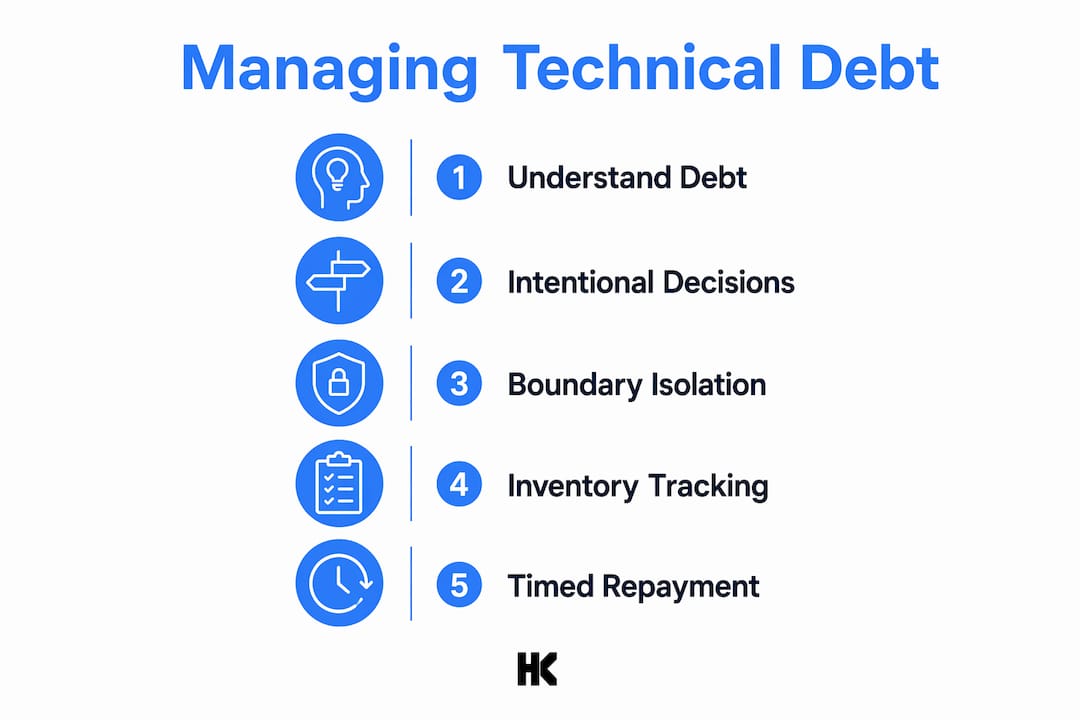
Decide intentionally, not reactively
The first rule: take on debt consciously. Before writing a shortcut, your team should name it. "We are skipping input validation here because we have 12 users and this endpoint is internal." Write that down. A shortcut you can name and locate is manageable. A shortcut you forgot about is a time bomb.
Contain debt behind clear boundaries
Isolating technical debt behind boundaries is one of the most underused tactics in early-stage startups. If you have a messy module handling payment processing, wrap it in a clean interface so the rest of the system does not depend on its internals. This way, the debt stays local. You can refactor or replace that module later without touching everything else.
Build a debt inventory
You cannot prioritize what you have not cataloged. A debt inventory is a simple document, or backlog tag, that records each known debt item with three fields: what it is, what it costs you now in engineering time per sprint, and what it would cost to fix. This turns opinion-based arguments about refactoring into ROI calculations.
Pro Tip: Link each debt item in your inventory to delivery signals. If a specific module causes three incidents per month and requires four hours of investigation each time, that is 12 hours of interest per month. A two-week refactor at the same engineer's rate pays itself back in under two months.
Use a comparison framework for repayment timing
| Debt type | Pay now | Delay |
|---|---|---|
| Blocking new features | Yes | No |
| Security or compliance risk | Yes | No |
| Isolated, low-traffic module | No | Yes, until product stabilizes |
| Performance under current load | Depends on user impact | Yes, if below threshold |
| Missing tests on stable code | No | Yes, with coverage gate |
Integrate quality gates in your CI/CD pipeline
Quality gates in CI/CD pipelines enforce standards that prevent new debt from entering the codebase automatically. Coverage thresholds, duplicated lines limits, and security hotspot reviews applied on new code mean you stop the bleeding before it starts. You do not need a perfect codebase to install a quality gate. You need a gate that rejects new code that is measurably worse than what you already have.
Measuring and reducing technical debt systematically
Good intentions about fixing debt rarely survive contact with sprint planning. What survives is measurement. If you can show that a specific debt item costs your team eight hours per sprint, it becomes a concrete argument for budget allocation, not a vague technical concern.
Most companies operate at a Technical Debt Ratio (TDR) between 10-25%, with 5% being the target for healthy codebases. A TDR above 0.3 signals that remediation is urgent. Allocating 15-20% of sprint capacity specifically to debt reduction yields measurable improvements without stalling product development.
Tools like SonarQube give you a TDR out of the box. Track it as a trend, not a snapshot. A TDR that is stable at 18% is less dangerous than one moving from 14% to 22% over three sprints.
A few metrics worth tracking on a regular basis:
- Debt velocity: Is the total estimated debt growing or shrinking each sprint?
- DORA metrics: Deployment frequency, lead time for changes, and mean time to recover all reflect debt health indirectly.
- Incident rate per module: High-incident modules are almost always high-debt modules.
- Onboarding time to first contribution: If it takes a new engineer more than two weeks to ship something small, your codebase is communicating a problem.
For repayment tactics, the strangler pattern consistently outperforms big-bang rewrites. You replace components gradually, keeping the old system running in parallel until the new one is proven. This approach has higher completion rates because it delivers value in chunks rather than betting everything on a six-month rewrite that may never ship. For a detailed breakdown of why full rewrites often fail, the internal tools backlog analysis from Gainable is worth reading.
Building a culture that controls debt generation
Managing technical debt in startups is not purely a technical problem. It is a cultural one. Founders who set realistic expectations about the speed-versus-quality balance from day one generate significantly less unintentional debt than those who push for speed without acknowledging the cost.
Practices that make a measurable difference:
- Regular code reviews with a specific question: "Does this introduce debt, and if so, is it intentional and documented?"
- Documentation as a default, not an afterthought. Even a three-sentence comment explaining why a shortcut exists saves hours of archaeology later.
- Knowledge sharing sessions where engineers walk through messy parts of the codebase together. Shared understanding of where the debt lives reduces the fear factor.
- Technical debt as a standing agenda item in sprint reviews, not a topic only raised when something breaks.
Hiring decisions matter as much as process. A single high-performing engineer reduces technical debt more effectively than multiple average developers. Poor hires increase debt, delays, and the cost of eventual rewrites. That is not a judgment of individuals. It is an argument for being deliberate about your first ten engineering hires.
Pro Tip: Watch for excessive TODO comments, difficulty onboarding new engineers, and engineers consistently avoiding certain parts of the codebase. These are internal signals that debt has reached a point where it is actively impeding the team, not just sitting in the backlog.
For founders without a technical background, the technical co-founder impact on startups provides useful context on how early technical leadership shapes long-term codebase health.
My take on debt as a strategic tool
I have worked with enough early-stage teams to say this clearly: the startups that treat all technical debt as failure are often the slowest ones. The obsession with clean code before product-market fit is a form of risk avoidance that costs more than the debt it prevents.
What I have actually seen work is intentional debt with a named owner and a repayment trigger. Not "we will fix this eventually," but "this shortcut lives in the payments module, costs us roughly four hours per sprint in maintenance, and we will replace it when we hit 500 paying customers." That is a business decision, not a technical failure.
The dangerous teams are not the ones with messy code. They are the ones who have forgotten where the mess is, or who have stopped caring. When debt becomes invisible in your process, it starts driving decisions you do not realize are being made for you. Feature timelines slip for reasons nobody can explain cleanly. Engineers lose confidence. Incident response gets slower.
I also push back on the "just rewrite it" instinct. I have seen startups burn three months on rewrites that shipped nothing to users and added new debt in different places. Incremental improvement, guided by data on where the debt is actually costing you, beats clean-slate thinking nearly every time.
The right question is not "how do we eliminate debt?" It is "which debt is costing us more than it would cost to fix, right now?"
— Hanad
Working through technical debt? Here's where to start.
If you are a founder or technical lead looking at a codebase that has started fighting back, Hanadkubat offers fixed-price rescue and scale engagements designed specifically for this situation. Starting from €4,500, these engagements begin with a direct assessment of where your debt is concentrated, what it is costing you per sprint, and which fixes deliver the highest ROI. No generic audits. No 80-slide decks.

Hanadkubat also handles full MVP development and technical consulting for founders who want to build fast without accumulating the kind of debt that kills scale. Every engagement is direct: you work with Hanad, not a project manager relaying messages. Pricing, scope, and past work are all visible at hanadkubat.com.
FAQ
What is technical debt in simple terms?
Technical debt is the future cost created when you choose a faster, simpler solution today instead of a better one. Like financial debt, it accrues interest in the form of ongoing maintenance and rework.
Is technical debt always bad for startups?
No. Intentional technical debt is often the correct decision in early-stage startups where speed and learning matter more than perfect code. The risk comes from untracked, unmanaged debt that compounds silently.
How do you measure technical debt?
The Technical Debt Ratio (TDR) is the most common metric, calculated as remediation cost divided by development cost. A TDR above 0.3 typically signals urgent attention, while most healthy teams maintain a TDR between 5-25%.
How much sprint capacity should go to debt reduction?
Allocating 15-20% of sprint capacity to debt reduction is a widely used model that balances ongoing product delivery with systematic repayment, based on data from tracked debt inventories.
When should a startup do a full rewrite vs. incremental refactoring?
Almost always incremental refactoring using a strangler pattern. Full rewrites have low completion rates and often introduce new debt. Incremental replacement keeps the system running while you improve it in measurable steps.