
TL;DR:
- Hanadkubat offers fixed-price SaaS MVP and AI integration services delivered directly by senior engineers, with scope and pricing established before work begins. Start with a strategy sprint or AI audit to obtain firm quotes and compliance artifacts essential for enterprise procurement. Focus on one core value loop to deliver production-ready software rapidly while embedding necessary legal and technical compliance in the development process.
"Mina product development" refers to fixed-price SaaS MVP builds and production-ready AI integration delivered through a direct senior-engineer model. The term is used here specifically for the service approach Hanadkubat offers: scoped, time-bounded engagements where you know the price before work starts and you work directly with the engineer writing the code.
Three things you can do right now:
- Run a 1-week strategy sprint (€1,500) to validate scope and get a firm fixed-price quote before committing to a full build.
- Request a fixed-price 4–12 week MVP quote if you have product-market evidence and need working software, not a deck.
- Book an AI feasibility audit (€1,500) if you already have a SaaS product and want a prioritized roadmap for adding production AI features.
Fixed-price means no hourly billing and no scope creep surprises. Hanadkubat serves DACH and EU clients from Vienna, plus US-based teams, with EU AI Act and GDPR-aware delivery built into every engagement.
Table of Contents
- When does hiring fixed-price engineering beat running your own sprint?
- What a fixed-price SaaS MVP engagement actually includes
- How should you architect AI features: RAG, agents, or something simpler?
- Why your AI MVP needs one value loop, not ten features
- What compliance artifacts do enterprise buyers actually ask for?
- What does the engagement process look like from first call to handoff?
- What do real delivered results look like?
- How do you start, and what does Hanadkubat need from you?
- Key Takeaways
- The case for direct-engineer fixed-price delivery
- Fixed-price SaaS MVP and AI integration: get a quote from Hanadkubat
- Further reading and practical resources
- FAQ
When does hiring fixed-price engineering beat running your own sprint?
Hire fixed-price when the cost of delay exceeds the cost of the engagement. Specifically: when an enterprise RFP has a response deadline, when procurement asks for a signed DPA or SOC 2 scoping note, or when you need a single core workflow in production within 4–12 weeks and your internal team lacks the bandwidth or the AI architecture experience to ship it cleanly.
Run an internal sprint instead when you are still in exploratory discovery, have no user data to validate against, and can tolerate iterative cost without a hard deadline.
Four signals that point toward hiring now:
- Enterprise buyer has asked for compliance artifacts (DPA, DPIA draft, AI transparency statement) before signing.
- You have a revenue runway under 12 months and need a shippable MVP to close your next funding round.
- Your team has the product vision but not the AI architecture depth (RAG, agentic patterns, inference cost controls).
- You need EU AI Act and GDPR documentation integrated during build, not retrofitted after.
Pro Tip: Before committing to a full fixed-price MVP, run a 1-week paid technical validation sprint. It produces a scoping report, a risk register, and a firm quote. The sprint cost applies toward the MVP if you proceed. This single step eliminates the most common source of fixed-price disputes: misaligned scope assumptions.

What a fixed-price SaaS MVP engagement actually includes
The deliverables at handoff are specific. No ambiguity about what you receive:
- Strategy sprint report (scope, risk register, architecture decision record)
- Clickable prototype with annotated user flows
- Working MVP codebase with automated tests and a deployment pipeline
- Runbook covering environment setup, rollback procedures, and monitoring basics
- DPA/SOC 2 readiness checklist and, for EU-facing products, a DPIA draft
Per EU AI Act Article 50 transparency obligations, AI-enabled products also ship with an AI transparency statement listing risk classification, data inputs, oversight contacts, and complaint procedures.
| Engagement type | Timeline | Price anchor | Core deliverable |
|---|---|---|---|
| Strategy sprint | 1 week | €1,500 | Scoping report + fixed-price quote |
| AI feature sprint | 2 weeks | €4,500 | Production-ready AI feature + monitoring |
| SaaS MVP (lean) | 4–6 weeks | From €18,000 | Prototype + working codebase + runbook |
| SaaS MVP (full) | 8–12 weeks | Custom quote | Full MVP + compliance artifacts + handoff |
| Rescue / scale | From 2 weeks | From €4,500 | Audit + refactor plan + stabilized codebase |
For product development best practices that inform how these handoff artifacts are structured, Hanadkubat's published guide covers validation and scope discipline in detail.
How should you architect AI features: RAG, agents, or something simpler?
Start with the simplest architecture that proves the core value loop. For most B2B SaaS workflows, that means RAG: a retriever pulls relevant chunks from an embedding store, a prompt template assembles context, and an LLM generates the output. Agents add multi-step orchestration and tool calls, which increases latency, cost, and failure surface. Only reach for agents when the workflow genuinely requires sequential decision-making across multiple tools.
A production RAG architecture has six layers worth getting right: document ingestion and chunking, an embedding store (Pinecone, Weaviate, or pgvector depending on scale), a retriever with hybrid search, a prompt/template layer with length caps, LLM inference with model selection per latency/price profile, and output handling with logging and human-in-the-loop checkpoints.
Cost-control checklist for LLM features:
- Cap response length at the minimum needed for the use case.
- Cache repeated queries (semantic caching cuts costs on high-frequency lookups).
- Batch non-real-time requests to reduce per-call overhead.
- Select models by latency/price profile: GPT-4o for complex reasoning, GPT-4o-mini or Claude Haiku for high-volume classification.
- Set token budgets per user tier and alert before they breach.
On inference residency: EU-resident inference matters when personal data is processed in the AI pipeline. Using a US-based inference endpoint for EU user data creates a GDPR transfer obligation. Azure OpenAI with EU data residency or Mistral's EU-hosted endpoints are the practical options for sovereignty-conscious clients.
Hanadkubat shipped a RAG workflow with a measured cost-per-query of $0.034 against an industry average closer to $0.18. The difference came from hybrid retrieval (reducing irrelevant chunks), aggressive response length caps, and semantic caching on repeated query patterns. The same architecture produced a production AI feature in 14 days with $80k+ in tooling cost savings identified during the audit phase.
Pro Tip: Measure RAG cost-per-query from day one, not after launch. Instrument your retriever to log chunk count, token usage, and latency per request. A dashboard showing cost-per-query trends lets you catch model drift and prompt bloat before they hit your infrastructure bill.
Documented operational controls expected by enterprise auditors include input/output logging, human oversight procedures, bias testing reports, and drift monitoring dashboards.
Why your AI MVP needs one value loop, not ten features
Successful AI MVPs focus on a single core workflow rather than packing multiple features. The reasoning is straightforward: each additional feature multiplies the surface area for failure, increases the cost of iteration, and delays the moment you get real user signal on anything.
A value loop is the shortest path from user input to measurable outcome. For a document-processing SaaS, that might be: upload PDF → extract key clauses → flag anomalies. For a support tool: user query → RAG retrieval → draft response. Pick one. Ship it. Measure it.
Practical rules for scope discipline:
- Limit the MVP to one workflow end-to-end.
- Define a single success metric before writing the first line of code (time saved per user, conversion rate on the core action, or cost-per-query).
- Do not fine-tune a model before you have user validation data. Fine-tuning on the wrong behavior is expensive to undo.
- Set a latency SLO (e.g., p95 under 3 seconds) and treat it as a hard constraint, not a nice-to-have.
Track these metrics during the MVP phase: time saved per user session, conversion rate on the core workflow action, RAG cost-per-query, p95 latency, and error/rollback rate per release.
What compliance artifacts do enterprise buyers actually ask for?
Include compliance documentation during development. Retrofitting it after the fact costs more and delays procurement. Integrating DPIAs and technical records early reduces rework and builds trust with enterprise buyers faster than any sales deck.
Enterprise RFP checklist:
- SOC 2 scoping note (even a Type I readiness statement unblocks many procurement teams)
- Signed DPA template covering sub-processors and data retention
- AI transparency statement (risk classification, inputs, oversight, complaint contact)
- Service runbook and incident response plan
- DPIA draft connected to your ROPA when personal data flows through the AI pipeline
For EU-facing products, SaaS companies that wrap third-party model APIs can assume provider obligations under Article 25 of the EU AI Act. Classify each AI feature as provider or deployer, maintain an AI system register listing every feature, data type, and intended purpose, and connect your DPIA to your ROPA.
Timeline urgency: AI literacy obligations applied from February 2, 2025; high-risk obligations phase in through August 2, 2026. If your product touches high-risk categories, August 2026 is the hard deadline for full compliance. The EU AI Act implementation guidance notes SME-specific measures and regulatory sandbox access for smaller teams.
Pro Tip: Build a one-page "AI inventory" document listing every AI feature, its risk classification, data inputs, and the name of the person responsible for oversight. Attach it to your product documentation. This single artifact answers 80% of the questions enterprise procurement teams ask during due diligence, and it satisfies the foundational requirement for technical validation under GDPR and the AI Act.
What does the engagement process look like from first call to handoff?
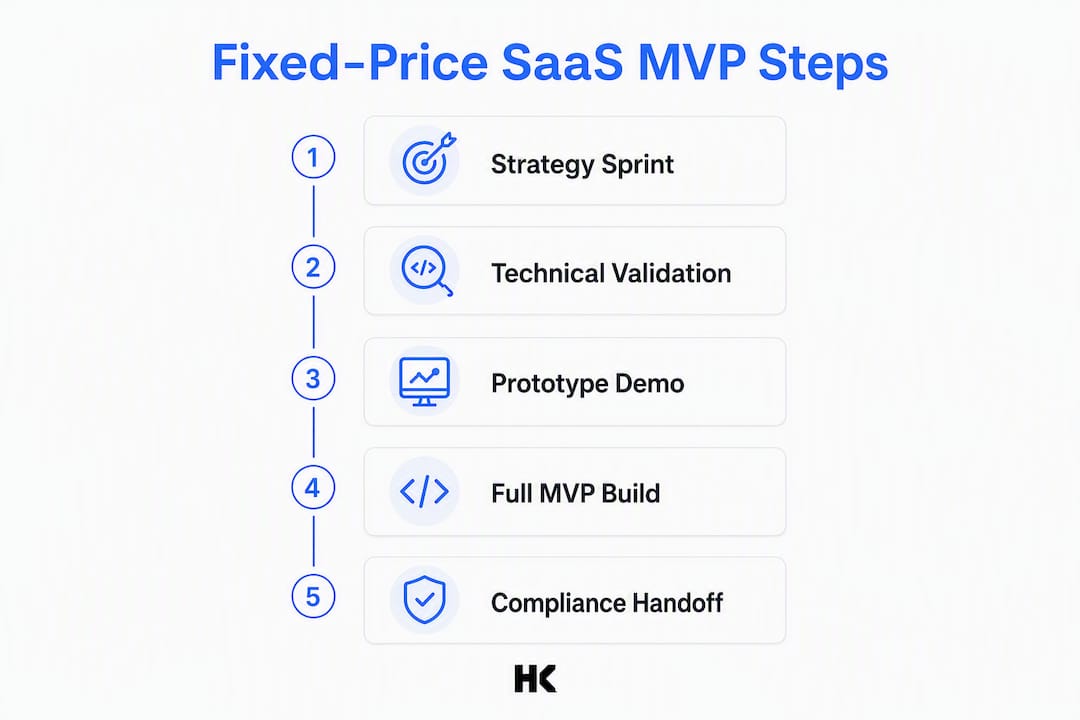
- Intake and scoping call (Day 1–3): 60-minute call to review your product brief, user journeys, and technical constraints. Output: a written scope summary.
- Strategy sprint (Week 1): architecture decision record, risk register, compliance checklist, and a firm fixed-price quote for the MVP build.
- MVP sprints (Weeks 2–12, depending on tier): 2-week sprint cadence with a demo at the end of each sprint. Acceptance criteria are agreed before each sprint starts.
- Acceptance and handoff (Final week): code merged to your repository, runbook delivered, compliance artifacts handed over, monitoring dashboards live.
- Post-launch support (Optional, from €4,500): codebase monitoring, incident response, and a 30-day stabilization window.
Milestone acceptance criteria are explicit: clickable prototype accepted in writing before build begins; code merged to staging after automated tests pass; performance tests meet agreed SLOs; compliance artifacts reviewed and signed off by your legal or procurement contact.
The direct-engineer communication model means weekly demos, async status notes in a shared channel, and a single decision owner on your side. No project manager relay. The person on the call is the person writing the code.
Common delay sources: data readiness (sample data not available at sprint start), procurement review cycles, and GDPR legal review of DPA templates. Budget an extra week for each if any of these apply.
What do real delivered results look like?
| Metric | Result | Context |
|---|---|---|
| RAG cost-per-query | $0.034 | vs. ~$0.18 industry average |
| Time to production (AI feature) | 14 days | Single-feature sprint |
| Tooling cost savings identified | $80k+ | During AI audit phase |
| AI Act risk dimensions categorized | 8 | Per product audit |
"The metrics that matter in procurement conversations are cost-per-query, time-to-production, and whether the compliance artifacts are ready to hand to a legal team on day one. Everything else is secondary." — Hanadkubat proof points
Production examples and measurable improvements are the strongest trust signals for technical buyers evaluating a fixed-price provider. When you ask for references, ask specifically for cost-per-query numbers, sprint-to-production timelines, and whether compliance artifacts were delivered at handoff.
How do you start, and what does Hanadkubat need from you?
Engagements start with a short scoping call and optionally a 1-week paid technical validation sprint to firm up a fixed-price quote. The sprint costs €1,500 and applies toward the MVP if you proceed.
What to prepare before the first call:
- A written product brief (one page is enough) covering the core user workflow and the problem it solves
- Sample data or API documentation for any data sources the AI feature will consume
- Your primary user journeys (3–5 is sufficient)
- Procurement contacts and any known compliance requirements (SOC 2, DPA, GDPR, AI Act)
- A security questionnaire template if your organization uses one
Price variability comes from three factors: data complexity (structured vs. unstructured, volume, access method), compliance depth required (DPIA, AI Act categorization, SOC 2 readiness), and integration surface (number of third-party APIs and auth systems). Hidden costs to watch for: data migration not scoped at intake, post-launch monitoring beyond the 30-day window, and legal review cycles that extend the compliance artifact phase.
After engagement begins, expect a written scope summary within 3 days and a first sprint demo within 2 weeks. The rapid-launch cadence Hanadkubat uses is documented publicly for buyers who want to review the process before committing.
Key Takeaways
Fixed-price SaaS MVP and AI integration engineering delivers bounded, production-ready software in 2–12 weeks when scope is defined upfront and compliance artifacts are built in from day one.
| Point | Details |
|---|---|
| Fixed-price model | No hourly billing; price is quoted upfront based on scope, data complexity, and compliance depth. |
| Single value loop | Limit AI MVPs to one core workflow and one success metric before writing code. |
| Compliance built in | Include DPA, DPIA draft, and AI Act records during development to avoid rework and win enterprise procurement. |
| Proof metrics | RAG cost-per-query at $0.034 and a production AI feature shipped in 14 days are the benchmarks to ask any provider for. |
| Hanadkubat engagement | Start with a €1,500 strategy sprint or AI audit; fixed-price MVP builds start from €18,000 with direct senior-engineer delivery. |
The case for direct-engineer fixed-price delivery
Most procurement friction in software projects comes from the gap between the person who scopes the work and the person who writes the code. I have seen this at BMW, Deutsche Bahn, and Bundesrechenzentrum Austria, where government-grade infrastructure work demanded that the engineer making architecture decisions also owned the outcome. That experience is what shaped the fixed-price, direct-engineer model I use at Hanadkubat.
When you work directly with the engineer, scope ambiguity gets resolved in the first sprint, not after three months of project manager relay. Fixed pricing forces the discipline of defining acceptance criteria before work starts, which is also the discipline that produces clean handoffs and compliance artifacts that actually hold up in procurement.
Vienna and DACH context matters for EU-facing products. EU AI Act and GDPR are not checkbox exercises here; they are procurement requirements from enterprise buyers. Building them in from the start is not extra work. It is the work.
Fixed-price SaaS MVP and AI integration: get a quote from Hanadkubat
If you need a production-ready AI feature in 14 days or a full SaaS MVP in 4–12 weeks, Hanadkubat delivers both at a fixed price with no hourly billing and no agency overhead. The entry point is a €1,500 strategy sprint or AI audit that produces a firm quote, a scoping report, and compliance artifacts your procurement team can review before you commit to a full build.
Hanadkubat serves DACH and EU clients from Vienna and works with US-based teams on the same fixed-price model. Every engagement is direct: you work with the engineer writing the code, not a project manager. Request a fixed-price quote at hanadkubat.com and expect a written scope summary within 3 business days.
Further reading and practical resources
- Rapid Launch Process for SaaS and AI Products: Hanadkubat's published sprint cadence and milestone structure for SaaS and AI product builds. Read this before your first scoping call.
- Technical Validation for B2B SaaS: EU Compliance Guide: How to integrate GDPR and EU AI Act documentation into your validation process so compliance artifacts are ready at handoff.
- Testing in Startups: What B2B SaaS Founders Must Know: Disciplined decision-making for AI product development, including how to define acceptance criteria and avoid scope drift.
- SaaS SEO: Automate 70% of Tasks for Growth: Partner resource on SaaS growth automation; useful for post-MVP go-to-market planning once your product is in production.
- EU AI Act Implementation Guidance (European Commission): The primary source for SME compliance paths, risk classification, and the August 2026 obligation timeline.
FAQ
What is mina product development in the SaaS context?
It refers to fixed-price SaaS MVP builds and production-ready AI integration services delivered by a senior direct-engineer model. The core offer is scoped, time-bounded work with a firm price quoted before any code is written.
How long does a fixed-price MVP build take?
Strategy sprints take 1 week (€1,500). Lean MVP builds run 4–6 weeks from €18,000; full MVP builds with compliance artifacts run 8–12 weeks at a custom quote.
What AI architectures does Hanadkubat use for production features?
RAG systems for content and retrieval workflows, agentic patterns for multi-step orchestration, and LLM cost controls including semantic caching, response length caps, and model selection by latency/price profile.
Which compliance artifacts are included at handoff?
Standard handoff includes a DPA template, SOC 2 readiness checklist, AI transparency statement, DPIA draft (for EU-facing products), and a service runbook. For AI Act scope, each feature is classified across provider/deployer obligations.
How do I start an engagement with Hanadkubat?
Book a scoping call at hanadkubat.com. Prepare a one-page product brief, sample data or API docs, and your primary user journeys. A written scope summary arrives within 3 business days.