

TL;DR:
- Rapid launch accelerates software product delivery by focusing on a single core feature and early real user feedback. It involves short, disciplined sprints with spec-first planning and immediate deployment to catch errors early. This approach reduces development time and enhances learning, especially for AI and SaaS products in 2026.
The rapid launch process is the strategic method of delivering software products to market quickly by prioritizing a focused MVP, continuous deployment, and early user validation. For tech entrepreneurs and product managers building AI and SaaS products in 2026, this approach is not a shortcut. It is a discipline. The core idea is simple: ship one working feature to real users as fast as possible, then learn from what happens. What is rapid launch process in practice? It is a structured sprint, typically 72 hours to 4 weeks, built around ruthless scope control, spec-first planning, and incremental deployment. Tools like ShipFast boilerplate, AI-assisted code generation, and continuous deployment pipelines make this timeline achievable for small teams without sacrificing production quality.
What is the rapid launch process and its core principles?
The rapid launch process, also called fast track development in some engineering circles, is defined by three non-negotiable constraints: one core feature, one user persona, and one pricing tier at launch. These constraints are not arbitrary. They exist because scope creep is the primary reason early-stage products miss their launch windows.

The spec-first approach is the foundation of any working rapid launch methodology. Before writing a single line of code, teams lock the technical specification: inputs, outputs, data models, and API contracts. Spec-first planning increases success rates by preventing mid-sprint scope additions that derail timelines. The discipline of writing the spec before coding forces clarity that most teams skip in their rush to build.
Sprint timelines in rapid launch fall into three tiers. The 72-hour sprint targets a single, fully functional feature shipped to a live URL. The 7-day SaaS launch targets a complete product with one feature, one pricing tier, and one persona. The 2–4 week sprint targets a validated MVP with enough surface area for meaningful user feedback. Each tier requires the same mindset: working is better than perfect.
Continuous deployment is the operational backbone of rapid launch. Teams deploy to production after every major feature, not at the end of the sprint. This catches DNS misconfiguration, SSL errors, and environment variable mismatches early, when they are cheap to fix.
Pro Tip: Write your landing page value proposition before you write any code. If you cannot articulate the product's core benefit in one sentence within 4 hours, the idea needs more refinement before a sprint begins.
How does rapid launch differ from traditional product development?
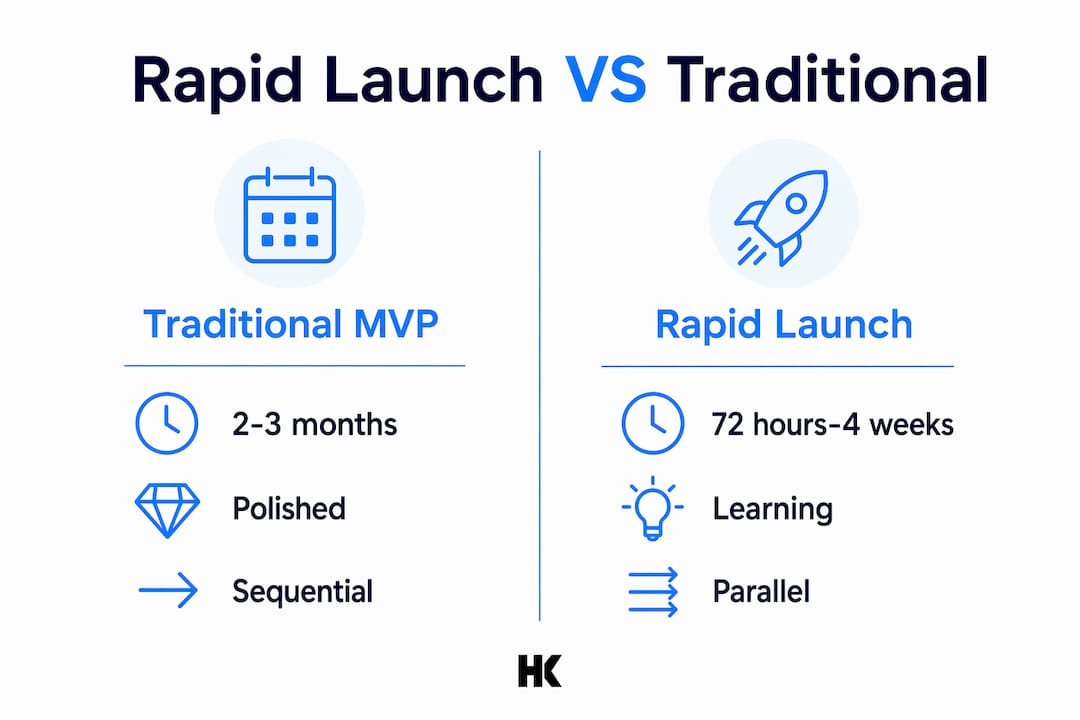
Traditional MVP development runs on 2–3 month timelines. Rapid launch compresses that to days or weeks. The difference is not just speed. It is a fundamentally different relationship with completeness.
Traditional product development optimizes for polish before release. Rapid launch optimizes for learning after release. A team following a traditional approach might spend six weeks on authentication, onboarding flows, and admin dashboards before a single user touches the product. A rapid launch team ships the core feature first and builds everything else based on what users actually need.
| Dimension | Traditional MVP | Rapid Launch |
|---|---|---|
| Timeline | 2–3 months | 72 hours to 4 weeks |
| Scope at launch | Multiple features | One core feature |
| Deployment cadence | End of project | Daily or per feature |
| Feedback source | Internal testing | Real users, live environment |
| Risk profile | High (late discovery) | Low (early validation) |
Rapid MVP development compresses typical multi-month timelines into 2–4 weeks through aggressive scoping, parallel workflows, and experienced teams. That compression delivers validated learning faster and reduces the cost of prolonged development. For a DACH B2B SaaS team, that cost difference can mean the gap between a funded next round and a stalled product.
Boilerplates and automation tools play a significant role in this compression. ShipFast, for example, eliminates weeks of authentication and payment setup. AI-assisted code generation handles boilerplate logic. The result is that experienced teams spend their sprint time on the actual differentiating feature, not infrastructure plumbing.
How to implement rapid launch: a step-by-step sprint breakdown
Implementing a rapid launch sprint follows a predictable sequence regardless of whether the timeline is 72 hours or 4 weeks. The phases are the same. Only the depth of each phase changes.
-
Validate the idea with a landing page. Write the value proposition and publish a landing page before writing any product code. Landing page clarity is an early signal of product readiness. If you cannot write a clear value proposition in 4–6 hours, the product idea lacks the clarity needed to survive a sprint.
-
Write the spec. Define inputs, outputs, data models, and API contracts in a single document. Lock the spec before coding begins. Any feature not in the spec does not exist for this sprint.
-
Deploy to production on Day 1. Push a placeholder to your live URL on the first day of the sprint. Deploying early exposes infrastructure issues like DNS, SSL, and environment config errors before they become launch-day blockers. This is not user-facing. It is a sanity check.
-
Build the single core feature. Code only what the spec defines. Ship at 80% quality and move on. A feature that works for real users at 80% teaches you more than a perfect feature that ships three weeks late.
-
Configure environments carefully. Maintain an
.env.examplefile and check it against your production environment variables before every deployment. Environment variable misconfiguration is a leading cause of launch-day failures. -
Launch and reach out directly. Send the product URL to 10–20 target users personally. Do not wait for organic traffic. Direct outreach in the first 48 hours post-launch generates the feedback that shapes your next sprint.
-
Collect feedback and define Sprint 2. Analyze user behavior and direct feedback. Use real data, not speculation, to scope the next iteration.
Pro Tip: Use a calendarized sprint with daily deliverables and a clear Time-to-First-Dollar (TTFD) target. Tracking TTFD reduces deadline slippage and keeps the team focused on revenue-generating functionality first.
What are the benefits and challenges of rapid launch in AI and SaaS?
The primary benefit of rapid deployment strategies is speed of learning. Faster launches accelerate product-market fit discovery, especially with AI-augmented development frameworks. Launching a real SaaS product within 2–4 weeks is becoming standard practice in 2026. Teams that wait for a "complete" product before launching are learning slower than their competitors.
Core benefits of rapid launch methodology:
- Real user feedback replaces internal assumptions within days, not months
- Infrastructure problems surface early when they are cheap to fix
- Scope discipline forces teams to identify the single most valuable feature
- Early revenue signals validate pricing before significant engineering investment
- AI-assisted development tools reduce per-sprint engineering hours materially
The challenges are real and worth naming directly. Scope creep is the most common failure mode. A team that adds "just one more feature" to a 72-hour sprint will not ship in 72 hours. The spec-first constraint exists precisely to prevent this.
"The 72-hour sprint is about ruthless prioritization, trusting learning cycles over perfection, and shipping minimum viable functionality." — TeachShield Build Playbook
Environment configuration errors are the second most common failure mode. API keys, database URLs, and domain settings that work in development frequently fail in production. Maintaining an .env.example file checked against production variables before every deployment is the practical fix. Teams that skip this step consistently hit launch-day failures that could have been caught on Day 1.
Team discipline is the third challenge. Rapid launch requires everyone on the team to accept that the first version will be incomplete. For product managers accustomed to shipping polished releases, this requires a genuine mindset shift. The right MVP focus after initial launch allows quick pivots driven by actual user data, not internal debate.
Key Takeaways
The rapid launch process succeeds when teams combine spec-first planning, a single-feature scope, and continuous deployment from Day 1 of the sprint.
| Point | Details |
|---|---|
| Spec-first planning | Lock inputs, outputs, and API contracts before writing any code to prevent scope creep. |
| Single-feature scope | Limit each sprint to one core feature and one user persona to ship on time. |
| Deploy on Day 1 | Push to a live production URL immediately to catch DNS, SSL, and config errors early. |
| Landing page first | Write your value proposition before coding; unclear copy signals an unclear product. |
| TTFD as a sprint metric | Tracking Time-to-First-Dollar keeps daily deliverables focused on revenue-generating features. |
Why I think most teams misunderstand rapid launch
Most teams treat rapid launch as a speed contest. They try to build faster without changing what they build. That is the wrong frame entirely.
I have worked with B2B SaaS teams across DACH and the EU, including projects with engineering pedigree from BMW and Deutsche Bahn, and the pattern is consistent. Teams that succeed with rapid launch do not build faster. They build less. The discipline is subtractive, not additive. Every feature you remove from Sprint 1 is a decision, not a failure.
The AI-assisted development tools available in 2026 make this even more important to understand. GitHub Copilot, Cursor, and similar tools can generate code faster than most developers can review it. That speed advantage disappears immediately if the scope is wrong. I have seen teams use AI code generation to build three features in the time it used to take to build one, then wonder why their launch failed. They built the wrong three features.
The other thing I would push back on is the idea that rapid launch is only for early-stage startups. I have used sprint-based rapid deployment approaches on AI integration projects for established B2B SaaS clients, shipping production-ready RAG features in 14 days. The methodology scales. What does not scale is the assumption that more time always produces a better product. It usually produces a more complicated one.
If you are a product manager or technical founder reading this, the most useful thing you can do before your next sprint is write the spec and the landing page on the same day. If they do not match, you have a problem worth solving before you write a single line of code.
— Hanad
Ready to ship your SaaS MVP in weeks, not months?
Hanadkubat applies the rapid launch methodology described in this article to real client projects, shipping production-ready SaaS MVPs and AI features on fixed timelines and fixed prices. If your team is scoping a new product or an AI integration, the SaaS MVP development process at Hanadkubat starts with a strategy sprint that validates scope before a single line of code is written.
For teams building AI-native features, Hanadkubat's AI toolkit and frameworks cover RAG systems, agentic patterns, and LLM cost optimization built for EU compliance. Fixed price. Direct partnership. No project managers between you and the engineer writing the code. Visit hanadkubat.com to see current service tracks and pricing.
FAQ
What is the rapid launch process in software development?
The rapid launch process is a structured sprint methodology that ships a working software product to real users in 72 hours to 4 weeks by limiting scope to one core feature and one user persona. It prioritizes early deployment and real user feedback over internal polish.
How long does a rapid launch sprint typically take?
Sprint timelines range from 72 hours for a single feature to 2–4 weeks for a complete validated MVP. The timeline depends on team size, product complexity, and how clearly the spec is defined before coding begins.
What is the biggest risk in a rapid launch?
Scope creep is the primary failure mode. Teams that add features mid-sprint consistently miss their launch window. The spec-first approach, locking all technical specifications before coding, is the standard mitigation.
How does rapid launch differ from fast track development?
Fast track development is a broader term used in enterprise project management for accelerated delivery timelines. Rapid launch process is the startup-specific application of that concept, focused on MVP validation and user feedback cycles rather than full feature delivery.
Can rapid launch methodology work for AI product features?
Yes. AI features like RAG systems and agentic workflows are well-suited to rapid launch sprints because they can be scoped to a single use case and tested with real data quickly. AI in product management shows that AI accelerates product management cycles when the scope is tightly defined from the start.