

Direct communication in software development means treating dialogue as engineering infrastructure, not a soft skill. Teams that shift from one-way status updates to genuine two-way dialogue ship features faster, catch edge cases earlier, and spend less time in clarification meetings.
- Faster alignment: Living feature briefs and PR descriptions with context cut synchronous interruptions, compressing sprint cycles.
- Fewer status meetings: When updates are async and visible, the meeting becomes redundant. A 2-week pilot sprint is enough to see the signal.
- Clearer recovery plans: Owning deviations immediately with a transparent fix and ETA builds client trust faster than any status report.
CTOs and technical founders building AI features or MVPs should pilot this in a single 2-week sprint. The signal is measurable: PR cycle time, clarifying-comment rate, and reopened ticket frequency all move within two weeks.
Table of Contents
- Why direct communication in dev determines your delivery speed
- Core practices that make direct communication operational
- How to roll out direct communication in your team
- Tools and templates that remove friction
- KPIs to measure the impact of direct communication
- Common pitfalls and how to avoid them
- What direct communication looks like in a real AI feature delivery
- Key Takeaways
- The part most teams skip
- Fixed-price services built on this communication model
- Useful sources
- FAQ
Why direct communication in dev determines your delivery speed
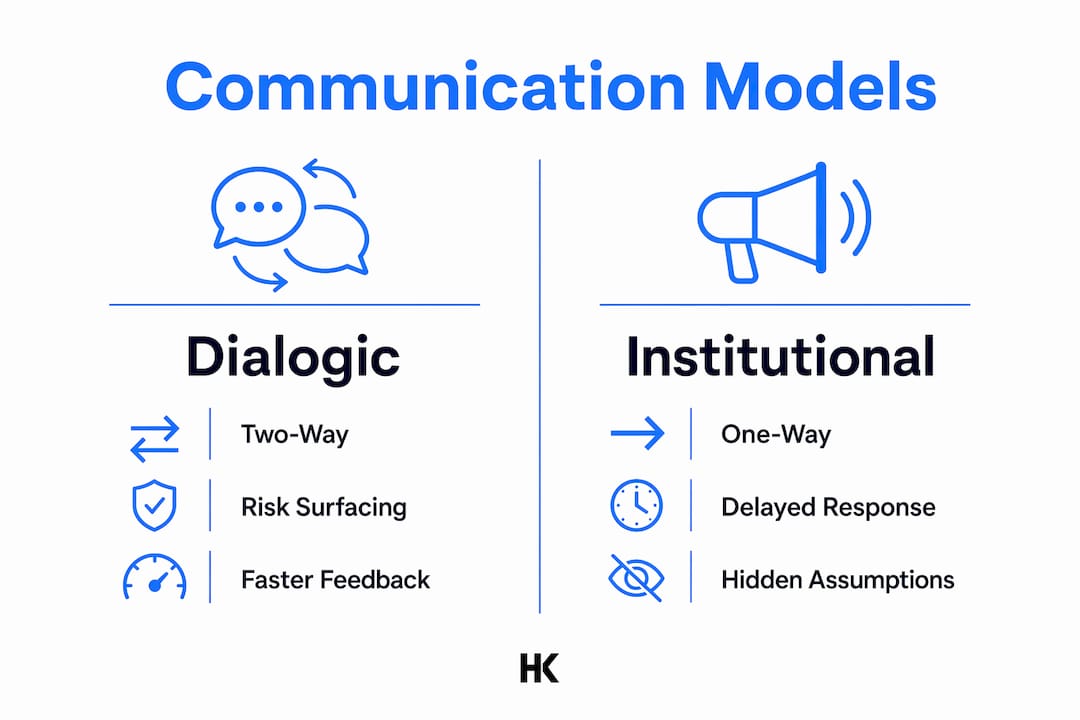
The core distinction is institutional versus dialogic communication. Institutional (vertical) communication flows one way: a PM writes a spec, a dev reads it, a QA team tests it. Dialogic (horizontal) communication is a two-way process that surfaces assumptions, edge cases, and political risks before they become bugs.
For B2B SaaS teams building AI features, the stakes are concrete. A RAG pipeline has retrieval parameters, chunking strategies, and latency constraints that a one-way spec cannot fully anticipate. Without a living brief that invites questions, those gaps surface in QA, not planning.
- Reduced rework: Mismatched assumptions caught in a feature brief cost hours. Caught in QA, they cost days and a sprint reset.
- Earlier edge-case discovery: Dialogic methods surface political and technical risks that one-way specs miss entirely.
- Fewer status meetings: Making dialog visible eliminates the need for separate status calls because alignment is continuous.
- Client trust: Transparent recovery plans with defined timelines build trust faster than polished project reports.
Scenario A: A dev catches an ambiguous success metric in a living feature brief on day 2 of a sprint. One async comment, one clarification, 30 minutes of rework. Scenario B: The same ambiguity surfaces in QA on day 12. The sprint resets. The client gets a delay email. The cost is qualitatively 10–20x higher, and the relationship takes a hit.
Core practices that make direct communication operational
These are the habits that turn communication from intention into engineering infrastructure.
- Living feature briefs: Write the brief as a commentable doc, not a locked PDF. Link it to your task tracker. Every open question becomes a recorded context item.
- Async-first updates: Post a daily or per-PR update in the thread, not in a meeting. Synchronous time is for decisions only.
- PR descriptions that answer why/how/risks: Clear PR context cuts synchronous "why did you do this?" meetings and preserves decision logic for future maintainers.
- Own deviations immediately: When something goes off-plan, the pattern is: what happened / impact / proposed fix / ETA. Align internally before going to the client.
- Internal alignment before external messages: Never send a client a problem without a proposed solution. Draft the recovery plan first.
- Pair devs on customer calls (selectively): One call per sprint where a developer hears the client's actual language. It changes how they write the next brief.
- Treat docs as engineering assets: PR descriptions, decision records, and runbooks are permanent assets with ownership, not throwaway notes.
Deviation report template:
What happened: [brief factual description] Impact: [scope, affected users/features] Proposed fix: [specific action] ETA: [date/sprint] Who approves: [name/role]
Pro Tip: Add a 5-field PR checklist (what, why, how, risks, rollout) to your PR template. Teams that do this report up to 40% faster review cycles.
How to roll out direct communication in your team
A phased rollout prevents the two most common failures: too much change at once, and no clear owner for each practice.
- Week 1–2 (Pilot sprint): Pick one active feature. Apply living brief, async updates, and PR description checklist. Measure PR cycle time and clarifying-comment rate at the end of the sprint.
- Week 3–4 (Review and adjust): Review pilot metrics with the team. Identify one friction point (usually the brief template or the deviation ownership rule) and fix it before expanding.
- Week 5–8 (Team rollout): Apply practices to all active features. Introduce the deviation report template. Assign owners for each artifact.
- Week 9–12 (Org adoption): Extend to client-facing communication. Add the internal-alignment-before-external rule to your team norms doc. Run one retrospective focused solely on communication artifacts.
| Artifact | Owner | Review cadence |
|---|---|---|
| Living feature brief | Tech lead or product owner | Updated per sprint |
| PR description | Authoring developer | Per PR |
| Deviation/recovery report | Authoring developer, approved by tech lead | Per incident |
| Communication KPIs | Engineering manager or CTO | End of each sprint |
Early architecture decisions made with dialogic alignment are far less likely to require costly rewrites at scale.

Tools and templates that remove friction
No tool debate needed. Pick one from each category and move.
- Collaborative docs with inline comments (Notion, Confluence, or any doc tool with comment threads): the feature brief lives here, linked to tasks.
- Connected task trackers (Linear, Jira, GitHub Issues): every comment in the brief generates a linked task. Context stays attached to work items.
- PR workflows with persistent discussion (GitHub PRs, GitLab MRs): the PR is the canonical record of a decision. Linked tasks and commentable briefs keep context from fragmenting across tools.
- Lightweight runbook storage (a /docs folder in the repo, or a dedicated wiki page): runbooks are engineering assets, not wiki orphans.
AI productivity tools can help teams automate routine PR summaries and generate deviation templates, cutting the time cost of maintaining these artifacts.
Feature brief template:
Title: [feature name] Intent: [one sentence: what problem this solves] Success metrics: [measurable outcomes] Constraints: [tech, compliance, timeline] Open questions: [unresolved items — this is the dialogic layer]
KPIs to measure the impact of direct communication
Track these before and after your pilot sprint.
- PR cycle time: Time from PR open to merge. Drops when descriptions are clear.
- Clarifying-comment rate per PR: Comments asking "what does this do?" or "why this approach?" should decrease.
- Mean time to recovery (MTTR): Incidents resolved faster when recovery plans are templated and owned.
- Reopened ticket frequency: Tickets reopened due to unclear requirements signal a brief quality problem.
- Lead time for change: Total time from commit to production. Shorter when handoff friction is low.
Teams that improved technical communication reported up to 40% faster review cycles and 50% fewer production bugs tied to miscommunication, according to Markaicode's analysis of developer communication practices.
Before/after pilot checklist:
- PR cycle time (baseline vs. end of sprint 2)
- Number of "clarification needed" PR comments
- Reopened tickets per sprint
- Incidents with a documented recovery plan vs. ad hoc response
Common pitfalls and how to avoid them
- Over-communication noise: Too many update channels create fatigue. Fix: one thread per feature, one async update per day.
- No owner for recovery plans: Deviations go unaddressed when nobody is named. Fix: the authoring developer owns the report; the tech lead approves it.
- Unreadable docs: Long briefs nobody reads. Fix: five sections maximum, one required action item per open question.
- Cultural resistance: Developers who see communication as "not my job." Fix: frame PR descriptions as self-defense against future "why did you do this?" interruptions.
- Tool sprawl: Slack threads, email, Jira comments, and Notion docs all carrying different versions of the same decision. Fix: one canonical doc per feature, linked everywhere else.
- Remote and cross-timezone gaps: Async-first breaks down when SLAs are undefined. Fix: set a 24-hour response SLA for async threads and a 4-hour SLA for deviation reports. Overlap hours are for decisions only.
What direct communication looks like in a real AI feature delivery
This is how a production AI feature engagement runs under a direct communication model.
- Scope: RAG-based document retrieval feature for a B2B SaaS product. Fixed-price, 2-week sprint.
- Who was involved: One senior engineer writing the code, one technical founder as the counterpart. No project manager layer.
- Living brief: Written on day 1, commentable, linked to GitHub Issues. Three open questions resolved async by day 3, preventing two architecture pivots.
- PR descriptions: Every PR included what, why, architecture rationale, and rollout notes. Zero "what does this do?" comments across the sprint.
- Deviation ownership: One retrieval latency issue surfaced on day 9. Deviation report filed within two hours: cause identified, fix proposed, ETA confirmed. Client informed after internal alignment.
- Outcome: Feature shipped in 14 days. RAG cost-per-query at $0.034 versus an $0.18 industry average, achieved through documented chunking and caching decisions preserved in PR descriptions.
The communication model was not separate from the engineering work. It was the engineering work.
Key Takeaways
Direct communication in dev is the difference between catching a misaligned requirement in a brief on day 2 versus in QA on day 12.
| Point | Details |
|---|---|
| Dialogic beats institutional | Two-way dialogue surfaces edge cases and assumptions that one-way specs miss entirely. |
| PR descriptions are assets | A 5-field PR checklist reduces clarifying comments and preserves decision logic for future maintainers. |
| Measure the pilot | Track PR cycle time, clarifying-comment rate, and reopened tickets across a 2-week sprint to see the signal. |
| Own deviations immediately | File a deviation report within hours: what happened, impact, fix, ETA, approver. |
| Hanadkubat's model | Fixed-price 2-week AI sprints and 4–12 week MVP builds run on this direct communication model, with the engineer writing the code as your single counterpart. |
The part most teams skip
Most communication guides stop at "write better docs." The harder part is leadership behavior. If the CTO sends a Slack message that bypasses the feature brief, the brief dies within a week. If the tech lead merges a PR with a blank description, the checklist becomes optional.
The direct partnership model I run at Hanadkubat is built around this reality. Clients work with the person writing the code, not a relay of project managers. That structure forces communication to be honest because there is no intermediary to absorb ambiguity. When a RAG pipeline's retrieval latency spiked mid-sprint, the deviation report went to the client within two hours, with a proposed fix and a revised ETA. No softening, no delay. That is what trust looks like in practice.
Two leadership behaviors that make it stick: first, the senior engineer or CTO writes the first feature brief themselves, modeling the standard. Second, they publicly acknowledge a deviation they owned, showing the team that transparency is rewarded, not punished.
Fixed-price services built on this communication model
If you want to ship an AI feature or MVP without the overhead of a traditional agency, Hanadkubat offers fixed-price engagements where you work directly with the engineer.
- 2-week AI integration sprints: production-ready AI features with living briefs, documented architecture decisions, and a deviation report if anything shifts.
- AI audits with prioritized roadmap: a structured review of your current AI stack with documented findings.
- 4–12 week fixed-price MVP builds: full-stack SaaS MVP development with the same direct communication model from day one.
- Codebase rescue and scale engagements: for teams with fragile or stuck codebases.
All engagements are quoted upfront, no hourly billing, no ongoing subscription. See the full service details and reach out for a fixed-price quote.
Useful sources
- Management in Software Development: The Communication-First Approach — ONES.com
- Why Your Communication Skills Matter More Than Your Code — Markaicode
- Dev-Client Communication that Builds Trust — DEV Community
- Communication for Development: A Practical Guide — C4D Manual
- World Bank Sourcebook on Development Communication — World Bank
- Hanadkubat.com — service pages, case studies, and fixed-price engagement details
FAQ
What is the role of direct communication in software development?
Direct (dialogic) communication surfaces mismatched assumptions, edge cases, and risks before they become bugs. It replaces one-way status reporting with two-way dialogue embedded in feature briefs, PR descriptions, and deviation reports.
How quickly can a team see results from better dev communication?
A 2-week sprint pilot is enough to measure the signal. Track PR cycle time, clarifying-comment rate per PR, and reopened ticket frequency before and after.
What is the difference between dialogic and institutional communication in dev?
Institutional communication flows one way: spec to developer to QA. Dialogic communication is horizontal, treating the ongoing conversation as the primary artifact that shapes the work.
How does Hanadkubat apply direct communication in fixed-price engagements?
Every engagement uses living feature briefs, 5-field PR descriptions, and a deviation report template. The client works directly with the engineer writing the code, eliminating the project manager layer that typically absorbs and distorts information.
Which KPIs best measure communication quality in a dev team?
PR cycle time, clarifying-comment rate per PR, mean time to recovery, and reopened ticket frequency are the four most direct signals. All four are measurable within a single 2-week sprint.