
TL;DR:
- End-to-end development involves one team owning all software creation phases within a structured lifecycle. Incorporating DevOps and security practices ensures continuous delivery and embedded security, improving reliability and compliance. This approach enhances predictability, reduces coordination costs, and builds trust with enterprise clients.
End-to-end development is the practice of owning every phase of software creation, from the first planning meeting to post-launch maintenance, within a single coordinated process. The industry standard for structuring this work is the Software Development Lifecycle, or SDLC, a methodology that IBM defines as a structured, iterative approach dividing software creation into distinct, interdependent phases. DevOps extends that structure into a continuous delivery model, while frameworks like NIST's Secure Software Development Framework (SSDF) embed security at every stage rather than bolting it on at the end. Together, these three pillars define what end-to-end software development actually means in practice.
What is end-to-end development and how does the SDLC structure it?
End-to-end development means one team, one process, and one chain of accountability covering all stages of building and shipping software. The SDLC is the framework that makes that chain concrete. IBM notes that SDLC phases help estimate costs and time, manage risks early, improve documentation, and align stakeholders across the project.

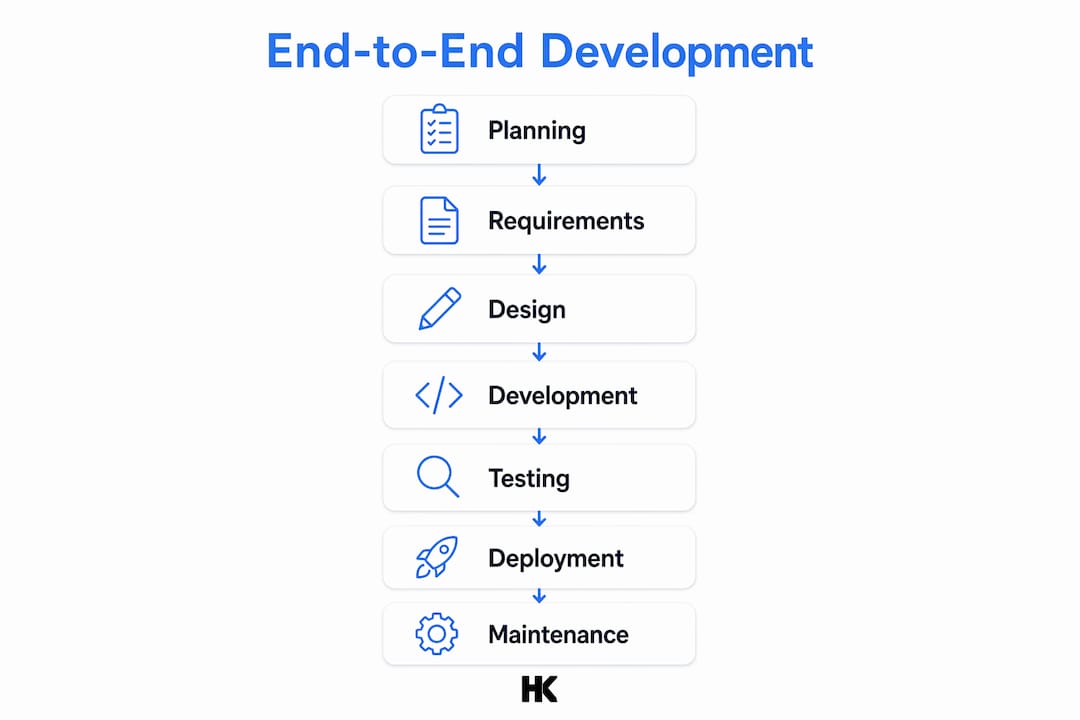
The SDLC breaks the end-to-end process into seven phases, each with specific deliverables that feed the next phase. Skipping or rushing a phase does not save time. It creates debt that surfaces later, usually at the worst possible moment.
| SDLC Phase | Typical Tasks | Primary Goal |
|---|---|---|
| Planning | Scope definition, resource allocation | Establish feasibility and budget |
| Requirements | User stories, functional specs | Define what the software must do |
| Design | Architecture diagrams, UI wireframes | Decide how the software will work |
| Development | Coding, code reviews, version control | Build the defined features |
| Testing | Unit tests, integration tests, QA | Verify correctness and catch defects |
| Deployment | Release pipelines, environment config | Deliver software to production |
| Maintenance | Bug fixes, performance monitoring | Keep software stable and current |
Each phase produces a documented artifact. That documentation is not bureaucracy. It is the evidence trail that lets you trace a production bug back to a requirement decision made in week one.
The practical benefit of this structure is risk control. Problems caught in the requirements phase cost a fraction of what they cost to fix after deployment. Structured lifecycle phases give project managers defined checkpoints to assess risk before committing resources to the next stage. For B2B SaaS teams, where a missed requirement can mean a failed enterprise demo, that early visibility is worth more than any individual technical decision.
End-to-end web development takes this further. One team handles front-end, back-end, databases, APIs, testing, deployment, and maintenance together. That single ownership model reduces the coordination overhead that kills velocity in fragmented teams.
How do DevOps and continuous delivery change the end-to-end process?
DevOps does not replace the SDLC. It reconfigures it. IBM explains that DevOps transforms rigid SDLC phases into a continuous cycle, enabling teams to deliver frequent, incremental updates instead of large, infrequent releases.
The cultural shift matters as much as the tooling. Atlassian describes DevOps teams as owning features end-to-end, with shared responsibility between development and operations creating faster iteration based on real user feedback. That ownership model is what separates a DevOps team from a team that simply uses CI/CD tools.
The core components of a DevOps-enabled end-to-end pipeline include:
- Continuous Integration (CI): Developers merge code frequently, triggering automated builds and tests on every commit.
- Continuous Delivery (CD): Every passing build is automatically prepared for release, reducing the manual steps between code and production.
- Infrastructure as Code: Environment configuration is version-controlled and reproducible, eliminating "works on my machine" failures.
- Automated monitoring: Production systems report errors and performance metrics back into the development cycle in real time.
Pipeline design quality determines whether continuous delivery actually works. IBM warns that flawed pipeline design threatens deployment continuity, turning what should be automated into fragile manual steps. A CI/CD pipeline that requires three manual approvals and two Slack messages to deploy is not continuous delivery. It is a waterfall process with better tooling.
Pro Tip: Audit your CI/CD pipeline for any step that requires a human to copy-paste a value, approve a ticket, or SSH into a server. Each of those steps is a reliability risk and a velocity bottleneck. Automate or eliminate them before adding new pipeline stages.
Why does security need to live inside the lifecycle, not after it?
Treating security as a final checklist is the most common and most expensive mistake in software delivery. NIST's SSDF exists specifically to correct this pattern. The framework provides high-level secure practices designed for integration across all SDLC phases, not for use as a single audit gate before release.
The DevSecOps model operationalizes that principle. NIST explains that DevSecOps combines development, security, and operations to continuously embed security throughout the software lifecycle, relying on automated flows to address risks early and prevent them from reaching production.
The practical difference between security-as-checklist and security-as-artifact is significant:
- Threat modeling in design phase: Identifies attack surfaces before a line of code is written.
- Static analysis in CI: Flags vulnerable code patterns on every commit, not once before launch.
- Dependency scanning: Catches known CVEs in third-party libraries automatically.
- Penetration testing in staging: Validates real-world attack resistance before production exposure.
"Security practices are most effective when integrated as ongoing artifacts in the SDLC, enabling traceability of what was checked, when, and with what results." — NIST SSDF
That traceability matters for EU-based teams in particular. GDPR and the EU AI Act both require documented evidence of security controls, not just assertions that controls exist. Embedding security as a continuous artifact across the lifecycle produces exactly that evidence, automatically, as a byproduct of normal development work.
How does end-to-end development improve predictability and team alignment?
The organizational benefits of a structured end-to-end process are concrete, not theoretical. IBM's SDLC research shows that structured lifecycle phases give project managers documented transparency for stakeholders and defined points for early risk mitigation. That transparency is what makes cross-functional teams function without constant escalation.
The contrast with fragmented workflows is stark:
| Dimension | Fragmented workflow | End-to-end aligned workflow |
|---|---|---|
| Risk visibility | Risks surface late, often in production | Risks identified at phase checkpoints |
| Stakeholder communication | Ad hoc updates, inconsistent information | Milestone-driven reports with documented artifacts |
| Team ownership | Handoffs between siloed groups | Shared accountability across the full lifecycle |
| Deployment frequency | Infrequent, high-risk releases | Frequent, low-risk incremental releases |
| Security posture | Security reviewed once before launch | Security embedded at every phase |
Disciplined development practices produce measurable improvements in predictability because every phase has defined entry and exit criteria. A developer knows when their work is done. A project manager knows when to move to the next phase. A stakeholder knows what to expect and when.
End-to-end ownership also reduces the coordination tax that kills velocity in larger teams. When one team owns the full lifecycle, there are no handoff delays, no blame cycles between development and operations, and no security reviews that block a release for three weeks because they were scheduled too late.
For B2B SaaS companies in the DACH region, this alignment has a direct commercial impact. Enterprise buyers in Germany, Austria, and Switzerland expect documented processes, clear audit trails, and predictable delivery timelines. A structured end-to-end process is not just an engineering preference. It is a sales asset.
Key takeaways
End-to-end development requires structured phases, continuous delivery pipelines, and security embedded throughout the lifecycle to produce reliable, production-ready software.
| Point | Details |
|---|---|
| SDLC provides the structure | Seven defined phases give teams clear objectives, deliverables, and risk checkpoints at every stage. |
| DevOps makes delivery continuous | CI/CD pipelines and shared ownership replace infrequent releases with frequent, low-risk increments. |
| Security belongs in every phase | NIST SSDF and DevSecOps embed security as ongoing artifacts, not a final gate before launch. |
| Ownership reduces coordination cost | One team covering the full lifecycle eliminates handoff delays and blame cycles between siloed groups. |
| Documentation is a business asset | Structured artifacts satisfy GDPR audit requirements and build trust with enterprise buyers in DACH markets. |
What I've learned from shipping software end-to-end
The hardest part of end-to-end development is not the technology. It is the discipline to treat every phase as equally important, even when a deadline is pressing and the temptation is to skip documentation or defer security reviews.
I built and shipped my own SaaS products end-to-end, and the pattern I saw repeatedly was this: teams that cut corners on requirements or design always paid for it in maintenance. The bugs that cost the most to fix were never technical surprises. They were requirements that were never written down.
The CI/CD pipeline lesson took longer to internalize. A pipeline that works 95% of the time is not a reliable pipeline. That 5% failure rate, compounded across dozens of deployments per week, creates exactly the kind of manual intervention and deployment anxiety that DevOps is supposed to eliminate. Reliability in the pipeline is not a nice-to-have. It is the foundation everything else depends on.
Security integration is where I see the most resistance from teams under pressure. The argument is always that security reviews slow things down. The reality is that a single production vulnerability costs more time to remediate than six months of integrated security checks. The NIST SSDF framing helped me articulate this to skeptical stakeholders: security artifacts are evidence, and evidence has value beyond the development team.
My work with clients at BMW and Deutsche Bahn reinforced that structured, documented processes are not overhead. They are what separates software that ships once from software that ships reliably for years.
— Hanad
End-to-end development support from Hanadkubat
Building software end-to-end requires more than good intentions. It requires the right architecture decisions from day one, a CI/CD pipeline that actually holds under pressure, and security practices that produce audit-ready evidence without slowing your team down.
Hanadkubat works directly with B2B SaaS teams and technical founders in the DACH region and beyond, covering the full lifecycle from scoping to production. Fixed prices, defined timelines, and no junior intermediaries. If your team is building a new product or rescuing a fragile codebase, the full service overview covers both tracks in detail.
FAQ
What does end-to-end mean in software development?
End-to-end in software development means one team or process owns every phase from planning and requirements through coding, testing, deployment, and maintenance. No phase is handed off to an unconnected group.
What are the phases of the SDLC in end-to-end development?
The SDLC covers seven phases: planning, requirements, design, development, testing, deployment, and maintenance. IBM defines each phase as having specific objectives and deliverables that guide the next stage.
How does DevOps fit into end-to-end software development?
DevOps transforms the SDLC from a sequential process into a continuous delivery cycle. Atlassian describes DevOps teams as owning features end-to-end, with development and operations sharing responsibility for every release.
Why is security integration important in end-to-end development?
Security treated as a final checklist consistently misses vulnerabilities that automated checks would catch earlier. NIST's SSDF framework provides practices for embedding security across every SDLC phase, producing traceable evidence rather than a single audit moment.
How does end-to-end development help project managers?
Structured lifecycle phases give project managers defined checkpoints, documented artifacts, and early risk visibility. IBM notes that this structure improves cost estimation, stakeholder alignment, and risk mitigation across the full project.