
TL;DR:
- End-to-end ownership assigns a single team or individual full accountability for a product or process lifecycle, from conception to continuous improvement. It enhances operational efficiency, reduces decision delays, and improves reliability by clarifying responsibilities and fostering collaboration across functions. Implementing this model requires clear boundaries, formal ownership contracts, measurable SLIs and SLOs, and a facilitative leadership approach to overcome organizational barriers.
End-to-end ownership is a governance framework where a designated owner or team holds full accountability for the entire lifecycle of a product, service, or process, from initial conception through execution, monitoring, and continuous improvement. This model applies across software products, IT services, business workflows, and operational processes. It eliminates the fragmented accountability that forms when design, delivery, and operations are split across separate teams with no unified owner. For business leaders and technology decision-makers, understanding this principle is the first step toward building organizations that respond faster, break fewer things, and fix problems without a blame cycle.
What is end-to-end ownership in practice?
End-to-end ownership means one person or team is accountable for every phase of a product or service lifecycle. That scope includes design, development, deployment, ongoing operations, incident response, and continuous improvement. It is not the same as being the person who writes the code or manages a sprint. It is the person who answers when the system goes down at 2 a.m. and who owns the roadmap for making it better next quarter.

In technical environments, true service ownership extends well beyond code delivery. It includes reliability targets expressed as SLIs and SLOs, operational runbooks, security posture, cost management, and on-call integration. A team that ships features on schedule but has no runbook and no defined escalation path does not practice end-to-end ownership. They practice feature delivery, which is a narrower and less accountable role.
In business process contexts, the scope is equally wide. A process owner for an order-to-cash workflow at a Mittelstand manufacturer is accountable for everything from order entry through invoicing and cash collection. That includes the handoffs between sales, logistics, and finance. If a handoff breaks, the process owner does not point at another department. They own the fix.
- Design and scoping: Define the boundaries of what is owned and what is not.
- Development and delivery: Oversee build quality and release readiness.
- Operations: Monitor performance, manage incidents, and maintain reliability.
- Continuous improvement: Run postmortems, track metrics, and iterate on outcomes.
Pro Tip: Write an ownership contract at the start of any new product or service. Include the SLIs you will measure, the SLOs you commit to, and the runbook location. This single document forces clarity before problems arise.
Why end-to-end ownership matters for business and tech leaders
Fragmented accountability impairs an organization's ability to respond to volatile market changes. When no single owner exists for a product or process, decisions stall, incidents escalate through three teams before anyone acts, and customers feel the friction before leadership does. This is not a theoretical risk. It is the default state of most organizations that have grown without deliberate ownership design.
End-to-end responsibility improves operational efficiency by creating clarity, enabling continuous feedback loops, and reducing decision latency. When one team owns the full lifecycle, they have both the context and the authority to act. They do not need to schedule a cross-functional meeting to approve a configuration change. They make the call, document it, and move forward.
"Organizations commonly struggle with the 'ship with too many captains' problem, where lack of unified ownership causes recurrent inefficiencies." — The GBS Edge
The business benefits are concrete. Faster incident resolution because the owner knows the system. Higher reliability because the owner feels the pain of downtime. Better cost management because the owner sees the infrastructure bill. These outcomes compound over time into a measurable competitive advantage, particularly for B2B SaaS companies where uptime and responsiveness directly affect retention.
Common symptoms of missing end-to-end ownership include:
- Incidents that bounce between teams with no clear resolution owner
- Features shipped that nobody monitors after go-live
- Process inefficiencies that everyone acknowledges but nobody fixes
- KPI conflicts between departments that share a workflow but own separate metrics
How end-to-end ownership differs from other models
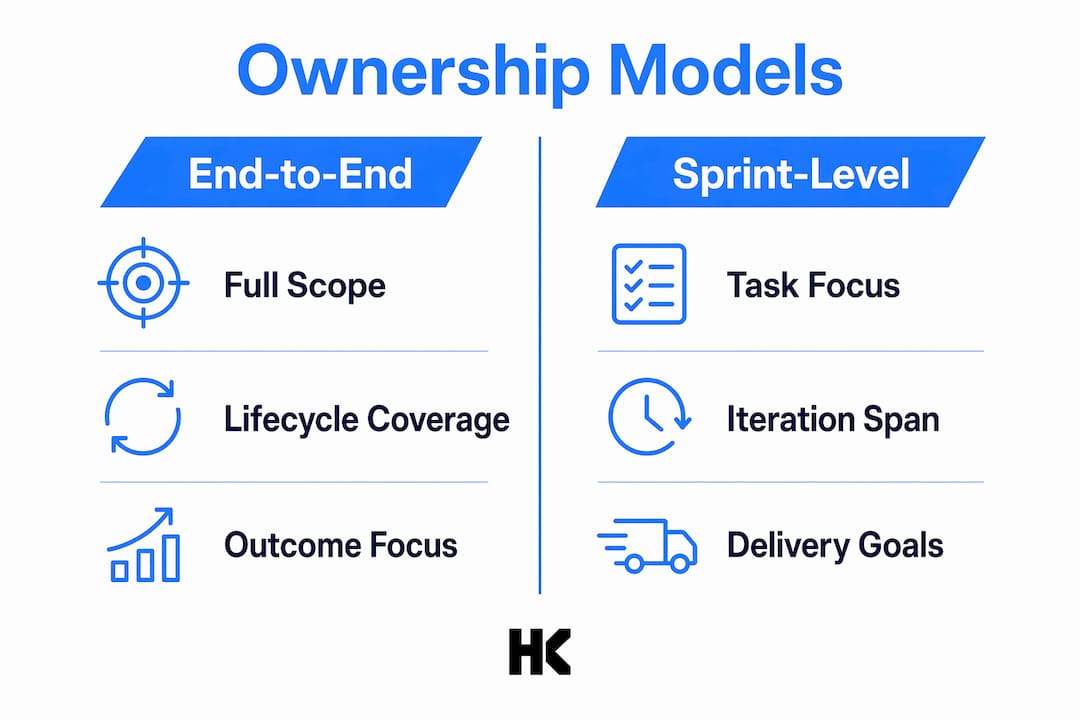
End-to-end ownership and sprint-level ownership address fundamentally different scopes. Sprint-level ownership focuses on delivering defined tasks within a two-week iteration. End-to-end ownership focuses on strategic outcomes across the full product or service lifecycle. Confusing the two leads to teams that ship features on schedule while the overall user journey degrades.
Code ownership, another common model, assigns responsibility for a specific codebase or module. It does not extend to the operational behavior of that code in production, its cost profile, or its contribution to business outcomes. Functional ownership, common in large enterprises, assigns accountability by department rather than by product or process. A finance team owns the ERP configuration; an IT team owns the infrastructure. Neither owns the end-to-end experience.
| Ownership model | Scope | Outcome focus | Lifecycle coverage |
|---|---|---|---|
| End-to-end ownership | Full product or process lifecycle | Business outcomes and reliability | Conception through improvement |
| Sprint-level ownership | Task delivery within an iteration | Feature completion | Single sprint |
| Code ownership | Specific codebase or module | Code quality and maintainability | Development phase only |
| Functional ownership | Department-specific responsibilities | Departmental KPIs | Partial, siloed |
For product managers, this distinction defines the job. A product manager practicing end-to-end product development owns the outcome, not just the backlog. For engineers, it means accountability does not end at the merge request. For process owners in operations or finance, it means owning the handoffs, not just the steps within their department.
Pro Tip: When hiring or assigning an end-to-end owner, test their understanding of the full lifecycle in the first conversation. If they describe their role as "managing the backlog" or "owning the code," the scope needs to be reset before they start.
How to implement end-to-end ownership in your organization
Implementing end-to-end ownership requires deliberate structure. It does not emerge from good intentions or org chart changes alone. The following steps reflect best practices for technical teams and apply equally to business process environments.
-
Map and define boundaries. Identify the full scope of what is being owned. For a SaaS product, this means every component from user authentication through billing and support. For a business process, this means every step and every handoff from start to finish. Ambiguous boundaries are the most common cause of ownership gaps.
-
Assign a dedicated owner with a formal mandate. The owner must have a clear charter. That charter should specify what they are accountable for, what decisions they can make unilaterally, and where they need to escalate. Without a mandate, the owner has a title but no authority.
-
Create an ownership contract. For technical services, this means defining SLIs, SLOs, and runbooks before the service goes to production. For business processes, it means documenting performance targets, escalation paths, and improvement responsibilities. This contract makes ownership measurable and visible to the rest of the organization.
-
Instrument monitoring and feedback loops. An owner without visibility is an owner in name only. Set up dashboards, alerts, and regular review cadences. For SaaS products, this means production monitoring with defined alert thresholds. For business processes, this means process performance metrics reviewed on a fixed schedule.
-
Build collaboration structures. End-to-end ownership does not mean the owner works alone. It means they are the accountable party who coordinates across functions. Regular touchpoints with engineering, operations, finance, and customer success keep the owner informed and keep stakeholders aligned.
Key elements of a working ownership contract:
- Defined SLIs and SLOs with agreed measurement methods
- Runbooks for common failure scenarios
- Escalation paths with named contacts and response time targets
- Cost visibility with a defined budget owner
- Postmortem process with a standard template
Pro Tip: Run a disciplined development review before assigning ownership of any existing product or service. You need a clear picture of the current state before you can define what the owner is inheriting.
What challenges should leaders anticipate?
Lack of formal authority is the most common barrier to effective end-to-end ownership. In most organizations, the end-to-end owner does not have direct authority over every team involved in the lifecycle. A process owner for a procurement workflow cannot fire the IT team that manages the ERP. This creates decision gridlock when cross-functional alignment is needed.
The solution is not to grant more authority. It is to shift the owner's role from controller to facilitator. Effective ownership means aligning functional owners, managing improvement pipelines, and mediating consensus. The owner's power comes from visibility and coordination, not hierarchy.
"Assigning an end-to-end process owner alone does not fix inefficiencies unless backed by clear communication channels and a mandate to facilitate consensus." — Implement Consulting Group
Other challenges that consistently derail ownership programs:
- Cross-functional resistance: Teams protecting their own KPIs resist changes that benefit the end-to-end process but complicate their local metrics. Address this by aligning incentives at the leadership level before assigning ownership.
- Poor communication: Ownership breaks down when the owner stops communicating proactively. Weekly status updates and shared dashboards prevent information gaps from becoming trust gaps.
- Confusing labels with commitment: Calling someone a "service owner" without giving them SLOs, monitoring access, and on-call responsibilities creates the appearance of ownership without the substance. This is a deployment label, not operational commitment.
- Scope creep: Owners who accept accountability for everything end up accountable for nothing. Tight boundary definitions at the start prevent this.
For enterprise teams at organizations like Deutsche Bahn or Bundesrechenzentrum Austria, where governance layers are thick and cross-departmental dependencies are deep, the facilitative model is not optional. It is the only model that works at scale.
Key takeaways
End-to-end ownership works when a designated owner holds formal accountability for the full lifecycle, backed by an ownership contract, measurable SLOs, and a facilitative mandate across functions.
| Point | Details |
|---|---|
| Full lifecycle accountability | The owner is responsible from design through operations and improvement, not just delivery. |
| Ownership contracts are required | SLIs, SLOs, runbooks, and cost visibility make ownership measurable and enforceable. |
| Facilitation beats authority | Owners succeed by aligning stakeholders and managing improvement pipelines, not by controlling teams. |
| Sprint-level is not end-to-end | Feature delivery within iterations addresses tasks, not strategic outcomes or operational health. |
| Monitoring closes the loop | Without dashboards and feedback cadences, ownership exists on paper but not in practice. |
Why I think most organizations get this wrong from the start
I have worked inside organizations at BMW, Deutsche Bahn, and Bundesrechenzentrum Austria, and I have built my own SaaS products end-to-end. The pattern I see most often is not a lack of ownership desire. It is a structural mismatch between the title and the tools.
Companies assign an owner, write it in a RACI matrix, and consider the problem solved. Six months later, incidents still bounce between teams, the process still has the same bottlenecks, and the "owner" is frustrated because they have accountability without authority or visibility. The RACI did not come with a runbook, a monitoring dashboard, or a mandate to facilitate cross-functional decisions.
The enterprise-grade approach treats ownership as an operational commitment, not an organizational label. That means the owner has SLOs they can measure, alerts they receive, and a postmortem process they run. It also means leadership has aligned the incentives so that functional teams support the owner's decisions rather than block them.
For startups and early-stage SaaS teams, the challenge is different. Ownership is often implicit because the founding team does everything. The problem surfaces at scale, when the team grows and nobody has formalized who owns what. By the time the first major incident hits, the ownership gaps are expensive to fix. I have seen this pattern cause technical delivery failures that set companies back by quarters.
The fix is the same in both contexts: define the boundaries, write the contract, instrument the monitoring, and give the owner a facilitative mandate. Do that before you need it.
— Hanad
Build products with real ownership built in from day one
If you are a CTO, technical founder, or IT director who wants accountability embedded in your product from the first sprint rather than retrofitted after the first incident, Hanadkubat works with you directly on exactly that.
Hanadkubat ships production-ready SaaS products and AI features with full lifecycle ownership built into the architecture from the start. Fixed prices, defined timelines, and no handoff to a junior team. Whether you need a complete MVP build from €18,000 or a focused strategy sprint at €1,500 to scope your next product, every engagement includes the governance structure that makes ownership real. Explore the service tracks and pricing at hanadkubat.com.
FAQ
What does end-to-end ownership mean?
End-to-end ownership means a single person or team is fully accountable for a product, service, or process from initial design through ongoing operations and improvement. It eliminates fragmented responsibility by placing one owner in charge of the complete lifecycle.
How is end-to-end ownership different from sprint-level ownership?
Sprint-level ownership covers task delivery within a single iteration, while end-to-end ownership covers strategic outcomes across the full product or service lifecycle. Confusing the two results in teams that ship features on schedule but fail to optimize the overall user experience or business value.
What should an ownership contract include?
An ownership contract should define SLIs and SLOs, operational runbooks, escalation paths, cost visibility, and a postmortem process. These elements make ownership measurable and give the owner the tools to act when something breaks.
What is the biggest barrier to end-to-end ownership?
Lack of formal authority across cross-functional teams is the primary barrier, often causing decision gridlock. The solution is to position the owner as a process facilitator who aligns stakeholders and manages improvement pipelines rather than attempting to control teams directly.
Does end-to-end ownership apply outside of software teams?
Yes. End-to-end process ownership applies to any business workflow, including procurement, order-to-cash, and customer onboarding. The same principles apply: define boundaries, assign an accountable owner, instrument performance metrics, and build feedback loops into the process.