
TL;DR:
- Disciplined development involves explicit decision-making and documentation to achieve predictable results amid complexity and ambiguity. It enables faster delivery, improved risk management, and better adoption of AI workflows by reducing miscommunication and alignment issues. Teams should start small, tailor practices to their context, and focus on specific failure modes to build a scalable, effective process.
Most teams assume discipline in software development means slower delivery, more bureaucracy, and less room for creative problem-solving. That assumption costs projects dearly. The real case for why use disciplined development is not about adding process for its own sake. It's about getting predictable results in environments where ambiguity, scope creep, and misaligned teams are the default. This article breaks down what disciplined development actually means in 2026, where it outperforms looser methodologies, and how business leaders can adopt it without grinding their teams to a halt.
Table of Contents
- Key takeaways
- Why use disciplined development: what it actually means
- The real benefits of disciplined development
- How to adopt disciplined practices in your team
- Disciplined development vs. agile and unstructured methods
- My take on discipline in real projects
- Thinking about disciplined development for your next project?
- FAQ
Key takeaways
| Point | Details |
|---|---|
| Discipline enables speed | Structured practices reduce rework and alignment drift, making teams faster over time, not slower. |
| Context determines method | Team size, regulatory environment, and technical complexity should drive which disciplined practices you adopt. |
| AI workflows need hard contracts | Version-controlled specs and enforced rules outperform informal conventions when working with AI coding agents. |
| Specs prevent expensive ambiguity | Closing key decisions before implementation reduces costly surprises during QA and incident response. |
| Adaptability is built in | Disciplined Agile toolkits allow continuous evolution of your Way of Working as teams and contexts change. |
Why use disciplined development: what it actually means
Disciplined development is not a single methodology. It's a category of practices that share a common commitment: make decisions deliberately, record them explicitly, and build from a shared, verifiable understanding of what needs to be built and why.
The contrast with ad hoc or "vibe coding" approaches is stark. In unstructured workflows, requirements live in chat threads and verbal agreements. Developers interpret intent differently. When something breaks in production, nobody can reconstruct the original decision logic. That's not a team failure. It's a structural one.
Disciplined Agile (DA) defines the alternative clearly: a flexible toolkit that lets teams choose practices fitting their specific context while maintaining enterprise governance and coordination. It scales from early-stage startups to regulated global enterprises. The key word is toolkit. No single practice is mandatory. What matters is that teams make conscious choices rather than defaulting to whatever feels easiest in the moment.
Plan-driven development (PDD) represents the more formal end of the disciplined spectrum. Here, early clarity on scope, roles, and risks is non-negotiable. Milestone delivery checkpoints and risk registers turn risk management from a reactive scramble into a repeatable routine. This is not waterfall in disguise. PDD can incorporate iterative delivery within a governed planning structure.
| Approach | Decision-making | Documentation | Risk management | Best context |
|---|---|---|---|---|
| Disciplined Agile | Context-driven | Lightweight artifacts | Continuous, adaptive | Growing teams, enterprise scale |
| Plan-driven (PDD) | Milestone-gated | Formal specs and registers | Structured reviews | Regulated, high-cost-of-error systems |
| Ad hoc / vibe coding | Reactive | Minimal or none | Informal | Prototypes only |
The core principles shared across disciplined approaches include early clarity on what is being built, formal or semi-formal specifications, governance that scales with team size, and controlled change management. These are not bureaucratic constraints. They're the mechanisms that allow complex teams to stay coordinated without constant synchronization overhead.
The real benefits of disciplined development
The benefits of disciplined development show up most clearly when things go wrong. A scope change request arrives mid-sprint. A key engineer leaves. An AI coding agent generates a feature that misses the original intent. Disciplined practices are what determine whether these events cause a day's delay or a month's rework.

Risk reduction through early clarity. Plan-driven development works best where the cost of being wrong is high: complex systems, regulated industries like finance and healthcare, and projects with dependencies on third-party integrations. Milestones tied to measurable engineering gates keep the plan honest and give decision-makers real data at each checkpoint rather than optimistic status updates.
Reduced cognitive debt in AI-assisted workflows. This is where the importance of structured development has spiked in 2026. Specification-driven development replaces vague prompting with clear specs that act as enduring artifacts. The plan-implement-verify loop means intent is preserved across iterations, not reconstructed from memory each time. When a spec exists, the AI agent has context. When it doesn't, the agent improvises.
Governed AI code generation. Structured Prompt-Driven Development (SPDD) treats prompts as first-class artifacts in version control. Structured prompts encode requirements, design intent, and constraints, making AI code generation reviewable and repeatable. This directly reduces alignment drift between what the product manager specified and what the engineer or agent shipped.
- Documented specs reduce the gap between business intent and technical implementation
- Version-controlled artifacts allow new team members to understand decisions without a knowledge transfer meeting
- Governed change management prevents scope creep from accumulating silently
- Structured prompts make AI contributions auditable, not just functional
Pro Tip: Before introducing any new disciplined practice, identify one specific failure mode your team has hit in the last three months. Choose the practice that addresses that failure directly. Generic adoption of "more process" rarely sticks.
The hard contracts approach to AI workflows makes this concrete. LLMs lack persistent working memory. Soft conventions ("always add tests") evaporate between sessions. Enforced rules encoded in artifact persistence, test-driven gates, and self-check scripts don't. Teams that enforce hard contracts reduce token budget waste and improve code quality measurably.
How to adopt disciplined practices in your team
Adoption failure is common because teams try to implement everything at once. The disciplined development advantages compound over time, but only if the initial implementation is scoped correctly.
Start with a diagnostic. Before choosing practices, assess three dimensions:
- Team size and distribution. A five-person co-located team needs lighter governance than a 40-person distributed team with offshore contractors. The Disciplined Agile toolkit explicitly adjusts recommended practices based on these factors.
- Regulatory and compliance environment. B2B SaaS products subject to GDPR, the EU AI Act, or SOC 2 requirements need documented decision records. A quick-iteration consumer app may not. The cost of missing this distinction is an expensive audit finding, not just a missed sprint.
- Technical complexity and AI involvement. Teams using AI coding agents need versioned prompts and specs to prevent repeated context reconstruction. Teams without AI involvement can use lighter artifact management.
Once the diagnostic is done, build a custom Way of Working rather than adopting a full framework wholesale. Disciplined Agile supports this explicitly: choose the practices that fit, not the practices that are theoretically correct.
For teams moving toward plan-driven workflows, introduce milestone-driven planning in phases. Start with a single delivery milestone tied to a measurable engineering gate. Require a brief risk register for that milestone. Review it honestly at the checkpoint. This creates the muscle memory for controlled change management without demanding a full PDD overhaul on day one.
For AI-assisted development workflows, the adoption path is specific. Closing key decisions in specifications before implementation is the highest-leverage action. An ambiguous spec produces ambiguous code whether a human or an LLM writes it. Add MLflow's Prompt Registry or a similar tool to version-control your prompts. Combine feature specs with architectural decision records (ADRs) to eliminate repeated context reconstruction when team membership changes.
Pro Tip: Treat your first disciplined practice as an experiment with a 30-day review. Define one success metric upfront, such as fewer rework cycles or faster QA sign-off. Review the data. If it worked, extend it. If it didn't, adjust.
Combining feature specs with ADRs also reduces onboarding overhead significantly. New engineers understand not just what was built but why specific decisions were made. That context is typically lost in codebases without structured documentation.
Disciplined development vs. agile and unstructured methods
The debate between disciplined development and traditional agile frameworks often generates more heat than clarity. The honest comparison depends on context, not ideology.
Traditional agile frameworks like Scrum and Kanban excel at short feedback loops in small, stable teams. Where they struggle is at scale and in regulated environments. A 15-team product organization running independent Scrum sprints with no coordination layer will produce integration conflicts, duplicate work, and architectural drift. This is not a failure of agile principles. It's a failure to recognize that agile's original design context was a single, co-located team.
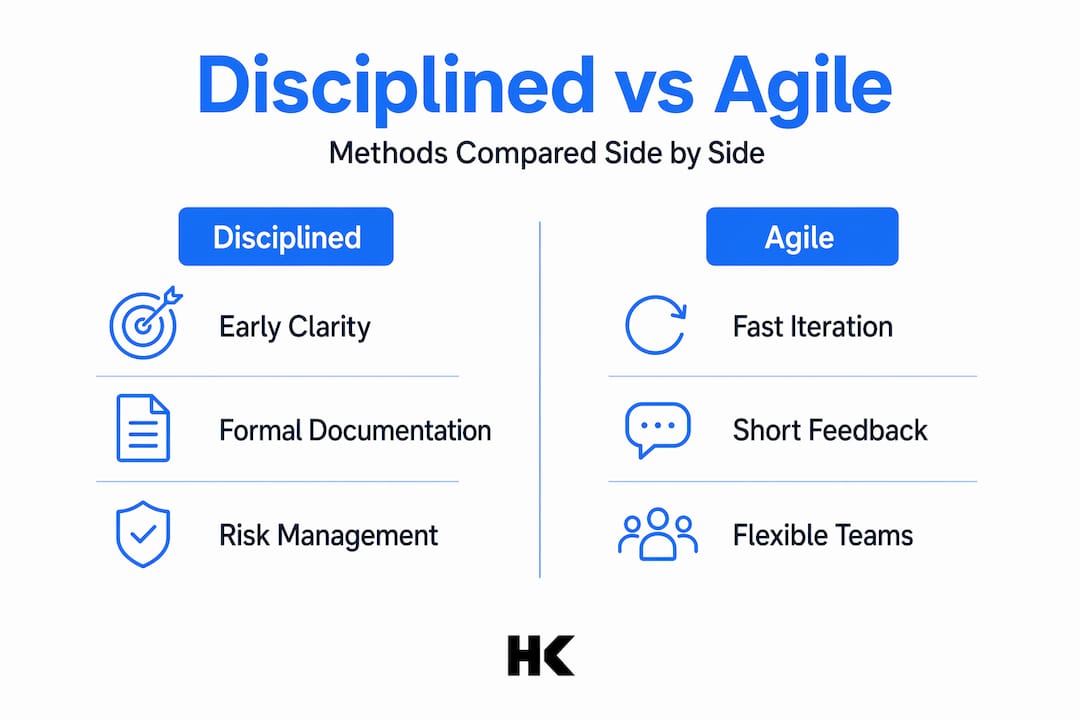
Disciplined Agile's context-driven approach addresses this directly. Teams select practices based on situation including team size, compliance needs, and technical complexity. An enterprise healthcare SaaS product with strict audit requirements needs different governance than an internal analytics tool. Disciplined Agile supports both without forcing either into an inappropriate framework.
| Dimension | Traditional agile | Disciplined Agile / PDD | Unstructured / ad hoc |
|---|---|---|---|
| Scalability | Limited without coordination | Designed for scale | Does not scale |
| Regulatory fit | Requires adaptation | Native support | Incompatible |
| AI workflow governance | Minimal | Explicit | None |
| Onboarding new team members | Dependent on tribal knowledge | Artifacts reduce dependency | High cost |
| Change management | Sprint-level only | Milestone-gated and auditable | Reactive |
The danger of unstructured methods, particularly ad hoc AI-assisted coding, is not that they produce bad code immediately. It's that they produce technical decisions with no paper trail. Six months later, when a feature breaks or a compliance audit arrives, nobody can reconstruct why the system was built the way it was. Disciplined development best practices prevent this by making documentation a natural output of the development process, not an afterthought.
The disciplined development advantages in enterprise and regulated environments are not marginal. They're structural. A team that has learned to work with specs, ADRs, and version-controlled prompts operates on a different level of coordination than one that doesn't.
My take on discipline in real projects
From my experience delivering software for BMW, Deutsche Bahn, and Bundesrechenzentrum Austria, discipline in development is almost never the limiting factor people think it is when a project struggles. The real limiting factor is usually ambiguity that was allowed to persist too long.
I've seen teams spend three weeks in rework because a spec was never written. I've seen AI-generated code pass review and then fail an EU AI Act compliance check because no one had encoded the regulatory constraints into the prompt. Both failures had the same root cause: decisions were deferred rather than made.
What I've learned is that the teams who resist disciplined practices the most are often the ones who feel the slowest once projects scale. The upfront investment in a spec or a structured prompt feels like overhead until you've experienced the alternative: a broken production environment where no one can agree on what the original intent was.
My honest advice for product managers evaluating whether to adopt disciplined practices is to start with one artifact. Pick the one that addresses your most recurring failure mode. Version it. Use it for 30 days. The compounding effect of having a shared, verifiable record of decisions is something you can't fully appreciate until you've experienced a complex project without one.
Discipline does not limit creativity. It gives creativity a stable foundation to build on. The teams I've worked with that ship fastest are also the ones with the clearest specs and the most deliberate decision records. That's not a coincidence.
— Hanad
Thinking about disciplined development for your next project?
If the patterns described here resonate and you're evaluating how to apply them in your own product team, Hanadkubat works directly with B2B SaaS teams and non-technical founders across the DACH region and EU to scope, build, and ship products with the kind of structure that prevents expensive surprises.

Whether you need a strategy sprint to define the right development approach before committing to a build, or a rescue engagement for a codebase that has accumulated too much undocumented technical debt, the work is done at fixed prices and shipped in weeks. There's no project manager between you and the person writing the code. You can review the full range of services and resources at hanadkubat.com and reach out directly to discuss your situation.
FAQ
What is disciplined development in software projects?
Disciplined development refers to a category of structured practices, including Disciplined Agile and plan-driven development, where teams make deliberate decisions, document them explicitly, and govern changes systematically. It is not a single framework but a toolkit of practices selected based on team context.
Why adopt disciplined practices for AI-assisted coding?
AI coding agents lack persistent memory, meaning informal conventions evaporate between sessions. Hard contracts and structured prompts enforce discipline by encoding requirements and design constraints as version-controlled artifacts, making AI contributions reviewable and reducing alignment drift.
When does plan-driven development outperform agile?
Plan-driven development is most effective where the cost of being wrong is high, such as in regulated industries, complex multi-team systems, or projects with stable and well-understood requirements. Milestone-gated checkpoints tied to measurable engineering criteria provide decision-makers with reliable progress signals.
How do teams start with disciplined development without disrupting delivery?
Start with one artifact that addresses your team's most common failure mode, such as a feature spec or a prompt template. Version it, use it for 30 days, and evaluate the result against a specific success metric like fewer rework cycles or faster QA sign-off before expanding to additional practices.
What are the benefits of disciplined development for scaling teams?
The core benefits of disciplined development at scale include reduced coordination overhead through shared documented artifacts, faster onboarding through architectural decision records, and better change management through milestone-gated reviews rather than reactive sprint adjustments.