
TL;DR:
- Most founders mistakenly believe launching an MVP signals the end of development challenges, but scalability remains unaddressed. Building a product that grows without breaking requires deliberate, staged phases of discovery, validation, execution, and scaling, especially for non-technical founders. Prioritizing learning, modular architecture, and early edge case testing ensures products can handle real growth and avoid costly rebuilds later.
Most founders launch an MVP and assume the hardest part is done. It isn't. Shipping fast is one skill. Building something that can grow without falling apart is a completely different one. The painful truth is that most early-stage products are not built to scale. They're built to prove a point. And when real users show up, the cracks appear fast. Core development phases include Discovery, Validation, Execution, and Scaling, and most MVPs skip or rush at least two of them. This guide breaks down exactly what scalable product development means, why it matters from day one, and how non-technical founders can actually apply it without needing to write a single line of code.
Table of Contents
- What is scalable product development?
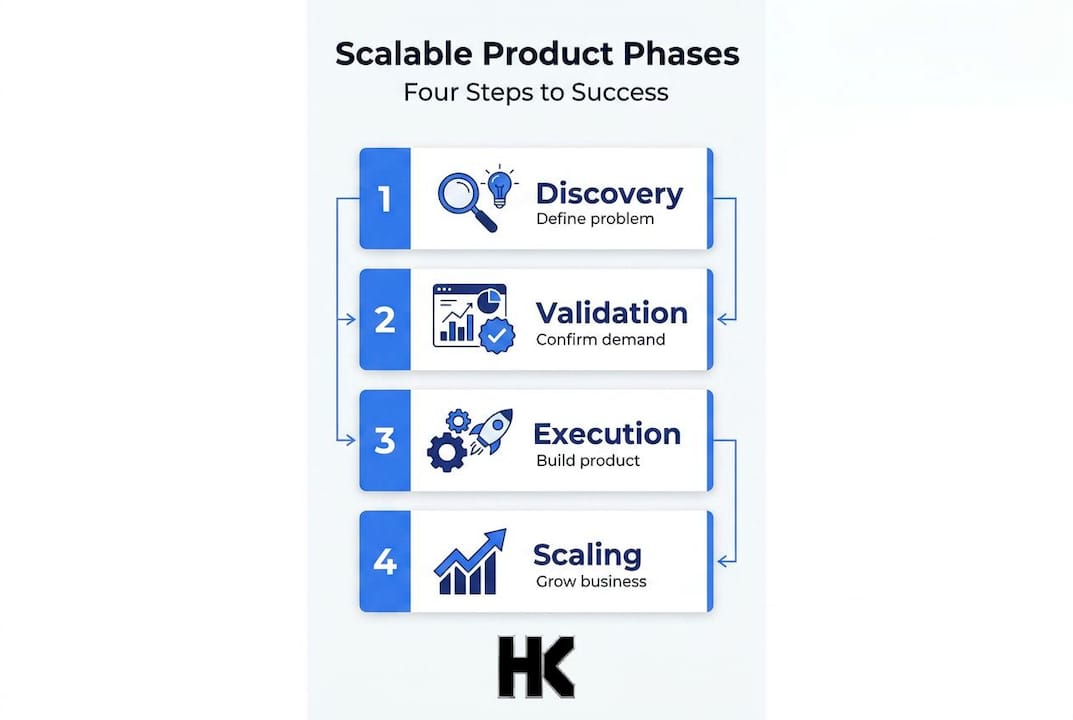
- The four phases: From discovery to scaling
- Key methodologies for scalability: Design Thinking, Lean, Agile
- Cost, speed, and edge cases in scalable product development
- Practical steps for non-technical founders to ensure scalability
- What most founders get wrong about scalable product development
- Need a senior partner for scalable product development?
- Frequently asked questions
Key Takeaways
| Point | Details |
|---|---|
| Sequence matters | Following the right stack—Discovery, Validation, Execution, Scaling—prevents costly redesigns later. |
| MVP ≠ scalable | Most MVPs are not scalable by default unless built with future growth and real user validation. |
| Senior expertise helps | Partnering with a senior technical expert enables smarter, faster, more scalable development for non-technical founders. |
| Test edge cases early | Catching risky assumptions and edge users early saves time and prevents product failures at scale. |
What is scalable product development?
Scalable product development means building a product in a way that lets it grow in users, features, and complexity without requiring a full rebuild every six months. It's not about over-engineering from the start. It's about making smart, deliberate choices early that keep your options open later.
Think of it like plumbing in a house. If you install pipes that only support two bathrooms, adding a third later means tearing out walls. If you plan for expansion from the beginning, adding that bathroom is straightforward. Software works the same way.
The classic cautionary tales are Twitter's "Fail Whale" and Monzo's early overload. Twitter's infrastructure buckled under viral growth in its early years because the architecture wasn't designed to handle millions of concurrent users. Monzo, the UK challenger bank, faced serious performance issues during rapid customer acquisition because the system wasn't stress-tested against real usage spikes. Both companies survived and rebuilt. Most startups don't have that runway.
Here's why this matters for MVPs specifically. An MVP is meant to be the smallest version of your product that tests a hypothesis. That's the right goal. But "small" should not mean "throwaway." There's a real difference between deliberately simple and accidentally fragile.
The development phases that support scalable product development are:
| Phase | Purpose | Scalability focus |
|---|---|---|
| Discovery | Understand user problems | Validate before building |
| Validation | Test riskiest assumptions | Avoid costly pivots |
| Execution | Build iteratively | Modular, clean architecture |
| Scaling | Grow users and features | Infrastructure and team growth |
Each phase builds on the previous one. Skipping Discovery means you build the wrong thing. Skipping Validation means you build it at full cost. Skipping proper Execution means the thing you built breaks when people actually use it.
Following best practices for non-technical founders means treating each phase as a real checkpoint, not a formality. The goal is to reduce waste and build confidence before committing serious money to code.
The four phases: From discovery to scaling
Now that scalable product development is defined, let's explore the essential phases every founder should follow and what makes each one actually work.
Phase 1: Discovery
Discovery is where you stop guessing and start listening. Design Thinking drives this phase. You're conducting user interviews, mapping pain points, and identifying the real problem worth solving. Most founders rush this because it feels slow and unproductive. It isn't. Every hour spent in Discovery can save days of wasted development later.

A critical output from Discovery is a clearly defined problem statement. Not "users want a better project management tool" but "remote teams with under ten people lose up to three hours a week coordinating async tasks because their current tools require too many manual updates." That specificity guides every decision that follows.
Phase 2: Validation
Validation is where you test your core assumptions before writing production code. The Build-Measure-Learn loop from the Lean Startup methodology is the engine here. You build the cheapest possible version of your idea, whether that's a landing page, a clickable prototype, or a no-code mock, and you measure real user behavior.
The goal is not to get compliments. The goal is to find out if people will actually pay, sign up, or change their behavior for your product. Validation done right protects you from the most expensive mistake in startups: building something nobody wants. You can explore step-by-step product validation to structure this process before you spend anything on engineers.
Phase 3: Execution
Execution is where the actual product gets built, in iterative Agile sprints. Each sprint typically runs one to two weeks and produces working, testable software. The focus is on releasing early, getting feedback, and adjusting. Not building in isolation for three months and hoping it lands.
Agile execution supports scalability because it forces modular thinking. You build one thing, you ship it, you see how it performs. That approach naturally produces cleaner code and clearer architecture than a six-month "big bang" release.
Phase 4: Scaling
Scaling covers both technical infrastructure and team growth. This is when you add server capacity, optimize databases, expand your technical team, and layer in new features that real users have validated. The critical word here is "actual usage data." You scale what's proven, not what you predict.
"The best sequence is Design Thinking for discovery, Lean Startup for validation, then Agile for execution. Skipping steps doesn't save time, it creates debt." Source
Following proper MVP launch steps means respecting this sequence. Founders who jump straight to Agile without doing Discovery and Validation end up building fast in the wrong direction.
Pro Tip: Don't start writing requirements for developers until you've done at least five user interviews. Five conversations can completely reframe what you thought you needed to build.
Key methodologies for scalability: Design Thinking, Lean, Agile
Understanding the phases, let's see how proven methodologies practically support scalability, especially for non-technical teams.
The three core methodologies are Design Thinking, Lean Startup, and Agile. Each one handles a different job. Using all three in sequence is what produces scalable, validated products. Using just one, or using them out of order, creates the most common startup failure modes.
The best sequence is clear: start with Design Thinking for discovery, move to Lean Startup for validation, and use Agile for execution. This isn't arbitrary. Each methodology is optimized for a specific type of uncertainty, and the sequence moves you from the most uncertain (does this problem exist?) to the least uncertain (how do we build this efficiently?).
| Methodology | Primary purpose | Key strength | Main risk if misused |
|---|---|---|---|
| Design Thinking | Understand user problems deeply | Human-centered, surfaces real needs | Produces insights without action |
| Lean Startup | Validate assumptions cheaply | Eliminates waste, speeds learning | Can lead to endless pivoting |
| Agile | Execute and iterate efficiently | Delivers working software fast | Builds wrong things quickly |
Here's what that looks like in practice. A founder using Design Thinking discovers that small e-commerce stores struggle with inventory management, not checkout conversion. She then uses Lean Startup to build a simple no-code prototype and validates that 40 out of 50 store owners would pay for automated low-stock alerts. She then brings in a technical partner to run Agile sprints and builds that specific feature first, with clean, modular architecture.
That sequence took eight weeks and cost a fraction of what it would have cost to just hand specs to a dev agency. And the product that came out the other side was built on proven demand, not hope.
Why do founders skip these steps? Usually because they feel slow at the start. Sitting in user interviews when you could be "building" feels like procrastination. But the founders who skip Discovery and Validation are the ones who later say they wasted six months building the wrong thing.
For lean MVP creation, the methodology sequence isn't optional. It's the whole strategy. And choosing the right MVP architecture from the start, guided by an experienced technical partner, means you won't need a full rebuild six months after launch.
Key principles for non-technical founders working through these methodologies:
- Talk to at least ten potential users before writing a single product requirement
- Build prototypes with tools like Figma or no-code platforms before any real development
- Treat your first sprint outputs as experiments, not finished products
- Review metrics after every sprint and cut features that don't move the needle
- Involve your technical partner in the Discovery phase, not just the build phase
Cost, speed, and edge cases in scalable product development
With frameworks in place, what should founders expect for timeline, cost, and handling unexpected hurdles?
Let's start with real numbers. A lean MVP typically runs $75,000 to $140,000 with a three to eight week discovery phase. A market-ready version one product typically costs $140,000 to $280,000. Those numbers reflect traditional development.
But the numbers shift significantly with no-code and modular tools. One Singapore startup launched their MVP in nine days by using modular business primitives, saving 94% of the cost compared to traditional development. That's not an outlier anymore. Founders who use the right tools can validate ideas in days, not months.
That said, cost cutting has limits. The biggest hidden cost in startup product development isn't the initial build. It's the rebuild. Founders who choose the cheapest developer, skip architecture planning, or build without thinking about scale are the ones who come back two years later needing a full rewrite.
| Development approach | Typical MVP cost | Timeline | Scale readiness |
|---|---|---|---|
| Traditional custom build | $75k to $140k | 3 to 6 months | High if done well |
| No-code plus modular tools | $5k to $30k | 1 to 4 weeks | Medium, depends on platform |
| Hybrid (no-code validation, then custom) | $30k to $80k | 6 to 12 weeks | High with right partner |
Edge cases are where scalability stress tests happen, and most teams ignore them until it's too late. Testing riskiest assumptions first is not just good practice; it's the difference between catching a fault in week two versus week twenty.
Edge cases to watch for in scalable MVPs:
- AI and data features: Machine learning models behave differently at scale. A recommendation engine that works for 500 users may produce garbage results for 50,000 users because the training data was too narrow.
- Microservices failures: Splitting your product into microservices sounds scalable, but poorly planned microservices create more failure points. Monzo's early issues came partly from an underestimated network complexity between services.
- Unexpected user behavior: Real users use products in ways you never anticipated. Stress tests based on your assumptions will always miss the actual breaking point. Only edge case testing surfaces those failure modes.
You can learn how to build an MVP without coding and still maintain scalability if you choose platforms designed for growth. But you still need someone experienced enough to spot when a no-code solution is starting to hit its ceiling.
Pro Tip: Always test the riskiest assumption first. Not the most exciting feature, not the flashiest use case, but the one thing that, if it turns out to be wrong, kills the whole business model. Every hour spent on that assumption saves ten hours later. And avoiding common MVP pitfalls starts with being honest about which assumptions are actually risky.
Practical steps for non-technical founders to ensure scalability
To wrap up, here's how you can apply all of this as a non-technical founder, concretely and effectively.
The core insight from lean MVP development for startups is straightforward: non-technical founders need to focus on ruthless prioritization, validated learning, and modular foundations built with a senior technical partner. That's not three separate things. It's one integrated approach.
Here are the practical steps:
-
Work with a senior technical partner from day one. Not a freelancer you found on Fiverr. Not an agency that assigns a junior developer to your project. A senior engineer who has built and scaled products before, ideally one who has also founded or co-founded something. That experience gap is enormous and it shows in every architecture decision.
-
Define your single core feature. What is the one thing your product does that justifies its existence? Everything else is secondary. Build that one thing well, make it scalable, and validate it before adding anything else. Feature bloat is the most common reason early products become unmaintainable.
-
Prioritize validated learning over theory. You do not know what your users want until they show you with behavior. Not surveys, not interviews alone, actual usage data. Run experiments. Track drop-off points. Watch session recordings. Let the data lead the roadmap, not your gut.
-
Lay modular, scalable technical foundations. This doesn't mean building microservices on day one. It means making architectural decisions that keep your options open. Using established frameworks, clean API structures, and separation of concerns. Your technical partner should be able to explain these choices in plain language, and if they can't, that's a red flag.
-
Treat edge cases as early warning signals. When one user hits a bug that nobody else hits, investigate it immediately. Those isolated incidents are often the first sign that your architecture has a fundamental weakness. Smart founders treat edge cases as product intelligence, not annoyances.
-
Invest in MVP UX strategies from the start. Poor UX is a scalability problem too. If users can't figure out how to use your product, you'll face retention issues long before you face infrastructure issues. Clean UX also tends to reflect clean product thinking, which correlates with cleaner code.
Common pitfalls to avoid:
- Choosing speed over architecture in the first sprint (you'll pay for it in sprint ten)
- Building features based on requests from a single user
- Treating your technical debt as a "future problem" until it becomes a crisis
- Hiring engineers before validating the product with users
- Ignoring performance monitoring until users start complaining
For founders who want to apply fast MVP validation best practices, the checklist above is your starting point. Work through it systematically before your first development sprint begins.
What most founders get wrong about scalable product development
Here's the uncomfortable truth: most founders believe that shipping fast makes them agile. It doesn't. Shipping fast without a scalable foundation just means you'll be rewriting your product at the worst possible time, right when you have real users, real revenue, and real pressure.
I've seen this pattern repeatedly. A founder gets excited, skips Discovery because it feels slow, hires a cheap dev to build quickly, and launches in six weeks. Then user number five hundred hits a database query that takes twelve seconds to run. Or user number one thousand finds that two features they use together create a race condition (a bug where two processes interfere with each other). The product breaks. The team scrambles. The original developer is unavailable or unqualified to fix it.
The real issue isn't the developer or the timeline. It's the mindset. Scalability is not a feature you add later. It's a design philosophy you embed from the start.
Validated learning beats overbuilding every single time. The startups that succeed are not the ones with the most features at launch. They're the ones that found their core value fast and built it on solid ground. Simplicity is a competitive advantage when your architecture is clean enough to extend it quickly.
Edge cases deserve more respect than they get. Most founders treat them as noise. The best founders treat them as signal. Those weird, rare failure modes often point directly at architectural weaknesses that will become catastrophic at scale. Watch them closely.
Finally, the technology is rarely the constraint. The thinking is. If you're still chasing top MVP trends for 2026 without having nailed your core loop first, you're solving the wrong problem. Invest in a product mindset shift. Build your understanding of user problems, validated learning, and modular architecture. That foundation outlasts any specific tool or framework.
Need a senior partner for scalable product development?
Scalable product development is within reach for non-technical founders. But it requires the right sequence, the right tools, and an experienced technical partner who has built and shipped real products before.
If you're ready to stop guessing and start building something that actually holds up under growth, work with a senior technical partner who brings Fortune 500 engineering discipline to founder-speed timelines. At hanadkubat.com, the model is simple: no agencies, no project managers, no game of telephone. You work directly with the engineer writing your code. From MVP to production-ready product, in four to twelve weeks. If your product needs to scale and you need it built right the first time, that's exactly what this is for.
Frequently asked questions
What does it mean for a product to be scalable?
A scalable product can handle rapid user growth, new features, and increased complexity without major redesigns or system failures. This requires thoughtful architecture from the earliest development phases, not just performance optimization after launch.
How much does a scalable MVP typically cost and how long does it take?
A lean MVP may cost $75,000 to $140,000 with a three to eight week discovery phase, though using no-code and modular tools can cut that dramatically, with some teams launching in under two weeks at a fraction of the cost.
What's the best process to build a scalable MVP as a non-technical founder?
Partner with a senior technical expert, prioritize one core feature, and validate it with real users before scaling. Following ruthless prioritization principles and using modular tools from day one gives you the best balance of speed and durability.
Why do so many MVPs fail to scale?
MVPs fail at scale because they skip critical phases, lack modular architecture, or never test for edge case failures. The result is systems that break under real user load at exactly the moment growth should feel like a win.