
TL;DR:
- A full stack developer manages both front-end and back-end development to build complete web applications. In 2026, their role involves working across the entire product lifecycle, from architecture to deployment, with skills in React, Node.js, and cloud services. Their end-to-end ownership reduces team handoffs, speeds up delivery, and enhances system understanding, especially in small, fast-moving teams.
A full stack developer is a software professional responsible for building both the front-end user interface and the back-end server logic, database, and application integration of a web application. The role of full stack developer sits at the intersection of design, engineering, and infrastructure. In 2026, job descriptions from companies across the DACH region and the US consistently expect full stack developers to work across the entire product lifecycle, from initial architecture decisions through deployment and monitoring. Technologies like React, Node.js, PostgreSQL, and MongoDB appear in nearly every current posting. This guide covers what the role actually demands, how it differs from specialist positions, and what skills you need to build a credible career in it.
What does a full stack developer do day to day?
A full stack developer builds and connects both the browser-facing interface and the server-side logic that powers it. That definition sounds simple. The daily reality is considerably broader.
Here is what the role looks like in practice across a typical sprint:
- Front-end development: Writing React or Vue components, managing state, handling routing, and translating design mockups into working interfaces.
- Back-end development: Building REST or GraphQL APIs in Node.js, Express, or Python. Defining business logic, authentication flows, and data validation.
- Database work: Designing schemas in PostgreSQL or MySQL, writing queries, managing migrations, and occasionally working with MongoDB for document-based data.
- Testing and debugging: Writing unit and integration tests, tracing bugs across the stack, and fixing issues that cross the front-end and back-end boundary.
- Deployment and monitoring: Pushing code through CI/CD pipelines, deploying to AWS, Google Cloud, or Azure, and watching logs and error rates in tools like Datadog or Sentry.
- Collaboration: Syncing with designers on component behavior, with product managers on feature scope, and with other engineers on API contracts and data models.
Full stack developer responsibilities in 2026 also include security practices baked into every layer, not bolted on at the end. That means input validation on the front end, parameterized queries on the back end, and proper secret management in deployment configs.
Pro Tip: When you start a new feature, write the API contract first. Define the request shape, response shape, and error codes before writing a single line of UI or server code. This prevents the most common source of rework in full stack projects.

Full stack vs. front-end vs. back-end: what is the real difference?
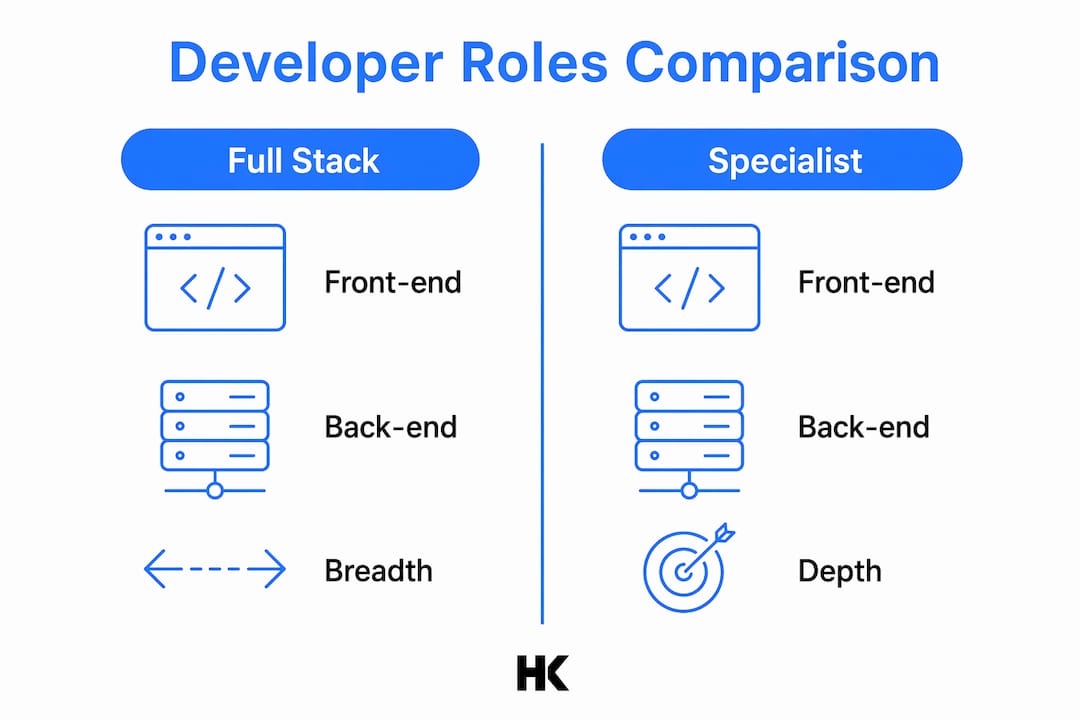
The distinction between full stack and specialist roles is about breadth versus depth, but the tradeoff is more nuanced than most job postings suggest.
| Dimension | Full Stack Developer | Front-End Specialist | Back-End Specialist |
|---|---|---|---|
| Scope | Entire application layer | Browser and UI only | Server, database, APIs |
| Depth | Broad, with one stronger area | Deep in CSS, JS, frameworks | Deep in systems, performance, data |
| Best fit | Small teams, MVPs, early-stage products | Large design-heavy products | High-throughput data systems |
| Career flexibility | High across roles | Moderate | Moderate |
| Collaboration overhead | Low (owns full feature) | High (needs back-end partner) | High (needs front-end partner) |
Most full stack developers are stronger on one side. A developer who came up through Node.js will write cleaner APIs than UI animations. One who started with React will produce better component architecture than database indexing strategies. That is normal and expected. The value of the role is not perfect parity. It is end-to-end context, meaning you understand how a UI change triggers an API call that hits a database query. That understanding reduces defects and speeds up decisions.
In small teams and early-stage products, full stack developers own features from database schema through API to rendered UI. This cuts coordination overhead significantly. A specialist team needs handoffs between front-end and back-end engineers for every feature. A full stack developer ships the whole thing.
Pro Tip: Do not try to match a specialist's depth in every area. Instead, know enough about each layer to ask the right questions and spot integration problems early. That judgment is what makes full stack developers valuable.
What technical skills does a full stack developer need in 2026?
The full stack development overview from current industry research frames the role as a disciplined execution model, not just a list of languages. Poor execution creates technical debt and security vulnerabilities. Strong execution increases time to market and system resilience.
Here are the core technical areas you need to cover:
Front-End Technologies
- HTML and CSS fundamentals, including CSS Grid, Flexbox, and responsive design
- JavaScript, including ES2024+ features, async patterns, and module systems
- A primary framework: React is the dominant choice in 2026, with Angular and Vue as strong alternatives
- State management tools like Redux, Zustand, or React Query depending on application complexity
Back-End Technologies
- Node.js with Express or Fastify for JavaScript-based stacks
- Python with FastAPI or Django for data-heavy or AI-adjacent applications
- Java or Go for performance-critical services in enterprise environments
Databases
- SQL fluency in PostgreSQL or MySQL, including query optimization and indexing
- NoSQL experience with MongoDB for document-based or flexible-schema use cases
- Basic understanding of caching with Redis
Infrastructure and Tooling
- Git with branching strategies like GitFlow or trunk-based development
- CI/CD pipelines using GitHub Actions, GitLab CI, or CircleCI
- Containerization with Docker and basic Kubernetes for orchestration
- Cloud deployment on AWS, GCP, or Azure
API Design Well-defined API contracts covering error handling and request semantics are what separate maintainable systems from fragile ones. A poorly designed API layer forces costly UI refactors downstream. Every full stack developer needs to understand REST conventions and at least the basics of GraphQL.
Security is not a separate skill. Input sanitization, JWT handling, HTTPS enforcement, and environment variable management are part of writing any production-quality code.
How do full stack developers improve team efficiency?
The importance of full stack developers in agile teams comes down to one thing: fewer handoffs. Every handoff between specialists is a potential delay, a miscommunication, or a blame boundary when something breaks.
Here is how full stack expertise translates into real delivery improvements:
-
Feature ownership reduces wait time. A full stack developer picks up a feature ticket and ships the entire thing, front end through back end. No waiting for another team member to build the API before the UI work can start.
-
Debugging crosses boundaries without friction. When a bug lives at the intersection of a React component and a Node.js API, a full stack developer diagnoses it without needing to involve two separate engineers. Treating the system as connected reduces resolution time and removes the "not my side" dynamic.
-
Prototyping is faster. Early-stage products need working demos quickly. A full stack developer can build a functional prototype with a real database and working API in days, not weeks.
-
Architecture decisions are better informed. A developer who understands both the UI and the data layer makes smarter tradeoffs. They know when a front-end caching strategy can replace a back-end optimization, and vice versa.
-
Collaboration with non-technical stakeholders is cleaner. Full stack developers can speak to the entire product, not just their slice of it. That makes sprint planning, scope discussions, and technical explanations to founders or product managers significantly more direct.
The tradeoff is real in larger organizations. A team of specialists with deep expertise in their domains will outperform a full stack developer on complex, high-scale systems. The full stack developer job description in 2026 reflects this: the role is most powerful in teams of two to eight engineers, in early-stage products, and in companies that need to move fast without a large headcount.
For scalable app development, full stack context also helps you make the right architectural calls before the system grows too large to refactor cheaply.
Key takeaways
The role of full stack developer is most valuable when one engineer needs to own an entire feature from database to UI, reducing handoffs and accelerating delivery in small, fast-moving teams.
| Point | Details |
|---|---|
| Core responsibility | Full stack developers build and connect both front-end interfaces and back-end APIs, databases, and business logic. |
| End-to-end ownership | Owning complete features from schema to UI cuts coordination overhead and speeds up delivery in small teams. |
| Breadth over depth | Full stack developers cover the entire stack but typically have one stronger side. That is normal and expected. |
| API contracts matter | Well-defined API contracts between front end and back end prevent fragile UI components and costly refactors. |
| Skills in 2026 | React, Node.js, PostgreSQL, Docker, and CI/CD pipelines are the baseline. Security and cloud deployment are non-negotiable. |
What i have learned building full stack products end to end
I have shipped full stack products across BMW, Deutsche Bahn, and Bundesrechenzentrum Austria, and built my own SaaS products from scratch. The pattern I see most often in struggling teams is not a skills gap. It is a mental model gap.
Developers who treat front end and back end as separate concerns build systems that fight each other. The API returns data in a shape that makes sense to the database but forces the UI to do awkward transformations. The front end makes assumptions about error codes that the back end never agreed to. These are not bugs. They are design failures that compound over time.
The developers who do this well think in contracts first. Before writing code, they define what the API will return, what errors it will surface, and what the UI needs to render. That discipline is what separates a maintainable product from one that needs a rewrite in 18 months.
My other observation: full stack developers who try to stay current on every framework burn out and produce shallow work. The developers who build real depth in one area, say React or PostgreSQL, and maintain working knowledge in the rest, consistently outperform the ones chasing every new tool. Pick your anchor. Go deep there. Stay current everywhere else.
For anyone considering the transition into AI-adjacent engineering roles, full stack context is a genuine advantage. You already understand data flow, API design, and deployment. Those skills transfer directly to building production AI features.
— Hanad
Take your full stack skills further
Building full stack products is one thing. Building ones that scale without breaking is another. At Hanadkubat, the engineering work spans the full stack, from React front ends and Node.js APIs through to cloud deployment and production monitoring, grounded in real delivery experience at BMW, Deutsche Bahn, and Bundesrechenzentrum Austria.
If you are building a SaaS product and need an engineer who owns the entire stack, Hanadkubat offers fixed-price MVP builds starting from €18,000, shipped in 4–12 weeks. No project managers in the middle. You work directly with the engineer writing the code. For deeper reading on architecture decisions that affect every full stack project, the Hanadkubat blog covers scalable app design, deployment strategies, and production engineering from real shipped projects.
FAQ
What is the role of a full stack developer?
A full stack developer builds and maintains both the front-end interface and the back-end server logic, APIs, and database of a web application. The role covers the entire delivery lifecycle from architecture through deployment.
What skills does a full stack developer need in 2026?
Core skills include React or Vue for front-end work, Node.js or Python for back-end services, SQL and NoSQL databases, Git, Docker, and CI/CD pipelines. Security practices and cloud deployment on AWS or GCP are expected at the professional level.
How is a full stack developer different from a front-end or back-end developer?
Full stack developers cover the entire application stack, while front-end and back-end specialists go deeper in their respective areas. The full stack role is most effective in small teams where one engineer needs to own complete features without handoffs.
Why are full stack developers valuable in small teams?
Full stack developers own features end to end, from database schema to rendered UI, which cuts coordination overhead and reduces the delays caused by handoffs between specialists. This makes them particularly effective in early-stage products and teams of two to eight engineers.
Do full stack developers need to be equally strong on front end and back end?
No. Most full stack developers have one stronger area and maintain working knowledge in the rest. The value is in understanding how all layers connect, not in matching a specialist's depth on every side of the stack.