

TL;DR:
- Custom software aligns workflows, deepens integrations, and enhances security, providing long-term strategic advantages over off-the-shelf solutions. Although initially more costly and time-consuming, bespoke development reduces operational friction and technical debt, ensuring scalability and proprietary AI moat creation. Selecting a strategic partner and carefully evaluating specific needs are critical for maximizing the value of custom development investments.
Most business leaders assume off-the-shelf software saves money. It has a known price, ships today, and someone else handles the infrastructure. That assumption collapses the moment your team spends three hours per week building workarounds, your enterprise integration fails at a critical API boundary, or a compliance audit reveals that a third-party SaaS stores sensitive customer data in a jurisdiction your legal team never approved. Understanding why choose custom development requires moving past sticker price and into total operational reality. This article gives you a clear framework for that decision.
Table of Contents
- Key Takeaways
- Why choose custom development over off-the-shelf
- The real cost picture
- Custom development and AI defensibility
- Choosing the right development partner
- When custom development is the right call
- My honest take on custom development decisions
- Build something that compounds, not just ships
- FAQ
Key Takeaways
| Point | Details |
|---|---|
| Workflow fit protects competitive advantage | Generic tools force your team to adapt to software instead of the software adapting to your business. |
| Total cost of ownership beats sticker price | Maintenance, integration, and workaround labor consume 60–80% of software lifecycle costs, often surpassing licensing fees. |
| Custom AI requires custom architecture | Proprietary data flywheels and compound inference quality cannot be built on generic SaaS platforms. |
| Partner selection determines outcome | The right development partner acts as a strategic extension, not just a coder delivering tickets. |
| Use a hybrid decision framework | Not everything needs custom development. Assess workflow uniqueness, integration depth, and control requirements before deciding. |
Why choose custom development over off-the-shelf
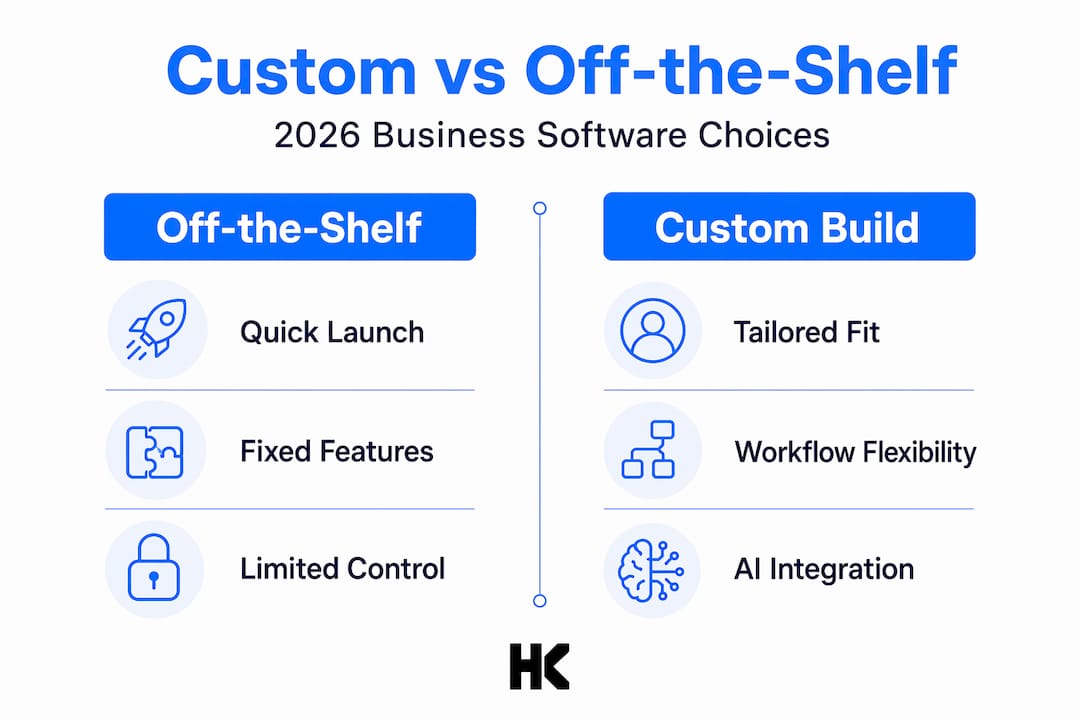
The term bespoke software development is the recognized industry standard for what many now call custom development. Both phrases describe the same outcome: software built specifically for your organization's workflows, data model, and strategic goals.
The core argument for bespoke solutions comes down to competitive differentiation. Tailored software removes the invisible taxes of generic tools: time loss, errors, and the compounding frustration of teams forced to work around software limitations every single day. Those workarounds are not free. They have a real cost measured in engineer hours, data entry mistakes, and delayed decisions.
Here is what bespoke software actually gives you that off-the-shelf cannot:
- Workflow alignment. Your processes are encoded into the software, not squeezed into someone else's product model.
- Integration depth. Custom systems connect to your existing stack at the architecture level, not via fragile third-party middleware connectors.
- Security and role control. You define the permission model, the audit trail, and the data residency. This matters significantly under GDPR and the EU AI Act.
- Scalability on your terms. The data model and service architecture grow with your product roadmap, not with the vendor's.
For comparison, consider how these two approaches perform across common decision factors:
| Factor | Off-the-shelf software | Custom development |
|---|---|---|
| Time to first deployment | Days to weeks | Weeks to months |
| Fit to unique workflows | Partial, requires workarounds | Exact, purpose-built |
| Integration with existing systems | Limited, connector-dependent | Deep, architecture-level |
| Security and compliance control | Vendor-defined | Owner-defined |
| Long-term cost trajectory | Rising license fees plus migration risk | Predictable, based on your roadmap |
Bespoke software demand is growing precisely because companies running disconnected systems and manual processes can no longer absorb the operational drag.
The real cost picture
The sticker price comparison between a SaaS license and a custom build almost always misleads decision-makers. License pricing is visible and feels concrete. Hidden costs like integration, training, and migration labor are invisible until they hit the budget in year two or three.

Here is what a more honest five-year cost model looks like for a mid-sized B2B SaaS team:
| Cost category | Off-the-shelf | Custom development |
|---|---|---|
| Year 1 investment | Low (license fees) | Higher (build cost) |
| Integration and migration | Often underestimated | Planned upfront |
| Workaround labor | Ongoing, invisible | Minimal by design |
| Maintenance over 5 years | Vendor-controlled | You control scope |
| Technical debt risk | Accumulates in customizations | Managed in your codebase |
Maintenance and operations consume 60–80% of total software lifecycle cost over a five-to-ten-year horizon. This is the number most executives miss when they green-light the cheaper option in year one.
Technical debt compounds. As technical debt grows, every new feature takes longer, every bug fix touches more fragile code, and the engineering team spends an increasing share of its time maintaining existing behavior rather than shipping value. Companies that build on a strong foundation early spend that engineering time on product differentiation instead.
Pro Tip: Before approving any software decision, ask your team to estimate the annual cost of workarounds in engineer hours and operational errors. Convert that to euros or dollars. That number belongs in the TCO model alongside the license fee.
Custom development and AI defensibility
This is where the strategic case for tailored software becomes genuinely urgent for any company building on AI.
Generic SaaS platforms give every customer access to the same model, the same features, and the same inference pipeline. Your competitor on the same platform has the same capabilities you do. There is no moat there.
Competitive advantage in AI increasingly comes from proprietary data flywheels and customer trust, not from which AI vendor you subscribe to. The compounding inference quality built on trusted, longitudinal customer relationships is a strategic moat that generic solutions simply cannot replicate. That moat requires a custom architecture to capture, store, and act on proprietary signals.
The implications for custom AI workflows include:
- Custom RAG systems that retrieve from your proprietary knowledge base, not a shared index.
- Agentic pipelines designed around your specific business logic, not a generic automation template.
- EU-resident inference for clients operating under GDPR or processing sensitive data under the EU AI Act.
- Audit trails and training rights that your legal and compliance teams have reviewed and approved.
AI-IP governance must cover data usage rights, training permissions, deployment rights, and commercialization pathways. A generic SaaS platform sets those terms for you. A custom system lets you define them.
"The real competitive advantage in AI is not raw data but the quality of inference compounded over time through trusted customer relationships." — Rohit Prabhakar
Custom AI solutions require comprehensive IP and data governance to realize durable competitive advantage. Without it, even excellent custom software leaks value.
Choosing the right development partner
The development partner you choose shapes the outcome more than the technology stack. This is not an exaggeration. Selecting the wrong partner leads to missed deadlines, budget overruns, and products that fail their business objectives. The right partner functions as a strategic extension of your team.
Here is a practical vetting framework for evaluating custom development partners:
- Ask for production examples, not portfolio mockups. Shipped code in production is evidence. A case study PDF is not.
- Clarify who writes the code. Many firms sell senior engineers and deliver junior ones. In a direct partnership model, the person scoping your project is the person building it.
- Test for strategic thinking early. A good partner will push back on your requirements when they spot a better approach. A pure executor will build exactly what you specified, even if it is the wrong thing.
- Check compliance fluency. If you operate in the EU, your partner needs to understand GDPR, EU AI Act implications, and data residency requirements without you explaining them.
- Evaluate communication patterns. How quickly and clearly do they respond before you sign? That cadence does not improve after the contract is signed.
Pro Tip: Run a small paid discovery engagement before committing to a full build. A €1,500 to €3,000 scoping sprint will tell you more about a partner's judgment and communication than any sales call.
A hybrid approach is worth considering for many businesses. Use off-the-shelf tools where your workflows are standard and speed is the priority, then build custom modules at the points where differentiation matters. This balances upfront investment against competitive positioning.
When custom development is the right call
Not every problem needs a custom build. The decision should follow a clear assessment of four factors.
The first factor is workflow uniqueness. If your core operational process has no off-the-shelf analog, or if the closest available product requires significant process compromise from your team, that is a strong signal for custom development.
The second factor is integration depth. When workflows are unique and integrations critical, tailored software is the recommended path. If your system needs to talk to three internal databases, a legacy ERP, and a third-party data feed in a way that a standard connector cannot handle, that connector tax will cost you more over time than a purpose-built integration.
The third factor is control requirements, including security, compliance, and data residency. Under GDPR and the EU AI Act, knowing exactly where your data lives and how it is processed is not optional. Generic SaaS platforms make that question harder to answer definitively.
The fourth factor is time horizon. Off-the-shelf software often wins on speed. If you need something functional in two weeks and your workflows are standard, that is a legitimate reason to go off-the-shelf. If you are building something you expect to operate for five-plus years and to differentiate on, that short-term speed advantage disappears quickly.
A useful checklist for the decision:
- Are your workflows genuinely different from industry defaults?
- Do you require deep integration with systems that lack standard connectors?
- Do compliance or data residency requirements constrain your vendor choices?
- Will your team adapt to the software, or does the software need to adapt to your team?
- Do you plan to build proprietary AI features on top of this system within 18 months?
If three or more of those questions produce a "yes," custom development deserves serious evaluation. You can also review a scalable product development guide for a more detailed breakdown of how these factors interact at different stages of company growth.
My honest take on custom development decisions
I have worked on both sides of this. At BMW and Deutsche Bahn, I saw large organizations accept years of operational friction to avoid the perceived risk of custom builds. The workaround cost was invisible in the budget but visible every day in how engineers spent their time.
When I started working with early-stage SaaS founders, I saw the opposite mistake: founders who chose custom builds for problems that did not warrant them, burning runway on architecture decisions that a €200-per-month SaaS tool would have handled fine.
The decision is not about ideology. It is about where your business actually creates value and whether your software infrastructure reflects that.
What I have found consistently is that founders and CTOs who focus on upfront cost alone make the decision in year one and pay for it in years three through five. The teams who get this right ask a different question: "Where does our software need to be uniquely ours?" That is the question that leads to good decisions about what to build, what to buy, and where to invest in a proper partnership.
The critical nuance is that custom development only delivers its long-term value when the partnership continues. Software is not a deliverable. It is a living system. A codebase without an ongoing relationship with its author accumulates debt and loses the institutional knowledge that makes future iteration fast.
If you are building something you plan to compete on, find a partner who treats the code as an ongoing responsibility, not a completed project.
— Hanad
Build something that compounds, not just ships
If your product roadmap depends on AI integration, proprietary data workflows, or deep system integration that generic SaaS cannot support, working with an engineer who has shipped production systems at BMW, Deutsche Bahn, and Bundesrechenzentrum Austria is a different conversation than hiring a development shop.
At Hanadkubat, both service tracks operate at fixed prices with defined timelines. The SaaS MVP track starts at €18,000 for a 4-to-12-week build. The AI integration track ships production features in two-week sprints at €4,500. You work directly with the engineer writing the code. See the full scope of available services and decide whether the approach fits your situation.
FAQ
What is custom development in software?
Custom software development, also called bespoke development, means building software specifically for one organization's workflows, data model, and technical requirements rather than adapting a generic product.
When does custom development make financial sense?
Custom development makes financial sense when hidden costs of workarounds, integration failures, and license escalation over five-plus years exceed the upfront build cost. Maintenance and operations typically consume 60–80% of total lifecycle costs.
How does custom development support AI integration?
Custom architectures allow you to build proprietary RAG systems, control data governance, define audit trails, and compound inference quality on your own customer data. Generic platforms set those terms for you.
What should I look for in a custom development partner?
Look for production evidence, direct engineer access, strategic pushback on requirements, and documented compliance fluency for your regulatory environment. A scoping sprint before a full commitment is a reliable test.
Is a hybrid approach a viable option?
Yes. Many businesses use off-the-shelf tools for standard workflows and custom modules for differentiated processes. The key is identifying specifically where your business creates unique value and protecting that with purpose-built software.