
TL;DR:
- Modern IT engineers focus on designing, integrating, and maintaining scalable systems, especially as AI transforms their workflows. They now supervise AI-generated outputs, prioritize foundational technical improvements, and require skills in systems integration, cloud infrastructure, and AI evaluation. Embedding AI across all phases of development with proper governance enhances reliability while demanding deeper system understanding.
Most people conflate an IT engineer with a help desk technician or a network engineer jobs posting they saw on LinkedIn. The actual role sits at a different level entirely. An IT engineer designs, integrates, and maintains the systems that keep software and infrastructure running at scale. In 2026, that definition is expanding fast. AI is changing how engineers write code, respond to incidents, and make architectural decisions. This article cuts through the noise and gives IT professionals and organizations a clear picture of what modern IT engineering looks like, what skills matter, and how to embed AI without losing accountability.
Table of Contents
- Key Takeaways
- What an IT engineer actually does
- How AI is reshaping IT engineering
- Balancing product work with foundational engineering
- Embedding AI in engineering without losing control
- My take on where this is heading
- Ready to ship AI features that actually work in production?
- FAQ
Key Takeaways
| Point | Details |
|---|---|
| IT engineers vs. support roles | IT engineers design and integrate systems; IT support specialists troubleshoot and maintain existing ones. |
| AI shifts the work, not the accountability | Engineers now guide and review AI outputs rather than write every line manually, but they remain responsible for results. |
| The 60/40 rule for engineering time | Effective teams spend 60% on product-driven work and 40% on foundational technical improvements. |
| AI integration belongs across the full lifecycle | Embedding AI in design, build, test, and operate phases produces better outcomes than using it only for code generation. |
| Upskilling beats hiring new titles | Organizations get better ROI from evolving existing engineers into AI-native roles than from creating isolated "AI engineer" positions. |
What an IT engineer actually does
The confusion starts with titles. "IT engineer" gets applied to roles ranging from desktop support to cloud architect, which makes it nearly useless as a job description without context. Let's be precise.
An IT engineer, in the modern sense, owns systems integration, infrastructure design, and the technical reliability of software environments. That includes building and maintaining network architecture in collaboration with network engineers, overseeing deployments, and making sure software components talk to each other correctly. The role is closer to software engineer roles on the development side and closer to an IT infrastructure engineer on the operations side. Sometimes it spans both.
The distinction from an IT support specialist matters. IT support specialists focus on troubleshooting, user access management, and maintaining existing systems. They do not build new infrastructure or architect integrations. An IT engineer, by contrast, is responsible for the design decisions that determine whether those systems are maintainable in the first place. Both roles are necessary. They are not interchangeable.
Here is what the day-to-day of an IT engineer typically covers:
- Systems integration: Connecting applications, APIs, and data sources so they function as a coherent environment rather than isolated tools.
- Infrastructure oversight: Managing servers, cloud environments, and network configurations, often in coordination with a dedicated network engineer.
- Incident response and root cause analysis: Going beyond fixing the symptom to understand why a failure occurred and preventing recurrence.
- Collaboration with software and product teams: Translating business requirements into technical architecture decisions.
- Documentation and compliance: Especially relevant in EU contexts where GDPR and the EU AI Act impose specific documentation obligations on systems handling personal data or AI-driven decisions.
On the maintenance side, IT support engineering roles require maintaining a minimum 75% utilization per fiscal year on proactive tasks like server patches and firewall updates. That figure reflects a real operational reality: a significant share of engineering time goes to keeping systems healthy, not building new features.
Compensation reflects the specialization. Senior desktop support roles in specialized US sectors command base salaries between $80,703 and $98,637. IT infrastructure engineers and IT systems analysts with cloud or AI experience command considerably more, particularly in DACH markets where demand outpaces supply.
How AI is reshaping IT engineering
The shift is not subtle. AI-led engineering moves coding from manual creation toward AI-assisted drafting, system reasoning, and quality review. Engineers spend less time writing boilerplate and more time making design decisions, reviewing AI-generated outputs for correctness, and thinking through system-level consequences.

Microsoft's internal engineering teams are a useful reference point. Their experience shows that AI-native engineering is not a separate job title. It is a mindset where engineers guide, review, and remain accountable for AI-assisted outputs. The code still ships under their name. The architecture decision is still theirs. AI accelerates the work; it does not absorb the responsibility.
This has concrete implications for how engineering teams are structured. The phases where AI adds the most value are not just code generation. Embedding AI across design, build, test, operate, and improve phases creates earlier issue surfacing and measurable quality improvements. An AI tool that flags a security misconfiguration during the design phase is worth far more than one that catches it in production.
"Engineers now focus more on supervising AI and reasoning through design than on manual coding. The value of human judgment increases, not decreases, as AI handles more of the mechanical work."
The reliability dimension is also shifting. Site Reliability Engineering treats operational reliability as an engineering constraint with measurable metrics like Service Level Indicators and error budgets. When AI systems enter the stack, those metrics become harder to predict. Non-deterministic outputs require evaluation pipelines that did not exist in traditional software environments.
Yahoo's engineering leadership makes a point worth taking seriously: senior engineers need protected focus time to manage the complexity of AI outputs, including evaluation pipelines for non-deterministic AI systems. Squeezing that work into the margins of a meeting-heavy week produces fragile systems.
Pro Tip: Before adopting any AI coding assistant for your engineering team, spend two weeks measuring how much time engineers currently spend on code review versus code writing. That baseline tells you where AI will actually move the needle, and where it will not.
Balancing product work with foundational engineering
One of the most practical frameworks for engineering time allocation comes from GitLab. Their engineering handbook specifies that effective organizations allocate 60% of engineering time to product-driven initiatives and 40% to foundational technology improvements. That split is not arbitrary. It reflects the reality that technical debt compounds faster than most organizations admit.
Here is how to apply that framework in practice:
- Map your current allocation honestly. Most teams discover they are spending 80% or more on product features and almost nothing on infrastructure health. The gap between perceived and actual allocation is usually significant.
- Define what counts as foundational work. This includes dependency upgrades, test coverage improvements, observability tooling, and architecture refactoring. If it does not ship a user-facing feature but makes the system more maintainable, it belongs in the 40%.
- Put foundational work on the roadmap explicitly. Work that lives only in engineers' heads gets cut first when deadlines move. A named item on the sprint board survives.
- Review the split quarterly. Product pressure is real. The 60/40 target will drift. Quarterly reviews catch the drift before it becomes a six-month technical debt crisis.
The table below shows how this plays out across different engineering focus areas:
| Engineering focus area | Product-driven (60%) | Foundational (40%) |
|---|---|---|
| Feature development | New user-facing capabilities | Refactoring underlying services |
| Testing | Acceptance tests for new features | Improving test coverage and CI pipeline speed |
| Infrastructure | Scaling for new product requirements | Upgrading dependencies, patching, observability |
| AI integration | Shipping AI-powered product features | Building evaluation pipelines and monitoring |
For teams working on scalable product development, this balance is the difference between a codebase that accelerates over time and one that slows to a crawl under its own weight. The IT project manager or engineering manager who enforces this split is doing one of the most valuable things they can do for long-term velocity.
Embedding AI in engineering without losing control
Organizations that treat AI as a productivity shortcut get productivity. Organizations that treat it as a systems-level concern get something more durable. Here is what the second approach looks like in practice:
- Start with AI in your existing tools. GitHub Copilot, AI-assisted code review, and automated test generation all integrate into workflows engineers already use. There is no need to rebuild processes from scratch.
- Frame AI as amplification, not replacement. Engineers who feel threatened by AI tools disengage from them. Engineers who understand that AI handles the mechanical work so they can focus on design and judgment use those tools aggressively.
- Invest in upskilling over hiring new titles. The AI engineer role has not been formalized as a separate function. It represents an evolving mindset. Your existing IT systems analysts and infrastructure engineers can develop that mindset with the right training and time.
- Measure what changes. Track time spent on manual toil, incident response time, and deployment frequency before and after AI tool adoption. Concrete numbers tell you whether the investment is working.
- Build governance into the process. In EU markets, this is not optional. The EU AI Act requires specific documentation and risk categorization for AI systems used in certain contexts. An IT engineer working on GDPR-relevant systems needs to understand where AI-generated outputs touch regulated data.
Pro Tip: When evaluating AI tools for your engineering team, run a two-week pilot with one team and one specific use case. Measure the before and after on a single metric, such as code review turnaround time. Broad rollouts without a baseline produce enthusiasm but no evidence.
For teams looking at lean product development approaches, embedding AI in the build cycle from day one is significantly easier than retrofitting it into an established codebase. The architecture decisions made in the first few sprints determine how much friction AI integration will create later.
My take on where this is heading
I have worked with engineering teams at BMW, Deutsche Bahn, and Bundesrechenzentrum Austria, and I have built my own SaaS products end to end. The pattern I keep seeing is the same: organizations adopt AI tools at the individual level, see productivity gains, and then discover they have no idea what is actually running in production.
The engineers who thrive in this environment are not the ones who use AI the most. They are the ones who understand the system deeply enough to know when AI output is wrong. That requires the kind of foundational knowledge that gets deprioritized when everyone is chasing feature velocity.
My honest view: the IT engineer role is becoming more demanding, not less. You need to understand AI well enough to supervise it, understand systems well enough to catch its mistakes, and understand the business well enough to know which mistakes matter. That is a broader skill set than most job descriptions acknowledge.
The organizations that get this right are the ones that invest in their engineers' depth of knowledge rather than just their tool fluency. AI tools change every six months. System thinking does not.
— Hanad
Ready to ship AI features that actually work in production?
If your team is working through how to integrate AI into your engineering workflows without creating compliance risks or fragile systems, that is exactly what Hanadkubat is built for. From production-ready AI features shipped in 2-week sprints at €4,500 to full AI audits with a prioritized roadmap at €1,500, the work is grounded in real architecture decisions, EU AI Act compliance, and GDPR-aware design. No strategy decks. No junior teams. You work directly with the engineer writing the code.
Explore the full range of engineering and AI services at Hanadkubat, including SaaS MVP builds and rescue engagements for teams with stuck codebases.
FAQ
What is the difference between an IT engineer and an IT support specialist?
An IT engineer designs, integrates, and maintains systems and infrastructure. An IT support specialist focuses on troubleshooting existing systems and managing user access. The roles require different skill sets and carry different levels of architectural responsibility.
How is AI changing the IT engineer role?
AI shifts the work from manual code writing toward supervising AI-generated outputs, making design decisions, and maintaining accountability for system quality. Engineers who adopt an AI-native mindset focus more on system reasoning and review than on line-by-line implementation.
What skills matter most for an IT engineer in 2026?
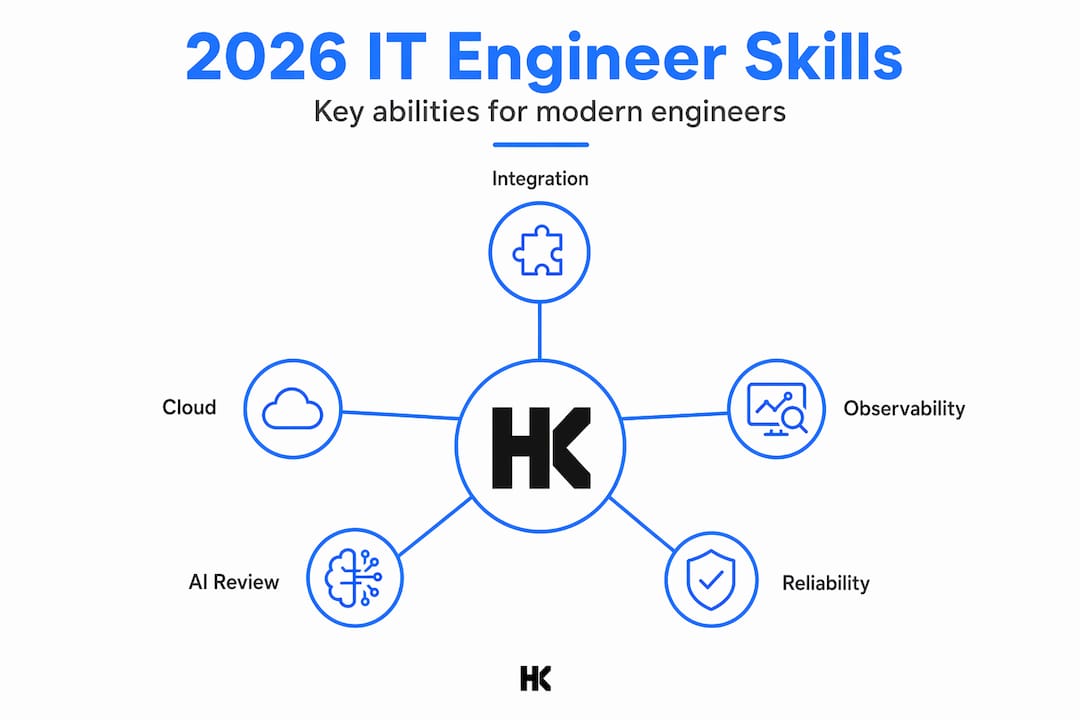
Systems integration, cloud infrastructure, observability, and the ability to evaluate AI-generated outputs are the most in-demand skills. In EU markets, familiarity with GDPR requirements and the EU AI Act adds significant value for any engineer working on data-handling or AI-driven systems.
How should engineering teams allocate time between product work and technical improvements?
The GitLab Engineering Handbook recommends a 60/40 split: 60% on product-driven initiatives and 40% on foundational technical improvements. Most teams discover their actual allocation is closer to 80/20, which accelerates technical debt accumulation.
How do you become an IT engineer?
Most IT engineers start with a computer science or information systems degree, then build experience in systems administration, software development, or network engineering. Certifications in cloud platforms (AWS, Azure, GCP) and hands-on experience with infrastructure tooling are now standard requirements for mid-level and senior roles.