
TL;DR:
- Minimum viable product steps help founders test core assumptions quickly with minimal investment before full development.
- The process involves problem validation, hypothesis formulation, risk assumption testing, and iterative feedback from early users.
Minimum viable product steps are the essential sequence founders and product managers use to build a testable product version, validate their riskiest business assumption, and gather real user feedback before committing to full development. An MVP is not a stripped-down final product. It is a hypothesis test designed to reduce risk with the least possible investment. Investors in 2026 expect measurable traction, such as monthly recurring revenue or clear engagement signals, before advancing a B2B SaaS product beyond the MVP phase. Getting the steps right from the start separates founders who learn fast from those who burn budget building the wrong thing.
What are the minimum viable product steps?
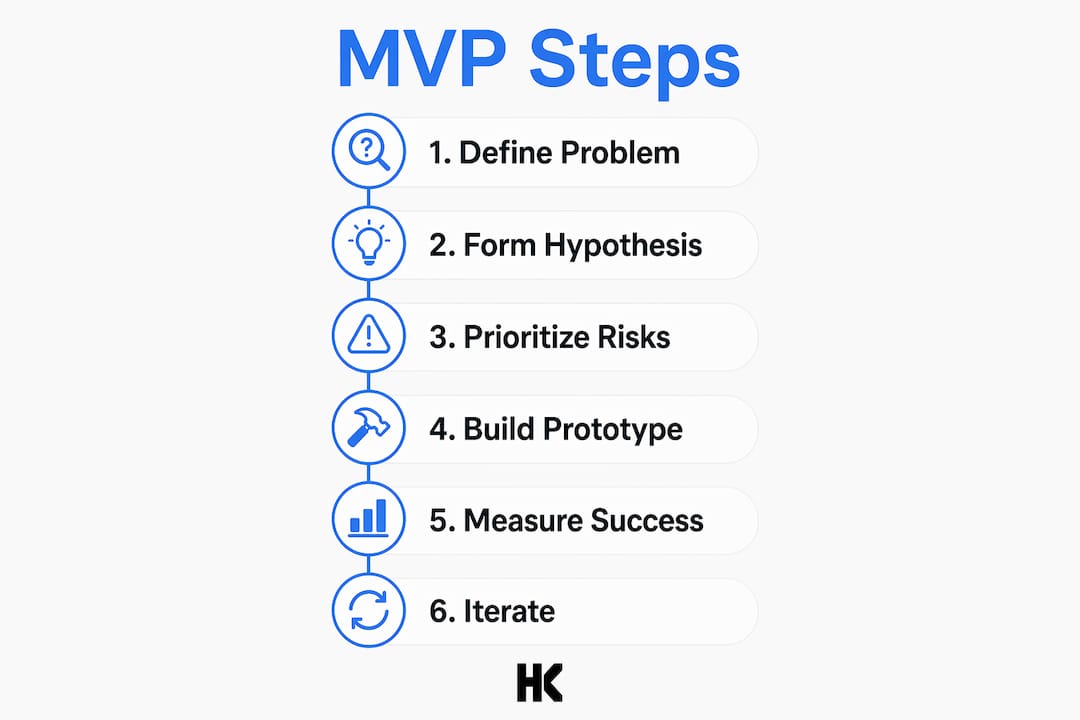
The minimum viable product steps follow a deliberate sequence: define the problem, form a hypothesis, prioritize the riskiest assumption, choose the right MVP format, build only the core workflow, release to early adopters, collect feedback, and iterate. Each step has a specific purpose. Skipping one does not save time. It creates gaps that surface later as wasted engineering effort or a product nobody wants.

The MVP development process starts with a clear problem statement, not a feature list. Founders who begin with features almost always overbuild. The goal at step one is to articulate exactly which user pain point you are testing and why solving it creates a viable business.
What do you need before starting MVP development?
Preparation determines how fast you learn. Three inputs are non-negotiable before writing a single line of code.
Customer research. Talk to at least ten potential users in your target segment. You are not selling. You are listening for the specific friction they experience, how often it occurs, and what they currently do about it. The MVP process begins with researching your target audience and mapping their pain points to the most basic solution that addresses them.
Defined success criteria. You must know what "working" looks like before you build. Success metrics must be defined before development starts, focused on user behavior such as activation rates and retention. A useful benchmark from product research is the "very disappointed" threshold: if fewer than 40% of users say they would be very disappointed without your product, the signal is too weak to proceed.
Tool and format selection. Speed matters more than elegance at this stage. No-code tools like Webflow, Notion, or Airtable let you test workflows in days. Spreadsheets and manual processes often work before any automation exists.
| Preparation area | What to produce |
|---|---|
| Customer research | 10+ user interviews with documented pain points |
| Hypothesis | One sentence: "We believe [user] needs [solution] to achieve [outcome]" |
| Success criteria | 2–3 measurable behavioral metrics defined before building |
| Tech stack | Fastest path to testable: no-code, manual, or single-feature build |
Pro Tip: Run a manual "concierge" version of your product first. Do the work by hand for two or three users before automating anything. You will learn more in one week than in a month of building.
How to execute the MVP development process step by step
The following eight steps reflect how building an MVP involves identifying core features, testing with users, and refining based on feedback in iterative cycles.
-
Validate the problem. Conduct structured customer interviews. Ask about current behavior, not hypothetical preferences. Confirm the problem is real, frequent, and worth paying to solve.
-
Write your product hypothesis. State it explicitly: "We believe [persona] experiences [problem] when [context]. We will know our solution works if [measurable outcome] occurs within [timeframe]." A vague hypothesis produces vague learning.
-
Identify the riskiest assumption. Every product rests on several assumptions. One of them, if wrong, kills the business. Find it. Test it first. Common riskiest assumptions in B2B SaaS include: users will change their current workflow, buyers will pay a specific price point, or a specific integration is technically feasible.
-
Choose the right MVP format. The format depends on what you are testing. A landing page tests demand. A concierge service tests behavior and willingness to pay. A single-feature build tests whether users complete a core workflow. Manual concierge methods and fake workflows accelerate learning at minimal cost, preventing wasted engineering resources.
-
Build only the core experience. Map the single workflow that delivers your core value. Cut everything else. If a feature does not directly test your hypothesis, it does not belong in the MVP. This is where most teams fail. They add "nice to have" features that feel safe but dilute the signal.
-
Release to early adopters. Target users who feel the problem acutely, not a broad audience. In B2B SaaS, this often means five to fifteen companies in a specific vertical. Early adopters tolerate rough edges. They also give honest feedback because they genuinely want the problem solved.
-
Collect qualitative and quantitative feedback. Watch users interact with the product. Do not just send surveys. Metrics like repeat usage, task completion, and customer retention signal product viability far better than sign-up counts. Pair usage data with direct conversations to understand the "why" behind the numbers.
-
Iterate based on real usage data. Update your hypothesis. Adjust the product. Run another cycle. The MVP development process is not a one-time event. It is a learning loop that continues until you have enough signal to commit to a full build or pivot.
Pro Tip: Set a hard deadline for each iteration cycle, typically two weeks. Without a deadline, "gathering more feedback" becomes a reason to avoid making a decision.
How do you measure MVP success and avoid common pitfalls?
Measuring MVP success requires behavioral metrics, not vanity metrics. Page views, sign-ups, and social media shares tell you nothing about whether users find real value. The metrics that matter are activation rate (did users complete the core workflow?), retention rate (did they come back?), and task completion rate.
Investors increasingly expect pre-validation through engagement metrics or MRR before advancing a B2B SaaS product beyond the MVP phase. This means your MVP needs to produce a number, not just a story. Even a small cohort of ten paying users with strong retention is a more credible signal than a thousand free sign-ups.
The most common pitfalls in MVP execution follow a predictable pattern:
- Overbuilding before validation. Teams spend three months building features that users never requested. Fix this by enforcing the single-hypothesis rule: one test per cycle.
- Ignoring qualitative feedback. Quantitative data shows what users do. Qualitative data explains why. Both are required for good decisions.
- Unclear hypotheses. If your hypothesis cannot be falsified, it is not a hypothesis. It is a wish. Write it so that a specific outcome either confirms or refutes it.
- Testing with the wrong users. Early adopters and mainstream users behave differently. Testing with people who are mildly interested produces weak signals. Find users who have the problem badly.
"An MVP is not a smaller version of your product. It is the fastest way to test whether your core assumption is true. Define what 'true' looks like before you build anything."
Knowing when to pivot versus persevere is the hardest judgment call in the MVP process. Pivot when the core assumption is definitively wrong. Persevere when the assumption holds but execution needs refinement. The MVP validation checklist at Hanadkubat covers this decision framework in detail.
What are the different minimum viable product types for B2B SaaS?
Different MVP types test different assumptions: demand, behavior, and willingness to pay. Choosing the wrong type wastes time. Choosing the right one produces a clear answer in days.
Demand-testing MVPs answer the question: do people want this? Formats include landing pages with a sign-up or waitlist, "fake door" tests where a feature button is shown before it is built, and email campaigns describing the product. These cost almost nothing and can run in 48 hours.
Behavior-testing MVPs answer the question: will people use this the way I expect? Formats include single-feature builds, Wizard of Oz MVPs (where a human manually fulfills what appears to be an automated system), and concierge services. These take longer but produce much richer data about actual usage patterns.
Willingness-to-pay MVPs answer the question: will people pay for this? Formats include paid pilots, pre-sales, and demo-to-contract sequences. This is the most important test for B2B SaaS because enterprise buyers behave very differently when money is involved.
The right MVP format depends entirely on your riskiest assumption. If you are unsure whether demand exists, start with a landing page. If demand is proven but usage patterns are unclear, run a concierge or single-feature build. If usage is proven but pricing is uncertain, run a paid pilot. For a deeper look at how these formats apply to early-stage validation, the MVP validation methods guide at Hanadkubat covers each approach with practical examples.
Key Takeaways
The most effective MVP development process tests one riskiest assumption per cycle, defines success metrics before building, and uses the cheapest format that produces a clear answer.
| Point | Details |
|---|---|
| Define success before building | Set 2–3 behavioral metrics like activation and retention before writing code. |
| Test the riskiest assumption first | Identify the one assumption that kills the business if wrong, and test it immediately. |
| Match MVP format to the question | Use landing pages for demand, concierge for behavior, paid pilots for willingness to pay. |
| Manual methods save budget | Concierge and Wizard of Oz approaches validate hypotheses without engineering investment. |
| Investor traction requires numbers | Measurable MRR or engagement data, not just user stories, is the baseline for B2B SaaS in 2026. |
The mistake I see most often in MVP projects
Most founders I work with arrive having already built too much. They spent four months on a product with twelve features, none of which were tested individually. When users do not engage, there is no way to know which assumption failed. The signal is noise.
The fix is not a better product. It is a better question. Before any build starts, I ask founders to write one sentence: "We will know this works if [specific behavior] happens within [specific timeframe]." Most cannot do it on the first try. That inability is the real problem, and it surfaces before a single line of code is written.
The manual-first approach is not a shortcut for non-technical founders. It is the correct method for any founder at the earliest stage. I have seen teams at BMW and Deutsche Bahn, with far more resources than any startup, waste months building automated systems for workflows that a spreadsheet could have tested in a week. The discipline of doing it manually first is not about saving money. It is about learning faster than your assumptions can mislead you.
Speed and quality are not in conflict at the MVP stage. Quality at this stage means clarity of signal, not polish of interface. A rough product that answers your hypothesis clearly is better than a polished product that answers nothing. The common MVP pitfalls I document come almost entirely from confusing these two definitions of quality.
— Hanad
Building your MVP with Hanadkubat
Founders who want to move from hypothesis to tested product in weeks, not months, work directly with Hanadkubat on fixed-price MVP builds. The process starts with a €1,500 strategy sprint to scope and validate the idea before any development begins. Full MVP builds run from €18,000 and ship in 4–12 weeks.
Every engagement is direct: you work with the engineer writing the code, not a project manager relaying messages. Hanadkubat has shipped SaaS products end-to-end and brings engineering experience from BMW, Deutsche Bahn, and Bundesrechenzentrum Austria to early-stage product work. For non-technical founders, the product development guide at Hanadkubat covers the full process from idea to launch. Service details and pricing are at hanadkubat.com.
FAQ
What is the first step in building an MVP?
The first step is validating the problem through customer interviews, not designing features. Confirm the pain point is real, frequent, and worth paying to solve before writing any code.
How long does the MVP development process take?
A well-scoped B2B SaaS MVP typically ships in 4–12 weeks, depending on complexity. Demand-testing formats like landing pages can run in 48 hours.
What metrics define MVP success?
Activation rate, task completion rate, and retention are the core behavioral metrics. Vanity metrics like sign-up counts do not indicate whether users find real value.
When should a founder pivot after an MVP?
Pivot when the core assumption is definitively falsified by user behavior data. Persevere when the assumption holds but execution or messaging needs adjustment.
What are the main minimum viable product types?
The three main categories are demand-testing MVPs (landing pages, waitlists), behavior-testing MVPs (concierge, single-feature builds), and willingness-to-pay MVPs (paid pilots, pre-sales). Each tests a different assumption.