

Technical debt is the implied future cost you take on when you choose a quick, expedient solution in software development instead of a better one that would take longer. Think of it like a car loan: you get the car now, but every month you don't pay it down, interest compounds. In software, that "interest" shows up as slower feature delivery, harder-to-maintain code, and eventually, a codebase that fights back every time you try to change it.
The concept covers more than just messy code. It includes architectural shortcuts, missing tests, outdated dependencies, and undocumented decisions baked into systems years ago. According to the CMU Software Engineering Institute, technical debt captures the tradeoff between the short-term benefits of rapid delivery and the long-term value of building software that is easy to evolve, modify, repair, and sustain.
Key aspects at a glance:
- Code quality trade-offs: Shortcuts that work today but cost more to maintain tomorrow
- Accumulating interest: The longer debt sits unaddressed, the more expensive it becomes to fix
- Intentional vs. unintentional: Some debt is a deliberate business call; other debt happens by accident
- Broad scope: Covers code, architecture, testing, documentation, and process decisions
- Measurable impact: Debt slows delivery, raises defect rates, and erodes team productivity
"Shipping first-time code is like going into debt. A little debt speeds development so long as it is paid back promptly with a rewrite." — Ward Cunningham, creator of the technical debt metaphor
Where did the concept of technical debt come from?
Ward Cunningham introduced the term in 1992 while working on financial software at Cunningham & Cunningham. His original framing was specific: deliberate trade-offs made with the explicit intention of fixing them later. The "debt" is the gap between what you shipped and what you know the right solution looks like. The "interest" is the ongoing cost of working around that gap every day you don't fix it.
Cunningham's metaphor was never meant to describe all bad code. Code written out of ignorance, or by developers who simply didn't know better, wasn't what he had in mind. That distinction matters because it changes how you respond.
Martin Fowler later expanded the framework with his Technical Debt Quadrant, which plots debt along two axes: deliberate versus inadvertent, and prudent versus reckless. The four resulting quadrants are:
- Prudent-Deliberate: "We know this is a shortcut; we'll fix it after launch." Acceptable when planned.
- Reckless-Deliberate: "We don't have time for design." A culture problem, not just a code problem.
- Prudent-Inadvertent: "Now we know what we should have done." Inevitable in complex systems.
- Reckless-Inadvertent: "What's layering?" Signals a skills or process gap.
The quadrant model matters because each type demands a different response. Reckless-deliberate debt often requires urgent rewrites and a hard conversation with leadership. Prudent-inadvertent debt can be addressed opportunistically as you touch related code. Treating all four the same wastes capacity and misses the real risks.
What causes technical debt in real software projects?
Most technical debt doesn't come from lazy developers. It comes from real pressures: tight deadlines, shifting requirements, and the constant tension between shipping and doing it right. Understanding the causes helps you catch debt earlier and make better trade-offs consciously rather than by accident.
Common causes include:
- Rushed delivery: A feature needs to ship by Friday. The clean solution takes two weeks. The quick one takes two days. The quick one ships.
- Poor architectural decisions: Early choices about data models or service boundaries that made sense at 1,000 users become bottlenecks at 100,000.
- Insufficient testing: Skipping unit or integration tests to save time means every future change carries hidden risk.
- Lack of documentation: Undocumented decisions force future developers to reverse-engineer intent, multiplying maintenance time.
- Evolving requirements: A feature built for one use case gets stretched to cover five others it was never designed for.
- Skills gaps: Junior developers or teams unfamiliar with a language or framework introduce patterns that work but don't scale.
- Legacy code: Systems built a decade ago under different constraints that no one has fully updated.
AI-generated code is a newer and underappreciated source. AI tools introduce hidden debt through unstated assumptions and subtle defects that standard testing pipelines often miss entirely. A function generated by an LLM may pass all tests and still encode architectural assumptions that conflict with the rest of the system. This category of debt requires continuous architectural governance, not just a periodic code review.
Intentional debt isn't always wrong. Shipping a proof of concept with known shortcuts to validate a market idea is a legitimate call. The problem is when that proof of concept becomes the production system without anyone ever paying down the shortcuts.

What happens when technical debt goes unmanaged?
Left alone, technical debt compounds. The first symptom is usually slower delivery: what used to take a sprint now takes three. Then defect rates climb, because every change in a fragile codebase risks breaking something else. Eventually, developers spend more time working around old decisions than building new features.
The consequences stack up quickly:
- Increased maintenance costs: More time spent understanding and patching old code
- Slower feature delivery: Every new feature has to navigate accumulated complexity
- Higher defect rates: Fragile code breaks in unexpected ways under change
- Developer burnout: Working in a codebase that fights back every day is demoralizing
- System instability: Architectural shortcuts can cause cascading failures under load
- Project failure: Unmanaged debt can threaten long-term sustainability and ROI entirely
One of the less-discussed impacts is what happens to team culture. When management punishes developers for reporting debt, the debt doesn't disappear. It goes underground. Teams stop flagging problems, hidden liabilities accumulate, and the first sign of trouble is often a production incident rather than a backlog item.
The U.S. Department of Defense has documented this pattern at scale. Systems built with accumulated design and implementation shortcuts made for expediency, without structural quality requirements, become prohibitively expensive to maintain or extend, as the CMU Software Engineering Institute has noted in its research on DoD software sustainment.
How do you manage and reduce technical debt effectively?
The single most practical guideline comes from sprint capacity allocation. Dedicating a moderate portion of each sprint to managing and paying down debt keeps it from compounding. Allocating too little time allows debt to accumulate faster than teams can address it, while too much time indicates the codebase may need an aggressive remediation plan.

Effective management goes beyond just allocating time. It requires treating debt as a portfolio of issues that need differentiated responses, not a uniform backlog to be paid down in order. Addressing all debt with the same priority wastes capacity and lets urgent architectural problems sit next to minor style inconsistencies.
Concrete management practices:
- Build a debt inventory: Catalog known debt items by type (code, architecture, test coverage, documentation) and business impact.
- Classify by quadrant: Use Fowler's framework to separate reckless debt requiring immediate action from prudent debt that can wait.
- Prioritize by delivery impact: Fix debt that slows the features your roadmap depends on next, not just the oldest items.
- Make debt visible: Include debt items in sprint planning and roadmap reviews so stakeholders understand the trade-offs. See how this fits into sprint planning in practice.
- Measure continuously: Track velocity trends, defect rates, and code churn. A sudden drop in velocity often signals debt accumulation before it becomes a crisis.
- Use combined analysis: Static code analysis alone misses most critical architectural debt. Combining it with commit history and developer feedback identifies the hotspots that actually affect delivery speed.
For measurement, tools like SonarQube track code-level metrics such as complexity, duplication, and test coverage. Architectural debt requires a layer on top: commit churn analysis, dependency mapping, and architectural decision records (ADRs) that document why key choices were made.
Pro Tip: Don't treat debt reporting as a failure. Teams that surface debt early give you options. Teams that hide it give you incidents. Build a culture where flagging a known shortcut is a sign of professional judgment, not an admission of incompetence.
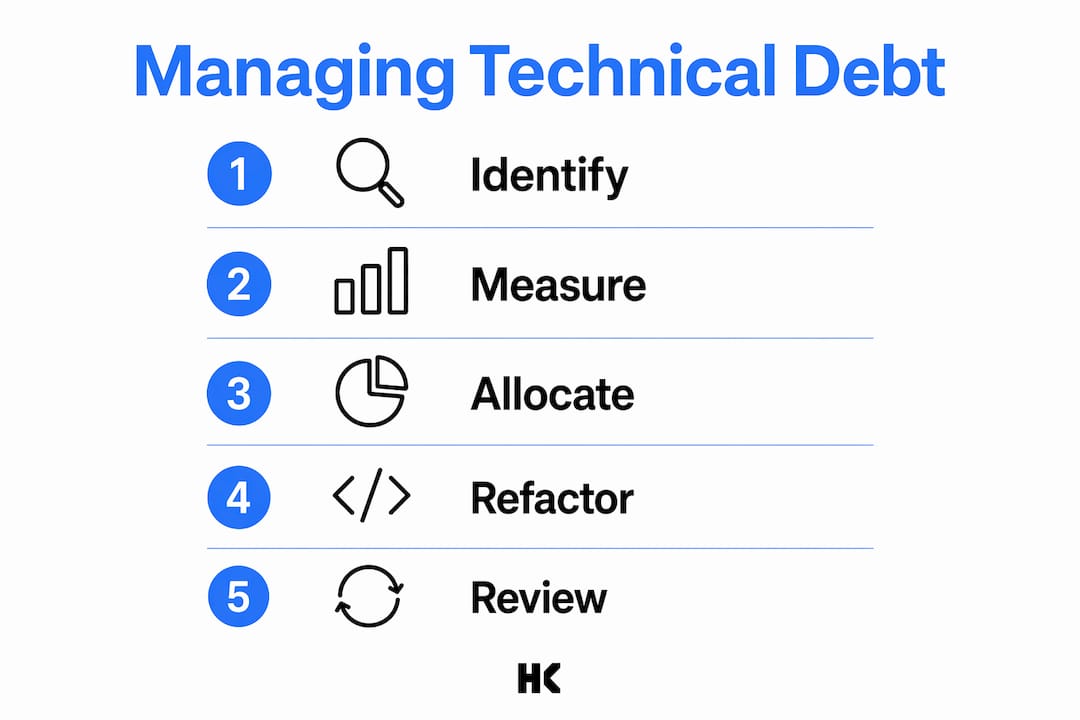
Taking on deliberate debt can be a valid business decision when the goal is to meet an immediate milestone, but only when there's a concrete plan to pay it back. Visibility, measurement, and a clear repayment strategy are what separate a calculated trade-off from a liability that quietly grows.
What does current research say about technical debt in 2026?
The most significant shift in the technical debt conversation right now is AI-generated code. As teams adopt LLM-assisted development, a new category of debt is emerging: code that passes review and tests but encodes unstated assumptions about data formats, API contracts, or system behavior. The future of AI in software development makes this pattern more common, not less, as generation speed outpaces architectural review. IBM's research on enterprise-scale code analysis found that continuous architectural governance is required, not periodic reviews, to catch this category of debt before it compounds.
The organizational side of the problem is equally documented. Forcing teams to prioritize speed over quality, then hiding the resulting debt from management, is one of the most reliable ways to turn manageable technical debt into a project-threatening liability. The pattern is consistent: management ignores architectural trade-offs, developers stop reporting problems, and the first visible sign is a production failure or a velocity collapse.
Research also reinforces the limits of standard measurement approaches. Static analysis catches code-level issues well, but architectural debt, the kind that actually kills delivery speed, requires combining static analysis with commit history, bug churn data, and direct developer input. The CMU Software Engineering Institute's work on data-driven debt management shows that design and architectural decisions are key contributors to debt that existing tools simply cannot detect on their own.
For DACH and EU teams, there's an additional layer: GDPR-aware architecture and EU AI Act compliance introduce their own technical constraints. Shortcuts taken to ship faster may create compliance debt that's far more expensive to fix than ordinary code debt, particularly for B2B SaaS products handling personal data under GDPR.
Pro Tip: If your team uses AI code generation, add architectural decision records (ADRs) to your workflow now. Document the assumptions behind generated code at the time of acceptance, not six months later when the original context is gone.
Early technical decisions compound in both directions. The early choices you make in a SaaS product shape how much debt you carry into every subsequent sprint.
Key Takeaways
Technical debt is a deliberate or accidental trade-off between short-term delivery speed and long-term maintainability, and left unmanaged it compounds into slower delivery, higher defect rates, and developer burnout.
| Point | Details |
|---|---|
| Debt accumulates interest | Every sprint you don't address known shortcuts, the cost to fix them grows. |
| Fowler's quadrant guides prioritization | Reckless-deliberate debt needs urgent rewrites; prudent debt can be addressed opportunistically. |
| Sprint capacity allocation | Dedicating 15%–20% of sprint capacity to debt management keeps it from compounding. |
| AI code introduces new debt | LLM-generated code encodes unstated assumptions that standard testing pipelines often miss. |
| Culture determines visibility | Teams that hide debt give you incidents; teams that report it give you options. |
FAQ
What is technical debt in simple terms?
Technical debt is the extra work created when you take a shortcut in software development instead of using the better, slower solution. Like financial debt, it accrues interest over time if you don't address it.
Is technical debt good or bad?
It depends on whether it's deliberate and planned. Taking on debt to hit a launch deadline is a valid trade-off if you have a concrete plan to pay it back. Unplanned or hidden debt that compounds without a repayment strategy is what causes real damage.
What is a concrete example of technical debt?
A team skips writing unit tests to ship a feature faster. Six months later, every change to that feature risks breaking something unexpected, and developers spend hours manually verifying behavior that tests would have caught automatically.
How do you measure technical debt?
Code-level debt can be tracked with tools like SonarQube using complexity and duplication metrics. Architectural debt requires combining static analysis with commit history, bug churn data, and developer input to identify the hotspots that actually slow delivery.
How much sprint capacity should go toward paying down debt?
Experts recommend dedicating 15%–20% of sprint capacity to debt management. Below 10%, debt accumulates faster than teams can address it; above 30% signals the codebase needs an aggressive remediation plan.