
TL;DR:
- A technical product roadmap is a strategic plan that aligns technology vision with business goals over a 1 to 18-month period. It differs from a product roadmap by focusing on system health, infrastructure, and scalability, serving engineering and technical stakeholders. Regular updates, stakeholder collaboration, and capacity buffers are essential for maintaining an effective and credible technical roadmap.
A technical product roadmap is a strategic plan that maps out technology vision, infrastructure priorities, and engineering efforts over a 1 to 18-month horizon to align technical teams with organizational goals. Unlike a feature list or sprint backlog, it connects engineering decisions directly to business outcomes. Product managers and development teams use it to communicate what the system needs to become, not just what it needs to do next. The term "technical roadmap" is the recognized industry standard for this artifact. Understanding what is technical product roadmap means understanding the difference between building software and building it in the right direction.
What is a technical product roadmap vs. a product roadmap?
A technical product roadmap focuses on system health, infrastructure, scalability, and architecture. A product roadmap focuses on feature delivery, customer value, and market positioning. These are two distinct artifacts with different audiences and different purposes, though they must stay aligned.
The audience split matters more than most teams realize. Executives want to see outcomes and strategic direction. Engineering teams need dependency chains, capacity constraints, and system-level priorities. A single roadmap trying to serve both audiences usually fails both.
Here is how the two artifacts compare across the dimensions that matter most:
| Dimension | Technical Roadmap | Product Roadmap |
|---|---|---|
| Primary focus | Infrastructure, scalability, system health | Feature delivery, customer value |
| Main audience | Engineering, CTOs, technical leads | Product managers, executives, stakeholders |
| Time horizon | 1–18 months, flexible | Quarterly to annual |
| Success metric | System reliability, tech debt reduction | User adoption, revenue, retention |
| Update frequency | Monthly or more often | Quarterly or per release cycle |
The two roadmaps complement each other when they share the same strategic goals. A product roadmap might call for a new AI-powered recommendation engine. The technical roadmap then captures the infrastructure work required: data pipeline upgrades, model serving architecture, latency targets, and monitoring setup. Without that technical layer, the product roadmap is a wish list.
Pro Tip: Run a quarterly sync between your product roadmap and technical roadmap owners. Misalignment between these two documents is one of the most common causes of missed delivery dates in B2B SaaS teams.
How to create an effective technical product roadmap
Building a technical roadmap that actually guides decisions requires more than listing upcoming work. The process follows a clear sequence, and skipping steps early creates confusion later.

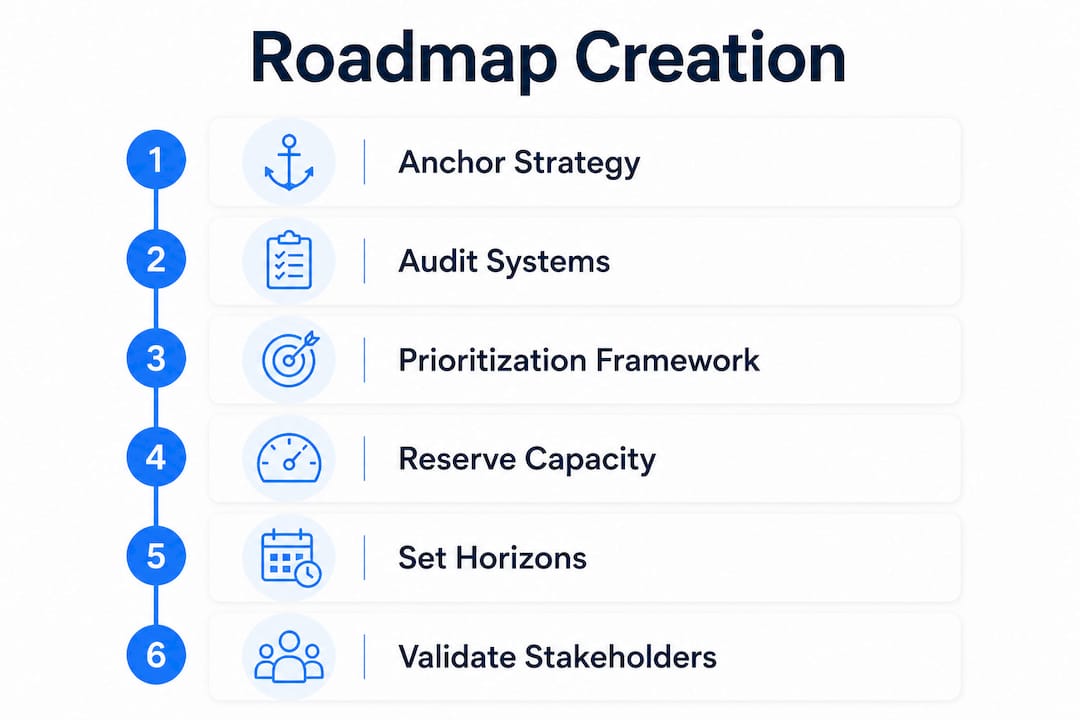
1. Anchor to business strategy first. Before writing a single initiative, identify the top three to five business goals for the next 12 months. Every item on the technical roadmap should trace back to at least one of them. If it cannot, it belongs in the backlog, not the roadmap.
2. Audit your current system state. Map existing architecture, known technical debt, and system bottlenecks. This audit gives you the baseline. Without it, you cannot prioritize accurately because you do not know what is already slowing you down.
3. Choose a framework for prioritization. The Tech Roadmap Prioritization (TRP) framework from AWS plots initiatives on a cost-versus-impact matrix. This shifts prioritization conversations from subjective opinions to objective comparisons. Outcome-based roadmaps, popularized by teams at companies like Spotify and Basecamp, take a similar approach by organizing work around measurable results rather than deliverables.
4. Reserve capacity for unplanned work. Best-in-class frameworks reserve 20–30% of team capacity for bugs, incidents, and technical debt. That buffer is not slack. It is the mechanism that keeps the roadmap from becoming obsolete within a single sprint.
5. Set time horizons using flexible formats. The Now, Next, Later format avoids hard date commitments while still communicating sequence and priority. It works especially well for technical roadmaps where dependencies shift frequently.
6. Validate with stakeholders before publishing. A technical roadmap that engineering built in isolation will not get executive buy-in. Run a one-hour collaborative session with both technical leads and business stakeholders. Use the cost-versus-impact matrix as the shared language. The facilitator's job is to keep the session moving, not to decide priorities.
This six-step process applies whether you are building a SaaS MVP product roadmap from scratch or restructuring an existing technical plan for a scaling product team.
What are the best practices for maintaining a technical roadmap?
A technical roadmap is a living document. Over 66% of product managers update their roadmaps at least monthly, and weekly updates are the most common pattern among high-performing teams. That frequency reflects a real operational need: priorities shift, incidents happen, and market conditions change.
The biggest maintenance mistake is treating the roadmap as a contract. Once teams start defending the roadmap instead of updating it, it stops being useful. The document exists to communicate current thinking, not to lock in decisions made three months ago.
Key practices for keeping your roadmap current and credible:
- Separate views by audience. Executives need a one-page view showing outcomes and timelines. Engineering needs the full dependency map. Tools like Productboard, Aha!, and Linear support multiple views from a single source of truth.
- Use the Now, Next, Later format to avoid broken promises when priorities change. Date-based roadmaps create accountability for the wrong thing. Sequence-based formats create accountability for direction.
- Schedule a standing review cadence. Monthly is the minimum. For fast-moving teams, bi-weekly works better. The review should take 30 minutes, not two hours.
- Track what changed and why. A short changelog attached to the roadmap builds trust with stakeholders. It shows that updates are deliberate, not reactive.
AI-powered living roadmaps are changing this maintenance work in 2026. Instead of manual updates, AI-driven tools can ingest data from Jira, GitHub, and customer feedback systems to flag when roadmap items need revision. This shifts roadmap refresh cycles from months to days.
Pro Tip: Never present your roadmap as a delivery commitment to executives. Present it as your current best thinking on priorities. That framing preserves your credibility when things change, and they always do.
Common challenges in technical product roadmapping
Most technical roadmaps fail for one of three reasons: they are too static, they ignore capacity reality, or they do not communicate clearly to non-technical stakeholders. Each failure mode has a direct fix.
Static roadmaps become obsolete fast. A roadmap built in January and reviewed in June is not a roadmap. It is a historical document. Without a capacity buffer, roadmaps become obsolete within six weeks or one sprint. The fix is building the update cadence into the process before the roadmap is published.
Ignoring capacity buffers breaks delivery. Teams that schedule 100% of capacity have no room for the incidents, bugs, and unplanned requests that arrive every sprint. The 20–30% buffer rule is not a suggestion. It is the difference between a roadmap that guides work and one that gets ignored.
Poor stakeholder communication kills buy-in. A roadmap designed only for engineering detail risks losing executive buy-in. Executives do not need to understand Kubernetes upgrade paths. They need to understand that the infrastructure work reduces downtime by 40% and unblocks the next product milestone.
The solution to all three challenges is the same: treat roadmapping as a communication discipline, not a planning artifact. Use collaborative prioritization sessions with mixed technical and business stakeholders. Plot initiatives on a cost-versus-impact matrix. Let the data drive the conversation, not the loudest voice in the room.
For DACH and EU B2B SaaS teams, there is an additional challenge worth naming: compliance work. GDPR requirements, EU AI Act obligations, and data residency constraints regularly appear as unplanned technical work. These items need a home on the technical roadmap, not just in the legal team's backlog. Building a compliance track into your roadmap structure from the start prevents last-minute scrambles before product launches.
For teams working through a product roadmap optimization process, addressing these three failure modes is the highest-leverage starting point.
Key takeaways
A technical product roadmap works when it connects engineering priorities to business outcomes, stays current through regular updates, and communicates differently to different audiences.
| Point | Details |
|---|---|
| Definition and scope | A technical roadmap spans 1–18 months and maps infrastructure, scalability, and system health to business goals. |
| Roadmap vs. backlog | A roadmap communicates strategic direction; a backlog tracks execution tasks. They serve different purposes and different audiences. |
| Capacity buffer | Reserve 20–30% of team capacity for unplanned work, or the roadmap becomes obsolete within one sprint. |
| Update frequency | Over 66% of product managers update roadmaps monthly; weekly is the most effective cadence for fast-moving teams. |
| Audience tailoring | Executives need outcome views; engineering needs dependency maps. One document, two views, same source of truth. |
Roadmaps are a communication tool, not a planning artifact
I have worked with engineering teams at BMW, Deutsche Bahn, and Bundesrechenzentrum Austria, and the pattern is consistent across all of them: the roadmap gets built once, presented to leadership, and then quietly ignored by the people doing the actual work.
The reason is almost always the same. The roadmap was built as a planning exercise, not as a communication tool. It answered the question "what are we building?" but not "why does this sequence make sense?" or "what does success look like at each stage?"
The teams I have seen get this right treat the roadmap as a living conversation. They update it when something changes. They explain the reasoning behind priority shifts. They maintain separate views for executives and engineers without maintaining two separate documents. That last point matters more than most teams realize. Duplication creates drift. One source of truth, multiple views, is the only structure that scales.
The shift toward AI-powered roadmap tools in 2026 is real, and it is useful. But the underlying discipline has not changed. The tool does not fix a process that lacks clear ownership, regular review, and honest stakeholder communication. Get the process right first. Then let the tooling accelerate it.
— Hanad
Ready to build a roadmap that actually ships?
If your technical roadmap is sitting in a slide deck that nobody reads, the problem is usually structure, not effort. Hanadkubat works directly with B2B SaaS teams and technical founders to scope, prioritize, and ship products on fixed timelines at fixed prices.
From strategy sprints that validate ideas before a single line of code is written (€1,500) to full MVP builds delivered in 4–12 weeks (from €18,000), every engagement is direct: you work with the engineer writing the code, not a project manager. Explore the full service overview and frameworks to see how Hanadkubat structures technical roadmaps for DACH and EU SaaS teams, including EU AI Act compliance tracks and GDPR-aware architecture planning.
FAQ
What is a technical product roadmap?
A technical product roadmap is a strategic document that outlines infrastructure priorities, system health goals, and engineering direction over a 1 to 18-month horizon. It connects technical decisions to business outcomes and serves as a communication tool for engineering teams, product managers, and executives.
How does a technical roadmap differ from a backlog?
A technical roadmap communicates strategic direction and priorities over months. A backlog is a prioritized list of execution tasks for the current or upcoming sprint. The roadmap answers "where are we going and why?" The backlog answers "what are we building this week?"
How often should a technical roadmap be updated?
Over 66% of product managers update their roadmaps at least monthly, with weekly updates being the most common pattern among high-performing teams. The right cadence depends on how fast your priorities shift, but monthly is the minimum for any active product team.
What is the best format for a technical roadmap?
The Now, Next, Later format is the most adaptable structure for technical roadmaps. It avoids hard date commitments that break when priorities change, communicates sequence clearly, and works well for both engineering and executive audiences.
Why do technical roadmaps fail?
Technical roadmaps fail most often because they are treated as fixed contracts rather than living documents, they schedule 100% of team capacity with no buffer for unplanned work, or they are built for one audience and presented to another. Reserving 20–30% capacity and maintaining separate audience views directly addresses all three failure modes.