
TL;DR:
- A product roadmap should be built on validated customer evidence, realistic capacity, and clear outcome targets, not just feature wish lists. Regular, evidence-based reviews and prioritization frameworks like RICE help teams ship what customers need and prevent stalling. Embedding continuous discovery and outcome focus into workflows ensures the roadmap remains a reliable, actionable guide for product success.
A product roadmap is defined as the strategic document connecting your product vision to the specific work your team commits to building, sequenced by evidence and capacity rather than opinion. Most roadmaps fail not because teams lack ambition, but because they treat the roadmap as a feature wish list instead of a set of validated bets. Knowing how to optimize your product roadmap means replacing gut-feel prioritization with customer evidence, honest capacity math, and explicit outcome targets. Frameworks like RICE, Opportunity Solution Trees, and continuous discovery exist precisely to make that shift concrete. The three pillars that separate a roadmap that ships from one that stalls are: validated customer evidence, realistic capacity allocation, and strategic alignment at every horizon.
How to optimize your product roadmap with customer evidence
The most common roadmap failure is committing to features before the evidence justifies it. Every roadmap item needs an explicit target outcome, customer evidence backing, and a capacity reality check. Without all three, you are building a wish list with a Gantt chart attached.

Customer evidence comes in two forms, and both matter.
Qualitative evidence includes user interviews, support tickets, sales call recordings, and churn conversations. These sources tell you why customers behave the way they do. A single well-conducted user interview can invalidate a feature that six stakeholders have been championing for a quarter.
Quantitative evidence includes usage analytics, NPS surveys, funnel drop-off data, and feature adoption rates. These sources tell you how many customers are affected and how severely. Tools like Mixpanel, Amplitude, and FullStory give you the usage signal; the interview gives you the interpretation.
The quality of your evidence determines your confidence level, which directly affects roadmap commitment. Evidence tiers affect whether an item belongs in your execution pipeline or your discovery backlog. Weak evidence moves an item into discovery. Strong, multi-source evidence justifies a delivery commitment.
To build a reliable evidence base, follow these practices:
- Run weekly customer research sessions, even 30-minute calls with two users per week compound fast.
- Tag every evidence item by theme, source type, quality tier, and date so you can filter and compare across time.
- Actively seek disconfirming evidence. If every interview confirms your hypothesis, you are probably talking to the wrong users.
- Retire evidence older than six months unless it has been revalidated. Markets shift, and stale assumptions are worse than no data.
- Use AI-moderated interview tools like Outset or Marvin to scale qualitative research without proportionally scaling researcher time.
Continuous discovery practices, embedding customer learning weekly and reprioritizing monthly, lead to higher feature adoption and reduced wasted effort. That is not a soft benefit. It is the difference between shipping features users actually use and shipping features that look good in a demo.
Pro Tip: Build a shared evidence repository in Notion, Coda, or Confluence where every team member can tag and retrieve customer insights. When prioritization debates start, you want evidence on the table in under two minutes, not a week-long research sprint.
What prioritization frameworks actually work for roadmap trade-offs
Prioritization frameworks convert subjective debates into objective, defensible decisions communicated clearly to stakeholders. The four frameworks worth knowing are RICE, Weighted Scoring, Kano, and Opportunity Scoring. Each has a specific use case.
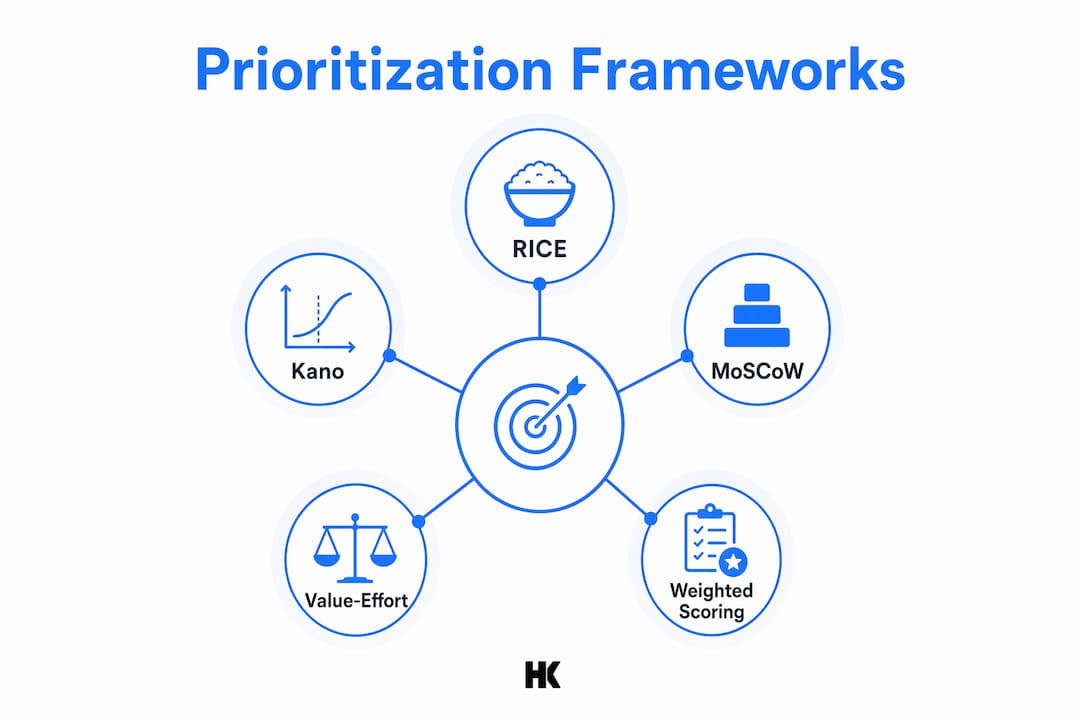
RICE (Reach, Impact, Confidence, Effort) is the most widely used for feature prioritization. Reach is the number of users affected per quarter. Impact is the severity of the problem solved, scored 0.25 to 3. Confidence is your evidence quality, expressed as a percentage. Effort is engineering weeks. The formula: (Reach × Impact × Confidence) / Effort. Customer research inputs calibrate each variable. Without them, RICE is just arithmetic applied to opinions.
Kano separates features into basic expectations, performance drivers, and delighters. It is most useful for deciding what not to build. A feature that users expect as baseline (like password reset) scores differently than a feature that creates genuine delight (like a one-click export). Kano prevents teams from over-investing in table-stakes functionality.
Opportunity Scoring maps customer-stated importance against current satisfaction. High importance, low satisfaction equals an underserved opportunity. This framework, developed by Tony Ulwick, connects directly to Opportunity Solution Trees and works well for longer-horizon strategic planning.
Here is a practical scoring sequence for your next roadmap review:
- List all candidate initiatives for the quarter.
- Score each using RICE with inputs drawn from your evidence repository.
- Plot each initiative on a value vs. complexity matrix: high value and low complexity are quick wins; high value and high complexity are strategic bets; low value items are deprioritized.
- Apply the 70/20/10 allocation: 70% of capacity to strategic bets, 20% to quick wins, 10% to maintenance and tech debt.
- Document the scoring rationale, not just the scores, so the team can revisit assumptions when new evidence arrives.
| Framework | Best used for | Key input required |
|---|---|---|
| RICE | Feature prioritization | Customer reach and effort estimates |
| Kano | Deciding what not to build | User satisfaction surveys |
| Opportunity Scoring | Strategic horizon planning | Importance vs. satisfaction data |
| Weighted Scoring | Cross-functional alignment | Agreed-upon criteria weights |
Pro Tip: Document the customer research inputs used in each RICE score. Explicitly recording inputs prevents biases from masquerading as objective decisions six weeks later when someone challenges the priority.
How often should you review and update your roadmap?
Quarterly roadmap reviews with balanced focus on short-term tactics and strategic long-term goals prevent staleness and roadmap thrashing. Atlassian's agile roadmap guidance is explicit on this: predictable cadence keeps roadmaps responsive without creating constant disruption.
The recommended structure is a three-horizon model using now, next, and later rather than fixed calendar dates. "Now" contains items with strong evidence and confirmed capacity. "Next" contains items in active discovery with growing evidence. "Later" holds strategic bets that need more validation before commitment. This structure lets you communicate direction without over-promising delivery dates.
Quarterly reviews should accomplish four things:
- Confirm capacity for the coming quarter by accounting for tech debt, context switching, and planned leave. Product teams commit to 2.3x more than is feasible per quarter on average. That number should make every product manager uncomfortable.
- Promote items from "next" to "now" only when evidence and capacity both support it.
- Archive or deprioritize items that have not gathered supporting evidence after two review cycles.
- Communicate changes to stakeholders with explicit rationale. Transparently explaining pivots builds trust and reduces political friction when priorities shift.
The product roadmap as a shared source of truth connecting vision, direction, and progress is only valuable if it is current. A roadmap last updated four months ago is not a source of truth. It is a historical artifact.
Pro Tip: Link each "now" item to its corresponding epic or user story in Jira, Linear, or GitHub Projects. This connection makes the roadmap executable rather than decorative, and it gives engineers context for why a feature exists.
Common roadmap problems and how to fix them
Most roadmap failures are predictable. Recognizing the pattern early is the fastest way to recover.
- Overcommitment: Teams routinely underestimate effort and ignore maintenance load. Fix this by calculating available capacity before committing to any item, not after.
- Feature dumping: Items enter the roadmap without a defined outcome or supporting evidence. Fix this by requiring every new item to answer: what customer problem does this solve, and what evidence supports that claim?
- Roadmap staleness: The document reflects decisions made six months ago and no one has updated it. Fix this by treating the roadmap as a living hypothesis document updated with each new evidence cycle.
- Weak prioritization inputs: Scores are based on internal assumptions rather than customer data. Fix this by sourcing RICE inputs directly from your evidence repository, not from stakeholder meetings.
- Stakeholder misalignment: Different teams are operating from different versions of the roadmap. Fix this by publishing a single canonical roadmap in a shared tool and linking it from every sprint planning session.
The underlying cause of most of these problems is the same: the roadmap was built around features rather than measurable outcome targets. Outcome-based roadmaps allow flexible execution without breaking commitments because the commitment is to a result, not a specific implementation.
Integrating roadmap optimization into your product workflow
Roadmap optimization is not a one-time exercise. It becomes effective when embedded into your regular product management rhythm. The table below maps each practice to the workflow artifact it connects to.
| Practice | Workflow artifact | Frequency |
|---|---|---|
| Customer interviews and evidence tagging | Evidence repository | Weekly |
| RICE scoring and prioritization review | Roadmap backlog | Monthly |
| Horizon review and capacity confirmation | Quarterly roadmap | Quarterly |
| Outcome tracking against delivery | Sprint retrospective | Per sprint |
| Stakeholder communication of changes | Roadmap changelog | On change |
For startup founders building their first product, connecting product discovery practices to roadmap decisions early prevents the most expensive mistake in early-stage development: building features no one asked for. For product managers in scaling SaaS companies, the discipline of disciplined development practices applied to roadmap reviews keeps velocity high without accumulating technical or strategic debt.
Maturity-dependent sequencing also matters here. Prerequisites like data governance infrastructure, authentication systems, or analytics instrumentation must appear as explicit roadmap items. Treating them as invisible background work is how teams arrive at a launch date with no way to measure whether the feature worked.
What I've learned from building and reviewing product roadmaps
The most consistent mistake I see across B2B SaaS teams, whether they are early-stage startups or established DACH Mittelstand companies, is confusing a roadmap with a commitment list. A roadmap is a hypothesis. Every item on it represents your current best guess about what will move the product forward, given the evidence you have today.
When I built my own SaaS products end-to-end, the quarterly review was the moment I learned the most. Not because the review itself was insightful, but because preparing for it forced me to confront which items had accumulated real evidence and which were still running on founder intuition. That distinction is uncomfortable. It is also the most productive discomfort in product management.
The teams I work with at Hanadkubat, across Vienna, Germany, and Switzerland, consistently underestimate how much capacity disappears to maintenance, context switching, and unplanned work. The 70/20/10 allocation framework is not a theoretical ideal. It is a forcing function that makes the capacity conversation happen before commitments are made, not after they are missed.
My practical advice: run your first evidence-based prioritization session with your current backlog, score every item with RICE using only data you can point to, and see how many items survive. The ones that do not survive are not necessarily bad ideas. They are just not ready for execution yet. Move them to discovery and keep building the evidence. That discipline, applied consistently, is what separates roadmaps that ship from roadmaps that slide.
— Hanad
Ready to build a roadmap that actually ships?
If this article gave you a clearer picture of what evidence-based roadmap planning looks like in practice, the next step is applying it to your specific product context.
Hanadkubat works directly with B2B SaaS founders and product teams across the DACH region and EU to scope, prioritize, and ship products with fixed timelines and fixed prices. Whether you need a strategy sprint to validate your roadmap before building, or a full SaaS MVP build shipped in 4 to 12 weeks, the work is done by the engineer you speak to, not a project manager. Explore the guides on continuous discovery and startup product strategy at hanadkubat.com to go deeper on the frameworks covered here.
FAQ
What does it mean to optimize a product roadmap?
Optimizing a product roadmap means replacing opinion-driven feature lists with evidence-backed, outcome-focused priorities sequenced against realistic capacity. The goal is a roadmap that reflects what your team can actually ship and what customers actually need.
How often should a product roadmap be updated?
Quarterly reviews are the recommended minimum, with monthly reprioritization of the near-term backlog based on new customer evidence. Atlassian's agile roadmap guidance supports this cadence as the baseline for keeping roadmaps responsive without constant disruption.
What is the best prioritization framework for a product roadmap?
RICE (Reach, Impact, Confidence, Effort) is the most widely used framework because it quantifies trade-offs using customer research inputs. For strategic horizon planning, Opportunity Scoring maps underserved customer needs more effectively than feature-level scoring.
Why do most product roadmaps fail to ship?
The primary cause is overcommitment: teams commit to 2.3x more than is feasible per quarter on average, according to Prodara's 2026 research. The secondary cause is weak evidence, where items enter the roadmap without validated customer need or defined outcomes.
What is the role of a product roadmap in a startup?
The product roadmap connects the founding vision to the specific work the team builds next, acting as the shared source of truth for prioritization decisions. For startups, it is most valuable as a hypothesis document updated continuously with customer evidence rather than a fixed delivery plan.