
TL;DR:
- Most non-technical founders mistakenly build products before testing key assumptions, risking wasted resources. An effective startup roadmap emphasizes validated learning, flexibility, and short feedback cycles to guide product development strategically. Regular updates based on user feedback and market signals ensure the roadmap remains relevant and focused on achieving validated business outcomes.
Most non-technical founders make the same mistake: they start building before they know what to test. The pressure to ship something fast is real, but without a structured plan, you burn through budget on features nobody asked for. A startup product roadmap is the tool that forces you to decide what matters before a single line of code gets written. This guide gives you a practical, step-by-step system for building a roadmap that validates your riskiest assumptions first, adapts as you learn, and actually gets your SaaS MVP out the door.
Table of Contents
- What is a startup product roadmap and why does it matter?
- Key principles: Hypothesis-driven, phased, and flexible
- Before you start: What you need for a solid roadmap
- Step-by-step: Building your SaaS MVP roadmap
- Adapting your roadmap: Validation, feedback, and iteration
- Why most startup roadmaps fail—and what actually works
- Get hands-on help to build your SaaS MVP roadmap
- Frequently asked questions
Key Takeaways
| Point | Details |
|---|---|
| Roadmap as validation tool | A startup roadmap should focus on testing key assumptions through interviews, prototypes, and experiments, not fixed timelines. |
| Hypothesis-first approach | Organize your plan into phases that validate the problem, solution, and business model for your SaaS MVP. |
| Adapt based on feedback | Continue updating your roadmap as real data and user insights emerge—iteration leads to stronger products. |
| Quality matters—even for MVPs | A minimum viable product should still be credible and usable to avoid misleading feedback. |
| Get expert help early | Guidance from technical partners can streamline roadmapping and help non-technical founders avoid costly missteps. |
What is a startup product roadmap and why does it matter?
A product roadmap is a strategic plan that shows what you want to build, in what order, and why. In a SaaS context, it is not a project timeline or a feature wish list. It is a communication tool that aligns everyone on the same priorities, from your first developer to your first investor.
Roadmap best practices describe it as an intentional cross-functional plan that visualizes what you want to achieve and the work and milestones needed to deliver it. Notice the word "achieve." The focus is on outcomes, not outputs. You are not just listing screens and buttons. You are mapping the path to a validated business result.
"A roadmap is not a promise. It is a hypothesis about how you will create value. Treat it that way and it becomes your most powerful alignment tool."
For early-stage SaaS teams, this distinction is everything. A traditional, calendar-driven roadmap written in quarter blocks gives a false sense of certainty. At the MVP stage, you do not know enough yet to promise Q3 feature delivery. What you know is your riskiest assumption and the fastest way to test it.
A SaaS launch roadmap guide for non-technical founders typically breaks this down further, showing how each roadmap milestone ties directly to a go-to-market decision. That connection matters more than most founders realize.
Here is what an MVP-stage roadmap typically includes:
- Target customer segment and the core job they need done
- The riskiest assumption your entire business depends on
- Phase 1 experiments to validate demand before building
- A minimum feature set that proves your core value proposition
- Success criteria for deciding when to move to the next phase
- Known dependencies like integrations, compliance, or third-party APIs
- Resource constraints that will affect sequencing
The key thing to understand is that this roadmap is not locked. It is alive. It changes every time you learn something new from a real user.
Key principles: Hypothesis-driven, phased, and flexible
The biggest mindset shift for non-technical founders is moving from "what are we building?" to "what are we testing?" That shift changes everything about how you structure your roadmap.
For early-stage SaaS, treating your roadmap as a validation plan rather than a year-long feature schedule is the right move. Early items should be interviews, prototypes, and experiments before you commit to a full build. This is not a soft principle. It is a hard cost-saving strategy. An interview that kills a bad idea costs you a few hours. A full build that nobody uses costs you €50K and three months.
Your roadmap should be organized around three phases:
-
Problem validation. Before anything else, confirm that the problem you are solving is real, frequent, and painful enough that people will pay to fix it. Conduct user interviews, analyze competitor positioning, and run landing page experiments. The output is a clear problem statement and evidence that your target user actually feels the pain you think they feel.
-
Solution validation. Build the smallest possible version that demonstrates your core value proposition. This could be a clickable prototype, a wizard-of-oz simulation (where manual processes replace automated ones), or a very scoped first version. The goal is not polish. The goal is learning whether your solution actually solves the problem people told you they had in phase one.
-
Business model validation. Prove that people will pay for it, at a price that makes the math work. This is where you introduce pricing pages, payment flows, and early sales conversations. Many founders skip straight to this step and wonder why their conversion rate is terrible. Without phases one and two, you are asking people to pay for something they do not fully understand or trust yet.
Pro Tip: Write each phase as a hypothesis statement: "We believe [target user] will [take this action] because [this is their pain]. We will know we are right when [specific measurable signal]." This single habit turns vague roadmap items into clear, testable commitments.
Flexibility is not a weakness in your roadmap. It is a feature. The founders who get stuck are the ones who published a 12-month roadmap publicly and now feel embarrassed to change it. Do not do that. Share goals, not timelines. Keep your bets short and your learning cycles fast. You can always validate your SaaS idea more deeply before committing resources to a full build.
Before you start: What you need for a solid roadmap
You cannot build a useful roadmap in a vacuum. Before you write a single milestone, you need answers to a specific set of questions. Skipping this step is why most founders end up with a roadmap that looks great on a slide and fails in practice.
Here is the prerequisite information you need to gather, and why each one matters:
| Input | What it means | Why it matters |
|---|---|---|
| Target customer | A specific person with a specific role and context | Prevents you from building for "everyone" |
| Core pain point | The real problem they face today, in their words | Ensures your value prop is grounded in reality |
| Resource constraints | Budget, time, team size | Forces honest sequencing decisions |
| Market signals | Evidence of demand, competitor moves, search behavior | Confirms the problem is worth solving commercially |
| Tech risk | Known unknowns in your stack, integrations, or compliance | Shapes where to invest early validation effort |
The startup product strategy guide goes deeper on each of these inputs and how they shape your early decisions. What most founders underestimate is the tech risk column. Not every SaaS idea is technically equal. Some depend on third-party APIs that have rate limits. Some require GDPR compliance work before they can onboard even one paying user. Identifying these risks upfront saves you from discovering them two weeks before your planned launch.
Early-stage SaaS teams also tend to hit predictable bottlenecks. Here are the most common ones:
- No clear owner for roadmap decisions, so everything stalls in group debate
- Feature creep from stakeholder opinions that have no user evidence behind them
- Technical debt from moving too fast in phase one without any architecture decisions
- Scope inflation when investors ask "what else can it do?" before the core is validated
- Missing success criteria, so nobody knows when a phase is actually complete
Roadmap tooling choice depends on the bottleneck you are trying to solve. For early-stage teams that need to align quickly with limited strategy depth, clarity of goals, work, and milestones is far more important than software features. A well-structured Notion page beats a complex roadmapping tool if your team actually reads and updates it.
Pro Tip: Before your first roadmap session, spend 30 minutes writing down your three riskiest assumptions. These are the things that, if you are wrong about them, sink the business. Your roadmap should address all three in the first two phases. You can reduce risk with validation by structuring experiments around each one explicitly.
Step-by-step: Building your SaaS MVP roadmap
Here is a practical build-out process you can follow right now, regardless of your technical background.
-
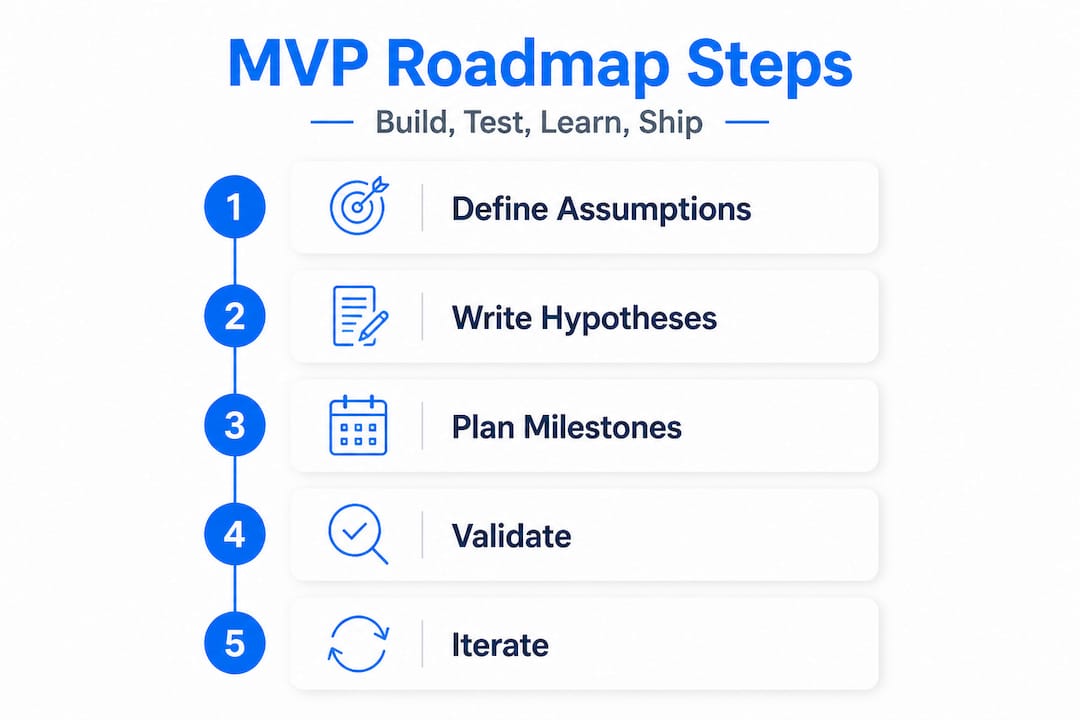
Write your core hypothesis. State your riskiest assumption in one sentence. Example: "We believe that HR managers at mid-sized companies in Germany will pay €200 per month for a tool that automates onboarding document collection because they currently spend four hours per new hire on manual paperwork."
-
List your top three unknowns. What do you not know yet that would make or break this? Typical answers: whether users will actually pay, whether your integration with an existing HR system is even possible, or whether the problem is painful enough to justify switching from a current workaround.
-
Assign each unknown to a phase. Demand unknowns belong in problem validation. Technical unknowns often need a quick spike (a short technical experiment) in parallel. Pricing unknowns belong in business model validation.
-
Draft your now/next/later structure. The now/next/later framing is a hypothesis lifecycle: discover the riskiest problem, build the minimum feature set that proves the value, then validate willingness to pay. "Now" is what you are actively working on this week. "Next" is what comes immediately after the current phase closes. "Later" is everything else, and it should stay vague on purpose.
-
Define exit criteria for each phase. How many user interviews prove demand? What conversion rate on your landing page is good enough? Without these numbers, you never know when to move on.
-
Sequence your build. Only build what you cannot fake. If you can test something with a manual process or a prototype, do not write code for it yet.
Here is a direct comparison of the three test types you will encounter at the MVP stage:
| Test type | When to use it | Cost | Risk |
|---|---|---|---|
| Public MVP | Demand and usability are your riskiest unknowns | Medium | Reputational if too rough |
| Internal prototype | Feasibility or compliance is the primary risk | Low | Limited signal on real demand |
| Simulation | You need to test workflows without building infrastructure | Very low | Results may not reflect real behavior |
The important nuance here is that launching a public MVP first is not always the right move. If your MVP is too rough, it can fail because of poor usability rather than lack of demand. In regulated industries like fintech or health tech, you may need internal prototypes or pilots before any public release. Know your riskiest unknown first, then choose the right test type.

Pro Tip: Map each roadmap milestone to a specific learning question. "User authentication" is not a milestone worth tracking. "Can users complete onboarding without contacting support?" is. This shift forces you to think like a product person, not a project manager. Learn more about the process in this product validation step-by-step guide and how to launch your SaaS app once validation is complete.
Adapting your roadmap: Validation, feedback, and iteration
A roadmap that never changes is a roadmap built on wishful thinking. The most successful SaaS founders treat their roadmap the way a scientist treats a hypothesis board: they update it every time new evidence comes in.
Here are the primary feedback sources you should build into your process:
- User interviews (structured, recurring, not ad hoc) to capture language and priorities directly from target users
- In-product analytics to see where users drop off, what they ignore, and what they return to
- Churn conversations where you ask directly why someone stopped using the product or did not convert
- Willingness to pay signals from pricing page behavior, upgrade rates, and direct sales calls
- Support tickets and bug reports which often reveal friction your team normalized and stopped seeing
- Competitor monitoring for feature releases, pricing changes, and positioning shifts that affect your assumptions
"Reframing failure as a data point rather than a setback is what separates founders who iterate to product-market fit from those who build confidently in the wrong direction."
The State of European Tech 2025 explicitly pushes to improve conditions for founders to build, grow, and sell across borders, naming risk culture and experimentation as foundational to growth. If you are building in Europe, this is your competitive context. The founders who treat every experiment as a learning opportunity are the ones accelerating while others wait for certainty that never comes.
Knowing when to update your roadmap is a skill. Update it when a phase closes and exit criteria are met. Update it when a core assumption gets invalidated by real user data. Update it when a market signal shifts your target segment or pricing. Do not update it every week based on one user comment. The signal-to-noise ratio in early feedback is brutal. Wait for patterns.
You can see how other early-stage teams have handled this process in these SaaS MVP success examples, which show how different companies sequenced their validation and when they made the call to scale.
Why most startup roadmaps fail—and what actually works
Here is what I see over and over again with founders who come to me after their first product cycle stalled: they built a roadmap that was really just a feature wishlist with dates attached. They felt good about it because it looked like a plan. It was not a plan. It was a comfort blanket.
The roadmap-as-checklist is the most common failure pattern I encounter. Founders list every feature they want to build, assign imaginary timelines to each one, and then spend the next six months either defending the list or feeling guilty about deviating from it. Neither behavior leads to learning. Both behaviors burn money.
The second failure pattern is prioritizing persuasion of investors over learning from users. Founders build features that look impressive in a demo rather than features that test the core value proposition. The product looks polished in a pitch deck. It does not work for an actual user trying to accomplish something.
What actually works is spending more time on hypothesis design before the roadmap session even starts. Most founders spend 80% of their roadmap time on feature decisions and 20% on assumption identification. Flip that ratio. If you can clearly articulate what you do not know and why it matters, the roadmap writes itself.
The teams I have seen achieve real traction shifted to a hypothesis-first approach. They cut the feature list down to three things per phase. They tied every build decision to a specific learning question. They made peace with shipping something that felt embarrassingly minimal because they knew it was enough to get the answer they needed. Then they iterated fast.
Roadmaps also fail when there is no designated decision-maker. In a team of three, everyone has opinions. Without one person who owns the roadmap call, every milestone becomes a negotiation. Assign a product owner, even if that is the founder themselves. Decisions need to happen in hours, not weeks.
The most effective roadmaps I have worked with share one characteristic: they make the cost of being wrong cheap. Every phase is designed to surface the most important failure mode as fast and cheaply as possible. The goal is not to succeed at every phase. The goal is to learn quickly enough to keep going. Validation lessons from founders who got this right consistently show the same pattern: short bets, fast feedback, honest scoring.
Get hands-on help to build your SaaS MVP roadmap
If you have read this far, you understand that a good SaaS product roadmap is not about planning every detail. It is about knowing what to test, in what order, with the least possible waste. That takes technical judgment most non-technical founders simply do not have yet, and that is completely normal.
I work directly with non-technical founders to turn their product ideas into production-ready MVPs in 4 to 12 weeks. No agency layers. No project managers playing telephone. You work with the person writing the code. I have shipped SaaS products for clients across Europe using React, Next.js, and Node.js, and I have built my own SaaS products using the same hypothesis-driven process described in this guide. If your roadmap feels unclear, your assumptions are untested, or you simply need a senior technical partner to help you prioritize and execute, let's talk about what you are building and whether I can help you ship it faster.
Frequently asked questions
How detailed should a startup product roadmap be for an MVP?
Focus on clarifying goals, the risky assumptions you need to test, and key milestones. As this MVP roadmap guidance confirms, early items should be interviews, prototypes, and experiments before committing to a full build. Overly detailed, feature-by-feature roadmaps create false certainty at this stage.
What makes a roadmap different from a product backlog?
A roadmap visualizes goals and major milestones over time, while a backlog is a running list of tasks and features. Roadmap best practices describe roadmaps as tools for defining goals, strategy, the work required, and a timeline. The backlog is operational. The roadmap is strategic.
Should every SaaS MVP launch as a public product right away?
Not necessarily. Sometimes a prototype or internal test is more appropriate, especially when quality or compliance is a key risk. Research on MVP approaches shows that if the MVP is too rough, it can fail due to poor usability rather than lack of demand, and in regulated contexts, internal prototypes or pilots are often the right first step.
How often should I update my startup product roadmap?
Review and adjust your roadmap after significant experiments, feedback cycles, or major market or resource changes. Roadmap best practices position roadmaps as communication tools for aligning internal teams, which means they should reflect current reality, not historical intentions.