
TL;DR:
- Building a founder-first product roadmap requires integrating feature priorities with AI compliance and regional regulations in DACH countries.
- By focusing on measurable goals, strategic themes, and explicit compliance tasks, founders can align development with legal requirements and market needs.
Building a founder-first product roadmap is hard enough when your only variable is feature priority. Add AI integration and DACH-specific compliance requirements and the problem compounds fast. You are deciding what to build, in what order, while simultaneously navigating GDPR consent flows, EU AI Act risk categorization, and Switzerland's FADP opt-out model. Most roadmap guides skip all of that. This one does not. What follows is a practical framework built specifically for B2B SaaS founders and CTOs operating in Austria, Germany, and Switzerland who need to ship real product while staying compliant.
Table of Contents
- Why founder-first product roadmaps matter for solo SaaS founders
- Preparing your founder-first product roadmap: goals, themes, and compliance requirements
- How to build your founder-first product roadmap with AI integration and compliance in mind
- Verifying and evolving your founder-first roadmap: lessons from post-launch reality
- Integrating AI governance and compliance into your roadmap
- Why rapid iteration beats consensus in founder-first roadmaps
- Accelerate your founder-first roadmap with expert MVP development
- Frequently asked questions
Key Takeaways
| Point | Details |
|---|---|
| Founder-first roadmap definition | It is a strategic plan looking 3-6 months ahead, focusing on what to build, why, and sequence rather than just tasks. |
| DACH AI compliance | Roadmaps must reflect jurisdiction-specific consent models and DPIA requirements for Austria, Germany, and Switzerland. |
| Roadmap time horizons | Use Now, Next, and Later buckets to balance current builds, upcoming features, and future plans. |
| Post-launch reality roadmap | Update roadmaps regularly based on retention data, churn reasons, and expansion opportunities. |
| AI governance integration | Embed workflows linking strategy, risk, people, and operations to manage AI responsibly within the roadmap. |
Why founder-first product roadmaps matter for solo SaaS founders
A founder-first product roadmap is not a backlog, a sprint board, or a feature wishlist. It is a strategic, living decision document that answers three questions: what are you building, why, and in what order. The planning horizon is typically 3 to 6 months. Anything longer becomes fiction. Anything shorter is just a to-do list.
The reason this framing matters so much for solo founders is bandwidth. You do not have a product team to absorb unclear priorities. Every week you spend building the wrong thing is a week you cannot recover. A well-structured roadmap gives you the clarity to say no to good ideas because you already committed to better ones.
Here is how the time horizons break down in practice:
- Now (current month): Features actively in development. Scope is locked. Execution is the only variable.
- Next (2 to 3 months out): Validated ideas that are queued. Requirements are forming but can still shift.
- Later (4 to 6 months out): Strategic bets. High uncertainty. Intentionally left loose until closer.
For DACH founders adding AI features, each horizon also carries compliance weight. A "Now" item like a document summarization feature may require a completed Data Protection Impact Assessment (DPIA) before it ships. Planning the horizon forces you to plan the compliance timeline alongside it.
Pro Tip: Treat your roadmap as a decision log, not just a plan. When you move something from "Later" to "Now," write one sentence explaining why. Three months from now, you will thank yourself.

If you are still figuring out how building SaaS MVP roadmaps works in practice, the mechanics of scope-locking and staged delivery make a lot more sense once you have built at least one.
Preparing your founder-first product roadmap: goals, themes, and compliance requirements
Before you place a single feature on a timeline, you need three things locked: measurable goals, two or three strategic themes, and a clear picture of your compliance surface by jurisdiction.
Goals need to be specific enough to make prioritization decisions. "Improve retention" is not a goal. "Reduce 30-day churn from 18% to 11% by Q3" is. That number tells you whether to invest in onboarding flows, usage analytics, or account health features. Vague goals produce vague roadmaps.
Strategic themes act as filters. If your two themes are "AI-assisted workflow automation" and "enterprise security posture," every feature idea gets tested against both. A feature that fits neither gets parked. This is how founders avoid building things that feel productive but do not compound toward the actual goal.
Compliance is where DACH founders face a real structural problem that most startup product planning frameworks ignore entirely. Jurisdiction matters in this region more than almost anywhere else in the world. Regulatory approaches differ by jurisdiction: Austria and Germany operate under GDPR with an opt-in model for AI data processing, while Switzerland's FADP uses opt-out for general processing and only requires explicit consent for high-risk profiling. That is not a minor detail. It changes your consent UX, your data flows, and the scope of your DPIA.
Here is a simplified reference for planning purposes:
| Jurisdiction | Regulation | Consent model | DPIA requirement |
|---|---|---|---|
| Austria | GDPR | Opt-in | Required for high-risk AI processing |
| Germany | GDPR | Opt-in | Required for high-risk AI processing |
| Switzerland | FADP | Opt-out (general) / opt-in (high-risk profiling) | Required for large-scale processing |
This table should live in your roadmap preparation doc, not buried in a legal review. When a feature touches personal data or AI inference, you check the table and decide whether a DPIA is a prerequisite for shipping.
Pro Tip: Do not treat DPIA as a legal checkbox at the end of development. Write a one-page DPIA outline before you design the feature. It surfaces architecture decisions early, when they are cheap to change.
The startup product strategy guide covers how to align these compliance decisions with your broader product positioning, which matters more than founders expect when selling to enterprise buyers in the DACH market.
How to build your founder-first product roadmap with AI integration and compliance in mind
With goals, themes, and compliance context defined, the actual roadmap construction is faster than most founders expect. A product roadmap built with AI agents can convert scattered ideas into a prioritized, structured plan in a few hours without a committee. The hard work is the input quality, not the tool.
Here is the process:
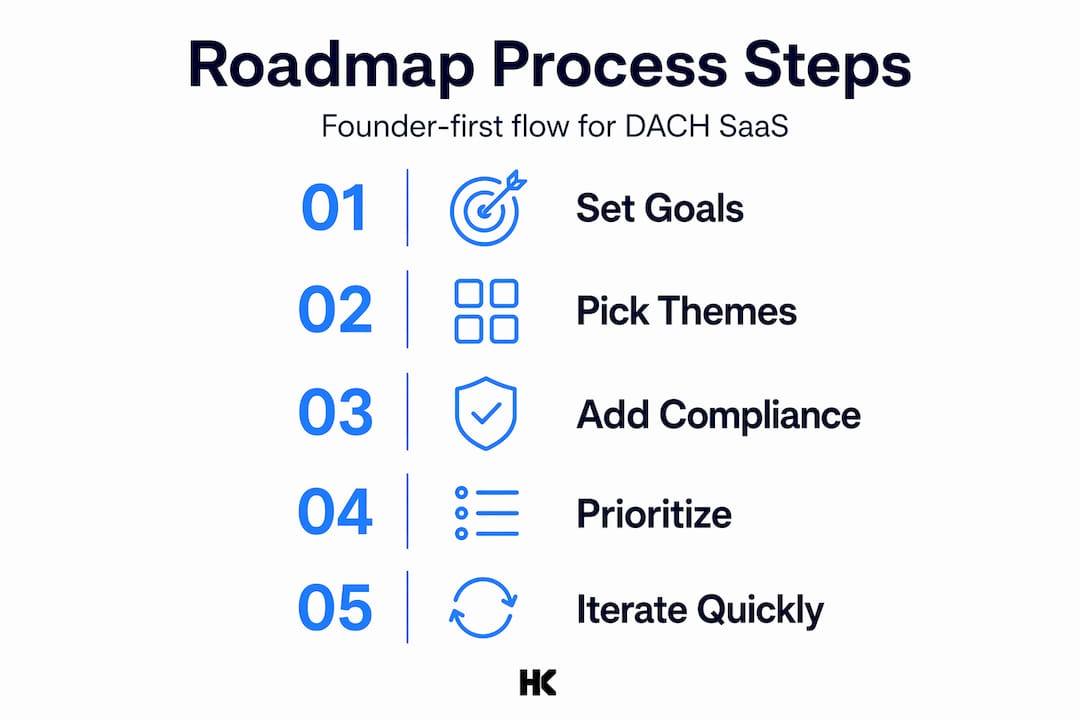
- List all feature candidates without filtering. Include AI features, compliance tasks, and infrastructure items. Everything goes on the list.
- Score each item on two dimensions: user impact (1 to 5) and implementation effort (1 to 5). A simple impact-divided-by-effort ratio gives you a first-pass priority order.
- Map each item to a strategic theme. Items with no theme match go to a parking lot. You are not killing the idea, you are protecting your focus.
- Assign compliance dependencies. Any item touching AI inference, personal data, or automated decision-making gets flagged. DPIA required? Consent UX needed? Mark it explicitly.
- Place items into Now/Next/Later. Respect your real capacity. If you can ship two meaningful features per month, your "Now" column has two items. Not eight.
- Review monthly. Block 90 minutes at the end of each month to move items, retire assumptions, and update compliance status.
The comparison below shows the difference between an ad hoc backlog and a structured founder-first roadmap:
| Dimension | Ad hoc backlog | Founder-first roadmap |
|---|---|---|
| Time horizon | Undefined | 3 to 6 months |
| Prioritization method | Gut feel or loudest voice | Impact/effort scoring against themes |
| Compliance tracking | Separate or none | Embedded as explicit items |
| Update cadence | Reactive | Monthly, scheduled |
| Decision audit trail | None | Logged reasoning per item |
Including compliance tasks as explicit roadmap items is not bureaucracy. It is how you prevent a last-minute legal review from blocking a launch. Consent UX toggles, DPIA completion, EU AI Act risk classification: these are features. Treat them as such.
Pro Tip: When you ship an AI feature, add a monitoring item to the "Next" column immediately. Production AI behavior drifts. Evaluation and monitoring are not optional maintenance, they are product requirements.
The founder-first development process goes deeper on how to structure technical execution so your build velocity matches your roadmap cadence.
Verifying and evolving your founder-first roadmap: lessons from post-launch reality
Most founders treat launch as the end of the planning cycle. It is actually the moment your roadmap starts telling the truth.
Launch is not the finish line. The pre-launch roadmap was built on hypotheses. The post-launch roadmap gets built on data. Specifically: retention curves, churn reasons, and the gap between what users said they wanted and how they actually behave inside the product.
Here is what a post-launch roadmap review process looks like in practice:
- Week 1 to 4: Focus entirely on activation. Are users reaching the "aha moment"? Onboarding flows are your highest-leverage target.
- Day 30 to 60: Shift to retention. Pull your cohort data. Which user segments are staying? Which are churning? Ask churned users directly. Three conversations beat a hundred data points.
- Day 60 to 90: Identify expansion bets. Where are retained users hitting walls? What would make them upgrade, refer, or expand usage?
Your roadmap at day 90 should look almost nothing like your pre-launch roadmap. That is not failure. That is the system working.
"Founders should replace pre-launch roadmaps with a 90-day 'reality roadmap' built around retention, churn, and expansion bets." — Mind the Product
For DACH founders, compliance monitoring belongs in this same cycle. GDPR enforcement patterns evolve. The EU AI Act's implementation timeline is moving. Switzerland's FADP updates continue. Compliance is not a one-time audit. It is a recurring operational item that belongs in your monthly roadmap review.
Pro Tip: Create a simple compliance status column in your roadmap tool. Values: "Not applicable," "In progress," "Cleared." Update it monthly. This gives you a defensible paper trail if a regulator ever asks.
The startup product development steps framework covers how to structure this post-launch iteration cycle so you are not rebuilding your process from scratch every quarter.
Integrating AI governance and compliance into your roadmap
AI governance is not just a legal topic. It is a product architecture decision. If you wait until your AI features are in production to think about governance, you are building rework into your roadmap before you have even shipped.
The OECD AI Governance Playbook frames AI governance as a system connecting four areas: strategy, risk and compliance, workforce readiness, and operational management. Each of those has a direct translation into roadmap action for a DACH SaaS founder.
Strategy layer:
- Define which EU AI Act risk tier your features fall into (minimal, limited, high, unacceptable)
- Assign an owner for AI ethics decisions inside your company, even if that is you
Risk and compliance layer:
- Map every AI feature to a specific regulation (GDPR Article 22 for automated decisions, EU AI Act Annex III for high-risk systems)
- Schedule compliance reviews as dated roadmap items, not vague future tasks
Workforce readiness:
- If you use contractors or a dev partner, confirm they understand GDPR-aware architecture requirements before work starts
- Document what EU-resident inference means for your data residency commitments
Operational management:
- Build evaluation loops into every AI feature from day one. Define what "working correctly" means in measurable terms before you ship.
- Set cost monitoring thresholds. A RAG system at $0.034 cost-per-query versus an unoptimized one at $0.18 is a 5x cost difference that compounds with scale.
- Schedule quarterly reviews of your AI model versions, provider contracts, and EU compliance status.
- Treat every AI provider change as a product event requiring a DPIA re-assessment.
Embedding these items into your roadmap turns governance from a compliance burden into a product quality signal. Buyers in the DACH enterprise market notice when you can explain your AI governance posture. Most of your competitors cannot.
The founder tech checklist includes specific architecture decisions that support this governance layer without adding unnecessary complexity to your stack.
Why rapid iteration beats consensus in founder-first roadmaps
Here is the uncomfortable reality most product planning frameworks will not say directly: consensus is a luxury that early-stage solo founders cannot afford, especially when AI compliance rules are changing faster than your quarterly planning cycle.
The standard advice is to "align stakeholders before updating the roadmap." For a funded team with a product manager, a legal counsel, and an engineering lead, that makes sense. For a founder shipping alone or with one engineer in Vienna or Munich, waiting for alignment means waiting for information that often does not exist yet.
Founder-first roadmaps need to prioritize learning speed over consensus. The goal is to be wrong faster and correct sooner. A roadmap that updates monthly based on real user behavior will outperform a roadmap that updates quarterly after a committee review. Every time.
This does not mean ignoring your advisors, investors, or dev partners. It means treating their input as data, not as permission. You gather it, weigh it, and make a call. Then you communicate the decision clearly and move. That communication piece matters more than founders realize. When you update your roadmap, send a one-paragraph summary explaining what changed and why. Your dev partner needs this to scope the next sprint. Your investors need it to trust you are not pivoting on a whim.
The AI compliance dimension makes this even more critical. EU AI Act guidance is still being clarified at the implementation level. DACH data protection authorities are issuing new guidance regularly. If you are waiting for perfect regulatory clarity before shipping an AI feature, you are not protecting yourself. You are losing ground to competitors who are shipping, monitoring, and adjusting. Build the monitoring loop into the feature, ship with reasonable compliance controls in place, and treat regulatory updates as roadmap inputs.
Explore how founder communication tips can help you keep dev partners and stakeholders aligned as your roadmap evolves rapidly.
Accelerate your founder-first roadmap with expert MVP development
Building a compliant, AI-integrated SaaS product in the DACH market is genuinely complex. The roadmap framework above gives you the structure. Execution is still the hard part.
If you are a non-technical founder or a CTO whose team is at capacity, you do not have to figure out EU AI Act compliance, GDPR-aware architecture, and MVP scoping alone. Expert MVP development for founders built specifically for the DACH market means fixed prices, delivery in weeks not months, and direct access to the engineer writing your code. Whether you need a strategy sprint to scope your roadmap (€1,500), a production AI feature shipped in a 2-week sprint (€4,500), or a full MVP build (from €18,000), the service is structured around your timeline and compliance requirements, not a generic process.
Frequently asked questions
What is a founder-first product roadmap?
It is a strategic, living decision document that a solo founder uses to prioritize what to build, why, and in what order across a 3 to 6 month horizon, distinct from a simple feature backlog or task list.
How do AI compliance requirements differ in the DACH region?
Austria and Germany require opt-in consent under GDPR for AI data processing, while Switzerland's FADP uses an opt-out model for general processing and only mandates explicit consent for high-risk profiling, requiring founders to implement jurisdiction-specific consent mechanics and separate or combined DPIAs.
Why should founders update their product roadmap after launch?
Post-launch updates replace pre-launch assumptions with real user data, and founders should replace pre-launch roadmaps with a 90-day reality roadmap focused on retention, churn patterns, and expansion opportunities.
How can AI governance frameworks help SaaS founders?
They provide a structured system that links strategy, risk, and operations, giving founders a repeatable way to embed ethical, compliant AI use across their product without waiting for a dedicated legal or compliance team.