

TL;DR:
- Sprint planning is a timeboxed Scrum event where the team establishes a clear sprint goal and selects backlog items aligned with business outcomes. It emphasizes a structured two-phase process, separating the "What" from the "How" to improve focus, reduce meeting duration, and foster shared understanding. Proper preparation, refined backlog items, and strict timeboxing are essential for effective sessions that drive predictable delivery and higher team motivation.
Sprint planning is defined as a timeboxed Scrum ceremony where the team sets a sprint goal and selects the backlog items they will deliver in the upcoming sprint. It is the starting point for every sprint, aligning developers, the Product Owner, and the Scrum Master on what work gets done and how. Without a structured planning session, teams begin sprints with misaligned expectations, unclear priorities, and no shared commitment. This guide breaks down the sprint planning process from its core outputs to its two distinct phases, common pitfalls, and the practices that separate high-velocity teams from those stuck in planning theater.
What is sprint planning and why does it matter?
Sprint planning is the Scrum ceremony that connects the product backlog to the team's daily work, giving every developer a clear understanding of the sprint goal before a single line of code is written. It is not a status update, a backlog review, or a project kickoff. It is a focused negotiation between the Product Owner and the development team about what is achievable in the next sprint and how to achieve it.

The importance of sprint planning goes beyond scheduling. Teams that skip or rush this ceremony often spend the first two days of a sprint clarifying requirements that should have been settled before the meeting started. That lost time compounds across sprints. A well-run planning session costs two to four hours. A poorly run one costs two to four days of mid-sprint chaos.
Sprint planning also creates psychological alignment. When a team collectively agrees on a sprint goal, each member understands how their individual tasks connect to a business outcome. That shared understanding reduces the need for constant check-ins and mid-sprint re-prioritization, which are two of the most common sources of developer frustration in Agile teams.
What are the key outputs of sprint planning?
Two critical outputs come from every sprint planning session: the sprint goal and the sprint backlog. Getting both right is what separates a productive sprint from a reactive one.
The sprint goal is an outcome-oriented statement that describes the business value the team will deliver. A strong sprint goal sounds like "increase checkout conversion by 10%" rather than "complete five user stories." The distinction matters because outcome-based goals increase team focus and motivation compared to output-based lists. When a blocker appears mid-sprint, an outcome-based goal gives the team latitude to adapt. An output-based goal turns every deviation into a failure.
The sprint backlog is the prioritized list of user stories and tasks the team selects to achieve that goal. It is not a fixed contract.
- The sprint goal is the primary commitment. The backlog is the current best plan for achieving it.
- Estimates are forecasts, not guarantees. Treat them as informed predictions based on available knowledge.
- Each backlog item should have clear acceptance criteria before planning begins, not during it.
- The team, not the Product Owner alone, decides how many items to pull into the sprint.
Pro Tip: Write the sprint goal on a shared board before selecting any backlog items. It forces the team to agree on the "why" before debating the "what," which cuts backlog selection time significantly.
The relationship between the sprint goal and the sprint backlog is one of the most misunderstood concepts in Agile. The sprint backlog is not a fixed list to complete at all costs. It is a living plan that serves the sprint goal. If a higher-value task emerges mid-sprint that still serves the goal, the team has room to adapt without declaring the sprint a failure.
How to conduct effective sprint planning meetings
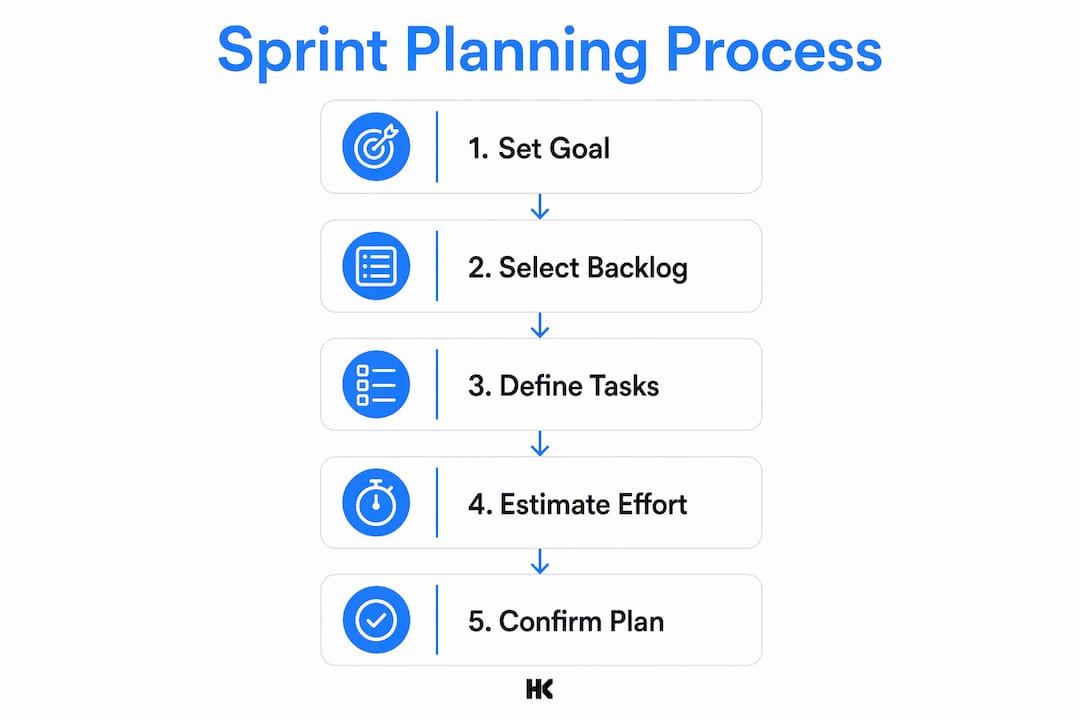
The sprint planning process divides into two distinct phases: "The What" and "The How." Keeping them separate is one of the highest-leverage changes a Scrum team can make.
-
Define the sprint goal ("The What"). The Product Owner presents the top priority items from the refined backlog and proposes a sprint goal. The team discusses the goal, asks clarifying questions, and agrees on the outcome they are committing to. This phase is collaborative, not a top-down assignment.
-
Select backlog items ("The What" continues). The team pulls user stories from the backlog that support the sprint goal. Selection is based on capacity, velocity from previous sprints, and the team's confidence in the estimates. The Product Owner answers questions about scope and priority.
-
Plan implementation ("The How"). Developers take ownership of this phase. They decompose selected user stories into tasks, identify dependencies, and assign work. The Product Owner does not drive this phase. Their job is to answer questions, not to dictate implementation.
-
Validate capacity. The team checks that the total estimated work fits within the sprint's available hours, accounting for meetings, code reviews, and planned absences.
-
Confirm the sprint goal and backlog. The team reads back the sprint goal and confirms the selected items. Everyone leaves the room with the same understanding.
The recommended timebox is two hours per week of sprint length. A two-week sprint gets four hours maximum. Most well-prepared teams finish in 60 to 90 minutes. If your planning sessions consistently run over, the root cause is almost always insufficient backlog refinement before the meeting, not a problem with the meeting itself.
Pro Tip: Keep "The What" and "The How" as separate blocks in the meeting agenda. Collapsing them into a single discussion inflates meeting length and creates confusion about who is making which decisions.
The two distinct phases also clarify role responsibilities. The Product Owner owns the "What." The developers own the "How." Blurring that boundary is where most sprint planning meetings go sideways. You can find more on structuring Agile delivery in the Agile for startups guide published by Hanadkubat.
Common pitfalls in sprint planning and how to avoid them
Approximately 86% of Agile teams conduct sprint planning, but many treat it as a backlog reading session rather than a collaborative planning exercise. That gap between running the ceremony and running it well is where most sprint failures originate.
-
Mixing refinement with planning. Spending time during planning to discover or clarify requirements is a sign that backlog refinement did not happen. Discovery belongs in refinement sessions, not in sprint planning. When teams conflate the two, planning sessions balloon to three or four hours and still produce unclear commitments.
-
Output-based sprint goals. "Complete the payment module" is not a sprint goal. It is a task. A goal describes the business outcome: "Enable users to complete purchases without leaving the app." Output-based goals give the team no guidance when priorities shift mid-sprint.
-
Overloading the sprint. Teams that do not track velocity accurately pull in more work than they can deliver. The result is a sprint that ends with 70% completion and a demoralized team. Use the last three sprints' average velocity as your capacity ceiling, not optimistic estimates.
-
Tasks longer than one day. Tasks broken down to one day or less expose hidden complexity and make daily standups meaningful. A task estimated at five days is a sign that the team has not thought through the implementation. It also makes tracking impossible until the last moment.
-
Skipping the sprint goal entirely. Some teams jump straight to backlog selection without agreeing on a goal. This turns the sprint into a list of unrelated tasks with no unifying purpose, which makes mid-sprint decisions harder and retrospectives less useful.
Teams that struggle with technical delivery patterns often share these planning failures. The common technical delivery mistakes Hanadkubat has documented across client engagements trace back to sprint planning breakdowns more often than to code quality issues.
Sprint planning best practices for Agile teams in 2026
The difference between a sprint planning session that energizes a team and one that drains it comes down to preparation, structure, and the right tools.
Preparation before the meeting:
- Refine backlog items with clear acceptance criteria and estimates at least two days before planning. Refined items with acceptance criteria are the single biggest predictor of a short, focused planning session.
- The Product Owner should rank the top ten to fifteen items by priority so the team is not debating order during the meeting.
- Share the proposed sprint goal in writing before the session so developers can think about feasibility in advance.
During the meeting:
- Use the sprint goal as the team's decision filter. When a backlog item does not clearly serve the goal, it does not belong in the sprint.
- Timebox each phase strictly. Use a visible timer. When the timebox expires, the team works with what it has.
- Encourage developers to push back on estimates they are not confident in. False confidence in estimates is worse than honest uncertainty.
Tools that support the process:
| Tool | Primary use in sprint planning |
|---|---|
| Jira | Backlog management, sprint board creation, velocity tracking |
| Azure DevOps | Work item tracking, capacity planning, sprint reporting |
| Linear | Fast task creation, cycle time tracking, developer-first interface |
| Miro | Visual sprint goal setting, story mapping, async collaboration |
For teams running virtual or hybrid planning sessions, structured facilitation tools make a measurable difference. A virtual problem-framing session approach, as outlined by Online Whiteboard, applies directly to the "The What" phase of sprint planning when teams are distributed across time zones.
Pro Tip: After selecting backlog items, ask the team: "If we could only deliver half of this, which half would still satisfy the sprint goal?" The answer tells you your actual priorities and protects the sprint goal when reality hits.
For teams building products with Agile frameworks, the agile development strategies guide from Hanadkubat covers how sprint cadence connects to MVP delivery speed.
Key takeaways
Effective sprint planning requires a clear outcome-based sprint goal, a refined backlog, and strict separation of the "What" and "How" phases to keep sessions focused and commitments realistic.
| Point | Details |
|---|---|
| Sprint goal over backlog rigidity | Commit to the outcome, not a fixed list. Adapt the backlog if the goal is still achievable. |
| Refine before you plan | Backlog items without acceptance criteria or estimates turn planning into discovery. Do refinement separately. |
| Timebox strictly | Two hours per sprint week is the ceiling. Most prepared teams finish in 60 to 90 minutes. |
| Break tasks below one day | Tasks longer than one day hide complexity and make daily tracking unreliable. |
| Separate the two phases | "The What" belongs to the Product Owner. "The How" belongs to developers. Mixing them inflates meeting time. |
What I have learned from sprint planning in real projects
The most common sprint planning failure I see is not a process failure. It is a preparation failure. Teams show up to planning with a backlog full of vague stories, no acceptance criteria, and estimates that are really just guesses. Then they spend the first hour of planning doing the work that should have happened two days earlier in a refinement session. By the time they get to actual planning, everyone is tired and the sprint goal is an afterthought.
The fix is not a better meeting format. It is a non-negotiable rule: if a backlog item is not refined with clear acceptance criteria and a team estimate, it does not enter sprint planning. Full stop. That rule alone cuts planning time in half and produces better sprint goals.
The other thing I have seen consistently is that teams underestimate the motivational value of a well-written sprint goal. When a developer can look at the sprint goal and understand how their task connects to a real business outcome, they make better decisions independently. They do not need to ask the Product Owner whether to fix a bug or finish a feature. The goal tells them. That autonomy is what actually increases velocity, not better estimation techniques or fancier tools.
Sprint goals also make retrospectives sharper. "Did we achieve the goal?" is a cleaner question than "Did we complete all the stories?" The first question drives meaningful conversation. The second just produces a completion percentage.
— Hanad
Build faster with structured Agile delivery
Sprint planning is one piece of a larger delivery system. When the full Agile process is working, including refined backlogs, clear sprint goals, and disciplined retrospectives, teams ship predictably and founders can plan with confidence.
Hanadkubat works with B2B SaaS teams and technical founders across the DACH region and EU to build products that ship on schedule. From fixed-price MVP builds completed in 4 to 12 weeks to AI integration features delivered in 2-week sprints at €4,500, every engagement runs on the same structured delivery model described in this guide. If your team's sprints are unpredictable or your backlog is a mess, explore the services and pricing at hanadkubat.com to see what a structured engagement looks like in practice.
FAQ
What is sprint planning in Scrum?
Sprint planning is a timeboxed Scrum ceremony where the team sets a sprint goal and selects backlog items to deliver in the upcoming sprint. It is capped at two hours per week of sprint length.
What are the two outputs of sprint planning?
Sprint planning produces a sprint goal and a sprint backlog. The sprint goal defines the business outcome; the sprint backlog lists the tasks the team plans to complete to achieve it.
How long should a sprint planning meeting last?
A two-week sprint gets a maximum of four hours, but most well-prepared teams finish in 60 to 90 minutes. Meetings that run longer typically signal insufficient backlog refinement before the session.
What is the difference between sprint planning and backlog refinement?
Backlog refinement is where the team clarifies requirements, writes acceptance criteria, and estimates stories. Sprint planning selects from that already-refined backlog. Mixing the two activities inflates planning time and weakens sprint commitments.
How do you write a good sprint goal?
A strong sprint goal describes a measurable business outcome, such as "reduce checkout abandonment by 15%," rather than a list of deliverables. Outcome-based goals give the team flexibility to adapt when blockers appear mid-sprint.