

TL;DR:
- Agile helps startups rapidly learn and adapt by delivering small, user-visible increments every one to two weeks.
- It prioritizes feedback and iteration over rigid ceremonies, supporting teams to find product-market fit efficiently.
Agile for startups is an iterative project management approach where small, cross-functional teams deliver working software in short cycles, collect real user feedback, and adjust priorities before writing more code. The Agile Manifesto defines the four core values behind this: working software over comprehensive documentation, customer collaboration over contract negotiation, individuals and interactions over processes and tools, and responding to change over following a plan. For a startup, those values are not philosophy. They are survival mechanics. Frameworks like Scrum and Kanban translate those values into daily practice without the ceremony overhead that slows down enterprise teams.
What is agile for startups, and why does it fit new ventures?
Agile methodology for startups works because startups operate under conditions that make rigid planning dangerous. You do not know yet whether your product assumptions are correct. You cannot afford to spend three months building something users will not pay for. Agile forces you to find out in two weeks instead.
The Agile Manifesto's twelve principles map directly onto startup realities. Deliver working software frequently, in cycles of one to two weeks. Welcome changing requirements, even late in development. Build projects around motivated individuals and give them the environment they need. Measure progress through working product, not slide decks or status reports. These principles were written for software teams, but they describe exactly how a lean founding team should operate.
What agile is not for startups is a checklist of ceremonies. Agile's true intent is working software and responding to change, not running daily standups for their own sake. A two-person founding team does not need a Scrum Master. A solo product manager does not need a formal sprint retrospective every two weeks. The ceremonies exist to serve the principles, not the other way around.
Pro Tip: If you are a team of fewer than five people, pick three agile practices that directly reduce your biggest risk right now. A prioritized backlog, a weekly demo to one real user, and a single WIP limit. Start there.
The practical result is that cross-functional small teams aligned on learning value reduce time-to-market while preserving quality. That is the core promise of agile practices for new businesses, and it holds up in practice.
Scrum vs. Kanban: which agile framework fits your startup?
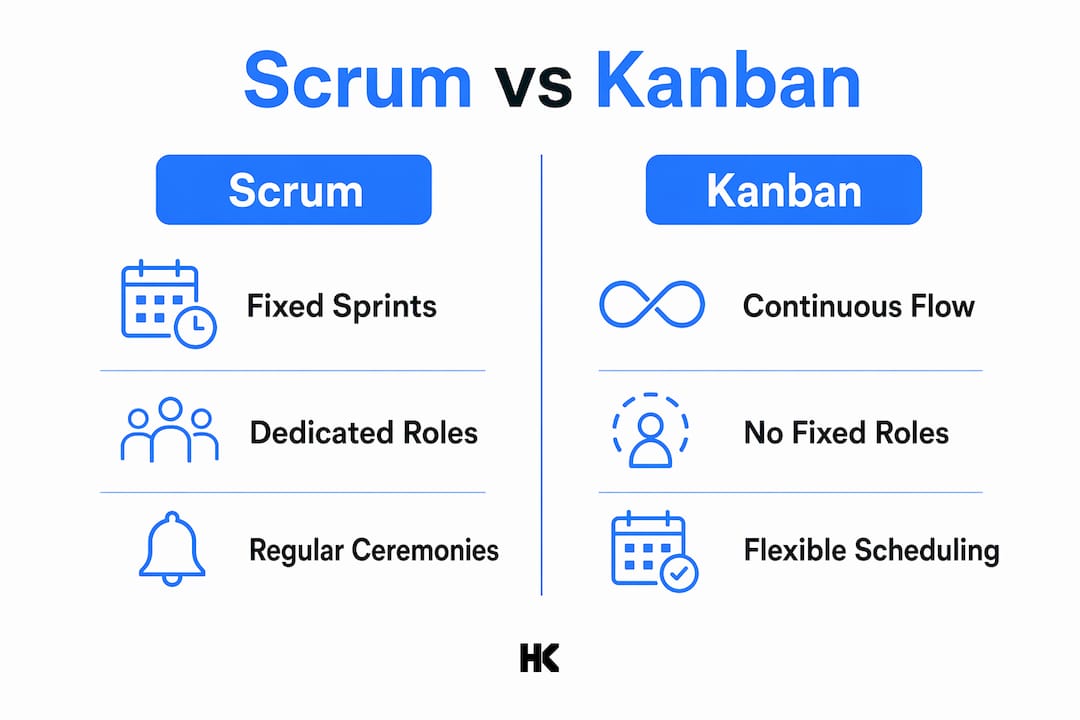
The two frameworks most relevant to startup teams are Scrum and Kanban. They share agile values but differ sharply in how they structure work.
How Scrum works for startup teams
Scrum organizes work into fixed-length sprints, typically one to four weeks. Each sprint has four ceremonies: planning, daily standup, review, and retrospective. Scrum ceremonies improve team transparency and iterative delivery through structured, time-boxed meetings. Three roles define the team: Product Owner, Scrum Master, and Developers.

For startups, Scrum's sprint cadence creates a forcing function. Every two weeks, you must show something working to a real user or stakeholder. That rhythm prevents the common founder trap of building in isolation for months. Scrum teams are small, self-managing, and cognitively diverse, which maps well onto a founding team of three to eight people.
How Kanban works for startup teams
Kanban does not use sprints. Work flows continuously through a board with columns representing stages: To Do, In Progress, In Review, Done. The defining constraint is the WIP limit. Kanban's WIP limits reduce multitasking and overload, improving focus and throughput in startup teams handling continuous work streams.
Cycle time is Kanban's primary metric. How long does it take a task to move from start to done? Cycle time and cumulative flow diagrams guide workflow adjustments in lean startups, making bottlenecks visible before they become crises.
Choosing between Scrum and Kanban
| Feature | Scrum | Kanban |
|---|---|---|
| Work structure | Fixed sprints (1–4 weeks) | Continuous flow |
| Primary metric | Sprint velocity | Cycle time |
| Best for | Teams needing regular inspection points | Teams with unpredictable or variable input |
| Ceremonies | Planning, standup, review, retro | Daily standup (optional), flow review |
| Roles required | Product Owner, Scrum Master, Developers | None required |
| Startup fit | Early-stage with defined feature roadmap | Support, growth, or ops-heavy teams |
Kanban's continuous flow model suits startups with unpredictable input, while Scrum's sprint cadence matches those needing regular inspection points. A B2B SaaS team building toward a fixed MVP launch date benefits from Scrum's structure. A team running ongoing customer onboarding and support alongside product work often does better with Kanban.
Pro Tip: You do not have to choose one permanently. Many startup teams run Scrum for product development and Kanban for support or bug queues simultaneously. The goal is matching the method to the work type, not picking a religion.
How to implement agile in startups without drowning in process
Implementing agile effectively in a startup means shipping usable increments every one to two weeks, not perfecting your process documentation. User-visible increments, whether feature slices or experiments, enable feedback-driven decisions within that window. Here is a practical sequence for getting started:
-
Define your backlog. Write user stories in the format "As a user], I want [action] so that [outcome]." Keep the backlog prioritized by learning value, not by what is easiest to build. A [lightweight sprint backlog with an active experiment log helps maintain audit trails for investors and co-founders.
-
Set a sprint length or WIP limit. For Scrum, two-week sprints work for most early-stage teams. For Kanban, start with a WIP limit of two tasks per developer. WIP limits should be treated as experiments with metrics-driven tuning to optimize cycle time, not fixed rules carved in stone.
-
Run a focused daily standup. Three questions, ten minutes maximum: What did I complete yesterday? What am I working on today? What is blocking me? Anything that takes longer than ten minutes becomes a separate conversation.
-
Demo to a real user every sprint. Not to your co-founder. Not to your investor. To someone who represents your actual customer. This single practice eliminates more waste than any other agile ceremony.
-
Measure what matters. Track cycle time, experiment win rate, and time-to-MVP. Skip vanity metrics like story points completed or lines of code written. If you cannot connect a metric to a decision you would actually make, stop tracking it.
-
Run a retrospective, but keep it short. One question: what one thing would make the next sprint faster or better? Implement that one thing before the next sprint starts.
The most common mistake founders make is adding ceremony before they have the basics working. Get the backlog, the demo, and the retrospective right first. Add Scrum roles or Kanban metrics only when you feel the absence of them.
Pro Tip: Tools like Jira, Linear, or GitHub Projects all support agile workflows. Linear is particularly well-suited for small startup teams because it is fast, opinionated, and does not require a dedicated administrator to maintain.
What are the real benefits of agile for startups?
The benefits of agile for startups are concrete and measurable, not abstract.
- Faster time-to-market. Shipping in two-week cycles means you get real feedback in two weeks instead of six months. That feedback either validates your direction or saves you from building the wrong thing at scale.
- Reduced waste. Iterative delivery prevents the most expensive startup mistake: building a complete product that users do not want. Each sprint is a controlled experiment, not a commitment to a full roadmap.
- Better team alignment. When everyone sees the same backlog, attends the same demo, and hears the same user feedback, you eliminate the information asymmetry that causes co-founder conflicts and misaligned engineering priorities.
- Visible bottlenecks. Kanban boards and Scrum sprint reviews make blockers visible before they become delays. A task sitting in "In Review" for five days is a signal, not a surprise.
- Investor-ready progress. Measurable progress toward validated hypotheses with a clear feedback cadence gives investors something concrete to evaluate, not just a roadmap slide.
"Startups find the highest value in agile when prioritizing rapid learning cycles as much as delivery speed, integrating experimentation with production workflows." — Presta, Complete Guide to Agile for Startups in 2025
Agile also supports lean product development by forcing scope discipline. When you have a two-week sprint, you cannot fit everything in. That constraint is a feature, not a bug.
Key takeaways
Agile for startups works when you treat it as a learning system, not a delivery checklist: short cycles, real user feedback, and ruthless prioritization are what separate teams that ship from teams that plan.
| Point | Details |
|---|---|
| Start with principles, not ceremonies | Apply the Agile Manifesto's four values before adding Scrum or Kanban structure. |
| Match the framework to the work | Use Scrum for fixed-scope sprints and Kanban for continuous or variable workflows. |
| Ship to real users every two weeks | User-visible increments are the only reliable source of validated product decisions. |
| Measure cycle time and experiment win rate | These two metrics tell you whether your process is working better than velocity or story points. |
| Avoid ceremony before basics | Get backlog, demo, and retrospective right before adding roles or tooling complexity. |
Why most startup agile advice gets it backwards
Most articles about agile methodology for startups spend 80% of their words explaining Scrum ceremonies and 20% on what actually matters: the feedback loop. I have seen this pattern repeatedly when working with early-stage teams in Vienna and across the DACH region. A founding team of four people installs Jira, sets up a two-week sprint, assigns a Scrum Master role to someone who has never done it before, and then wonders why they feel slower than before they started.
The problem is not agile. The problem is that they adopted the structure without the intent. Agile's real value for a startup is not the standup or the retrospective. It is the forcing function of shipping something real to a real user on a fixed cadence and then making a decision based on what you learn. Everything else is scaffolding.
The teams I have worked with that get the most out of agile practices are the ones who treat each sprint as a hypothesis test. They define a success criterion before the sprint starts. "If we ship this onboarding flow, we expect 30% of new signups to complete it within 24 hours." They ship it. They measure it. They decide what to do next based on the result. That is learning velocity, and it is what separates startups that find product-market fit from those that run out of runway first.
One more thing worth saying directly: agile does not fix a broken product strategy. If you are building something nobody wants, two-week sprints will just help you find out faster. That is still valuable. But do not confuse process discipline with product clarity. They are different problems.
— Hanad
Build your MVP with agile from day one
If you are a non-technical founder or early-stage product manager trying to ship a first product, the gap between understanding agile and actually executing it with a reliable engineering partner is significant.
Hanadkubat works with founders and product teams across the DACH region and internationally to build SaaS MVPs in 4 to 12 weeks at fixed prices, starting from €18,000. Every engagement runs on agile delivery: two-week sprints, user-visible increments, and direct access to the engineer writing the code. No project managers in the middle, no junior teams. You can review the full MVP build process and service details at hanadkubat.com. If you want to scope your idea before committing to a build, a strategy sprint at €1,500 maps your product to a validated, buildable plan in one week.
FAQ
What is agile for startups in simple terms?
Agile for startups is an approach where teams build and ship small pieces of working software every one to two weeks, collect real user feedback, and adjust priorities based on what they learn. It replaces long planning cycles with short, measurable delivery loops.
Should a startup use Scrum or Kanban?
Use Scrum if your team needs a fixed inspection rhythm and is building toward a defined product milestone. Use Kanban if your work is continuous, variable, or includes ongoing support alongside development. Many startups run both in parallel for different work types.
How many agile ceremonies does a small startup actually need?
A team of fewer than five people typically needs three practices: a prioritized backlog, a weekly or bi-weekly demo to a real user, and a short retrospective. Daily standups and formal sprint planning add value once the team grows past five to six people.
What tools support agile practices for new businesses?
Linear, Jira, and GitHub Projects all support agile workflows. Linear is the fastest to set up for small teams and does not require a dedicated administrator. Jira scales better for larger teams that need detailed reporting and custom workflows.
How do you measure agile success in a startup?
Track cycle time (how long a task takes from start to done), experiment win rate (what percentage of shipped features achieve their defined success criterion), and time-to-MVP. These metrics connect directly to product decisions. Story points and velocity are internal team metrics, not success indicators.