
TL;DR:
- Scope creep involves uncontrolled project scope expansion without adjustments to time or budget, often leading to failure. It results from vague requirements and informal requests, causing schedule delays, cost overruns, and lower quality. Implementing clear scope definitions, formal change processes, and fixed-price contracts can effectively prevent and control scope creep.
Scope creep is the uncontrolled expansion of a project's agreed work after kickoff, without matching changes to time, budget, or resources. According to Atlassian, it affects three dimensions simultaneously: the work itself (added features or deliverables), the schedule (a stretched timeline), and the budget (increased costs). Left unchecked, it is one of the most reliable predictors of project failure, not because any single addition is catastrophic, but because the additions compound.
The three project elements scope creep attacks:
- Scope — new features, deliverables, or requirements added without approval
- Schedule — deadlines that slip as work expands
- Budget — costs that climb without a corresponding change order
Table of Contents
- What is scope creep, and how does it differ from a real scope change?
- Why does scope creep happen?
- How does scope creep affect your project's schedule, cost, and quality?
- How do you spot scope creep before it becomes irreversible?
- How do you prevent and control scope creep?
- Who owns scope, and who approves changes?
- Real-world scope creep scenarios and what they teach
- When is adding scope actually the right call?
- Why fixed-price delivery reduces scope creep exposure
- Which tools help you track and manage scope creep?
- Key Takeaways
- The real problem with scope creep is that it feels reasonable
- Fixed-price delivery as a scope-creep control
- Useful sources
- FAQ
What is scope creep, and how does it differ from a real scope change?
Scope creep and a controlled scope change describe the same surface event — more work gets added — but they are operationally opposite. Atlassian defines scope creep as expansion that bypasses formal approval and arrives without any adjustment to time, budget, or resources. A controlled scope change, by contrast, follows a documented process: someone submits a request, the team assesses the impact, a sponsor approves it, and the project baseline gets updated.
The vocabulary around this is worth sorting out. "Feature creep" refers specifically to software products accumulating unplanned features during development. "Requirement creep" describes requirements that keep shifting or expanding during the definition phase. "Scope creep" is the broader term that covers any project type. All three share the same root problem: work grows without a corresponding adjustment to constraints.
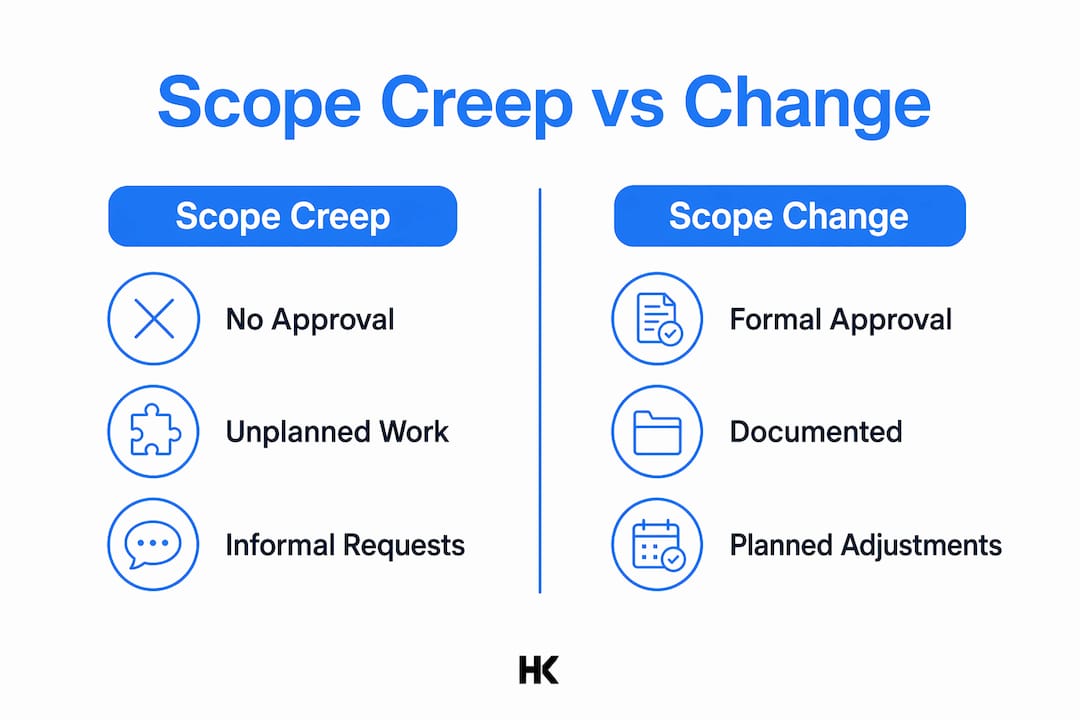
| Dimension | Scope creep | Controlled scope change | Feature creep |
|---|---|---|---|
| Approval | None — informal or assumed | Formal sponsor sign-off | Usually none |
| Impact assessment | Skipped | Required before approval | Rarely done |
| Baseline update | No | Yes | No |
| Typical trigger | Stakeholder request, gold plating | Business need, discovery | Developer initiative |
Why does scope creep happen?
Most scope creep traces back to a handful of systemic failures, not bad actors. Wikipedia's entry on scope creep identifies vague initial scope documents as the primary driver: when the original agreement leaves room for interpretation, informal assumptions fill the gap.
Common causes, with concrete examples:
- Vague requirements. A statement like "the dashboard should be user-friendly" gives developers no acceptance criteria to work against. Every stakeholder interprets it differently, and each interpretation adds work.
- "While you're at it" requests. A stakeholder sees a demo and asks for a small tweak. It seems harmless. Multiply that by ten stakeholders over twelve weeks and you have a different project.
- Missing out-of-scope definitions. Failing to write down what the project will not deliver is one of the most common documentation gaps. Without it, anything not explicitly excluded is fair game.
- Gold plating. Team members add features or polish they believe the client will appreciate, without being asked. The intent is good; the effect on schedule and budget is not.
- Inadequate change control. When there is no formal process for handling new requests, verbal approvals become the norm, and verbal approvals leave no audit trail.
Coursera's project management guide reinforces this: meticulous planning and formal change requests are the two controls that most directly address these root causes.
How does scope creep affect your project's schedule, cost, and quality?

The project triangle — scope, schedule, budget — is a zero-sum system. Add work without adjusting the other two constraints and something breaks. Usually it is quality first, then schedule, then budget.
Schedule slippage is the most visible effect. As Atlassian notes, if your project plan keeps growing but your deadline does not, the project is experiencing scope creep in real time. Teams absorb the extra work through overtime, which degrades quality and morale simultaneously.
Budget overruns follow directly. Each unplanned feature carries hidden costs: developer time, QA cycles, documentation updates, and sometimes vendor or licensing fees. None of these were in the original estimate.
The compounding effect: Small additions seem harmless individually. A two-hour task here, a minor integration there. But cumulatively, these degrade quality and exhaust resource margins well before the project reaches its original finish line.
Secondary impacts are just as damaging. Team morale drops when people are asked to absorb work that was never scoped. Stakeholders who approved the original plan grow frustrated when delivery dates slip. Vendors may charge change-order premiums. And the final product, built under pressure with a stretched team, rarely matches the quality the original plan targeted.
How do you spot scope creep before it becomes irreversible?
Early detection is the difference between a manageable adjustment and a project in crisis. The challenge is that scope creep is usually incremental — a string of small requests rather than one large demand — so teams need to monitor cumulative change counts, not just individual asks.
Early warning checklist:
- Stakeholders are making requests in Slack or email rather than through a formal channel
- The phrase "can we just add..." appears more than once per week
- Acceptance criteria are being revised after sign-off
- Rework is increasing on tasks already marked complete
- Sprint velocity is dropping without a clear technical reason
- The team is working overtime but the backlog is not shrinking
The "frog in boiling water" dynamic explains why teams miss these signals. Each individual request is reasonable. No single addition triggers an alarm. But the water temperature rises steadily, and by the time the team notices, the project is already behind.
Pro Tip: Add a standing five-minute agenda item to your weekly team sync: "Any informal change requests this week?" Surfacing these verbally before they become assumptions is far cheaper than catching them in a retrospective.
Solid documentation habits make detection easier. A running change log, even a simple spreadsheet, lets you see the cumulative picture that individual requests obscure.
How do you prevent and control scope creep?
Prevention starts before the project does. The controls below form a practical playbook you can implement now.
The core control suite:
- Scope statement / SOW. Write down what the project will deliver, what it will not deliver, and the acceptance criteria for each deliverable. Explicit out-of-scope language is as important as the in-scope list.
- Work Breakdown Structure (WBS). Decompose deliverables into tasks. Anything not in the WBS is out of scope by definition.
- Defined acceptance criteria. Each deliverable needs a testable definition of done. "User-friendly" is not a criterion; "page load time under two seconds on a 4G connection" is.
- Enforced change control process. Every new request goes through the same gate, regardless of who is asking.
Change request template (minimum fields):
- Requester name and date
- Description of the requested change
- Business rationale
- Estimated impact on schedule (hours or days)
- Estimated impact on cost
- Quality or risk implications
- Decision (approved / deferred / rejected) and approver signature
Change control process flow:
- Requester submits a formal change request using the template above
- PM conducts an impact assessment (time, cost, quality, risk)
- PM presents the assessment to the project sponsor
- Sponsor approves, defers, or rejects
- If approved, the PM updates the project baseline and communicates the change to the team
- If rejected, the PM documents the decision and notifies the requester
Supporting tools for tracking include issue trackers, backlog management systems, and a dedicated change log. Sprint planning practices that enforce acceptance criteria at the story level add another layer of protection in iterative projects.
Who owns scope, and who approves changes?
Blurred accountability is one of the fastest routes to uncontrolled scope growth. Every role needs a clear lane.
Role responsibilities:
- Project Manager. Owns the change control process, maintains the change log, conducts impact assessments, and escalates to the sponsor when a decision is needed.
- Project Sponsor. Final authority on scope trade-offs. Approves or rejects changes that affect the baseline. Should not be bypassed, even for "small" requests.
- Product Owner / Business Owner. Prioritizes the backlog and decides which requests are worth the trade-off. Owns the business case for any scope addition.
- Team Leads. Provide honest effort estimates for change requests. Flag gold plating internally before it reaches the PM.
- QA. Enforces acceptance criteria. If a deliverable does not meet the agreed criteria, it is not done — regardless of what was added informally.
- Stakeholders. Submit requests through the formal channel. Understand that every addition has a cost.
Decision-ready questions for any new request:
- Is this in the current SOW?
- If not, what is the business impact of not doing it now?
- What does adding it cost in time and budget?
- What gets deferred or removed to make room?
When a pattern of requests emerges from multiple stakeholders, or when a single request significantly affects the baseline, escalate to a formal Change Control Board (CCB). A CCB typically includes the PM, sponsor, and key stakeholder representatives, and it meets on a defined cadence rather than ad hoc.
Real-world scope creep scenarios and what they teach
Scenario 1: SaaS MVP feature cascade
Initial scope: A non-technical founder contracts a fixed-price MVP build covering user authentication, a core workflow, and a basic dashboard. Creeping additions: During development, the founder requests email notifications, then a CSV export, then a second user role. Each request arrives via Slack and is absorbed informally. Detection point: Week eight of a twelve-week build, when the team realizes two weeks of work remain but four weeks of features have been added. Controls absent: No formal change request process; no out-of-scope list in the SOW. Outcome: Launch delayed by six weeks; budget exceeded. Lesson: A fixed-price SOW with an explicit out-of-scope list and a formal change request gate would have surfaced the cost of each addition before work began. Agile development strategies that enforce sprint-level scope locks help here.
Scenario 2: Internal IT infrastructure upgrade
Initial scope: Migrate three internal applications to a new server environment. Creeping additions: The IT director asks the team to integrate a fourth application "since you're already in there," then requests performance monitoring dashboards for all four. Detection point: A budget review in week six reveals the project is tracking 40% over the original estimate. Controls applied: The PM retroactively submitted change requests for both additions and presented the cost impact to the sponsor. One addition was approved with a budget increase; the other was deferred to a follow-on project. Outcome: Partial recovery; one deliverable deferred cleanly. Lesson: Retroactive change requests recover some control, but they cost more than proactive ones. The "since you're already in there" trigger phrase is a reliable early warning signal.
Scenario 3: Marketing deliverable that doubled
Initial scope: A brand refresh covering a new logo, color palette, and homepage redesign. Creeping additions: The marketing director added social media templates, then email headers, then a brand guidelines document. Detection point: The designer flagged the additions at the halfway mark when the original deliverable list had tripled. Controls applied: The PM called a scope review meeting, documented all additions as change requests, and negotiated a phased delivery: original scope on the original timeline, additions in a second engagement. Outcome: Original deliverables delivered on time; additions scoped and priced separately. Lesson: Phased delivery is a clean resolution when scope has already grown. It protects the original commitment and gives the client a clear path to the additional work.
When is adding scope actually the right call?
Not every scope addition is harmful. ClickUp's project management guide draws a clear line: a scope change is legitimate when it is documented, impact-assessed, and sponsor-approved before work begins. The problem is not growth itself — it is growth without governance.
Approval flow for a legitimate scope change:
- Requester submits a written change request
- PM assesses impact on time, cost, quality, and risk
- PM and product owner negotiate a trade-off (what gets deferred or removed)
- Sponsor reviews the trade-off and signs off
- PM updates the project baseline and communicates to the team
The "yes with trade-offs" mindset is the practical key here. When a stakeholder asks for something genuinely valuable, the answer is not automatically no. It is: "Yes, and here is what we defer or remove to make room." That framing keeps constraints balanced and makes the cost of the addition visible before it is absorbed.
Discovery-driven changes are a good example of legitimate scope evolution. In a complex technical project, you often learn things during execution that change what the right solution looks like. A change driven by real discovery, documented and approved, improves the outcome. A change driven by a stakeholder's preference, absorbed informally, is creep.
Why fixed-price delivery reduces scope creep exposure
Fixed-price engagements force a discipline that time-and-materials contracts rarely achieve. When the price is fixed, both sides have a strong incentive to define the work precisely before it starts. The SOW becomes a real document, not a placeholder. Acceptance criteria get written down because there is no other way to agree on when the work is done.
ClickUp's analysis confirms the operational logic: a flexible project updates baselines after sponsor approval; scope creep keeps deadlines and budgets fixed while adding unapproved work. Fixed-price delivery makes the second scenario structurally harder, because any addition requires a formal change order that reprices the engagement.
Practical tactics used in fixed-price delivery:
- Detailed deliverable lists with explicit out-of-scope items in the SOW
- Milestone sign-offs before the next phase begins
- Pre-defined change rates for out-of-scope work (so additions are priced, not absorbed)
- Decision SLAs: the client has a defined window to approve or reject a change request
- A change log reviewed at every milestone meeting
Operational metrics worth tracking:
| Metric | What it tells you |
|---|---|
| Approved change count per milestone | Whether scope is growing faster than planned |
| Average decision lead time | How quickly the sponsor resolves change requests |
| Scope variance hours | Hours worked on unapproved additions vs. baseline |
| Rework rate | Percentage of completed tasks reopened due to scope shifts |
Which tools help you track and manage scope creep?
No tool prevents scope creep on its own, but the right setup makes it much harder to miss. The goal is a system where informal requests cannot become work without leaving a paper trail.
Issue and backlog trackers like Jira, Linear, or GitHub Issues give every request a ticket, a status, and an owner. When a stakeholder asks for something verbally, the PM's response is: "Open a ticket and I'll assess it." That single habit eliminates a large share of informal absorption.
Project management platforms such as Asana, Monday.com, or Notion let you maintain a live scope baseline alongside the task list. When the task list grows faster than the approved scope, the gap is visible.
Document collaboration tools (Confluence, Notion, Google Docs) work well for maintaining the SOW, the change log, and the acceptance criteria in one place that the whole team can reference. Version history is important here: you want to know exactly when a requirement changed and who changed it.
For teams running agile methodology, the sprint backlog itself is a scope-control mechanism. Work that is not in the sprint is not in scope for that sprint. Combined with QA documentation standards that define acceptance criteria at the story level, this creates a tight loop between what was agreed and what gets built.
The simplest effective setup is often a shared change log (a spreadsheet works) reviewed at every team sync, combined with a rule that no task enters the sprint without a ticket. Complexity in tooling does not substitute for discipline in process.
Key Takeaways
Scope creep is a process failure, not a people failure — and the controls that prevent it are straightforward to implement once the team agrees to enforce them.
| Point | Details |
|---|---|
| Define scope precisely upfront | Write explicit in-scope and out-of-scope lists in the SOW before work begins. |
| Enforce a change request gate | Every addition, regardless of size, goes through a documented impact assessment and sponsor approval. |
| Monitor cumulative change counts | Small requests compound; track the total, not just individual asks. |
| Use the "yes with trade-offs" mindset | Approve valuable additions by deferring or removing equal-value work to keep constraints balanced. |
| Hanadkubat's fixed-price model | Fixed-price SOWs with milestone sign-offs and pre-defined change rates make scope discipline structural, not optional. |
The real problem with scope creep is that it feels reasonable
Most scope creep does not arrive as a demand. It arrives as a favor. A stakeholder asks nicely. The team wants to help. The PM does not want to seem inflexible. And so the work grows, quietly, until the deadline is two weeks away and the team is still building features that were never in the original plan.
The conventional advice is to "communicate clearly" and "set expectations." That is true but incomplete. The real fix is structural: a SOW with explicit out-of-scope language, a change request template that makes the cost of additions visible, and a sponsor who is willing to say no. Without those structures, good intentions and clear communication are not enough.
What I have seen consistently in fixed-price delivery is that the discipline is not painful once it is in place. Clients who go through a proper scoping process at the start — where we define what is in, what is out, and what a change costs — almost never push back on the change control process mid-project. They understand the system. The friction happens when the process is skipped at the start and imposed mid-flight.
The other thing worth saying: scope creep is not always the client's fault. Gold plating by the team, vague acceptance criteria written by the PM, and a sponsor who approves verbal requests without documentation — these are internal failures. The change control process protects the team as much as it protects the budget.
Fixed-price delivery as a scope-creep control
Scope creep costs projects time, money, and quality. The structural fix is a fixed-price engagement with a real SOW, explicit acceptance criteria, and a formal change request process baked in from day one.
Hanadkubat delivers fixed-price AI integration and SaaS MVP builds where the scope is defined before a line of code is written. Every engagement includes a detailed deliverable list, milestone sign-offs, and pre-defined rates for out-of-scope work, so additions are priced and approved rather than absorbed. Clients work directly with the engineer writing the code, not a project manager relaying messages to a junior team. If you are planning a build and want to avoid the scope conversations that derail most projects, review the service details and reach out for a scoping call.
Useful sources
Authoritative references for further reading on scope creep, change control, and project management standards:
- Scope Creep in Project Management: How to Manage It — Atlassian. Covers the core definition, the three-part impact on scope/schedule/budget, and practical prevention tactics. One of the most cited industry resources on the topic.
- Scope creep: definition and prevention — ClickUp. Strong on the distinction between scope creep and controlled scope change, and on the procedural requirements for a legitimate change request.
- Scope creep — Wikipedia. Useful for the taxonomy of related terms (feature creep, requirement creep) and the historical context of how the concept developed in project management literature.
- What Is Scope Creep? — Coursera. Accessible overview with practical prevention steps; good for team members newer to formal project management.
- Scope Creep: 5 Essential Project Management Tips — APU/APUS. Practitioner-focused tips from an academic project management program; useful for the change control and stakeholder communication sections.
- Project planning — NetFusion Designs. Covers pragmatic project planning and change management processes; a practical complement to the process flows described in this guide.
- Hanadkubat — fixed-price AI integration and SaaS MVP delivery. Service pages covering fixed-price SOW structures, milestone sign-offs, and acceptance criteria practices in production engagements.
FAQ
What is scope creep in simple terms?
Scope creep is when a project's work keeps growing beyond what was originally agreed, without any adjustment to the deadline or budget. It usually happens through a series of small, informal additions rather than one large change.
Is scope creep always bad for a project?
Uncontrolled scope creep is harmful because it degrades schedule, budget, and quality. However, Wikipedia notes that well-managed scope changes can improve the final product when they go through a formal approval process with an updated baseline.
What is the difference between scope creep and a scope change?
A scope change is documented, impact-assessed, and approved by the project sponsor before work begins; the project baseline is then updated. Scope creep bypasses this process entirely, as ClickUp explains.
How do you prevent scope creep on a fixed-price project?
Write an explicit SOW with both in-scope and out-of-scope items, define testable acceptance criteria for every deliverable, and enforce a formal change request process for any addition. Hanadkubat's fixed-price engagements use milestone sign-offs and pre-defined change rates to make this structural.
What tools help manage scope creep?
Issue trackers (Jira, Linear, GitHub Issues), project management platforms (Asana, Monday.com), and a shared change log reviewed at every team sync are the most practical combination. The tool matters less than the rule: no task enters the sprint without a ticket and an approved scope entry.