
Agile methodology is an iterative approach to project management that delivers value in small, frequent increments rather than one large release at the end. Rooted in the 2001 Agile Manifesto, it was shaped by 17 software practitioners who wanted a better alternative to rigid, plan-heavy development. The core idea is simple: build a little, get feedback, adjust, and repeat. That cycle keeps teams aligned with what customers actually need, not what was assumed at the start.
Key components of Agile methodology include:
- Iterative cycles (sprints): Short, time-boxed work periods that produce a usable product increment
- Customer collaboration: Continuous involvement of stakeholders throughout the project
- Rapid feedback loops: Regular reviews that surface problems early, before they compound
- Adaptability: The ability to change direction based on new information or shifting priorities
- Cross-functional teams: Small, self-organizing groups that own planning, execution, and delivery together
Table of Contents
- What are the core values and twelve principles of Agile?
- Which Agile frameworks should you know: Scrum, Kanban, and XP?
- What are the real benefits of Agile methodology?
- How does Agile compare to traditional Waterfall project management?
- How does Agile work in software development specifically?
- How does a typical Agile sprint cycle actually run?
- Key Takeaways
- FAQ
What are the core values and twelve principles of Agile?
The Agile Manifesto establishes four core values that define the Agile mindset. Each value is a deliberate trade-off, not a rejection of the right side, but a clear statement of priority:
- Individuals and interactions over processes and tools
- Working software over comprehensive documentation
- Customer collaboration over contract negotiation
- Responding to change over following a plan
These values are not abstract philosophy. They show up in daily decisions: a team that ships a working feature beats one that produces a 40-page spec no one reads.
The twelve principles behind the Manifesto give those values operational meaning. The most practically significant ones include:
- Deliver working software frequently, from a couple of weeks to a couple of months
- Welcome changing requirements, even late in development
- Build projects around motivated individuals and give them the environment they need
- The most efficient way to convey information is face-to-face conversation
- Working software is the primary measure of progress
- Maintain a sustainable development pace that sponsors, developers, and users can hold indefinitely
- Continuous attention to technical excellence improves agility
- Simplicity, defined as maximizing the work not done, is a core discipline
- The best architectures emerge from self-organizing teams
- At regular intervals, the team reflects and adjusts its behavior
The sustainable pace principle deserves a closer look. Traditional projects often push teams through crunch periods that produce short-term output and long-term burnout. Agile explicitly rejects that pattern by treating a steady, maintainable pace as a design goal, not a luxury.
Which Agile frameworks should you know: Scrum, Kanban, and XP?

Scrum, Kanban, and Extreme Programming (XP) are the three frameworks most teams encounter first. They all implement Agile values, but they do it differently.
Scrum is the most widely used Agile framework. It organizes work into time-boxed sprints lasting 1–4 weeks, with three defined roles:
- Product Owner: Owns the product backlog and prioritizes what gets built
- Scrum Master: Removes blockers and protects the team's process
- Development Team: Self-organizes to plan and deliver each sprint
Scrum's structure makes it a natural starting point for teams new to Agile. The fixed sprint rhythm creates predictable delivery cadences and regular checkpoints.
Kanban takes a different angle. There are no sprints and no fixed roles. Instead, work items move through a visual board with columns like "To Do," "In Progress," and "Done." The critical discipline is limiting work-in-progress (WIP): each column has a cap, which forces the team to finish tasks before pulling in new ones. That constraint surfaces bottlenecks fast.
Extreme Programming (XP) focuses on the technical side of software quality. Its signature practices include:
- Pair programming: Two developers work at one machine, one writing code and one reviewing in real time
- Test-driven development (TDD): Tests are written before the code they validate
- Continuous integration: Code is merged and tested multiple times per day
XP is less about project structure and more about engineering discipline. Teams that struggle with code quality or technical debt often find XP practices more immediately useful than Scrum's ceremonies.
Pro Tip: You don't have to pick just one. Many teams run Scrum for project structure and borrow XP practices like TDD for code quality. The frameworks are not mutually exclusive.
What are the real benefits of Agile methodology?
Agile's advantages are concrete, not theoretical. The most consistent ones teams report across software and product work:
- Faster delivery: Working increments ship every sprint, so customers see progress in weeks, not months
- Lower risk: Small releases mean smaller failures. A bad assumption surfaces after two weeks, not after a year of development
- Better alignment: Regular reviews keep the product aligned with what customers actually want, not what was documented at kickoff
- Improved team morale: Self-organizing teams with a sustainable pace tend to stay engaged longer than those grinding through crunch cycles
- Continuous improvement: Retrospectives after each sprint create a built-in mechanism for the team to fix its own process
Agile's emphasis on incremental delivery also means teams learn faster. Each sprint is a feedback loop. A traditional project might run for 12 months before anyone outside the team sees the product. An Agile team running two-week sprints gets 26 feedback cycles in the same period.
One underappreciated benefit is what Agile does to documentation overhead. The Manifesto does not say "write no documentation." It says working software takes priority over comprehensive documentation. Teams stop writing specs for features that may never ship and start shipping features that prove their own value.
How does Agile compare to traditional Waterfall project management?
Waterfall moves linearly through fixed phases: requirements, design, implementation, testing, and deployment. Each phase must close before the next opens. Agile runs all of those activities concurrently within each sprint.

| Dimension | Waterfall | Agile |
|---|---|---|
| Planning | Extensive upfront, fixed scope | Continuous, scope evolves |
| Delivery | Single release at project end | Incremental releases each sprint |
| Change handling | Expensive, requires formal change requests | Expected and welcomed |
| Stakeholder involvement | Heavy at start and end | Continuous throughout |
| Risk exposure | High (problems surface late) | Lower (problems surface each sprint) |
| Best fit | Stable, well-defined requirements | Evolving or uncertain requirements |
The practical difference shows up most clearly when requirements change mid-project. In Waterfall, a late requirement change can invalidate months of work and trigger a formal change-control process. In Agile, the team simply reprioritizes the backlog at the next sprint boundary. No paperwork, no renegotiation.
That said, Waterfall is not always wrong. Construction projects, regulatory compliance work, and hardware manufacturing often have genuinely fixed requirements where sequential phases make sense. Agile's edge is in environments where continuous adaptation increases return on investment because the right answer is not fully known at the start.
How does Agile work in software development specifically?
Agile software development, sometimes called agile engineering, applies the Manifesto's values directly to how code gets written, tested, and shipped. The iterative delivery model shortens the development cycle by completing work in sprints, with production-quality code expected at the end of each one.
Typical roles in an Agile software team:
- Product Owner: Writes user stories, maintains the backlog, and defines acceptance criteria
- Scrum Master (or Agile Coach): Facilitates ceremonies and removes process blockers
- Developers and QA engineers: Plan, build, test, and integrate within each sprint
Common ceremonies that structure the work:
- Sprint planning: The team selects backlog items and commits to a sprint goal
- Daily stand-up: A 15-minute sync on progress, plans, and blockers
- Sprint review: A demo of completed work to stakeholders for feedback
- Retrospective: A team-only session to identify what to improve next sprint
Tools commonly used to support Agile software teams include Jira for backlog and sprint tracking, Confluence for documentation, GitHub Projects for lightweight kanban boards, and Miro for collaborative planning sessions.
A common failure pattern worth knowing: teams sometimes treat sprints like mini-Waterfalls, splitting coding, testing, and QA into separate sub-phases within the sprint. That approach, sometimes called Scrummerfall, produces incomplete increments and accumulates technical debt. Every sprint should produce fully tested, shippable code, not just "dev complete" features waiting for a QA phase.
For teams building iterative product development cycles from scratch, getting the sprint structure right from day one matters more than picking the perfect tool.
How does a typical Agile sprint cycle actually run?
A sprint is a fixed-length work period, typically 1–4 weeks, that starts with planning and ends with a shippable product increment—learn how to run these effectively in the Design-Sprints Online Kurs – Effektive E-Learning Schulung für Ihre Weiterbildung. The cycle repeats until the product is done or the team pivots.
Here is what a standard two-week sprint looks like in practice:
Day 1: Sprint planning. The team pulls the highest-priority items from the product backlog, breaks them into tasks, and commits to a sprint goal. A well-run planning session takes two to four hours for a two-week sprint.
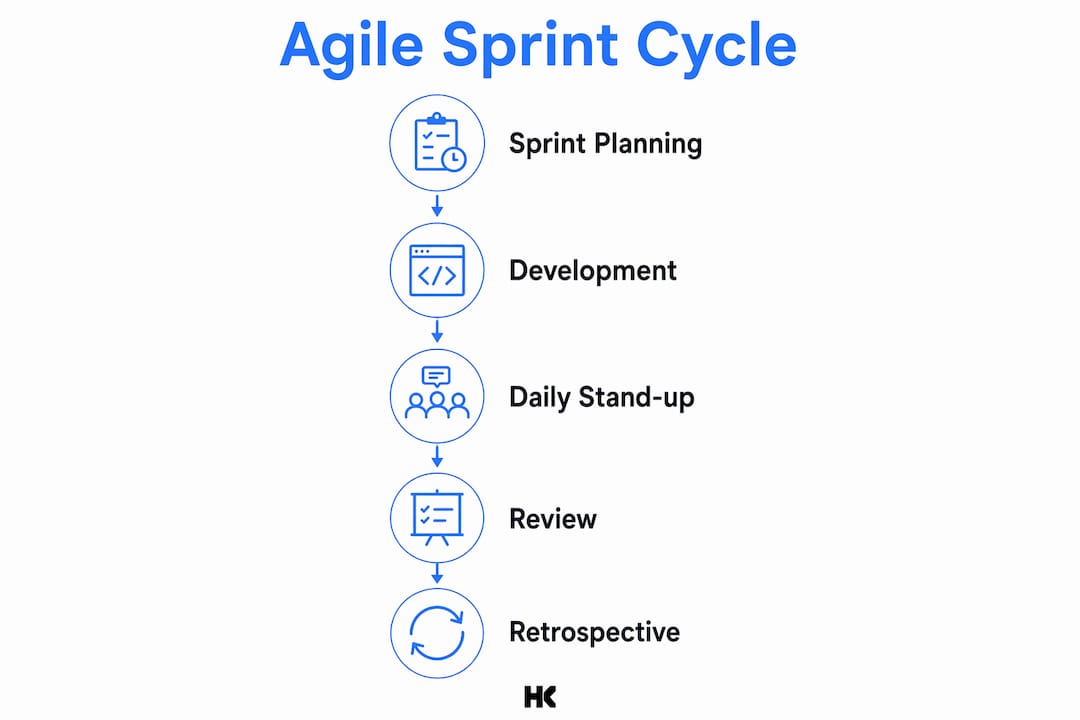
Days 2–9: Development. The team builds, tests, and integrates daily. The daily stand-up keeps everyone aligned without requiring lengthy status meetings. Work moves across the Kanban board or sprint board in real time.
Day 10: Sprint review and retrospective. The review is a demo for stakeholders. The retrospective is internal: what went well, what did not, and one concrete change for next sprint. Both sessions together rarely exceed two hours.
Between sprints, the Product Owner refines the backlog, adding detail to upcoming items so the next planning session runs smoothly. That ongoing refinement is what keeps sprint planning from turning into a three-hour debate.
One thing beginners often miss: the sprint goal matters more than the task list. A team that ships the goal with three tasks incomplete has succeeded. A team that completes every task but misses the goal has not. That distinction keeps teams focused on outcomes rather than activity.
Agile as a mindset means no two implementations look identical. The sprint structure above is a starting point, not a prescription. Teams adjust cadence, ceremony length, and tooling to fit their context.
Key Takeaways
Agile methodology delivers faster, lower-risk software by replacing single large releases with short iterative cycles that keep teams aligned with real customer needs throughout the project.
| Point | Details |
|---|---|
| Agile origin | The Agile Manifesto was written in 2001 by 17 practitioners establishing four core values. |
| Sprint length | Sprints run for short, limited time periods and must produce fully tested, shippable code each cycle. |
| Three main frameworks | Scrum structures roles and sprints; Kanban limits work-in-progress; XP focuses on code quality. |
| Key risk | Treating sprints like mini-Waterfalls creates technical debt and incomplete increments. |
| Core discipline | Simplicity means maximizing work not done, shipping minimum viable features over exhaustive plans. |
FAQ
What is Agile methodology in simple words?
Agile is an iterative approach to project management where teams deliver work in short cycles, gather feedback, and adjust continuously rather than following a fixed plan from start to finish.
What are the four core values of Agile?
The Agile Manifesto defines four values: individuals and interactions over processes and tools; working software over comprehensive documentation; customer collaboration over contract negotiation; and responding to change over following a plan.
What is the difference between Agile and Scrum?
Agile is a mindset and set of principles; Scrum is a specific framework that implements those principles using defined roles, time-boxed sprints of 1–4 weeks, and structured ceremonies like sprint planning and retrospectives.
Can Agile be used outside of software development?
Yes. Marketing teams use Agile sprints to run campaign experiments, and manufacturing teams apply Kanban-style boards to manage production flow. The core practices of iterative delivery and continuous feedback transfer across industries.
What is the biggest mistake teams make when starting Agile?
The most common error is treating sprints like mini-Waterfalls by separating coding, testing, and QA into sequential sub-phases within the sprint, which produces incomplete increments and accumulates technical debt over time.