
TL;DR:
- Iterative development involves short cycles of building, testing, and refining software to reduce risk. It enables teams to learn quickly from real user feedback and adjust before costly mistakes occur.
Iterative development is defined as a cyclical software process where teams build a small increment, test it, evaluate the results, refine the work, and repeat. This approach contrasts sharply with the Waterfall model, where requirements are locked upfront and feedback arrives only after months of work. Companies like Google, Meta, and OpenAI run their product development on iterative cycles because the method surfaces real user behavior early, before expensive mistakes compound. The core operating framework is the Build-Measure-Learn loop, which treats every release as a hypothesis test rather than a finished deliverable. Minimum viable products, or MVPs, are the tool that makes this practical at speed.
What is the iterative development process, step by step?
The standard iterative cycle follows five distinct steps: Create, Test, Evaluate, Refine, and Repeat. Each step is short by design. The goal is to complete one full loop in weeks, not months.
- Create. Build the smallest version of a feature that tests one specific assumption. Not the full feature. Not the polished version. Just enough to generate real signal.
- Test. Put the increment in front of actual users or run it against real data. Controlled testing environments miss the friction that real use reveals.
- Evaluate. Analyze what the test showed. Did users complete the task? Did retention improve? Focus on behavior, not opinions.
- Refine. Change only what the evidence points to. Resist the urge to fix everything at once. Targeted changes produce cleaner learning.
- Repeat. Start the next cycle immediately. Each loop builds on the last, compounding knowledge over time.
Think of it like refining a recipe. You do not rewrite the entire dish after one dinner. You adjust one variable, cook it again, and taste the result. Iterative product building works the same way.
Pro Tip: Test your riskiest assumption first, not your easiest one. The assumption most likely to kill the product deserves the first cycle.

Feedback loops shorten from months or years to weeks when teams follow this structure. That compression is the primary speed advantage of the iterative development process.
How does iterative development compare to other models?
The Waterfall model runs in a straight line: requirements, design, build, test, deploy. Each phase closes before the next opens. Feedback arrives at the end, when changing course is expensive. Iterative development runs in circles by design, with feedback built into every cycle.
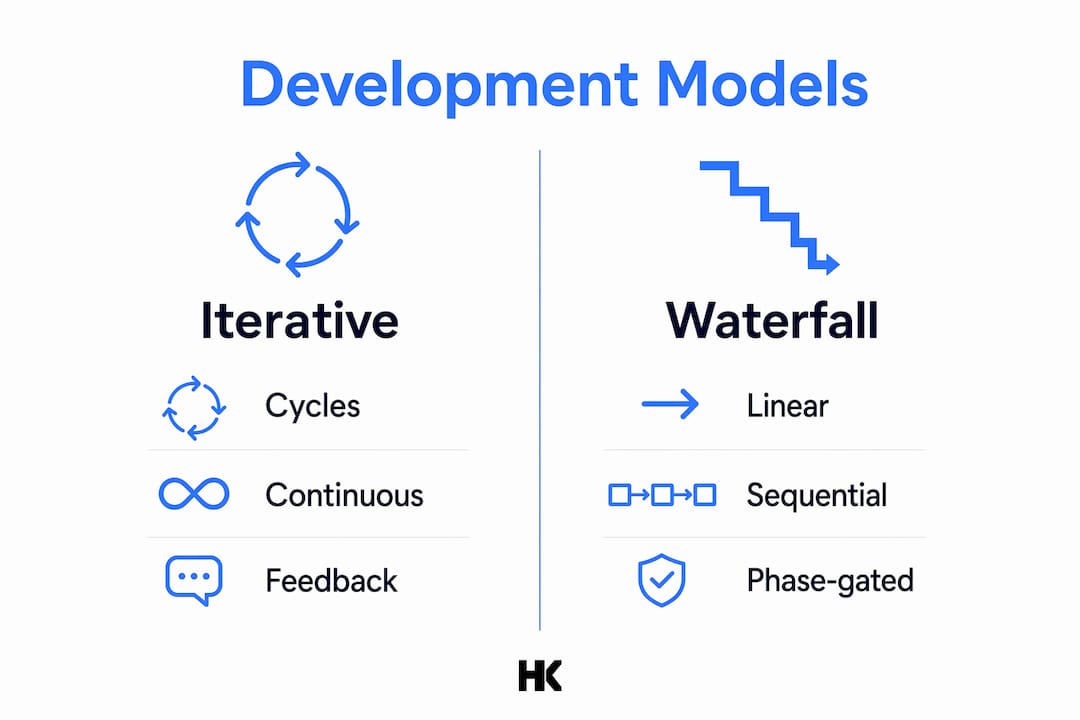
The distinction between iterative and incremental development trips up many teams. Incremental development adds complete, working pieces of a product one at a time. Iterative development refines those pieces through repeated cycles. In practice, Agile methodologies like Scrum combine both. A sprint delivers an increment, and the retrospective drives iteration on how the team works. The two concepts reinforce each other.
A common misconception is that iteration means adding features. It does not. Iteration is a defensive practice. Its purpose is to reduce risk and recalibrate based on evidence, not to ship more.
| Feature | Waterfall | Iterative | Agile (Scrum) |
|---|---|---|---|
| Feedback timing | End of project | End of each cycle | End of each sprint |
| Planning style | Full upfront plan | Hypothesis per cycle | Sprint backlog |
| Change tolerance | Low | High | High |
| Risk exposure | High until late | Reduced each cycle | Reduced each sprint |
| Best fit | Fixed requirements | Evolving requirements | Cross-functional teams |
Key differences worth remembering:
- Waterfall treats change as a failure. Iterative development treats change as the expected output of learning.
- Agile is not a synonym for iterative development. Agile is a set of values. Iteration is a specific technical practice that Agile frameworks use.
- Iterative development applies equally to UX design, backend architecture, and onboarding flows, not just feature development.
What are the benefits and challenges of iterative development?
The core benefit of iterative product development is risk reduction. Each cycle converts an unknown assumption into a known fact. Over time, the product aligns more closely with what users actually need, not what the team assumed they needed at the start.
Benefits:
- Faster learning. Short cycles produce evidence quickly. Teams correct course before small errors become large ones.
- Better user alignment. Real behavior data replaces guesswork. Products built this way tend to solve actual problems.
- Reduced waste. Features that fail early cost far less than features that fail after a full build.
- Adaptability. Market conditions change. Iterative teams adjust within weeks, not quarters.
Challenges:
- Organizational discipline. Successful iteration requires saying no to noisy feature requests and prioritizing evidence-based work. Most teams find this harder than the technical side.
- The mini-waterfall trap. The mini-waterfall trap occurs when teams claim to iterate but still do rigid upfront planning and large releases. The label changes; the behavior does not.
- Release infrastructure. Rapid cycles require reliable deployment pipelines. Teams that cannot ship safely cannot iterate safely.
The most important shift is measuring outcomes, not outputs. True iteration focuses on outcomes like user retention and task completion, not tickets closed or features shipped. A team that closes 40 tickets in a sprint but sees no improvement in user retention has not iterated. It has just been busy.
Pro Tip: Track one outcome metric per cycle. Retention rate, task completion rate, or activation rate. One number forces clarity on whether the cycle actually worked.
How do modern product teams apply iterative development in practice?
The Build-Measure-Learn loop is the core operating system for iterative teams. It works because it forces specificity. Before building anything, the team states the hypothesis: "We believe that adding inline error messages will increase form completion by a measurable amount." The build is designed to test that specific claim.
MVPs are the delivery vehicle for this process. A good MVP is not a stripped-down product. It is the smallest increment designed to test a high-risk assumption. Dropbox famously tested its core assumption with a demo video before writing a line of sync code. That is iterative product building at its most efficient.
Modern teams collect both qualitative and quantitative feedback within each cycle. Quantitative data from tools like Mixpanel or Amplitude shows what users do. Qualitative data from user interviews shows why. Neither alone is sufficient. The combination produces hypotheses worth testing in the next cycle.
UX design applies the same iterative logic through continuous prototyping and user testing. A design team at a B2B SaaS company might run three rounds of usability testing on a single onboarding screen before shipping it. Each round refines visual hierarchy, copy, and interaction patterns based on observed behavior.
Practical elements that support effective iteration:
- Release pipelines. Stable release practices and performance budgets are foundational to sustaining rapid cycles without risking failures in production.
- Feature flags. Shipping code to a subset of users lets teams measure impact before full rollout.
- Defined hypotheses. Every cycle starts with a written hypothesis. Teams that skip this step cannot evaluate results objectively.
- Retrospectives. Agile retrospectives close the loop on process, not just product. How the team iterates is itself subject to iteration.
For non-technical founders building their first product, understanding how MVPs validate ideas before full investment is the most practical entry point into iterative thinking. For teams already shipping, lean product development principles provide the operational framework to run cycles faster without sacrificing quality.
Key Takeaways
Iterative development works because it converts assumptions into evidence through repeated, short cycles, reducing risk and improving product-market fit over time.
| Point | Details |
|---|---|
| Five-step cycle | Every iteration follows: Create, Test, Evaluate, Refine, Repeat. |
| Feedback speed | Cycles compress feedback from months to weeks, accelerating learning. |
| Outcomes over outputs | Measure retention and task completion, not tickets closed or features shipped. |
| Mini-waterfall risk | Claiming to iterate while doing rigid upfront planning defeats the method entirely. |
| Infrastructure matters | Stable release pipelines and performance budgets are prerequisites for fast, safe cycles. |
Why most teams iterate wrong, and what actually fixes it
The teams I have seen struggle with iterative development share one pattern: they treat iteration as a delivery schedule rather than a learning system. They run two-week sprints, ship features on time, and call it iterative. But if no one defined a hypothesis before the sprint started, there is nothing to evaluate at the end. The cycle produces output, not knowledge.
The fix is treating iteration like the scientific method. Write the hypothesis before writing the code. Define what success looks like in measurable terms. Then build only what tests that specific claim. This discipline feels slow at first. It is actually faster, because it eliminates the rework that comes from building the wrong thing confidently.
The other failure mode I see regularly is skipping release infrastructure. Teams want to iterate fast, but their deployment process takes two days and requires three approvals. You cannot run weekly cycles on a two-day deploy pipeline. Fixing the pipeline is not a nice-to-have. It is a prerequisite.
Iterative development done well produces calmer teams. When every cycle generates evidence, decisions become less political. The data answers the argument. That shift alone is worth the investment in getting the process right.
— Hanad
Building products that actually ship on time
Applying iterative development effectively requires more than a framework. It requires the right engineering foundation from the start.
Hanadkubat works with B2B SaaS teams and non-technical founders across the DACH region and EU to build products using fixed-price, time-boxed sprints. From MVP strategy and scoping to full builds delivered in 4–12 weeks, every engagement is structured around clear hypotheses, measurable outcomes, and code written by the engineer you hired. Pricing and service details are at hanadkubat.com.
FAQ
What is iterative development in simple terms?
Iterative development is a process where software is built in short, repeated cycles. Each cycle produces a working increment that is tested, evaluated, and refined before the next cycle begins.
How is iterative development different from Agile?
Agile is a set of values and principles. Iterative development is a specific practice that Agile frameworks like Scrum use. All Agile teams iterate, but not all iterative teams use Agile.
What is the biggest risk in iterative development?
The mini-waterfall trap is the most common risk. Teams adopt the language of iteration but keep rigid upfront planning and large releases, which eliminates the feedback benefits the method is designed to produce.
How long should one iteration cycle take?
Most modern product teams run cycles of one to four weeks. The right length depends on how quickly the team can ship a testable increment and collect meaningful feedback.
What metrics should teams track during iteration?
Teams should track outcome metrics like user retention, task completion rate, and activation rate. Output metrics like tickets closed or features shipped do not indicate whether the cycle produced real improvement.