
TL;DR:
- Product stabilization is a continuous process of maintaining product quality and performance over time.
- Treating stabilization as a strategic priority improves release velocity, reduces incidents, and builds customer trust.
Product stabilization is defined as the process of maintaining a product's integrity, quality, and performance under intended conditions over time without significant degradation. In B2B SaaS, this translates directly to architectural health, release reliability, and the ability to ship new features without triggering cascading failures. Product managers, engineers, and CTOs who treat stabilization as a strategic discipline, rather than a cleanup task, consistently outpace teams that treat it as optional. The methods range from accelerated stability testing and batch monitoring to roadmap capacity allocation, and each one addresses a different layer of product risk.
What is product stabilization and why does it matter?
Product stabilization is the systematic process of sustaining quality and performance across a product's lifecycle, particularly during the maturity phase when market share is most vulnerable to performance variability. The term originates in pharmaceutical and manufacturing contexts, where regulatory bodies like the FDA set formal stability study requirements. In software, the same principle applies: a product that degrades under load, drifts in behavior after deployments, or accumulates unresolved technical debt is an unstable product, regardless of how many features ship.

The maturity phase is where stabilization earns its keep. A product that reached product-market fit now faces a different threat: entropy. Without deliberate stabilization work, performance erodes, reliability drops, and the cost of every new feature climbs. Stabilization extends product longevity and sustains market confidence in competitive environments. That is not a soft benefit. It is the difference between a product that compounds value and one that slowly becomes a liability.
What are the key product stabilization methods?
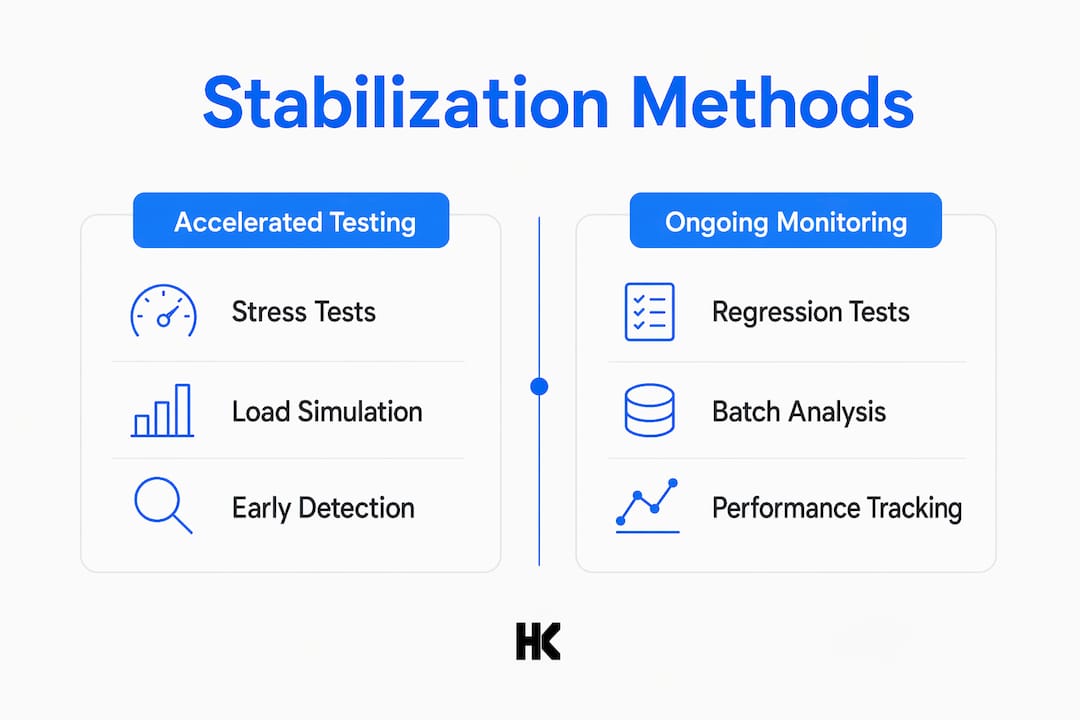
The most widely used product stability techniques fall into two categories: accelerated testing and ongoing monitoring. Each serves a different purpose, and effective teams use both.
Accelerated stability testing
Accelerated stability testing compresses 12–24 months of real-time product behavior into 3–6 months by applying elevated environmental stress conditions. In physical products, typical conditions run at 40°C–45°C and 75% relative humidity. In software, the analog is load testing, chaos engineering, and fault injection under conditions that exceed normal production traffic. The goal is identical: surface failure modes before they appear in the field.
The value of accelerated testing is early signal. A team that discovers a memory leak under 10x load in a controlled test environment fixes it in a sprint. A team that discovers it in production fixes it during an incident, at 3 a.m., with customers watching.
Ongoing batch monitoring
Standard industry practice involves testing three initial batches in the first manufacturing year, followed by annual monitoring of at least one batch. In SaaS, this maps to structured regression testing cycles, performance benchmarking after each major release, and periodic audits of core system behavior. The point is not to test everything constantly. The point is to maintain a documented baseline and detect drift before it compounds.
| Testing type | Timeframe | Primary use case |
|---|---|---|
| Accelerated stability testing | 3–6 months | Predict long-term behavior early |
| Real-time batch monitoring | Ongoing, annual cycles | Detect drift and maintain compliance |
| Environmental stress testing | Variable | Expose edge-case vulnerabilities |
| Regression testing (SaaS) | Per release cycle | Confirm stability after changes |
Pro Tip: Design your testing protocol around your riskiest components first. In SaaS, that usually means authentication flows, billing logic, and any module that touches customer data. Test those under stress before you test anything else.
Why does product stabilization matter in B2B SaaS?
The most common misconception is that stabilization means bug fixing. It does not. Bug fixing is reactive. Stabilization is a strategic roadmap priority tied to business outcomes like conversion rates, uptime SLAs, and scaling capacity. The distinction matters because it changes how you fund the work and how you communicate its value to stakeholders.
Stable, modular codebases enable rapid shipping of experiments and prevent the resource-draining firefighting cycles that define unstable systems. Teams that skip stabilization do not save time. They borrow it at a high interest rate, paid back in incidents, rollbacks, and slowed delivery. The competitive advantage of a stable architecture is not visible on a feature roadmap. It shows up in release velocity, engineer retention, and customer churn rates.
The benefits of prioritizing stabilization as a first-class engineering concern include:
- Faster release cycles. Stable systems require less pre-release validation overhead because the baseline is known and trusted.
- Lower incident rate. Fewer surprises in production means fewer all-hands incidents and less context-switching for engineers.
- Reduced technical debt accumulation. Stabilization work pays down existing debt and prevents new debt from forming at the same rate.
- Better scalability. A product built on a stable foundation scales predictably. An unstable one hits unexpected ceilings at the worst moments.
- Stronger customer trust. Reliability is a product feature. Customers notice uptime and performance consistency, even when they do not explicitly report it.
For teams building on SaaS MVP foundations, stabilization is not a post-launch concern. It is a design decision made at the architecture level from day one.
What are the common pitfalls in product stabilization?
The most damaging mistake is testing an unfinished or partial product version. Results from development builds or staging environments with incomplete configurations do not reflect production behavior. Testing in the finished configuration is the only way to uncover real-world stability risks. Teams that skip this step often discover their stability data is meaningless after a post-launch failure.
Lack of documented stabilization protocols, including defined tests and schedules, signals low process maturity and high risk of product failure. If your team cannot point to a written stabilization schedule, you do not have a stabilization process. You have a hope. The absence of documentation is a red flag for any engineering organization, and it is one of the first things a technical audit surfaces.
Two other pitfalls are common and underappreciated. First, teams make sweeping, unvalidated changes when a product shows instability. Successful stabilization requires incremental, controlled testing and fixing of identified causes, not broad rewrites that introduce new failure modes. Second, teams underestimate the organizational challenge. Stabilization work competes with feature work for roadmap space, engineering time, and management attention. Without explicit advocacy from product leadership, it loses that competition every time.
Pro Tip: Define measurable stabilization objectives before you start any remediation work. "Reduce p99 API latency below 400ms" is a stabilization goal. "Improve performance" is not. Specific targets make the work fundable and the outcomes verifiable.
How do you integrate stabilization into your team's workflow?
Embedding stabilization as a continuous practice requires treating it with the same planning discipline as feature development. Stabilization initiatives belong on the roadmap as "Now" items, visible and protected alongside feature work. Teams that bury stabilization in a backlog column labeled "tech debt" rarely complete it. Teams that put it on the roadmap with a named owner and a delivery date do.
A practical integration follows these steps:
- Audit your current stability baseline. Run load tests, review error rates, and document known failure modes. This is your starting point, not your endpoint.
- Identify your highest-risk components. Use production incident data and product validation methods to rank components by failure frequency and business impact.
- Write stabilization objectives with measurable outcomes. Tie each objective to a business metric: uptime, latency, error rate, or release frequency.
- Allocate dedicated engineering capacity. A common model reserves 20% of sprint capacity for stabilization work. The exact number matters less than the consistency of the allocation.
- Schedule regular monitoring cycles. Define when batch monitoring and regression testing happen, who owns them, and what triggers an escalation.
- Make progress visible to stakeholders. Report stabilization metrics in the same format as feature delivery metrics. If leadership sees only feature velocity, stabilization will always lose the prioritization argument.
Testing in production-equivalent environments is non-negotiable. Final product testing produces reliable data that development prototypes cannot. For teams managing a technical product roadmap, this means maintaining a staging environment that mirrors production configuration as closely as possible, including infrastructure, data volumes, and third-party integrations.
Cross-team communication is the last piece most teams underinvest in. Stabilization work that is invisible to product, sales, and customer success leadership gets cut when budgets tighten. Make the business case in business language: fewer incidents means lower support costs, higher renewal rates, and faster onboarding for new enterprise customers.
Key Takeaways
Product stabilization is a continuous architectural discipline, not a one-time cleanup, and teams that fund it explicitly outperform those that treat it as optional backlog work.
| Point | Details |
|---|---|
| Definition of stabilization | Maintaining product integrity, quality, and performance under intended conditions without degradation. |
| Accelerated testing value | Compresses 12–24 months of behavior into 3–6 months, surfacing failures before production. |
| Strategic framing | Treat stabilization as a roadmap priority tied to uptime, latency, and release velocity metrics. |
| Biggest pitfall | Testing partial or development builds produces unreliable data; always test in final configuration. |
| Workflow integration | Allocate dedicated sprint capacity, document protocols, and report stabilization metrics to leadership. |
Stabilization is the foundation, not the finish line
I have worked with engineering teams at BMW, Deutsche Bahn, and Bundesrechenzentrum Austria, and the pattern is consistent across all of them: the teams shipping the fastest are not the ones with the most features in flight. They are the ones with the most stable underlying systems.
The framing I push back on most often is "we will stabilize after the next release." That release never comes with fewer dependencies than the current one. Every sprint that ships features on top of an unstable foundation increases the cost of the stabilization work you are deferring. I have seen teams spend six months untangling a codebase that could have been stabilized in six weeks if the work had been done incrementally.
The other thing I have learned is that stabilization is a political problem as much as a technical one. Engineers usually know what needs to be fixed. The barrier is getting roadmap space and management buy-in. The teams that solve this frame stabilization in business outcomes, not technical debt ratios. "This work reduces our incident rate and cuts our mean time to recovery" lands differently than "we need to refactor the service layer."
Stable architecture is not a constraint on innovation. It is the precondition for it. You cannot run fast experiments on a fragile system. You can only run cautious ones.
— Hanad
How Hanadkubat supports product stabilization work
Product stabilization requires both technical depth and product judgment. Hanadkubat works directly with B2B SaaS teams in the DACH region and internationally to embed stabilization practices into product development from the architecture level up.
Engagements cover testing protocol design, capacity allocation modeling, and roadmap structuring that protects stabilization work from being displaced by feature pressure. Whether your codebase is fragile and needs a rescue engagement or you are building from scratch and want stability designed in from day one, the work is done by the engineer who writes the code, not a project manager. Fixed prices, defined timelines, and no vague deliverables. See current service tracks and pricing at hanadkubat.com.
FAQ
What is the definition of product stabilization?
Product stabilization is the process of maintaining a product's integrity, quality, and performance under intended conditions without significant degradation over time. It applies to both physical products and software systems.
How does product stabilization differ from bug fixing?
Bug fixing is reactive and addresses known failures after they occur. Product stabilization is proactive, using systematic testing and monitoring to prevent degradation before it affects users or business metrics.
What are the main product stabilization methods for SaaS?
The primary methods are accelerated stress testing, ongoing regression testing after each release, performance benchmarking, and structured batch monitoring cycles tied to documented protocols.
What factors affect product stability in software?
The main factors are architectural modularity, test coverage of critical paths, deployment frequency, infrastructure configuration consistency, and the discipline of testing in production-equivalent environments rather than development builds.
How do you get organizational buy-in for stabilization work?
Frame stabilization in business outcomes: reduced incident rates, lower support costs, faster release cycles, and higher uptime. Placing stabilization on the roadmap as a named, measured initiative with a dedicated capacity allocation is the most reliable way to secure and protect funding.