
TL;DR:
- A disciplined product launch employs a structured, repeatable operating system to align teams and reduce time-to-revenue. It emphasizes upfront coordination, tiered resource allocation, and outcome-focused metrics to improve launch success and efficiency. Most failures stem from weak cross-functional alignment rather than product issues, highlighting the importance of systematic planning and measurement.
A disciplined product launch is defined as a structured, repeatable operating system for bringing software products to market, not a one-time event managed by instinct and urgency. The industry term for this approach is a launch operating system, and it stands in direct contrast to the checklist-based or reactive launches most B2B SaaS teams default to under pressure. Disciplined launches compress time-to-revenue by 20–30% compared to chaotic launches. That gap compounds across every release cycle. For product managers and founders shipping multiple features per quarter, the difference between a structured and an unstructured approach is not marginal. It is the difference between a predictable growth engine and a recurring fire drill.
What is a disciplined product launch in B2B SaaS?
A disciplined product launch is a cross-functional process where positioning, audience definition, and success metrics are agreed upon before any execution begins. The word "disciplined" here means repeatable and measurable, not rigid or slow. Teams that treat launch as an operating system rather than a project plan build durable alignment between Product, Marketing, and Sales that survives personnel changes and product pivots.

The core insight is this: most launches fail not because the product is weak, but because the coordination model is weak. Coordination failures between Product, Marketing, and Sales cause the majority of launch chaos. A disciplined approach fixes the coordination layer first, then executes.
This matters especially in B2B SaaS, where a single enterprise feature launch can involve sales enablement, customer success onboarding, pricing page updates, API documentation, and partner notifications. Without a system, each team optimizes for its own timeline and the launch fragments.
What frameworks and processes define a disciplined product launch?
Two frameworks dominate current practitioner thinking: the 5-Lens Framework from Product Marketing Alliance and the 7D Model from Trust Insights. Both share a common principle. They force teams to work through sequential, documented phases rather than jumping straight to execution.
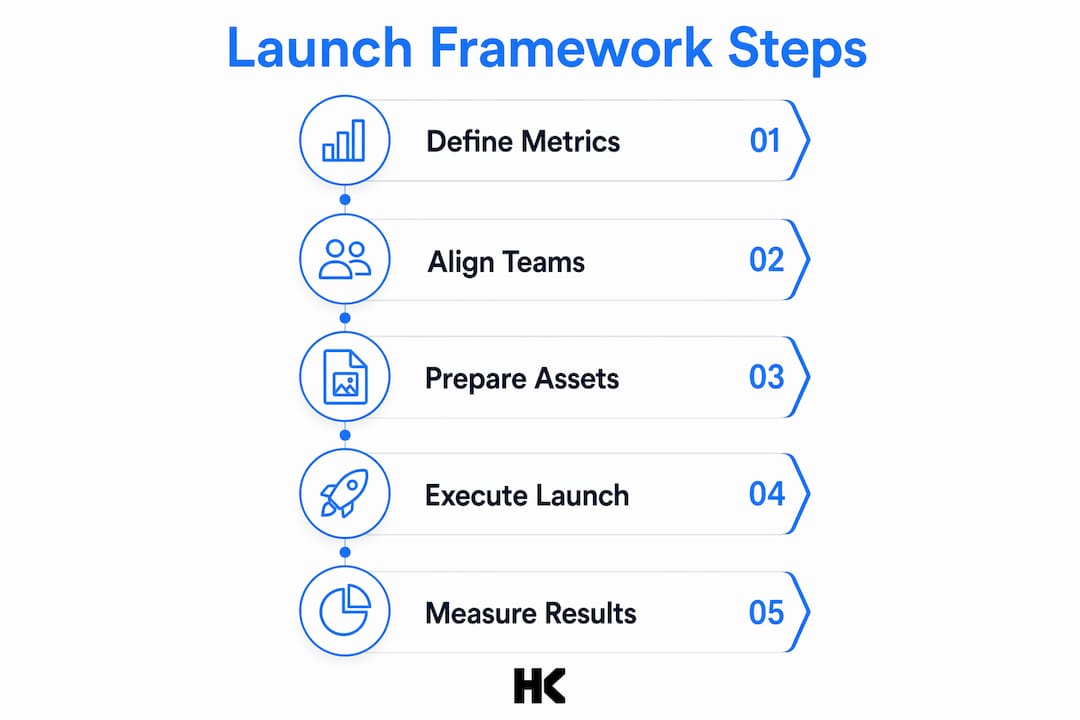
The 5-Lens and 7D frameworks
The 5-Lens Framework evaluates launch readiness across five dimensions: market, message, channel, sales, and customer success. Each lens surfaces assumptions that would otherwise stay hidden until go-live. The 7D Model adds a dedicated Determine phase for measurement, which most teams skip entirely. Teams that document assumptions and run readiness reviews encounter fewer late-stage blockers than those relying on informal handoffs.
The practical value of sequencing is dependency management. When you map the steps in order, you see which tasks cannot start until others finish. That visibility prevents the most common B2B SaaS launch failure: a sales team trained on messaging that the product team changed two days before launch.
- Define the launch tier, target audience, and primary business outcome.
- Diagnose current baseline performance and document all assumptions.
- Design the go-to-market motion, including channel, message, and pricing.
- Develop all launch assets with explicit ownership assigned per deliverable.
- Deploy with a readiness review gate before any public announcement.
- Detect anomalies in real time using pre-defined metric thresholds.
- Determine what worked, what did not, and what the next iteration requires.
Pro Tip: Run a readiness review 72 hours before launch, not on launch day. That buffer gives teams time to fix blockers without delaying the release.
Launch tiering protects your best resources
Launch tiering prevents burnout by focusing senior resources on Tier 1 launches and applying lighter treatments to minor releases. A Tier 1 launch might be a new product line or a major enterprise feature. A Tier 3 launch is a UI improvement or a minor API update. Treating both identically wastes the attention of your best people on low-impact work.
Most B2B SaaS teams have no tiering system. Every launch gets the same all-hands meeting, the same press release template, and the same post-mortem format. The result is exhaustion and mediocre execution across the board.
How does disciplined measurement improve launch outcomes?
Measurement is the phase most often skipped, yet it is the one that determines whether a launch actually delivered business value. Skipping the measurement phase is common and detrimental. Teams that skip it spend weeks after launch debating whether the release worked, with no shared data to resolve the argument.
Define metrics before you build the launch plan
The right approach is a metrics tree: a structured map that connects pre-launch leading indicators directly to primary business outcomes. A metrics tree aligned to business objectives increases launch effectiveness by keeping teams focused on outcomes rather than activity. More metrics do not mean better outcomes. A focused set of three to five outcome-linked metrics outperforms a dashboard of twenty vanity metrics every time.
Key metrics to define before launch in B2B SaaS:
- Activation rate: the percentage of new users who complete the core action within the first session
- Time to first value: how long it takes a new customer to reach their first meaningful outcome
- Expansion revenue signal: early indicators that launched features drive upsell conversations
- Sales cycle impact: whether the new feature shortens or lengthens average deal length
Pro Tip: Set anomaly thresholds before launch day. If activation rate drops below 40% in the first 48 hours, you want an automatic alert, not a weekly review meeting.
Real-time anomaly detection is not a luxury for large teams. Even a two-person founding team can set up basic threshold alerts in tools like Amplitude or Mixpanel before launch. The cost of not doing it is weeks of corrective rework after the fact.
Disciplined vs. chaotic launches: what actually differs?
The contrast between a disciplined and a chaotic launch is not about effort. Chaotic launches often involve enormous effort. The difference is in where that effort goes.
| Characteristic | Disciplined launch | Chaotic launch |
|---|---|---|
| Alignment timing | Before execution begins | During or after execution |
| Success metrics | Defined pre-launch with thresholds | Defined post-launch or not at all |
| Resource allocation | Tiered by business impact | Equal treatment for all releases |
| Timeline management | Buffers placed at high-risk handoffs | Buffers added reactively when things slip |
| Cross-functional ownership | Explicit, documented per deliverable | Assumed or verbally agreed |
| Post-launch learning | Structured retrospective with data | Informal debrief or none |
Buffer placement between critical milestones protects timelines without making schedules rigid. This is a practitioner technique, not a theoretical one. Placing a two-day buffer before the sales enablement handoff, for example, absorbs the inevitable last-minute messaging change without pushing the launch date.
The checklist approach fails because a checklist confirms tasks are done, not that teams are aligned. You can check every box and still ship a product that Sales cannot explain and Marketing cannot position. A launch operating system builds alignment as a byproduct of the process itself.
How to implement a disciplined product launch in B2B SaaS
Adopting a launch operating system does not require a six-month organizational change program. You can implement the core structure in your next release cycle.
-
Start with upfront diagnosis. Spending at least one week on diagnosis often prevents over four weeks of corrective post-launch effort. Collect baseline performance data, document your assumptions about the target buyer, and identify the three dependencies most likely to cause delays.
-
Assign explicit cross-functional ownership. Every deliverable needs one owner, not a team. "Marketing owns the landing page" is not ownership. "Sara owns the landing page, with a deadline of T minus 10 days" is ownership.
-
Apply launch tiering before you plan anything else. Classify the launch as Tier 1, 2, or 3 based on expected revenue impact and customer visibility. That classification determines the level of process you apply. A Tier 3 release does not need a press release or a sales kickoff.
-
Run a structured readiness review. Use the 5-Lens Framework or a simplified version of it. Walk through market readiness, message clarity, channel activation, sales enablement, and customer success preparation. Document gaps and assign owners before the review ends.
-
Build your metrics tree before writing a single asset. Define the primary business outcome, then work backward to the leading indicators you can measure in the first 48 hours. Set thresholds and alert conditions in your analytics tool of choice.
-
Close the loop with a post-launch retrospective. Schedule it for day 14, not day 90. Use the metrics tree to drive the conversation. The goal is one documented learning that improves the next launch cycle.
Pro Tip: For agile product launches, treat the launch operating system as a living document. Review and update the tier classification and metrics tree after every major release.
Managing assumptions is the hardest part in complex B2B SaaS environments. Every assumption about buyer behavior, sales readiness, or integration stability is a potential failure point. Write them down explicitly in a shared document during the diagnosis phase. Revisit them at the readiness review. The act of writing assumptions down forces the team to either validate them or flag them as risks.
Key takeaways
A disciplined product launch is a repeatable operating system that aligns cross-functional teams before execution, applies tiered resource allocation, and measures outcomes against pre-defined metrics to compress time-to-revenue.
| Point | Details |
|---|---|
| Launch as operating system | Treat every release as a repeatable process, not a one-time project. |
| Tiering protects resources | Classify launches by business impact before planning to focus senior effort where it counts. |
| Metrics tree before assets | Define outcome-linked metrics and alert thresholds before writing any launch copy. |
| Upfront diagnosis saves time | One week of diagnosis prevents four or more weeks of post-launch rework. |
| Coordination is the failure point | Most launches fail due to weak cross-functional alignment, not weak products. |
Why I think most SaaS teams are solving the wrong launch problem
The teams I work with, whether they are early-stage founders in Vienna or product managers at DACH Mittelstand SaaS companies, almost universally believe their launch problems are execution problems. They want better checklists, faster asset production, more detailed timelines. What they actually have is an alignment problem that no checklist can fix.
The insight that changed how I think about launches came from watching a well-funded team ship a genuinely good product to near silence. The product worked. The positioning was wrong, and nobody had agreed on what "success" looked like before launch day. The post-mortem was a three-hour meeting where everyone argued about metrics that had never been defined. That is not an execution failure. That is a system failure.
The compounding return from a launch operating system is real. The first time you run it, it feels slow. The second time, the readiness review takes half as long because the team already knows the format. By the third launch, alignment happens faster because everyone has a shared mental model of what "ready" means. That is the return that ad-hoc launches never generate.
The biggest mistake I see founders make is treating tiering as optional. They apply the full launch process to a minor UI update and wonder why the team is burned out. Or they skip the process on a major enterprise feature because they are "moving fast" and then spend two months cleaning up the go-to-market mess. Tiering is not bureaucracy. It is how you protect the quality of your most important launches.
Build the system. Run it twice. Then refine it. That is the only path to launches that compound rather than repeat the same mistakes.
— Hanad
Ready to ship your next B2B SaaS launch with a real system behind it?
Hanadkubat works directly with B2B SaaS product teams and founders across DACH and the EU to scope, build, and ship software products on fixed timelines and fixed prices. Whether you are preparing a first MVP or restructuring a fragile codebase before a major release, the work starts with the same upfront diagnosis that separates disciplined launches from reactive ones.
If you want to see how a structured launch approach applies to your specific product and market, explore the SaaS launch resources at Hanadkubat or review the launch planning guide for B2B SaaS teams. Every engagement starts with a strategy sprint at €1,500 to align on scope, positioning, and success metrics before a single line of code is written.
FAQ
What is a disciplined product launch?
A disciplined product launch is a structured, repeatable operating system that aligns Product, Marketing, and Sales on positioning, audience, and success metrics before execution begins. It replaces ad-hoc, checklist-based launches with a process that compounds in efficiency across every release cycle.
How does launch tiering work in B2B SaaS?
Launch tiering classifies each release as Tier 1, 2, or 3 based on business impact and customer visibility. Tier 1 launches receive full cross-functional process and senior resource allocation; Tier 3 releases use a lighter treatment to protect team capacity.
Why do most product launches fail?
Most launches fail due to coordination failures between Product, Marketing, and Sales, not due to poor product quality or insufficient effort. Weak alignment on messaging and metrics is the root cause in the majority of cases.
What metrics should I define before a SaaS product launch?
Define activation rate, time to first value, expansion revenue signals, and sales cycle impact before writing any launch assets. A focused metrics tree tied to primary business outcomes outperforms a large dashboard of activity-based metrics.
How long should launch preparation take for a B2B SaaS product?
At minimum, one week of upfront diagnosis is required to collect baseline data and document assumptions. Skipping this phase typically generates four or more weeks of corrective rework after launch.