
TL;DR:
- Technical due diligence assesses a company's software, security, and engineering risks to evaluate deal viability. It produces a priority-based risk register, remediation plan, and confidence statement on technology support. Early and thorough TDD helps prevent costly post-close surprises and guides commercial decision-making.
Technical due diligence (TDD) is an independent, evidence-driven assessment that converts a software platform, security posture, and engineering organization into commercial risk and remediation priorities — plus a confidence statement about whether the technology can support the deal or roadmap. The verdict it produces is binary in practice: can this technology do what the deal thesis requires, or can't it?
Core outputs from a competent TDD engagement:
- Executive summary with a confidence statement (go / conditional go / no-go)
- Prioritized risk register with impact, probability, and remediation estimates
- Remediation roadmap with owner assignments and cost ranges
- Technical appendix covering architecture diagrams, sampled code, and cloud cost models
Investors increasingly run lighter technical checks earlier in the process — sometimes before the first deep call — to confirm the product is real before committing to a full review.
Table of Contents
- What does technical due diligence actually examine?
- Why technical due diligence matters for deals and fundraising
- What a competent TDD report actually delivers
- How long does TDD take, and what does it cost?
- How technical findings translate into commercial decisions
- Red flags you can spot before commissioning a full review
- How do you choose the right reviewer for your deal?
- Key Takeaways
- What most TDD guides miss
- Fixed-price TDD and AI audits from Hanadkubat
- Useful sources and further reading
- FAQ
What does technical due diligence actually examine?
A thorough TDD engagement covers seven core areas: architecture and scalability, code quality and test coverage, security posture, open-source dependencies and licensing, IP ownership, team and key-person risk, and cloud cost trajectory. A report that skips any of these is checkbox work, not a rigorous review.
Scope areas and what reviewers request:
- Architecture: system diagrams, ADRs, scalability test results, database schema
- Code quality: repository access, CI/CD history, test coverage reports, static analysis output
- Security: penetration test results, access control policies, incident logs, secrets management config
- Infrastructure and cloud cost: current monthly spend, cost-per-tenant model, IaC files
- Dependencies and OSS licenses: dependency trees, license inventory, SBOM
- Data controls: data-flow diagrams, GDPR/privacy policy, retention schedules
- Observability: alerting runbooks, SLO definitions, on-call records
- Team and process: org chart, key-person map, sprint velocity, bus-factor analysis
- IP ownership: contractor agreements, IP assignment records, patent filings
Focused vs. comprehensive review: A 2-week focused review surfaces deal-killers — missing tests, plaintext secrets, single-engineer dependencies. A 4–6 week comprehensive review validates integration plans, post-close roadmaps, and multi-system architecture. If the deal thesis depends on rapid scaling or an AI feature layer, budget for the longer track.
Pro Tip: Before commissioning a full review, ask the target for a dependency tree and the last 90 days of cloud spend. Both arrive in hours and immediately reveal whether a deeper review is warranted.
Why technical due diligence matters for deals and fundraising
Technology is now so embedded in operations that a single outage or breach can change the balance sheet. TDD is the mechanism that makes that risk visible before capital is committed. Running it after close is expensive — remediation costs that could have been negotiated into the price become the buyer's problem entirely.
Concrete risk categories TDD surfaces:
- Hidden technical debt that inflates post-close engineering spend
- Security vulnerabilities that trigger regulatory fines or breach liability
- Undisclosed cloud cost trajectory that compresses runway faster than the model assumes
- License or IP exposure from unvetted open-source components
- Key-person dependency where one engineer's departure stalls the product
The right moment to run TDD is parallel with financial and legal diligence, not after term sheet. For earlier-stage deals, a lightweight technical check before the first deep call confirms the product exists as described. Running early technical decisions through a structured review prevents balance-sheet-level surprises at close.
What a competent TDD report actually delivers

Effective TDD turns engineering claims into evidence — commits, cloud bills, dependency trees — so non-technical decision-makers have something to act on. A usable report contains more than findings; it maps each finding to a commercial consequence.
Core deliverables:
- Executive summary with a go / conditional go / no-go confidence statement
- Risk register with severity, probability, remediation cost estimate, and owner
- Integration and hand-off plan for post-close engineering
- Technical appendix: architecture diagrams, sampled code diffs, infra config
- Security test results and access control audit
Sample risk-register entry:
| Field | Example |
|---|---|
| Risk | No automated test suite; manual QA only |
| Impact | High — any refactor risks regression across core flows |
| Probability | Confirmed |
| Remediation estimate | 4–6 weeks of engineering, — |
| Owner | Acquiring engineering lead |
Appendices typically include evidence links, sampled commit diffs, a cloud cost model, and dependency license inventory. A board or CFO can read the executive summary; legal can pull the risk register directly into warranty schedules.
How long does TDD take, and what does it cost?
Timeline and cost scale with deal size and scope depth. A focused review takes roughly 2 weeks; a comprehensive review runs 4–6 weeks. Picking the wrong depth wastes budget and leaves risks unexposed.
| Review type | Duration | Typical cost range |
|---|---|---|
| Lightweight pre-check | 3–5 days | $5,000–$15,000 |
| Focused review | ~2 weeks | $30,000–$80,000 |
| Mid-market boutique | 4–6 weeks | $30,000–$80,000 |
| Large-deal enterprise | 4–6 weeks | — |
Pricing models: Boutique fixed-price engagements work well for mid-market SaaS deals where scope is defined upfront. Daily-rate consultants suit exploratory work where scope is unclear. Enterprise retainers make sense for PE firms running multiple deals per year. For AI integration or MVP audits, fixed-price scoped engagements with defined assumptions and a change-control process give the clearest budget certainty.
How technical findings translate into commercial decisions
The reviewer's job is to stop trusting slide decks and read the repository: commit history, cloud spend, and dependency trees reveal the real state of the product. Each finding then maps to a commercial action.
- Critical security flaw → indemnity clause, price reduction, or deal kill
- Unknown cloud spend trajectory → price holdback or explicit capex allocation post-close
- Single engineer dependency → retention bonus escrow or key-person clause in the SPA
- Undocumented architecture → integration risk premium or extended warranty period
- Stale dependencies with known CVEs → remediation budget carved out of deal proceeds
Remediation cost estimates come from scoping the fix: lines of code affected, engineering days required, and any third-party tooling. Sanity-check them against technical debt remediation benchmarks for your stack. TDD informs commercial decisions; it does not replace legal counsel. Feed the risk register directly into your legal team's warranty and indemnity schedules.
Pro Tip: Ask the reviewer to tag each risk register item with a deal-impact category (valuation, warranty, completion condition, or post-close investment). That single column saves hours in legal negotiation.
Red flags you can spot before commissioning a full review
Some signals are visible in a 30-minute triage. If you see any of these, escalate to a full review immediately.
- Inaccessible repository or no CI history — the product may not exist as described
- Zero automated tests — any change is a manual regression risk
- Plaintext secrets or basic auth in production — immediate security exposure
- No monitoring or alerting — the team is flying blind on production incidents
- Inconsistent service ownership — nobody knows who is responsible for critical components
- No IP assignment agreements with contractors — ownership of the codebase is legally unclear
When a red flag appears, request three artifacts immediately: the last 90 days of incident logs, a dependency tree with license annotations, and the most recent cloud cost breakdown. These three documents answer 60% of the follow-up questions before a single interview.
Pro Tip: Run a quick SaaS security checklist against the target's public-facing endpoints before the first call. Open ports, missing HTTPS enforcement, and exposed admin panels are visible without repo access.
How do you choose the right reviewer for your deal?
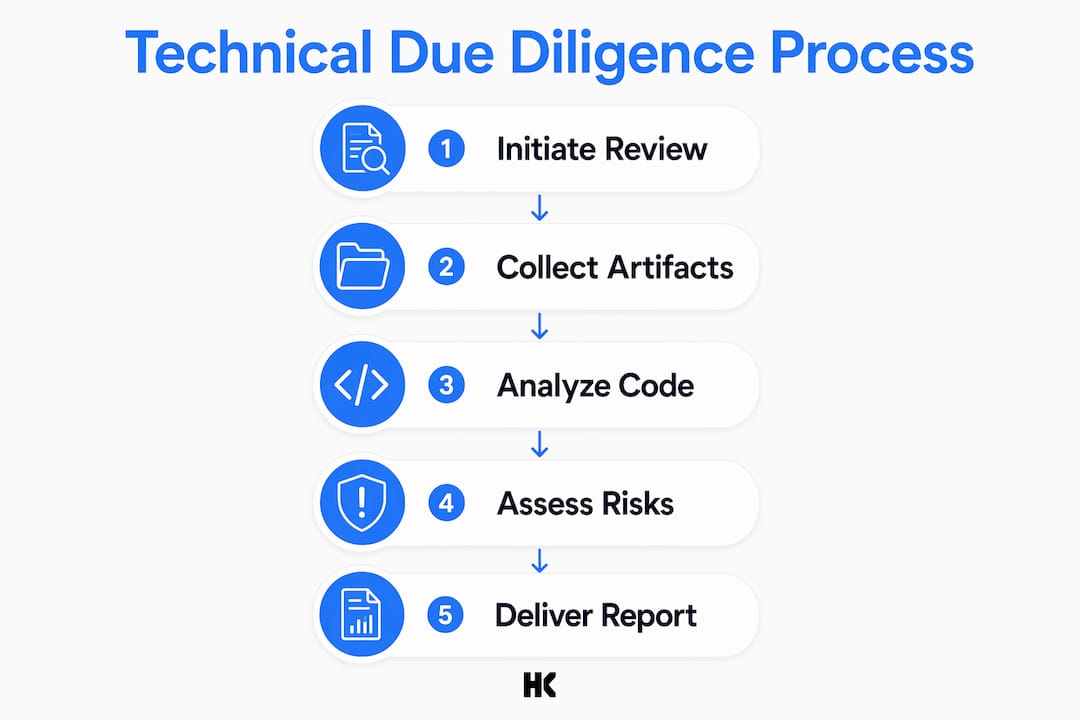
The TD process requires a proven playbook: a data request, document review, targeted interviews, code sampling, risk assessment, and a prioritized remediation list. Ask every candidate how they execute each step.
Must-ask questions for any proposal:
- What is explicitly in and out of scope?
- Can you share a redacted sample report from a comparable deal?
- Who does the actual code sampling — a senior engineer or a junior analyst?
- What is your methodology for cloud cost modeling?
- Do you have references from deals in our sector and deal size?
- What is the SLA for delivering the final report?
Trust signals to require: hands-on code sampling by a senior engineer, security testing beyond a vulnerability scan, cloud cost modeling with actual spend data, and experience with EU AI Act or GDPR-relevant architecture if the target handles EU data. Fortune 500 engineering standards in a reviewer's background matter because enterprise-scale systems surface failure modes that startup-only experience misses.
On fixed-price offers: a credible fixed-price TDD proposal lists every deliverable, states the timeline, defines assumptions explicitly (e.g., "assumes repo access within 48 hours of kickoff"), and includes a change-control process for scope additions.
"A technical due diligence checklist should include architecture and scalability, cloud infrastructure, security and access, engineering team and process, code quality, technical debt, IP ownership, open source licensing, data controls, and operational hygiene. Each item should be framed as an investor question and linked to commercial risk, not just technical completeness." — FoundationState
Key Takeaways
Technical due diligence converts engineering evidence into commercial risk — run it parallel with legal and financial diligence, not after close.
| Point | Details |
|---|---|
| Run TDD early | Start parallel with financial diligence; lightweight pre-checks before term sheet catch deal-killers cheaply. |
| Insist on full scope | A report missing any of the seven core areas (architecture, security, debt, team, IP, infra cost, data) is incomplete. |
| Match depth to deal size | A 2-week focused review surfaces deal-killers; a 4–6 week comprehensive review validates integration plans. |
| Map findings to commercial actions | Every risk-register item should carry a deal-impact tag: valuation, warranty, completion condition, or post-close investment. |
| Hanadkubat for AI/MVP audits | Fixed-price AI audits (€1,500) and codebase rescue engagements (from €4,500) deliver a prioritized risk register and remediation roadmap in weeks. |
What most TDD guides miss
Most TDD write-ups treat the review as a checklist exercise. The checklist matters, but the real value is in calibration: knowing which findings are ordinary maturity gaps and which ones actually affect price, warranties, or whether the deal should close at all. A reviewer who hands you 47 findings without ranking them by commercial impact has done half the job.
The other thing guides understate: the reviewer's pedigree changes what they find. Someone who has built and operated production systems at scale — not just audited them — reads a commit history differently. They recognize the difference between a team that moved fast and left debt versus a team that never understood what they were building. That distinction rarely shows up in a static analysis report.
Fixed-price TDD and AI audits from Hanadkubat
If your deal or product roadmap involves an AI feature layer, a SaaS MVP, or a codebase you inherited and need to understand fast, Hanadkubat delivers fixed-price technical audits with no open-ended billing.
An AI audit (€1,500) produces a prioritized roadmap covering RAG architecture, LLM cost trajectory, EU AI Act risk categorization, and GDPR-aware data handling — delivered in under a week. Codebase rescue and architecture reviews start at €4,500 and include a risk register, remediation roadmap, and a direct handoff session. Every engagement is scoped upfront: defined deliverables, a fixed timeline, and explicit assumptions so there are no surprises at invoice. Hanad brings BMW, Deutsche Bahn, and Bundesrechenzentrum Austria engineering experience to every review — government-grade infrastructure work, not slide-deck consulting.
See the full service offering or review the detailed engagement options to scope your audit.
Useful sources and further reading
These references are worth citing in a deal memo or internal brief:
- Snyk: What Is Technical Due Diligence? — Clear process walkthrough covering code review, documentation audit, team interviews, and final report structure. Good for briefing non-technical stakeholders.
- FoundationState: Technical Due Diligence Checklist — Investor-framed checklist linking each scope area to commercial risk. Use it to validate a vendor's proposed scope.
- Liberty Advisory Group: Technical Due Diligence Importance and Approach — Practitioner guide on process steps and how technology failures translate to balance-sheet impact.
- AuditFront: Preparing for Technical Due Diligence — Founder-side preparation guide; useful for targets preparing a data room.
Suggested search terms to find sample reports and risk-register templates: "technical due diligence sample report PDF," "TDD risk register template M&A," "software due diligence checklist investor," "SaaS technical audit deliverables."
FAQ
What is technical due diligence in simple terms?
Technical due diligence is an independent review of a company's software, infrastructure, security, and engineering team that converts technical evidence into commercial risk — telling buyers or investors whether the technology can support the deal thesis.
How long does a technical due diligence review take?
A focused review takes roughly 2 weeks and surfaces deal-killers; a comprehensive review runs 4–6 weeks and validates integration plans and post-close roadmaps.
What does a technical due diligence report include?
A complete report includes an executive summary with a confidence statement, a prioritized risk register with remediation cost estimates, an integration plan, a technical appendix, and security test results.
When should a startup run technical due diligence?
Founders should run a self-directed technical review before seeking investment, and investors should run TDD parallel with financial and legal diligence — not after term sheet is signed.
How much does technical due diligence cost?
Mid-market boutique and focused review engagements typically run $30,000–$80,000; lightweight pre-checks start around $5,000–$15,000. Fixed-price AI and codebase audits from Hanadkubat start at €1,500 for a scoped AI audit.