

TL;DR:
- Reliable engineering ensures systems perform their intended functions consistently throughout their entire lifecycle, not just at launch.
- Leadership decisions made early in architecture, staffing, and culture heavily influence long-term reliability outcomes.
What reliable engineering actually means for software and AI systems
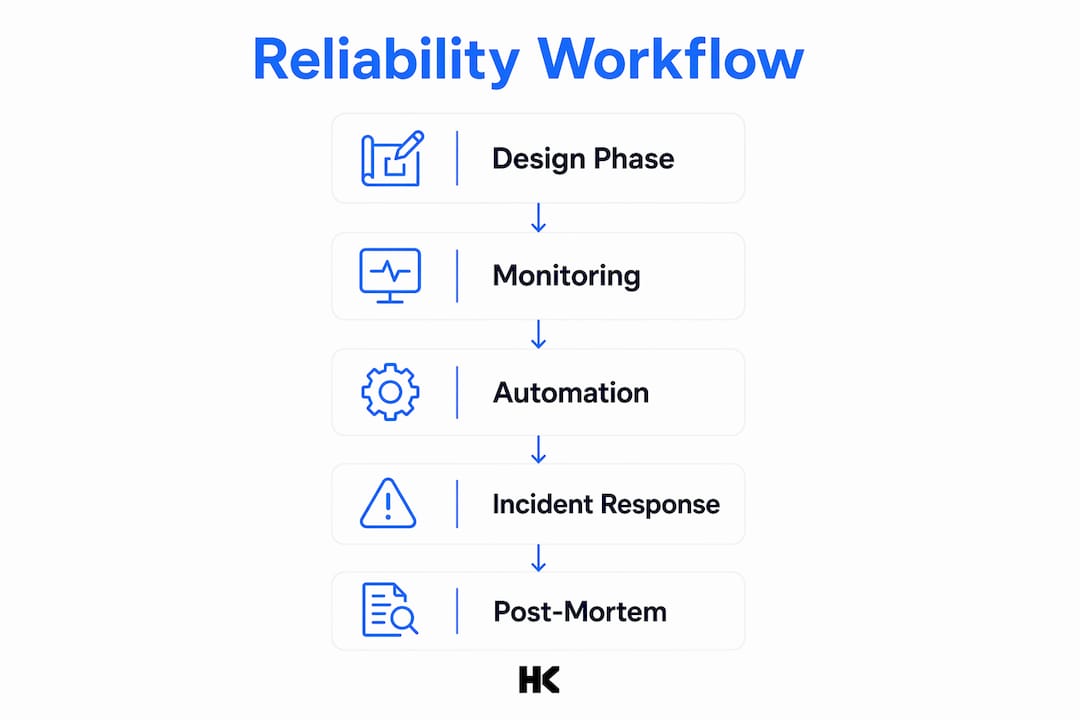
Reliable engineering is the discipline of ensuring a system performs its intended function consistently over its entire lifecycle, not just at launch. The formal definition from systems engineering: reliability is the probability that a product will perform its intended function under specified conditions for a defined period. That scope matters. It covers design, development, operation, and maintenance, not just the warranty window.
Four core objectives define the work:
- Prevent failures through engineering knowledge and proven techniques
- Identify and correct causes of failures that occur despite prevention efforts
- Determine how to cope with failures when root causes remain uncorrected
- Estimate the likely reliability of new designs before they ship
The QRS framework (Quality, Reliability, Safety) treats these as an integrated discipline. Separating them is one of the most common professional mistakes in engineering organizations. Techniques like FMEA, fault tree analysis, root cause analysis (RCA), and reliability-centered maintenance (RCM) are the standard toolkit.
Table of Contents
- Why leadership is the real bottleneck in reliability engineering
- Balancing reliability trade-offs with economic reality
- Why academic reliability models fall short in real-world SaaS and AI
- Applying Fortune 500 engineering standards to SaaS reliability
- Tools and techniques for building and monitoring reliability
- Real-world examples of reliable engineering in software and AI
- How to run incident response and post-mortem analysis
- Key Takeaways
- FAQ
Why leadership is the real bottleneck in reliability engineering
Reliability engineering is a leadership discipline, not an ops cleanup task. The most common mistake CTOs make: treating reliability as something to fix after growth arrives. By then, the architecture already has the fragility baked in.
Leadership decisions shape reliability outcomes long before anything fails in production. Architecture choices, staffing, incident response culture, and testing standards all flow from how seriously the CTO treats reliability at the design stage. Key principles and pitfalls:
- Treat reliability as a design constraint, not a post-launch feature request
- Avoid siloing reliability away from security and disaster recovery planning
- Staff for it explicitly: weak reliability talent creates hidden fragility that surfaces at the worst moment
- Instrument before you scale: teams that lack telemetry from day one are flying blind during incidents
Balancing reliability trade-offs with economic reality
Higher reliability reduces maintenance needs, but it also changes cost structure. Aiming for 100% uptime is almost always economically infeasible. The real goal is finding the reliability level that balances failure risk against budget and business impact.
Reliability risk is a function of failure probability multiplied by failure severity, including safety exposure, operational cost, and customer impact. That calculation drives decisions about redundancy, maintenance intervals, and acceptable downtime windows.
Pro Tip: Integrate reliability trade-off analysis during concept feasibility, before any prototype exists. Decisions made at that stage cost a fraction of what corrections cost after the system is in production.
Why academic reliability models fall short in real-world SaaS and AI
Mathematical reliability models are useful starting points. They are not accurate predictors. As the Wikipedia entry on reliability engineering states directly, having the equation for reliability does not begin to equal having an accurate predictive measurement of it. Real systems are massively multivariate, and the ranges of uncertainty involved largely invalidate purely quantitative prediction methods.
| Aspect | Theoretical modeling | Practical engineering |
|---|---|---|
| Input data | Assumed failure rates | Observed telemetry and field data |
| Uncertainty handling | Probabilistic formulas | Empirical learning from incidents |
| Security integration | Often isolated | Inseparable in cloud-native systems |
| Disaster recovery | Separate concern | Built into reliability architecture |
Observability-driven telemetry, incident learning, and integrated security are not optional add-ons. In cloud-native SaaS and AI systems, security and reliability cannot be treated as separate disciplines.
Applying Fortune 500 engineering standards to SaaS reliability
Working across BMW, Deutsche Bahn, and Bundesrechenzentrum Austria, the pattern is consistent: organizations that invest in reliability at the design stage spend far less on failure remediation later. About 70% of a project's budget is committed during the design phase, making that the highest-leverage point for reliability integration.
Design-phase reliability investment is the most cost-effective approach to failure prevention. Applying reliability considerations during concept feasibility means every downstream decision inherits that constraint.
Practical best practices from Fortune 500 engineering, applied to SaaS reliability:
- Set reliability goals based on survivability, such as 95% reliability at 90% confidence over 15 years, rather than relying on MTBF alone
- Run concurrent engineering: reliability, security, and compliance teams work together, not sequentially
- For AI systems, map EU AI Act risk categories and GDPR data flows into the reliability architecture from day one
- Instrument every service with SLIs (Service Level Indicators) before it reaches production
Tools and techniques for building and monitoring reliability
The engineering best practices that actually move the needle in SaaS and AI systems combine proactive design tools with real-time monitoring:
Design phase: FMEA and fault tree analysis to surface failure modes before code is written. Physics of failure (PoF) analysis for hardware-adjacent components. Redundancy design to eliminate single points of failure (SPOF).

Operational monitoring: Distributed tracing with tools like OpenTelemetry, structured logging pipelines, and error budget tracking against defined SLOs. For AI systems specifically, production evaluation frameworks that monitor model output quality and latency drift over time.
Automation: Canary rollouts, automated rollback triggers, and chaos engineering practices (controlled fault injection) to validate that recovery mechanisms actually work under real conditions.
Real-world examples of reliable engineering in software and AI
Deutsche Bahn rail scheduling systems operate under strict availability requirements where a missed SLO has direct safety and operational cost consequences. Reliability engineering there means formal FMEA at the architecture level, redundant data paths, and defined degraded-mode behavior when components fail.
B2B SaaS AI integration presents a different profile. A RAG (retrieval-augmented generation) pipeline running at $0.034 per query needs reliability engineering across three layers: the LLM inference endpoint, the vector store retrieval path, and the orchestration logic. Each layer needs its own failure mode analysis and fallback behavior. Shipping a production AI feature in 14 days is achievable; doing it without reliability instrumentation from day one creates technical debt that compounds fast.
EU-resident inference for GDPR-sensitive workloads adds a compliance dimension to reliability: if the inference endpoint fails over to a non-EU region, the system may be functionally available but legally non-compliant. That is a reliability failure by definition.
How to run incident response and post-mortem analysis
Incident response has a structure that works. Deviate from it under pressure and the incident takes longer to resolve and teaches you less afterward.
During an incident: Declare it early, assign a single incident commander, and keep a live timeline in a shared document. Resist the urge to fix and investigate simultaneously. Stabilize first, then diagnose.
Post-mortem analysis: The goal is a blameless account of what happened, why detection took as long as it did, and what specific system or process change prevents recurrence. A post-mortem that ends with "we'll be more careful" is a failed post-mortem. The output should be a concrete engineering change: a new alert threshold, an added circuit breaker, a revised runbook. For stable SaaS systems, post-mortems feed directly back into the FMEA and reliability architecture.
Key Takeaways
Reliable engineering is a lifecycle discipline, not a launch checklist. The majority of project budgeting occurs during the design phase, making early investment the most cost-effective path to durable systems.
| Point | Details |
|---|---|
| Lifecycle scope | Reliability covers design through decommissioning, not just the warranty window. |
| Leadership ownership | CTOs who treat reliability as a post-growth cleanup task inherit fragile architecture. |
| Design-phase leverage | About 70% of project budget is committed at design, making it the best point for reliability integration. |
| Empirical over theoretical | Real-world SaaS and AI systems require telemetry and incident learning, not just mathematical models. |
| Survivability goals | Set reliability targets as survivability bounds (e.g., 95% reliability at 90% confidence) rather than MTBF alone. |
FAQ
What is the difference between reliability engineering and quality control?
Quality control targets defect prevention during the warranty phase. Reliability engineering addresses failure prevention across the entire product lifecycle, from design through decommissioning.
How do you set a reliability goal for a SaaS product?
Set goals based on survivability bounds, such as 95% reliability at 90% confidence over a defined period, rather than relying on MTBF, which assumes a constant failure rate that rarely holds in practice.
Why do academic reliability models fall short in real-world AI systems?
Real systems are massively multivariate. Having a reliability equation does not produce an accurate prediction when operational uncertainty is high. Empirical telemetry and incident data are required to supplement theoretical models.
When should reliability engineering start in a SaaS project?
At the concept feasibility stage, before prototyping. Decisions made that early propagate through every downstream architecture and cost decision.
How does AI integration change reliability requirements?
AI systems add failure modes at the inference, retrieval, and orchestration layers, each requiring its own analysis. For EU-based SaaS, a failover to a non-EU inference endpoint can be a compliance failure even when the system stays functionally available.