
TL;DR:
- Disciplined engineering applies strict, repeatable principles and automated gates to ensure safe and predictable software delivery. It reduces cycle time, enhances quality, and prevents hidden risks by enforcing behavior contracts and architectural limits at every stage.
What disciplined engineering actually means
Disciplined engineering is the practice of applying strict, repeatable principles and deterministic guardrails to software development to guarantee quality, safety, and predictable delivery. It governs not just how code is written, but how teams interact, how architecture evolves, and how verification happens at every stage.
The core elements are concrete:
- Guardrail principles that contain failure without blocking progress
- Deterministic tools that gate every checkpoint automatically
- Behavior contracts defining exactly what a system must do
- Automated quality gates replacing manual review bottlenecks
- Iterative specifications moving from intent to acceptance criteria to executable Gherkin specs
- Architectural governance enforced by tooling, not by convention
This is the disciplined engineering approach that separates teams shipping reliable software at speed from teams accumulating hidden risk until they stop entirely.
Business benefits that make the case for adoption
Cycle time reduction and faster feedback are the primary competitive advantages disciplined engineering delivers. Liberty IT describes it directly: disciplined engineering "boils down to one key objective: reduced cycle time and faster feedback. This is a strategic business advantage that allows us to build high-quality, customer-centric solutions, coupled with the ability to react faster than our competitors to emerging business opportunities."
The operational benefits stack up quickly:
- Faster market response through shorter iteration cycles and daily product owner contact
- Higher code quality from test-driven development and continuous refactoring baked into the workflow
- Reduced rework because automated gates catch problems before they compound
- Knowledge distribution across the team through pair programming, eliminating dangerous single points of failure
- Risk containment that coexists with velocity rather than trading against it
"Disciplined engineering boils down to one key objective: reduced cycle time and faster feedback. This is a strategic business advantage that allows us to build high-quality, customer-centric solutions." — Liberty IT, via Silicon Republic
The last point is the one most teams miss. Discipline does not slow you down. It removes the hidden drag of debugging production failures, onboarding engineers who inherit undocumented systems, and rearchitecting code that was never designed to scale.
How Guardrail Engineering works as a doctrine
Guardrail Engineering is the practice of introducing intentional constraints that guide systems and teams toward safe, sustainable outcomes. It applies physical safety engineering logic, the same principles governing highway design, to software architecture and organizational governance.
The doctrine rests on a few principles worth understanding precisely:
- Guardrails absorb impact, they do not block motion. Like a highway barrier, a software guardrail redirects an unsafe trajectory rather than stopping all movement.
- Install before accidents, not after. Guardrails are placed where the cost of installation is less than the risk of the hazard. The same standard applies to software governance.
- Governance is the road, not the brake. Sustainable velocity emerges when teams operate confidently within known boundaries. Organizations that skip governance accumulate hidden risk until they stop entirely.
- Complexity must justify its own cost. Every abstraction, integration, and automation carries a long-term maintenance burden. Guardrail Engineering requires asking whether each layer pays for itself over time.
- Well-designed guardrails make the safe path the easiest path. When governance feels like obstruction, teams route around it. When it feels like clarity, teams move through it efficiently.
- Failures live at the boundaries. Most systemic failures emerge at the connections between teams, services, and ownership domains, not inside individual components.
Engineering maturity, by this doctrine, is not defined by how much complexity an organization can build. It is defined by how safely it can operate at scale.
Why disciplined engineering is not process overhead
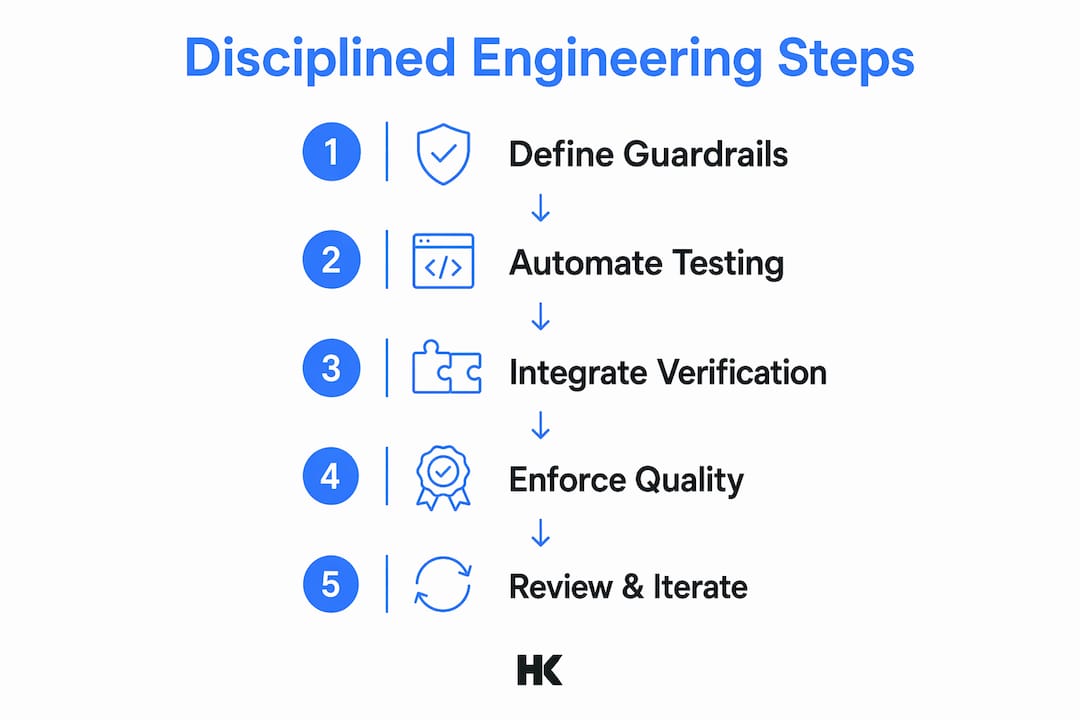
The most common objection is that discipline means bureaucracy. It does not. Disciplined engineering replaces overhead with automated quality gates and deterministic tools that catch problems before they compound, with zero manual overhead per pull request.
The contrast with "vibe coding" is instructive. Ad-hoc AI-assisted development produces code with no charter, no behavior contract, and no verification gates. The result is fast initially, then brittle and drifting. Disciplined Agentic Engineering takes the opposite position: every feature has a charter, acceptance criteria in domain language, a Gherkin spec a human can read and defend, and two test streams that must both pass before anything merges.
Key distinctions:
- Automated gates, not manual checklists. Every PR is reviewed before it merges through tooling, not through a process document someone ignores.
- Behavior contracts, not hope. Acceptance Test Driven Development (ATDD) plus mutation testing forms a semantic firewall. Code can be refactored or extended by AI agents without the system's intended behavior drifting.
- Anti-rationalization by design. Requirements must be verifiable through automation or rewritten. There is no path for an AI agent to silently bypass a requirement.
- Humans own architecture, agents own keystrokes. Disciplined engineering shifts repetitive implementation tasks to AI agents while engineers maintain architectural control.
Best practices for implementing disciplined engineering in your team
Adoption works best when it starts with the highest-impact automations and expands incrementally. Trying to install every guardrail at once creates friction; installing them where failure is most costly creates clarity.
Core practices:
- Treat development as a product effort. Daily contact with the product owner is not optional. Teams that talk to their product owner every day build the right thing; teams that don't build the wrong thing faster.
- CI/CD pipelines are mandatory infrastructure. When a team starts a new engagement, the first thing they set up is continuous integration and delivery pipelines. Everything else depends on this.
- Test-driven development from the start. Write tests before code. This forces clarity on what the code must actually do before anyone writes it.
- Continuous refactoring, not big rewrites. Small, incremental improvements keep the codebase readable and reduce the cost of future changes.
- Pair programming for knowledge sharing. It eliminates the silos that form on traditional projects and distributes design knowledge across the team.
- Layered specifications. Move from intent (feature.md) to behavior in domain language (ACs) to executable Gherkin spec to architecture plan. Each layer is reviewed before the next is written.
- Meaningful commits and pull requests. Commits are a conversation across time. Document the why, not just the what. Future engineers debugging a failure need context, not a list of changed files.
Pro Tip: Start guardrail installation at your highest-risk boundaries first: the interfaces between services, teams, and ownership domains. That is where systemic failures concentrate, and where a single automated gate delivers the most immediate return.
Expert insights from Fortune 500 engineering practice

Working across BMW, Deutsche Bahn, and Bundesrechenzentrum Austria, the pattern is consistent: teams that ship reliably at scale are not the ones with the most talented individuals. They are the ones with the clearest contracts between components, the most automated verification, and the least tolerance for undocumented architectural decisions.
A few observations from that experience:
- Documentation is a first-class engineering artifact. A README that explains why the system is designed the way it is saves more time than any individual optimization.
- Pairing parity matters. Design knowledge must be distributed evenly across the team. When one engineer holds the architectural context and leaves, the team does not just lose a person. It loses the system's memory.
- EU AI Act compliance and GDPR-aware architecture are not add-ons. Building with EU-resident inference and data sovereignty constraints from day one is far cheaper than retrofitting them. Disciplined engineering makes this tractable because the architecture is explicit and governed from the start.
- Production AI features require the same discipline as any other production code. A RAG system with no behavior contract and no mutation-tested test suite will drift. The same guardrail principles apply.
Hanadkubat's work on Fortune 500 engineering standards in B2B SaaS contexts consistently shows that the gap between a fragile codebase and a maintainable one is almost never talent. It is discipline, applied consistently at the boundaries.
How disciplined engineering evolved historically
The roots of disciplined engineering trace back to the software crises of the 1960s and 1970s, when projects routinely ran over budget, missed deadlines, and delivered unreliable systems. The NATO Software Engineering Conferences of 1968 and 1969 formalized the problem and introduced "software engineering" as a discipline requiring the same rigor as civil or mechanical engineering.
The V-model, formalized in the 1980s, gave teams a structured lifecycle connecting requirements on one side to verification and validation on the other. Extreme Programming (XP), introduced by Kent Beck in the late 1990s, brought practices like test-driven development, pair programming, and continuous integration into mainstream use. Robert C. Martin's work on clean code and ATDD extended these principles into the agentic AI era, where the same discipline that governed human-written code now governs AI-generated code.
The current moment, where AI agents write most of the keystrokes, has not changed the underlying values. A good engineer in 1975 cared about correctness, structure, and maintainability. A good engineer in 2026 cares about exactly the same things, applied to specifications, acceptance criteria, and architecture rather than assembly code.
Common challenges disciplined engineering addresses
Most teams do not fail because their engineers lack skill. They fail because of specific, recurring structural problems:
Knowledge silos. One engineer understands the payment service. When they leave, the team spends weeks reverse-engineering decisions that should have been documented. Pair programming and pairing parity solve this directly.
Behavior drift in AI-assisted development. AI agents that operate without behavior contracts and mutation-tested test suites produce code that works initially and drifts over time. The semantic firewall formed by ATDD plus mutation testing prevents this.
Late-stage defect discovery. Finding a bug in production costs far more than finding it before a PR merges. Automated quality gates at every checkpoint shift discovery left, where it is cheap.
Undocumented architectural decisions. Teams inherit systems where no one knows why a particular design choice was made. Disciplined commit practices and layered specifications make the why explicit and searchable.
Compliance retrofitting. GDPR and EU AI Act requirements added after a system is built require expensive rearchitecting. Disciplined engineering builds compliance constraints into the architecture from the start.
Real-world examples of disciplined engineering in practice
Liberty IT applied disciplined extreme programming practices across their development teams, with daily product owner contact, test-driven development, continuous refactoring, and mandatory CI/CD pipelines. The result was measurable cycle time reduction and faster response to market opportunities.
Disciplined Agentic Engineering (DAE) applies the same principles to AI-assisted development. Every feature progresses through eight checkpoints, each gated by deterministic tools rather than prompt rules. The human engineer approves the architecture plan before any code is written. Two test streams must pass. Mutation testing proves the tests actually catch bugs. The system's intended behavior remains stable across agent-driven refactoring.
Bundesrechenzentrum Austria operates government-grade EU infrastructure where failure is not an option. The engineering discipline required at that scale, explicit state machines, verified transitions, and documented ownership, mirrors exactly what Guardrail Engineering formalizes as a doctrine.
Tools and technologies that support disciplined engineering
The tooling ecosystem maps directly to the principles:
- CI/CD platforms (GitLab CI, GitHub Actions) enforce the pipeline discipline that makes continuous delivery possible.
- ATDD frameworks (Cucumber, SpecFlow, FitNesse) make behavior contracts executable and verifiable.
- Mutation testing tools (PIT for Java, Stryker for JavaScript/TypeScript) prove that test suites actually catch bugs rather than just achieving coverage numbers.
- Architecture enforcement tools like
arch-checkin the DAE toolkit gate layering, cycles, forbidden patterns, and file size at every checkpoint. - Static analysis and linting catch type errors, style violations, and common bugs before human review.
- Spec-driven development tools like Speckit enforce iterative, layered specification from intent through to executable Gherkin.
The pattern across all of these is the same: automated enforcement at boundaries, not manual process compliance.
What team structures work best for disciplined engineering
Disciplined engineering does not require a specific org chart. It requires specific role clarity and communication patterns:
- Product owner embedded in the team. Daily contact is the baseline. The product owner is not a stakeholder who reviews work at the end of a sprint. They are a daily collaborator who keeps the team building the right thing.
- Engineers who own architecture, not just implementation. Someone on the team must be able to read a proposed architecture plan and judge whether it is sound. Disciplined engineering is not for teams where architecture is delegated entirely to AI agents.
- Pairing as a default, not an exception. Knowledge distribution requires deliberate practice. Pair programming is the most direct mechanism.
- Clear ownership at service boundaries. The interfaces between teams and services are where failures concentrate. Ownership must be explicit, documented, and enforced.
Small teams of 3–6 engineers with a dedicated product owner tend to apply these principles most effectively. Larger organizations can apply the same structure at the squad level, with architectural governance operating across squads through shared guardrail tooling and documented contracts.
Hanadkubat applies these exact principles to AI integration and SaaS MVP development for B2B SaaS companies and technical founders. Fixed prices, shipped in weeks, with EU AI Act compliance and GDPR-aware architecture built in from day one.
Key Takeaways
Disciplined engineering delivers faster, safer software by replacing ad-hoc process with automated guardrails, behavior contracts, and verified specifications at every stage.
| Point | Details |
|---|---|
| Core definition | Disciplined engineering applies deterministic guardrails, behavior contracts, and automated quality gates to ensure repeatable, safe software delivery. |
| Primary business benefit | Cycle time reduction and faster feedback loops give teams a strategic advantage in responding to market opportunities with high-quality solutions. |
| Guardrail Engineering doctrine | Guardrails make motion survivable rather than blocking it; governance is the enabler of sustainable velocity, not a brake on it. |
| Not process overhead | Automated quality gates replace manual checklists, catching problems before they compound with zero added bureaucracy. |
| Team structure | A product owner embedded in daily collaboration, engineers who own architecture, and pairing as a default are the structural requirements for disciplined engineering to work. |
FAQ
What is disciplined engineering in software development?
Disciplined engineering is a methodology that applies strict, repeatable principles including guardrail tools, behavior contracts, and automated verification gates to software development to guarantee quality, safety, and predictable delivery.
How does Guardrail Engineering differ from standard governance?
Guardrail Engineering applies physical safety principles to software: constraints are installed before failures occur, absorb operational impact rather than blocking motion, and make the safe path the easiest path rather than enforcing compliance through friction.
Does disciplined engineering slow teams down?
No. Cycle time reduction is one of its primary outcomes. Automated quality gates eliminate the manual overhead that slows teams, and catching defects early is far cheaper than fixing them in production.
What is the difference between disciplined engineering and vibe coding?
Vibe coding produces AI-generated code with no charter, no behavior contract, and no verification gates. Disciplined engineering enforces acceptance criteria, Gherkin specs, two test streams, and mutation testing at every checkpoint, creating a semantic firewall against behavior drift.
Which tools are most important for disciplined engineering?
CI/CD pipelines are the mandatory foundation. ATDD frameworks, mutation testing tools, and architecture enforcement tooling build on top of that to create the automated verification layer that makes discipline repeatable at scale.