

A successful software project handover means the incoming team holds full operational ownership: admin access to every account, verified backups, and a passing set of tests they ran themselves. Start now by moving repositories and billing into accounts your business owns and block out 10 to 20 days of overlap with the outgoing team for verification and questions.
TL;DR:
- Moving repositories and billing into the new owner's accounts should be completed with a 10- to 20-day overlap for verification and questions.
- Transferring code repositories must be a full transfer, preserving issue and commit history, not just a zip export, to avoid silent failures.
- Account ownership and billing information must be verified for all services, including cloud, DNS, payment gateways, and app stores, to prevent outages caused by unresponsive or locked accounts.
- Credential transfer and rotation are separate steps; new credentials must be verified to work before revoking old ones, with secrets rotated immediately after access is revoked.
- Restoring backups into a fresh environment to verify data recoverability and test scheduled jobs is essential to confirm backups are functional and trustworthy.
Table of Contents
- What Does a Software Project Handover Actually Cover?
- Code Repositories, CI/CD, and Developer Tooling
- Infrastructure and Account Transfers: Billing, DNS, Hosting
- Secrets and Rotation: Transfer, Then Rotate
- Data, Backups, and Restore Verification
- Documentation, ADRs, and the Decision Log
- Transition Plan: Overlap, Timeline, and Assistance Budget
- Contracts, IP, and Exit Clauses That Protect the Buyer
- Verification and Sign-Off: The Pass/Fail Checks That Matter
- A One-Page Checklist and Templates You Can Copy
- How I Run a Two-Week Engineer-Led Handover
- What Most Handover Advice Gets Wrong
- If You Need Hands-On Help With a Handover
- Sources
- FAQ
What Does a Software Project Handover Actually Cover?
A software project handover breaks down into six workstreams, and most failed handovers skip at least two of them. Skipping anyone turns "done" into a support ticket three weeks later.
- Code: repositories, branches, CI/CD, build tooling
- Infrastructure and accounts: hosting, DNS, cloud tenancy, billing
- Secrets: API keys, database credentials, certificates
- Documentation: README, architecture decision records, known issues
- Data: backups, restore procedures, scheduled jobs
- Verification and contracts: sign-off tests, IP assignment, transition terms
The pattern that runs through all six is the same: transfer, rotate, verify. You move ownership to the new team, invalidate the old team's access, then prove the system still works under the new ownership. A software handover checklist built around repositories, secrets, documentation, licenses, and data holds up because it maps to how systems actually break: not from missing files, but from missing access to the files. The most common failure mode is treating "we sent a zip file" as a transfer. It isn't.
Code Repositories, CI/CD, and Developer Tooling
Get the source code moved correctly before you touch anything else. This is the workstream with the most silent failure modes, because a broken export can look identical to a working one until someone tries to build from it.
- Transfer the repository, don't export it. Move the GitHub, GitLab, or Bitbucket repo into an organization account your business owns. A transfer preserves issue history, pull requests, and commit history; a zip export or a fresh git unit does not. That history is often the only record of why a bug fix exists.
- Inventory branches and release rules. Get a list of active branches, tags used for releases, and any branch protection rules. If the outgoing team used a specific release process (tag on
main, then deploy), write it down before the person who knows it leaves. - Transfer package registry access. If the project publishes to npm, a private registry, or a container registry, get admin rights transferred, not just read access. Pull the lockfiles (
package-lock.json,yarn.lock,poetry.lock) and confirm they're committed, not just present on someone's laptop. - Move CI/CD configuration and re-point runners. Export the pipeline config (GitHub Actions, GitLab CI, CircleCI) and confirm which secrets and runners it depends on. Every credential the pipeline uses needs to point to something your organization controls, not the outgoing vendor's account.
- Run a fresh build and a clean pipeline. Clone the repo onto a machine that has never touched the project. Follow only the README. If the local build fails, or the CI pipeline can't run without someone's personal token, the handover isn't finished.
A few failure modes show up again and again in this stage:
- Repo transferred, but the CI pipeline still authenticates against the old vendor's cloud account
- Package registry access "shared" via a personal login instead of transferred
- Lockfiles missing or out of sync, so the fresh build pulls different dependency versions than production runs
- Release process lives only in someone's memory, not in a document
Pro Tip: Hand the README to someone who has never seen the project and watch them try to get it running on a fresh machine. Every place they get stuck, pause, or Slack a question is a gap in the documentation, and it's far cheaper to find that gap now than during an incident at 2 a.m. Testing the README this way is one of the fastest ways to surface missing environment steps and undocumented assumptions before they become production problems. For a deeper look at how build pipelines should be structured, see this breakdown of the deployment pipeline.
Infrastructure and Account Transfers: Billing, DNS, Hosting
Build an account inventory before you do anything else in this stage. For every service, record three things: the legal owner of the account, who's paying the bill, and who has technical admin rights. These are frequently three different people, and that mismatch is exactly what causes outages after a handover.
Billing transfer comes first, ahead of almost everything else. A handover that treats account ownership and billing as primary reduces the risk of an outage caused by supplier-funded infrastructure: if the outgoing vendor's credit card is still attached to your production hosting account, a canceled card can take your app offline with no warning.
Check ownership on each of these account types:
- Cloud hosting and compute (AWS, Google Cloud, Azure, or similar)
- DNS registrar and any CDN in front of the domain
- Payment gateway (Stripe, PayPal, or similar)
- Analytics and monitoring tools
- App store developer accounts (Apple, Google Play)
If an account is locked behind a supplier's personal login and they're unresponsive, escalate through the platform's official account recovery or business-transfer process rather than trying workarounds. Most major platforms have a documented path for exactly this situation, even if it takes a few business days.
Secrets and Rotation: Transfer, Then Rotate
Handing over a secret and invalidating the old one are two separate steps, and treating them as one is how former contractors end up with live access months after a contract ends. Record every credential type: API keys, database passwords, service account tokens, signing keys, and TLS certificates.
The sequence matters:
- Grant the new team credentials scoped to what they need
- Verify the new credentials actually work in a real deployment
- Revoke the outgoing team's access
- Rotate any secrets that were shared across environments
Once outgoing access is revoked, every API key, database credential, signing key, and certificate needs rotation, not just a password reset on the main admin account. Treat transfer and rotation as two separate checklist line items, because skipping the second one is the more common mistake. Frameworks like OWASP's guidance on credential management, and baseline recommendations from national cybersecurity agencies like the UK's NCSC, both treat rotation after any personnel change as a default, not an edge case.
Pro Tip: Deploy to a staging environment using the rotated secrets before you revoke the old ones. If staging works cleanly, production will too, and you've avoided finding out about a missed environment variable during a live cutover.
Data, Backups, and Restore Verification
A backup you've never restored is a backup you don't actually have. That sounds obvious until you realize how many teams treat "backups are running" as equivalent to "backups work."
- Document the backup schedule. Write down frequency, retention period, encryption method, and who to contact if a restore fails.
- Run a full restore into a fresh environment. Do this while the outgoing team is still reachable, not after. A verified restore into a clean environment is the only reliable proof that a backup is usable; backups that were never tested may have been silently failing for months.
- Check scheduled jobs and background workers. Cron jobs, queue workers, and scheduled reports often depend on environment variables or file paths that don't survive a restore untouched. Confirm each one runs.
- Log the results. Record what passed, what failed, and what got fixed, as part of the formal sign-off package.
Documentation, ADRs, and the Decision Log
Good documentation for a handover isn't a wiki with forty pages nobody reads. It's a small, specific set of artifacts that answer the questions a new engineer will actually ask in week one.
- A README that gets someone from a blank machine to a running local environment in a single read-through, no side conversations required
- Architecture decision records that capture why a choice was made, not just how the system works today
- Recorded walkthroughs of the deploy process and any high-risk operations (database migrations, key rotations)
- A known issues list with workarounds and who to contact if something breaks
Architecture decision records capture the reasoning behind technical choices and save future engineers from repeating evaluations that already failed once. A short ADR that records the decision, the alternatives considered, and the tradeoffs is worth more than a long wiki page describing how the current code works, because "how" documentation goes stale the moment the code changes. Capturing early technical decisions this way also pays off well beyond the handover itself, as this piece on why early technical decisions matter lays out.
Pro Tip: If a decision took more than a day of debate to reach, write an ADR for it. If it took five minutes, skip it. ADRs are for judgment calls, not routine choices.
Transition Plan: Overlap, Timeline, and Assistance Budget
Budgeting a fixed number of senior engineering days for the handover, typically 10 to 20, produces dramatically better outcomes than assuming the outgoing team will answer questions for free after the contract ends. Nobody prioritizes unpaid support tickets, and a vague "reach out if you have questions" arrangement tends to evaporate within a week.
A realistic two-to-four-week transition might look like this:
- Days 1 to 3: account and repository inventory, ownership transfer begins
- Days 4 to 8: secrets rotation, CI/CD re-pointing, first clean build on new infrastructure
- Days 9 to 14: documentation review, recorded walkthroughs, ADR handoff
- Days 15 to 20: full restore test, verification suite, formal sign-off
Put the assistance terms in writing, not in a Slack message: specific deliverables, a day rate, and acceptance criteria for what counts as "done." On each checkpoint day, confirm:
- What was scheduled for that day actually got completed
- Any blockers get logged immediately, not discovered a week later
- The outgoing team is still reachable if a verification test fails
Contracts, IP, and Exit Clauses That Protect the Buyer
Paying every invoice on time does not automatically mean you own the copyright to the code. That's a common and costly misunderstanding. Confirm the contract includes an explicit IP assignment clause, or get a written transfer of rights before the engagement ends, not after.
Beyond IP, check for these terms specifically:
- A defined notice period before access gets revoked
- A written scope for transition assistance, including hours or days covered and what happens if more are needed
- Clear acceptance criteria the incoming team can point to if something isn't delivered
- A specific revocation date for old credentials, paired with a rotation obligation
- A three-way sign-off requirement involving the outgoing lead, the incoming owner, and the project sponsor
If any account is locked behind a supplier's own login and the contract doesn't cover access transfer, get legal or procurement help involved early. Waiting until the contract has already ended makes every one of these conversations harder.
Verification and Sign-Off: The Pass/Fail Checks That Matter
Don't accept a handover on documentation alone. Run these checks and require every one of them to pass before signing off:
- Restore a backup into a fresh environment and run smoke tests against it
- Run the full CI/CD pipeline end to end, including a deployment to staging or a canary release
- Confirm administrative access, not just read access, to every account on the inventory
- Confirm billing ownership has moved and no supplier card is still attached to production
Capture evidence for each: screenshots, log excerpts, or a recorded terminal session. A two-week overlap combined with hands-on verification testing routinely surfaces issues that documentation review alone misses, which is exactly why the overlap period earns its cost. Close the process with a three-way sign-off, outgoing lead, incoming owner, and sponsor, each confirming deliverables, access, and documentation were received and understood. That structure matters because it removes the single point of failure of one person saying "looks good" without anyone else checking.
A One-Page Checklist and Templates You Can Copy
Keep the master checklist somewhere your team already works, a project tracker or shared doc, not buried in an email thread. Revisit and adjust it after every handover; the version you use on your third transition should be better than the one you used on your first.
One-page structure:
- Deliverables: what's being handed over, itemized
- Access: every account, current owner, transfer status
- Open items: what's deferred and who owns following up
- Documentation: README, ADRs, known issues, all linked
- Ownership: legal, billing, technical, recorded per account
- Confirmation: signed by all three parties
Small templates worth building once:
- Account inventory row:
Service | Legal owner | Billing owner | Technical admin | Transfer status - Verification test record:
Test | Expected result | Actual result | Pass/Fail | Evidence link - Sign-off stub:
Outgoing lead | Incoming owner | Sponsor | Date | Signature
A reusable handoff checklist built around deliverables, access, status, documentation, and confirmation turns a one-time scramble into a repeatable process, and this due diligence checklist has more detail on building that habit into how your team operates.
How I Run a Two-Week Engineer-Led Handover
I build the code as though someone else will maintain it, because eventually someone else will. That means TypeScript, Next.js, React, Node, Cloudflare Workers, SQL, and Stripe: a deliberately boring stack chosen so the next developer doesn't need a translation layer to understand it.
When a handover is part of the engagement, I deploy together with the incoming team at least once before I step away, and I prioritize two things above everything else: a README that actually gets someone running from scratch, and a restore test that proves the backups work. Everything else in the checklist matters, but those two catch the failures that hurt the most.
What Most Handover Advice Gets Wrong
Most handover guides treat documentation as the deliverable. It isn't. Documentation is the record of what happened; verification is the proof that it's true. I've seen README files that read beautifully and still fail the moment someone tries to follow them on a machine that isn't configured exactly like the original developer's laptop.
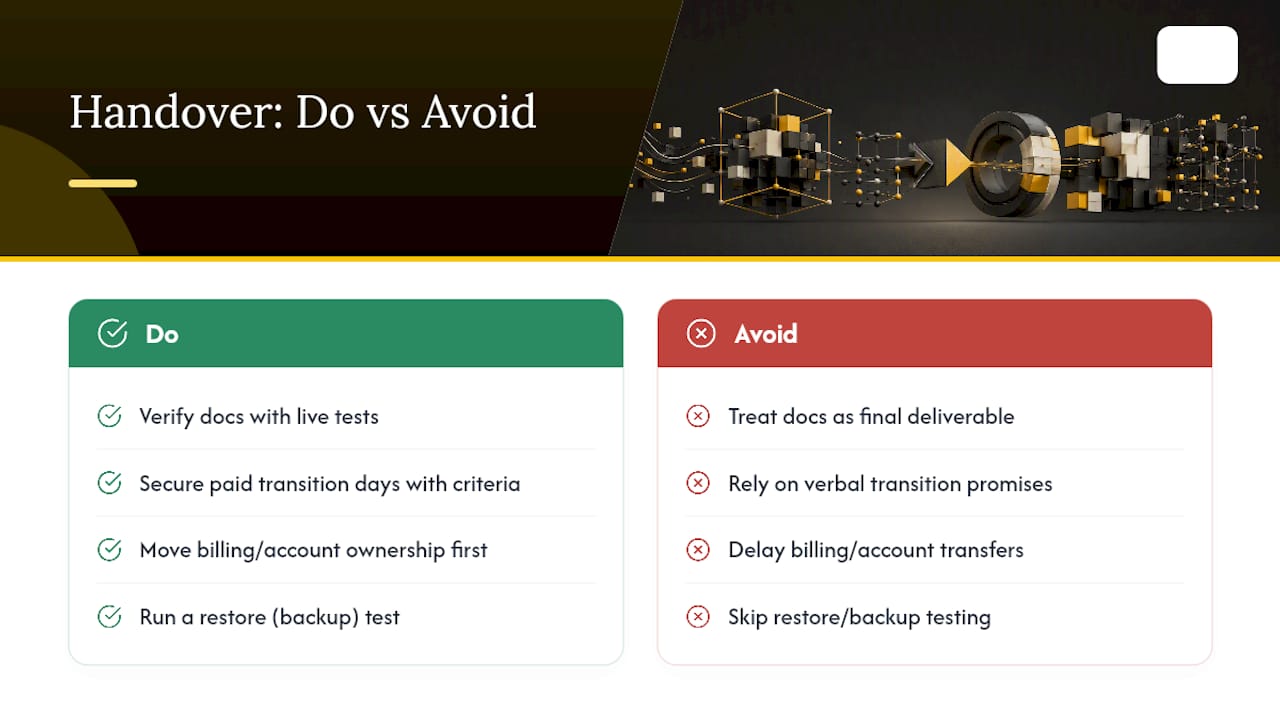
The conventional advice also underweights the contract. A handover checklist with forty perfect line items is worthless if the outgoing vendor's contract never assigned IP rights, or if "transition assistance" was a verbal promise instead of a scoped, paid deliverable. I'd rather see a founder negotiate 15 days of paid senior engineer time with clear acceptance criteria than get handed a beautiful wiki with no legal teeth behind it.
If you're choosing what to prioritize first: get billing and account ownership moved before anything else. A broken deploy pipeline is annoying. A production outage because a former vendor's credit card got declined is a Tuesday you don't get back. After that, the restore test. Everything else on the checklist is real, but those two items are where handovers actually fail in practice.
— Hanad Kubat
If You Need Hands-On Help With a Handover
Hanad Kubat is the alternative to hiring a full agency when a handover has stalled or a rescue is needed: one senior engineer, fixed price, and you own the code from the first commit. If a prototype from Lovable, Bolt, Replit, or a similar tool has hit its ceiling, or an agency handed you code nobody can read, that's rescue and rebuild territory. If you're starting from a Figma file or no code at all, that's a first real version: one core workflow, built properly and handed over.
Every build runs two to four weeks with senior engineer leadership and no surprise invoices. Builds start from €12,000, scoped and frozen at kickoff. Book a call through Hanadkubat to talk through what a handover or rescue would actually take for your project.
Sources
- How to Hand Over a Software Project Without Making Everyone Miserable | EvolRed
- Architecture decision records — documenting your project's decisions
FAQ
What Should Be Included in a Project Handover?
A complete handover includes six workstreams: source code and its history, infrastructure and account access, secrets and credentials, documentation including ADRs, backups with a verified restore, and the contract terms covering IP and transition assistance. Each item needs a pass/fail verification test, not just a checkbox.
What Is Handover in Software Development?
A software project handover is the structured transfer of a codebase, its infrastructure, and operational knowledge from one team to another, verified through testing rather than assumed from documentation. It typically closes with a three-way sign-off between the outgoing lead, the incoming owner, and the project sponsor.
What Are the Different Types of Project Handovers?
Handovers generally fall into a few categories: switching development vendors or agencies, an internal team taking over from a contractor, a founder taking over from a no-code or AI-prototype build, or an acquisition where a buyer inherits an existing codebase. The core checklist stays similar across all of them, though the contract and IP concerns are sharpest in vendor switches and acquisitions.
What Does "Handover Project" Mean?
"Handing over a project" means transferring both the technical assets, code, infrastructure, data, and the operational knowledge needed to run and extend it, to a new owner or team. The goal is that the incoming team can deploy, debug, and extend the system without needing the outgoing team on call.
How Much Does a Handover-Ready Rebuild Cost?
Pricing depends on scope: rescue and rebuild engagements through Hanad Kubat start from €12,000, while a first real version starts from €12,000. Exact scope and pricing get fixed at kickoff after a review of the existing codebase or requirements.