
Use retrieval-augmented generation when your SaaS needs to answer questions with per-customer, up-to-date context: help center bots that know a specific account's history, internal search across a tenant's own documents, runbook lookups tied to real configuration. Skip it for static content, simple CRUD screens, or anything that doesn't change per customer. The rest of this article covers the architecture, tenancy rules, live-data patterns, and evaluation metrics you need once you've decided RAG earns its place.
TL;DR:
- RAG is most effective for SaaS products with tenant-specific, dynamic data, such as support support, internal documentation, or account-aware assistants.
- Implementing a robust RAG pipeline involves five stages: ingest, chunk, embed, retrieve, and generate, with clear testingability for each component.
- To prevent data leaks, tenancy must be enforced at the vector store or query layer, typically using silo or pool patterns based on compliance needs and scale.
- Keeping RAG content current requires event-driven ingestion, re-embedding only changed records, and mixing semantic search with live API calls for transactional data.
- Regular, focused metrics like recall@k, refusal rate, latency, and cost help verify RAG pipeline performance and diagnose common failures such as stale data or ranking issues.
Table of Contents
- Where RAG for SaaS Fits and When to Skip It
- What Happens Inside the RAG Loop?
- What Does a Production RAG Architecture Look Like?
- How Do You Isolate Tenant Data in a Multi-Tenant RAG Setup?
- How Do You Keep RAG Current With Live SaaS Data?
- What Metrics Prove Your RAG Pipeline Actually Works?
- Why Do RAG Pipelines Break in Production?
- What Does a RAG Rollout Actually Look Like Week by Week?
- Why I Keep RAG Stacks Boring
- Ready to Scope Your RAG Feature?
- Selected Resources for Deeper Reading
- Sources
- FAQ
Where RAG for SaaS Fits and When to Skip It
RAG earns its complexity when the answer depends on data that's both current and tenant-specific: a support assistant that needs to reference a customer's actual invoices, a search feature over uploaded documents, an onboarding bot that answers from your changing product docs. It's premature when your data is static, small enough to hardcode, or identical for every user.
Before building, run a cost check. Retrieval infrastructure, embedding pipelines, and evaluation tooling all cost engineering time that a simple FAQ page or a hardcoded lookup table might not need. A useful rule: RAG is primarily an access strategy for tenant-specific, changing knowledge, and if your product doesn't need that, the complexity isn't worth it.
Good starting scenarios:
- Customer support search over a single knowledge base, scoped to one tenant
- Internal runbook or documentation search for a technical product
- Account-aware assistants that answer from a customer's own uploaded files
If none of that describes your product yet, read up on when RAG beats fine-tuning before committing engineering weeks to either.
What Happens Inside the RAG Loop?
Every RAG for SaaS pipeline runs through the same five stages, and building them as visible, testable functions beats hiding them inside a framework you can't debug at 2 a.m. A primer on building RAG from scratch makes exactly this point: opaque frameworks turn debugging into guesswork.
- Ingest: pull documents from their source (files, database rows, API responses) and normalize them into text.
- Chunk: split documents into retrievable pieces, ideally preserving heading structure so a table or list doesn't get cut mid-sentence, per standard content-structuring guidance.
- Embed: convert chunks into vectors, tagged with the embedding model version so you can re-embed cleanly when you upgrade models.
- Retrieve: query the vector store for the top-k candidates, often with a cross-encoder reranker on top.
- Generate: pass retrieved chunks to the model with instructions to cite sources and refuse when nothing relevant surfaced.
That last stage matters more than most teams assume. An abstention threshold, forcing the model to say "I don't have that" instead of guessing, is one of the three fixes that actually matter in production retrieval.
What Does a Production RAG Architecture Look Like?
A RAG for SaaS system that survives real users needs five separate, boring components: an ingestion worker, a vector store paired with a metadata store, a retrieval service, an answer service, and telemetry wired into all four. Each one should be small enough that a new engineer can read it in an afternoon.
Keep the vector store dumb. Push business rules, access filters, and freshness logic into the metadata layer and the retrieval service instead of trying to encode them as embeddings. This split is exactly what production-grade RAG architecture guides recommend: ingestion, index and metadata storage, retrieval, answer generation, and telemetry as five distinct, independently testable layers.
Pro Tip: Log every retrieval call with the query, the retrieved chunk IDs, the model name, the prompt version, latency, and cost. Without that log, you can't reproduce a bad answer six weeks from now.
Minimum fields to log on every request:
- Raw user query and the tenant ID it came from
- Retrieved chunk IDs and their relevance scores
- Model name and prompt version used for generation
- Latency (retrieval and generation, separately) and cost per call
Instrumentation this granular sounds excessive until the first time support asks why the bot told a customer something wrong, and you have nothing to check. Logging prompt version alongside retrieved chunk IDs turns that into a five-minute fix instead of a guessing game, a pattern confirmed by Apptension's production patterns guide.
How Do You Isolate Tenant Data in a Multi-Tenant RAG Setup?
The single most expensive mistake in SaaS RAG isn't a bad chunking strategy. It's one tenant's document showing up in another tenant's answer. Multi-tenant isolation has to happen at the vector store and query layer, not just in application code that a future refactor might accidentally bypass.
Two patterns dominate: silo (a separate index per tenant) and pool (shared index, filtered by metadata). Silo gives you cleaner compliance guarantees and simpler auditing; pool is cheaper to operate at scale but demands airtight metadata filtering on every single query. Choose based on your compliance obligations and the number of tenants you're running, not on which pattern sounds more sophisticated.
- Enforce isolation with JWT-driven access control or fine-grained filters at query time, not just app-level checks
- Mirror source-system ACLs into vector metadata so a document's permissions travel with it
- Write a test that deliberately tries cross-tenant retrieval and confirm it fails
Architecture guides on strict data isolation in multi-tenant RAG pipelines walk through the namespace-versus-per-index tradeoff in more depth. For sensitive or regulated tenants, some teams also look at dedicated deployment options for stronger data sovereignty guarantees.
Pro Tip: A cross-tenant leakage test costs an afternoon to write. A cross-tenant leakage incident costs a customer, and possibly a compliance audit.
If you're still designing the tenancy model itself, multi-tenant SaaS architecture guidance is worth reading before you pick silo or pool.
How Do You Keep RAG Current With Live SaaS Data?
SaaS data changes constantly, and a nightly batch re-embed job means your assistant is answering from yesterday's account state. Event-driven ingestion fixes this: webhooks trigger updates as records change, with a periodic backfill job catching anything the webhooks missed.
- Normalize incoming events into a consistent schema regardless of source, and verify webhook signatures before trusting the payload.
- Re-embed selectively: only the changed record, not the whole tenant's index, using an
is_latestflag so old chunk versions get marked stale instead of deleted outright and causing gaps. - Split reads by field type: index descriptive, slow-changing text (like a support ticket's original description) into the vector store, but fetch transactional fields (account balance, subscription status, ticket state) live from the source API at answer time.
That hybrid pattern, index for semantic search, live API call for anything transactional, is what keeps an agent from confidently telling a customer their invoice is unpaid when it was settled ten minutes ago. It's the core recommendation in guidance on building RAG pipelines for live SaaS data, and it pairs with event-driven ingestion practices that treat polling as a fallback, not the primary sync mechanism. If your product includes agents that take action on this data, read up on the risks of agents acting on stale state before shipping.
What Metrics Prove Your RAG Pipeline Actually Works?
You need a small, fixed set of numbers you check on every deploy, not a vague sense that "the answers seem fine." Track recall@k (did the right chunk show up in your top results), mean reciprocal rank, citation coverage (does the answer actually cite what it retrieved), refusal rate, p95 latency, and cost per answer.
- Build a 30 to 50 query eval set from real user questions before you optimize anything
- Expand to 100 queries once you're iterating on retrieval tuning, not before
- Run the eval set as an automated regression check on every index or prompt change
- Alert on sudden refusal-rate spikes, which usually signal a broken index update
Starting with one source and a small eval set, then measuring regressions as you expand, is more productive than trying to build a comprehensive test suite on day one. This RAG evaluation approach is detailed further in a retrieval evaluation playbook built for exactly this kind of iteration.
Why Do RAG Pipelines Break in Production?
Most RAG failures trace back to five repeat offenders, each with a known fix.
- Bad chunking (tables split mid-row, headings stripped): fix with structure-aware chunking that respects document hierarchy
- Stale or duplicate documents: fix with the
is_latestversioning pattern and scheduled backfill - Wrong access filters: fix by mirroring ACLs into metadata and testing cross-tenant queries
- Prompt injection from untrusted retrieved content: fix by treating retrieved text as data, never as instructions
- Hallucination with no citations: fix with a cross-encoder rejection threshold that forces abstention
Pro Tip: When retrieval returns near-identical scores across your top results, that's usually not a ranking problem. It's a sign you need hybrid search (semantic plus keyword, merged with reciprocal rank fusion) instead of relying on embeddings alone.
A common diagnosis path: support reports a wrong answer, you pull the logged chunk IDs, and you find the retriever grabbed a duplicate document from three versions ago because nobody flagged the old chunk stale. That single missing is_latest field explains a surprising share of "the AI is lying" tickets.

What Does a RAG Rollout Actually Look Like Week by Week?
A working RAG feature doesn't need a quarter. It needs a scoped plan and someone who sticks to it.
- Audit (days 3 to 5): map one data source, one user segment, and the access rules that govern it.
- Build (weeks 2 to 4): ingestion worker, retrieval service, answer service, and telemetry wired in from day one, not bolted on after launch.
- Eval set (parallel to build): 30 to 50 real queries with expected answers, checked before every deploy.
- Staged rollout: one tenant or one segment first, watching refusal rate and latency before wider release.
- Rollback trigger: if citation coverage drops or refusal rate spikes after an index change, roll back the index, not the whole feature.
| Phase | Duration | What "done" looks like |
|---|---|---|
| Audit | 3 to 5 days | Scoped source, tenant model, and access rules documented |
| Build | 2 to 4 weeks | Working feature with logging, one source, one segment |
| Eval and rollout | Ongoing | 30 to 50 query eval set passing, staged tenant release |
Why I Keep RAG Stacks Boring
I've spent ten years writing production systems, including work for organizations like Deutsche Bahn and BMW, where "the demo worked" was never the finish line. RAG projects fail for the same reason prototypes stall at 70%: someone chose a clever framework instead of five visible stages they could debug.
I build RAG features the same way I build everything else: TypeScript, Next.js, Node, boring and well-documented, so the next engineer who touches it doesn't need me to explain it. Fixed price, fixed scope, code ownership from the first commit. If your use case doesn't need RAG yet, I'll tell you that instead of selling you a pipeline you don't need.
— Hanad Kubat
Ready to Scope Your RAG Feature?
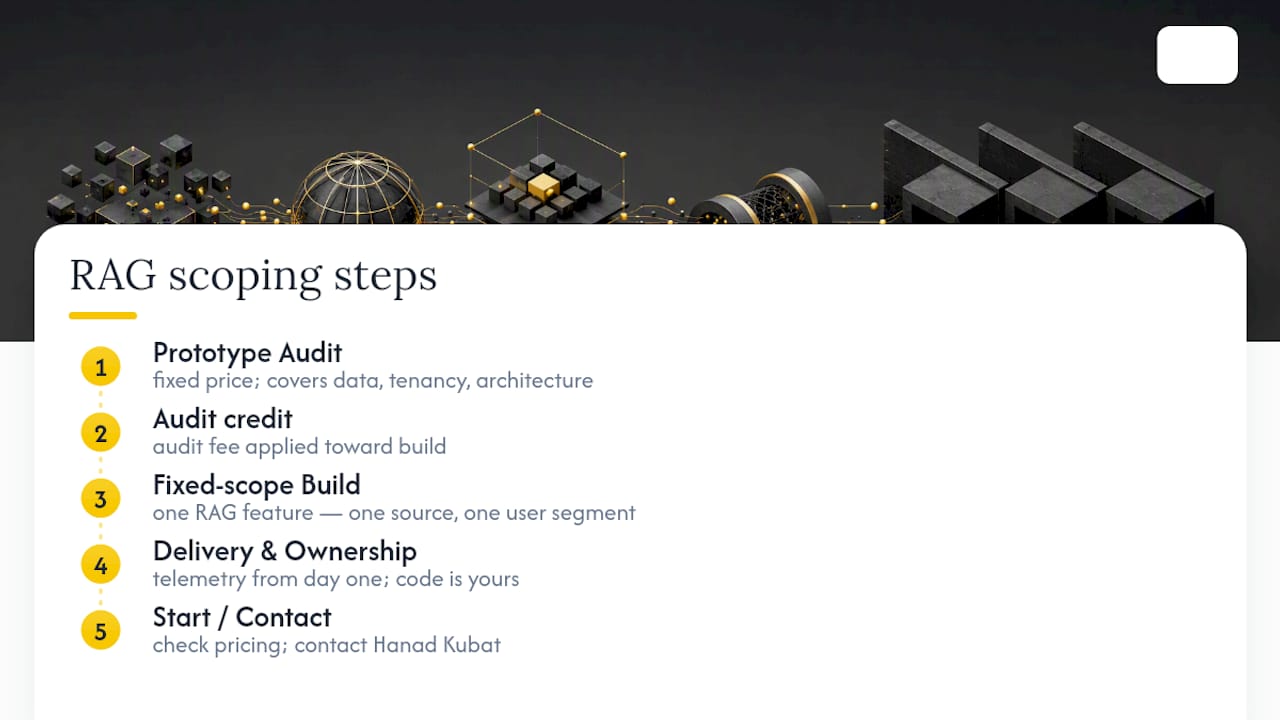
If you're weighing a full RAG build against duct-taping a chatbot API to your docs, there's a middle path: a fixed-scope audit that tells you exactly what you need before you commit to either. The Prototype Audit runs a fixed price and covers your data sources, tenancy model, and a realistic architecture plan, credited against the build if you move forward.
From there, a fixed-scope build gets you one working RAG feature: one source, one user segment, telemetry from day one, delivered in weeks with no surprise invoices and every line written by an experienced engineer. You own the code from the first commit, which means the next developer you hire (or the next investor's due-diligence engineer) can actually read it.
Check current pricing and start with Hanad Kubat.
Selected Resources for Deeper Reading
For architecture patterns, read the production-grade RAG guide. For live-data ingestion, see Unified. For a working example, browse the RAG-SaaS boilerplate on GitHub.
Sources
- RAG for SaaS: Add Retrieval Augmented Generation to a Boilerplate App (Apptension)
- Unified
- Building a RAG Pipeline From Scratch: The Three Fixes That Actually Matter (Bitan Sarkar)
FAQ
Is ChatGPT a RAG Model?
No. ChatGPT is a large language model that generates text from what it learned during training. RAG is a technique you add on top of a model like it, retrieving your own documents at query time so the model answers with current, specific context it wasn't trained on.
Is RAG Still Relevant in 2026?
Yes, especially for SaaS products with tenant-specific or frequently changing data. RAG remains one of the most reliable ways to give a model accurate, sourced answers without retraining it every time your data changes.
Which AI Tool Is Best for SaaS?
There's no single best tool since it depends on your data, tenancy model, and whether your fields are static or transactional. For teams building a scoped, production-ready RAG feature without maintaining an in-house AI team, Hanad Kubat offers a fixed-scope build after a short paid audit.
What Is Replacing SaaS?
Nothing is replacing SaaS outright. What's changing is how much of a SaaS product's interface gets mediated by an AI layer, like a RAG-powered assistant, sitting on top of the same underlying data and workflows.
How Do I Know If My SaaS Actually Needs RAG?
Check whether your answers depend on data that's both tenant-specific and changing. If your content is static or identical across every customer, a simpler search or hardcoded FAQ will outperform a RAG pipeline on cost and reliability.