
For most SaaS products, the right answer is a hybrid tenancy model: pool by default, silo when a customer or regulation demands it. That single decision, made early, costs almost nothing. Made late, after a schema is locked and customers are live, it's one of the most expensive rewrites in software. The rest of this guide covers the models, the database patterns, the security layers, and a checklist you can use before you write a line of tenant-aware code.
TL;DR:
- Most SaaS systems should start with a pooled tenancy model and only switch to siloed or hybrid models if specific regulatory, performance, or contractual needs arise.
- Database partitioning should be chosen based on tenant isolation requirements, with shared schema, separate schema, or separate database options, knowing switching later is costly.
- Tenant identity must be securely propagated through signed claims and logged at every request; relying on header-based methods risks data leaks.
- Combining application-level filtering with database row security offers the strongest tenant data isolation, especially for regulated or sensitive data.
- Deploying dedicated stacks, either per tenant or group, is justified only for tenants with high compliance or load demands, otherwise shared compute remains cheaper and simpler.
Table of Contents
- What Is Multi-Tenant SaaS Architecture?
- Pool, Silo, or Bridge: Which Tenancy Model Fits?
- How Should You Partition Tenant Data?
- How Do You Track Tenant Identity Across the Stack?
- App Checks or Database Controls: What Actually Isolates Tenants?
- Should You Use Deployment Stamps for Multi-Tenant Scaling?
- How Do You Prevent Noisy Neighbors and Control Costs?
- Why Is Changing Tenancy Models So Risky?
- Decision Checklist: Which Tenancy Model Should You Choose?
- What I Fix First in a Rescue or MVP Build
- Performance Optimization for Multi-Tenant Systems
- Backup and Disaster Recovery With Tenant Isolation in Mind
- Compliance in Multi-Tenant Environments: GDPR, HIPAA, and Beyond
- How Should Tenant Onboarding and Offboarding Work?
- Customizing Tenant Features Without Breaking the Architecture
- An Honest Take on Multi-Tenant SaaS Architecture
- Sources
- FAQ
What Is Multi-Tenant SaaS Architecture?
A tenant is a customer, or a customer's organization, that uses your software with its own data, users, and configuration. Tenancy is the strategy you use to keep those tenants separate while running on shared infrastructure. Multi-tenant SaaS architecture is the pattern where one codebase and one deployment serve many tenants at once, instead of standing up a separate copy of the application for each customer.
SaaS itself is a business model: software delivered as a subscription, hosted by the vendor, accessed over the internet. Multitenancy is an implementation choice inside that model, not a requirement of it. You can run a SaaS business on single-tenant infrastructure (some enterprise vendors do exactly that), and you can run multi-tenant infrastructure for something that isn't SaaS at all. Azure's architecture guidance makes this distinction directly: multitenancy doesn't mean every component is shared.
That matters because you don't have to make one binary choice for the whole system. You can share:
- The application runtime and compute layer, while keeping data logically separated
- The database engine, while giving high-value tenants their own schema or instance
- The authentication layer entirely, even when everything downstream is siloed
Multitenancy fits best in B2B SaaS with many small-to-mid customers, and in platform products where thousands of tenants need to onboard without a human provisioning each one. A B2C product with millions of individual users is a different shape of problem: the "tenant" is often the whole platform, not each user.
Pool, Silo, or Bridge: Which Tenancy Model Fits?
Three models cover almost every real system, and the trade-offs are consistent enough to name specific signals for each.
- Pool. All tenants share the same application instance and often the same database. This is the cheapest model to run and the fastest to scale horizontally, because you're managing one fleet, not thousands. It's the right starting point for early-stage SaaS with low-to-medium compliance requirements and a customer base that looks similar across accounts.
- Silo. Each tenant gets a dedicated instance, dedicated database, or both. Silos cost more per tenant and add operational overhead (more things to patch, monitor, and back up), but they buy you strict data isolation, predictable performance for that tenant, and a clean story for auditors. Enterprise contracts with data residency clauses or strict SLAs often force this.
- Bridge (hybrid). Most of your tenants run pooled. A smaller set of high-value or regulated tenants run siloed, on the same codebase. Microsoft's multitenant architecture guidance frames this as the common real-world pattern: decompose services by isolation need instead of picking one model for the entire product.
The signals that push you toward a silo, even inside a hybrid system, are specific: a regulatory requirement that data physically reside in one region, a single tenant whose load pattern would degrade everyone else sharing the pool, or a contract that explicitly promises dedicated infrastructure. Absent those, pool first and keep the door open.
How Should You Partition Tenant Data?
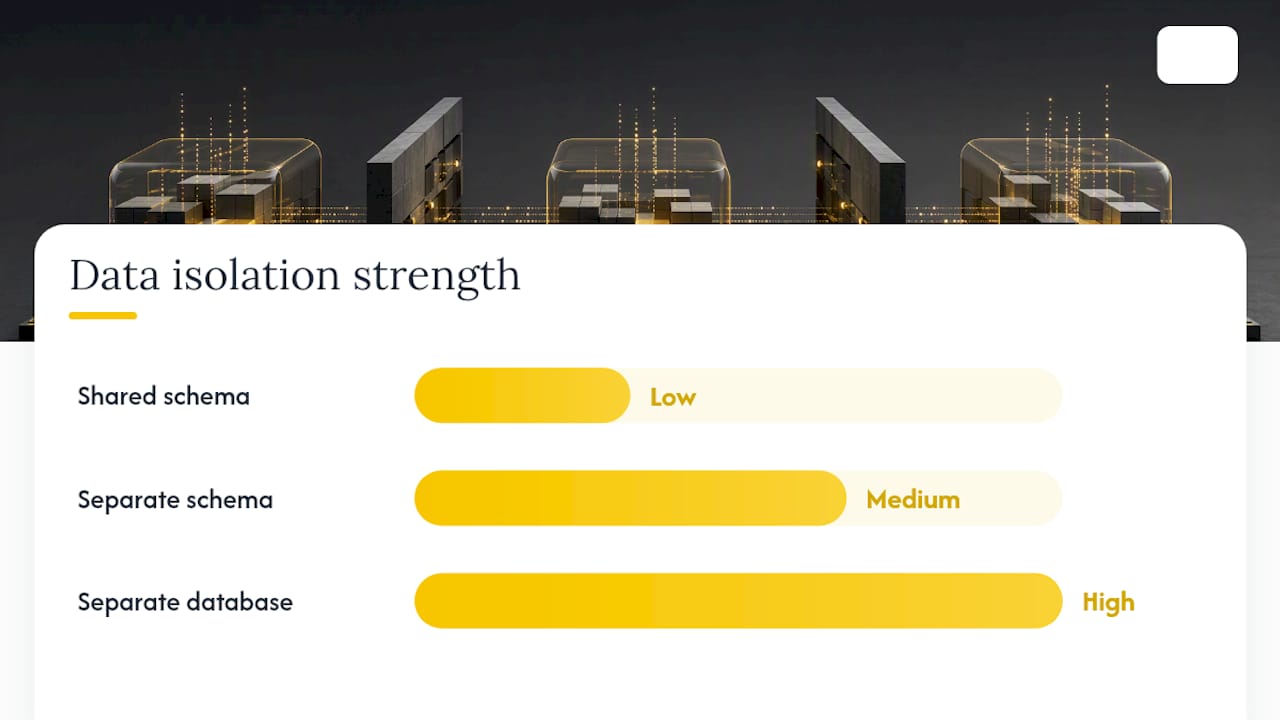
Database tenancy has three well-established shapes, and Azure SQL's tenancy pattern documentation lays them out clearly: shared schema, separate schema, and separate database per tenant.
- Shared schema. Every tenant's rows live in the same tables, distinguished by a
tenant_idcolumn. Cheapest to run, simplest to migrate schema changes across, but it puts the full weight of isolation on your application code and query discipline. - Separate schema, same database. Each tenant gets its own schema inside a shared database instance. You get cleaner logical separation and easier per-tenant backup and restore, at the cost of schema-migration tooling that now has to run against N schemas instead of one.
- Separate database per tenant. Maximum isolation, easiest compliance story, and the most operational overhead: more connections to manage, more instances to patch, more cost per tenant unless you use elastic pools to share compute across many small tenant databases.
Sharding sits alongside these choices when tenant count gets large. A sharded setup needs a catalog that tracks which shard holds which tenant, plus split and merge procedures for when a shard gets too full or a tenant outgrows its shard. That catalog is infrastructure you'll be glad you built early, because retrofitting it under load is painful.
The database pattern you choose also decides your backup granularity, your restore blast radius, and whether you can promise a regulator that one tenant's data never physically leaves a specific region. Switching between these models after launch is, according to Microsoft's own guidance, often cost-prohibitive and technically complex once real customer data and integrations depend on the current shape.
How Do You Track Tenant Identity Across the Stack?
Every request, job, and background process needs to know which tenant it belongs to, reliably, from the first line of code to the last. The cleanest place to carry that is a signed claim in the auth token: a tenant_id in the JWT payload, set once at login by a centralized identity provider, and never trusted from a client-supplied header or query parameter.
Centralizing this in your IAM layer pays off fast. Instead of every service reimplementing "which tenant is this," they all read the same signed claim and reject anything that doesn't have one.
- Sign the tenant claim server-side; never let a client set or override it.
- Propagate the claim through internal service calls, not just the initial API request.
- Attach tenant context to background jobs and queue messages explicitly. A retried job that loses its tenant context is a silent data-leak risk, not just a bug.
- Log tenant_id on every request at the edge (API gateway or reverse proxy), so cost and latency are attributable without forensic work later.
Third-party integrations are the edge case people forget. A webhook coming back from Stripe or an OAuth callback doesn't carry your internal tenant claim. You have to map it back to a tenant using whatever identifier you passed out when you registered the integration.
Pro Tip: Store the tenant_id at the source, in your API gateway or database proxy logs, rather than reconstructing it later from application logs. It's the difference between a five-minute cost investigation and a half-day one.
App Checks or Database Controls: What Actually Isolates Tenants?
Neither layer alone is enough. AWS's architecture guidance on multi-tenant SaaS systems is direct about this: tenant isolation has to be enforced across the stack, and database-level isolation acts as a critical second line of defense when an application-level check inevitably has a bug.
Application-level filtering means every query includes a WHERE tenant_id = ? clause, enforced by an ORM layer or a query builder that makes it hard to forget. It's fast to build and easy for a new engineer to reason about. It also means one missed WHERE clause in one endpoint is a data leak across every tenant.
Row-Level Security, available in PostgreSQL, moves that enforcement into the database itself: a policy scopes every query to the current tenant regardless of what the application code does. PostgreSQL's own documentation on row security policies confirms RLS enforces per-row access at the database layer, independent of application logic. It's genuinely strong protection, and it adds real runtime overhead and a new category of bug: a misconfigured policy that silently returns zero rows instead of throwing an error.
- Combine both layers for anything handling regulated or high-value tenant data. RLS is a backstop, not a replacement for correct application logic.
- For early-stage products without compliance pressure, a disciplined application filter, paired with automated tests, is often the more maintainable starting point.
- Write isolation tests that actively try to read another tenant's data with a valid session for tenant A. If that test doesn't exist, you don't actually know your isolation works.
For a hands-on walkthrough of setting this up correctly, I wrote a practical guide to Postgres Row-Level Security for exactly this kind of implementation.
Should You Use Deployment Stamps for Multi-Tenant Scaling?
Deployment stamps, a full copy of the application stack deployed per tenant or per tenant group, are worth the operational cost only when a tenant genuinely needs its own blast radius: a regulated customer, a huge tenant whose load would otherwise dominate a shared pool, or a contractual promise of dedicated infrastructure. Otherwise, a shared runtime serving many tenants from one fleet is cheaper to operate and easier to reason about.
- Shared runtime for the majority. Most tenants run on shared compute, whether that's containers behind a load balancer or a serverless function fleet. This is where the bulk of your automation investment should go.
- Stamps for the minority that need them. Azure's multitenant architecture guidance recommends deployment stamps specifically as a scaling and isolation tool for that smaller, higher-need tenant segment, not as the default for everyone.
- Automate the stamp, don't hand-roll it. Infrastructure-as-code (Terraform, Pulumi, or your cloud's native IaC) turns "spin up a new tenant's dedicated stack" into a repeatable pipeline run, not a checklist a human follows at 11 p.m.
Containers give you more control over resource limits per tenant group and are easier to run on your own terms. Serverless gives you near-zero idle cost for low-traffic tenants, at the price of cold-start latency and less predictable per-tenant cost attribution. Most hybrid systems end up running both: containers for the pooled majority, and either containers or serverless for the siloed stamps, depending on that tenant's traffic pattern.
How Do You Prevent Noisy Neighbors and Control Costs?
A pooled system lives or dies on whether one tenant's traffic spike can degrade service for everyone else. The fix starts with visibility: you need tenant-aware metrics, not just system-wide dashboards, and AWS's Well-Architected SaaS Lens lists tenant-level metering and tenant tiers as core requirements, not optional extras.
- Track per-tenant CPU, request latency, and database query time, attributed at the source, in the API gateway or the database proxy, rather than reconstructed after the fact.
- Set throttles and quotas per tenant tier, so a free-tier tenant's traffic spike can't degrade a paying enterprise tenant's experience.
- Offer tiered quality-of-service: pooled by default, with a documented threshold at which a tenant gets moved to a dedicated silo.
- Model cost per tenant explicitly. A pooled tenant costs a fraction of a dollar in shared compute; a siloed tenant carries the full weight of its own instance, patching, and monitoring.
When a pooled tenant consistently trips your quotas, that's your signal to move them to a silo, not to raise the quota for everyone else.
Why Is Changing Tenancy Models So Risky?
Migrating a live tenant from shared schema to a dedicated database, or from pooled infrastructure to a silo, means moving real customer data without downtime while every foreign key, index, and background job still has to find it. Most migration failures trace back to the same root cause: tenant logic that got hard-coded somewhere nobody remembered, plus a catalog that was never built to handle the move.
- Build a tenant catalog before you need one. A single source of truth for "which tenant lives where" turns a migration from a forensic exercise into a lookup.
- Keep application code tenancy-agnostic. If your code doesn't know or care whether a tenant is pooled or siloed, you can move a tenant between them without touching application logic at all.
- Write cutover automation and test it in staging first. A migration script that's never been run against a realistic staging copy of tenant data is a script you're testing on a live customer.
Pro Tip: Build a replay harness that can run a tenant's migration against a staging copy before you touch production. It catches the schema edge cases that only show up with real data, not synthetic test rows.
Decision Checklist: Which Tenancy Model Should You Choose?
Three questions settle most of this before you write code: What's your customer profile, mostly small self-serve accounts or a handful of enterprise contracts? What does peak load look like, evenly spread or dominated by a few large tenants? And does any tenant carry a compliance requirement, GDPR, HIPAA, or a data-residency clause, that a shared pool can't satisfy?
- If most tenants are self-serve and similar in size, start pooled and add silos only for exceptions.
- If a handful of tenants are large enough to affect shared performance, isolate those specific tenants, not the whole system.
- If any tenant has a hard compliance requirement, that tenant goes in a silo regardless of what the rest of your base needs.
| Signal | Recommended default | Exception trigger |
|---|---|---|
| Customer profile | Pool (shared schema/runtime) | Enterprise contract requires dedicated infra |
| Peak load pattern | Pool with quotas | One tenant dominates shared resources |
| Compliance requirement | Pool | GDPR residency clause or HIPAA scope forces silo |
| Growth stage | Bridge/hybrid from day one | Rarely: pure silo for a single regulated customer at launch |
Bridge/hybrid is the right default for nearly everyone reading this. Pure pool works only if you're confident no tenant will ever need isolation; pure silo works only if every tenant already does.
What I Fix First in a Rescue or MVP Build
Three patterns show up constantly: tenant IDs hard-coded into route logic instead of pulled from a signed claim, zero tenant-level telemetry so nobody can say what one customer costs, and RLS bolted on without the application tests to confirm it actually blocks cross-tenant reads. On a TypeScript, Next.js, Node, and Postgres stack, I default to application-level filtering plus tests, and reach for RLS only once a tenant's contract demands it. More on planning this from the start in my guide to planning SaaS architecture.
Performance Optimization for Multi-Tenant Systems
Performance problems in multi-tenant systems rarely look like a slow query in isolation. They look like one tenant's report job locking a table that fifty other tenants are trying to read from at the same time. That's the core difference from single-tenant performance work: you're not just optimizing a query, you're bounding its blast radius.
Connection pooling is the first lever. A shared-schema system with thousands of tenants can't open a database connection per tenant per request; you need a pooler like PgBouncer sitting between your application and Postgres, and you need to size that pool against your actual concurrent tenant count, not your total tenant count.
Indexing strategy changes shape too. Every index on a shared table needs tenant_id as its leading column, or the database ends up scanning across tenants to satisfy a query that should only ever touch one. Composite indexes on (tenant_id, created_at) or (tenant_id, status) are the pattern you'll write over and over.
Caching needs a tenant-aware key. A cache key of user_profile:123 is a data leak waiting to happen the moment two tenants both have a user with ID 123. Every cache key, every queue message, every background job payload needs the tenant identifier baked in, not assumed from context.
For siloed tenants, performance isolation is almost free: one tenant's slow query only affects that tenant. For pooled tenants, it takes active work: query timeouts, statement-level resource limits where your database supports them, and the quotas already covered in the operations section above.
Backup and Disaster Recovery With Tenant Isolation in Mind
Your backup strategy has to match your data partitioning choice, or you'll discover the mismatch during an actual incident, which is the worst possible time. A shared-schema database backs up and restores as one unit: every tenant is in the same backup file, and a restore brings back every tenant's data at once. That's fine for a full-database disaster, and useless if one tenant asks you to restore their data to a point three days ago without touching anyone else's.
Separate-schema and separate-database patterns give you per-tenant backup and restore as a natural consequence of the isolation you already built for other reasons. If a single enterprise tenant needs a point-in-time restore, or needs proof that their backup is stored in a specific region for a data-residency clause, siloed tenants make that trivial to satisfy and pooled tenants make it require custom tooling.
For pooled tenants, the practical middle ground is logical, tenant-scoped exports: a scheduled job that extracts one tenant's rows into a separate archive, on top of your regular full-database backup. It's more storage and more job scheduling overhead, but it means "restore just this tenant" is possible without restoring everyone.
Disaster recovery planning needs the same tenant-level lens. Your recovery time objective and recovery point objective might reasonably differ by tenant tier: a free-tier pooled tenant can tolerate a longer recovery window than an enterprise tenant with an SLA. Build that tiering into your DR runbook explicitly, rather than promising the same recovery time to every tenant and hoping you never have to test it against your largest customer's data volume during an actual outage.
Compliance in Multi-Tenant Environments: GDPR, HIPAA, and Beyond
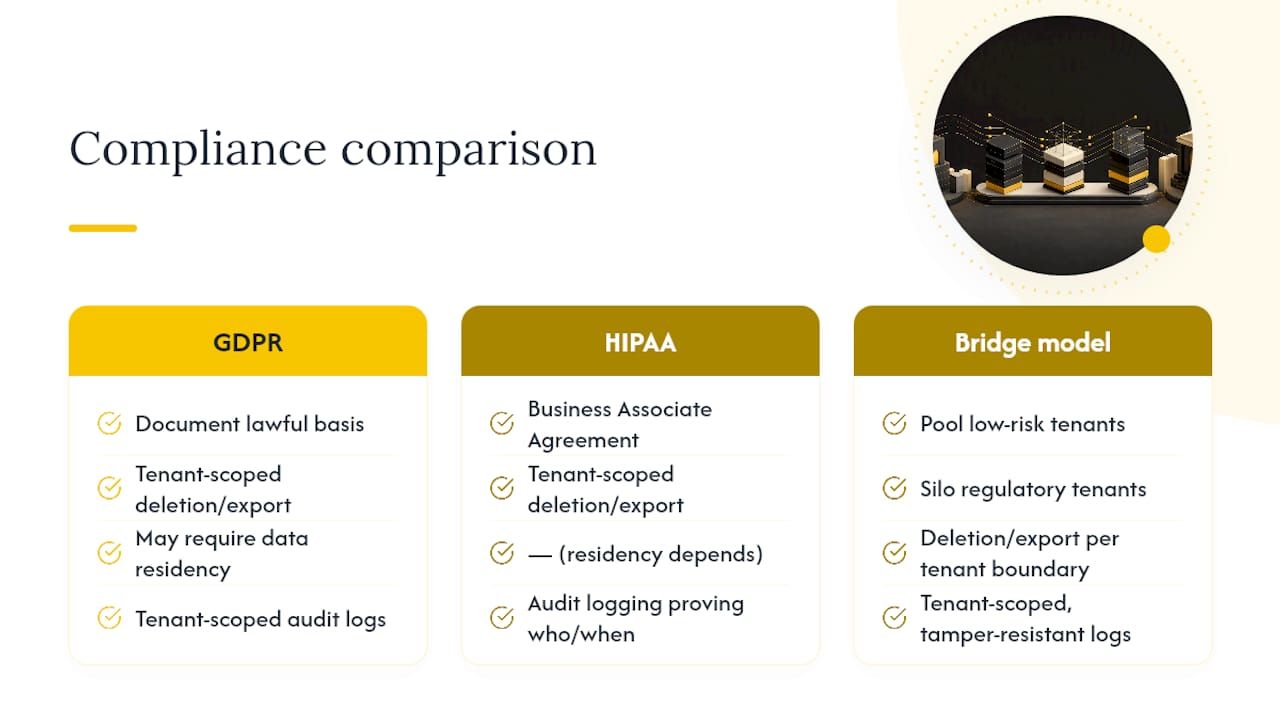
Compliance requirements don't apply uniformly across your tenant base, and treating them as if they do is where most multi-tenant systems get into trouble. A tenant subject to GDPR needs a documented lawful basis for processing, the ability to fulfill a data-subject deletion request without touching other tenants' data, and, depending on the tenant's own commitments to their customers, a guarantee about where in the world that data physically sits. A tenant subject to HIPAA needs a Business Associate Agreement in place and audit logging that can prove who accessed what patient data, and when.
Both of these are far easier to satisfy in a siloed or separate-schema model than in a shared schema, because deletion and export requests naturally scope to one tenant's data boundary instead of requiring a filtered query across a shared table that has to get every clause right, every time. This is one of the strongest concrete arguments for the bridge model: pool your low-risk tenants, and silo the ones carrying regulatory weight, rather than building your entire compliance posture around the lowest common denominator.
Audit logging deserves its own line item regardless of which model you pick. Every access to tenant data, who, when, what record, needs to be logged in a way that's itself tenant-scoped and tamper-resistant. That log is what you hand an auditor or a due-diligence reviewer, and it's exactly the kind of thing that's painful to retrofit after a compliance review flags its absence.
None of this is legal advice, and GDPR and HIPAA obligations depend heavily on your specific data flows and jurisdiction. Treat this as an architecture starting point, and confirm the specifics with counsel who knows your tenant base.
How Should Tenant Onboarding and Offboarding Work?
Onboarding a new tenant should be a repeatable, mostly automated flow: provision the tenant record, assign a tenant_id, create whatever database partition your model calls for (a new schema, a new database, or just a new row scope), set default quotas and tier, and issue the first admin user's credentials through your centralized IAM. If any step in that flow requires a human to manually run a script, that's the step that will eventually get skipped or done wrong under time pressure.
Offboarding gets less attention and causes more damage when it's neglected. A tenant that cancels needs a defined data retention window, clear in your terms of service, after which their data is actually deleted, not just marked inactive in a status column. For a pooled tenant, that deletion has to be surgical: every row across every table that carries their tenant_id, with foreign key cascades verified to actually cascade rather than orphaning records. For a siloed tenant, offboarding is closer to decommissioning: drop the schema or database, deprovision the infrastructure, and confirm the backup retention policy for that tenant's data separately.
The gap most systems have is the middle state: a tenant that's canceled but still inside the retention window. That tenant shouldn't be billed, shouldn't appear in active-tenant metrics, and shouldn't be reachable by other tenants' data queries, but their data still has to exist for compliance or win-back purposes. Building that state explicitly into your tenant lifecycle, rather than improvising it the first time a customer cancels, saves a genuinely painful debugging session later.
Customizing Tenant Features Without Breaking the Architecture
Every growing SaaS product eventually hits the same request: a tenant, usually your biggest one, wants a feature or a workflow tweak that doesn't apply to anyone else. Handle enough of these with tenant-specific if statements scattered through your codebase, and you've quietly turned a multi-tenant product into dozens of forked single-tenant products that happen to share a repository.
The more durable approach is metadata-driven customization: store what varies by tenant, feature flags, workflow steps, field visibility, as data, not as code branches. Salesforce's platform architecture is the clearest large-scale example of this pattern: a shared kernel handles the actual logic, and tenant-specific behavior lives in metadata the kernel reads at runtime, so customization doesn't require touching the physical schema per tenant.
For a smaller product, this doesn't need Salesforce's scale to be worth doing. A tenant_settings table with typed configuration keys, a feature-flag service scoped by tenant_id, and a plugin or hook architecture for the handful of workflow steps that genuinely need to branch, that's enough to keep 90 percent of "can we customize this for one customer" requests out of your core codebase entirely.
The discipline that makes this hold up over time is refusing the shortcut. When a tenant asks for a one-off change, the question isn't "can we hard-code this for them," it's "does this belong in tenant metadata, or is it actually a feature the whole product needs." Answer that wrong a few dozen times and the metadata layer itself becomes as tangled as the code branches it was meant to replace.
An Honest Take on Multi-Tenant SaaS Architecture
The conventional advice on this topic treats tenancy model as a one-time architectural decision, something you settle in a design doc before writing code and never revisit. That's backwards. The research on migration difficulty is consistent: switching models after launch is expensive precisely because most teams design as if they'll never need to switch. The teams that don't get burned are the ones who assumed from day one that some tenants would eventually need to move, and built a catalog and tenant-agnostic application code to make that possible.
What's overrated is Row-Level Security as a default. It's a genuinely good tool, and I reach for it when a contract or a regulation demands database-level proof of isolation. For most early-stage products, a disciplined application filter with real tests catches the same bugs with less operational overhead. RLS earns its complexity later, not on day one.
What I'd prioritize first, if I were building this today: a tenant catalog, tenant-scoped telemetry from the first API gateway log line, and application code that genuinely doesn't care whether a tenant is pooled or siloed. Everything else, the specific database pattern, the specific isolation control, is a decision you can defer. That one isn't.
— Hanad Kubat
Sources
- Let’s Architect! Building multi-tenant SaaS systems — AWS Architecture Blog
- Row Security Policies — PostgreSQL documentation
- Architectural approaches for a multitenant solution — Microsoft Learn
FAQ
What Is a Multi-Tenant SaaS Architecture?
It's an architecture where a single application instance and, typically, shared infrastructure serve multiple customers (tenants), with each tenant's data and configuration kept logically separate rather than run on entirely dedicated systems.
What Is a Multi-Tenant Architecture, in General?
Outside SaaS specifically, multi-tenant architecture is any system design where one set of infrastructure or software serves multiple distinct customers or organizations, each isolated from the others despite sharing the underlying resources.
What Are the Key Differences Between Single-Tenant and Multi-Tenant SaaS?
Single-tenant SaaS gives each customer a dedicated instance and often a dedicated database, which maximizes isolation and customization at a higher per-customer infrastructure cost. Multi-tenant SaaS shares infrastructure across many customers, which lowers cost and simplifies operations, but requires deliberate isolation controls, application-level, database-level, or both, to keep tenant data separate.
How Do You Build a Multi-Tenant SaaS Product?
Start by defining your tenant identifier and propagating it as a signed claim through your identity layer, choose a database partitioning pattern (shared schema, separate schema, or separate database), add layered isolation checks at the application and, where needed, database level, and build tenant-aware telemetry before you have real customers, not after.
When Should You Choose a Silo Instead of a Shared Pool?
Choose a silo when a specific tenant carries a compliance requirement your shared pool can't satisfy, when a tenant's load would degrade performance for everyone else, or when a contract explicitly requires dedicated infrastructure. Otherwise, pooling with a hybrid path to silo later is the more efficient default.