

AI agents in SaaS are shifting value away from the interface and toward execution and data ownership, and that shift is already pressuring seat-based pricing. Systems of record that own the underlying data stay defensible. Workflow tools that just sit between other systems are the most exposed. The immediate priority for any CTO is an honest agent inventory, clear data ownership, and a small, reversible pilot before committing to a rebuild.
TL;DR:
- Most AI agents in SaaS today automate cross-system, repeatable tasks that rely on proprietary data, making them harder to replace than simple workflow tools.
- Adoption of agent-based and usage-driven pricing models will significantly disrupt traditional seat-based SaaS revenue, with projections indicating at least 40% of enterprise SaaS spend shifting by 2030.
- Embedding agents via chat panels or headless control planes is safest initially, while external orchestration layers pose the highest risk due to limited control over agent actions.
- Proper governance includes unique identity tokens, scoped access, cost controls, and immutable audit logs, which are critical to prevent security issues and uncontrolled spending.
- Starting small with reversible pilots and strict safety gates reduces risk, while scaling governance before expansion ensures a smooth and secure transition to wider agent adoption.
Table of Contents
- What AI Agents Do for SaaS Right Now
- How AI Agents Change SaaS Business Models and Pricing
- Integration Patterns for Adding Agents to a SaaS Product
- Governance, Security, and Observability Checklist for Agentic SaaS
- A CTO's Adoption Roadmap for Scaling Agents
- What I've Built and How I Approach Agentic Features
- Perspective: Where Vendors and CTOs Get It Wrong
- How I Can Help: Fixed-Price Prototype Audit and Agent Integration
- Sources
- FAQ
What AI Agents Do for SaaS Right Now
Most agent deployments inside SaaS products fall into a handful of proven categories. None of them are speculative anymore. They're running in production today, quietly doing work that used to require a human clicking through five screens.
The pattern that shows up most often is autonomous orchestration: an agent that reads a support ticket, checks account status in the billing system, pulls context from a knowledge base, and drafts or sends a resolution without a human touching three separate tabs. That's not a chatbot bolted onto a help center. It's a process that used to take a support rep four minutes now taking the agent twenty seconds, with a human reviewing only the edge cases.
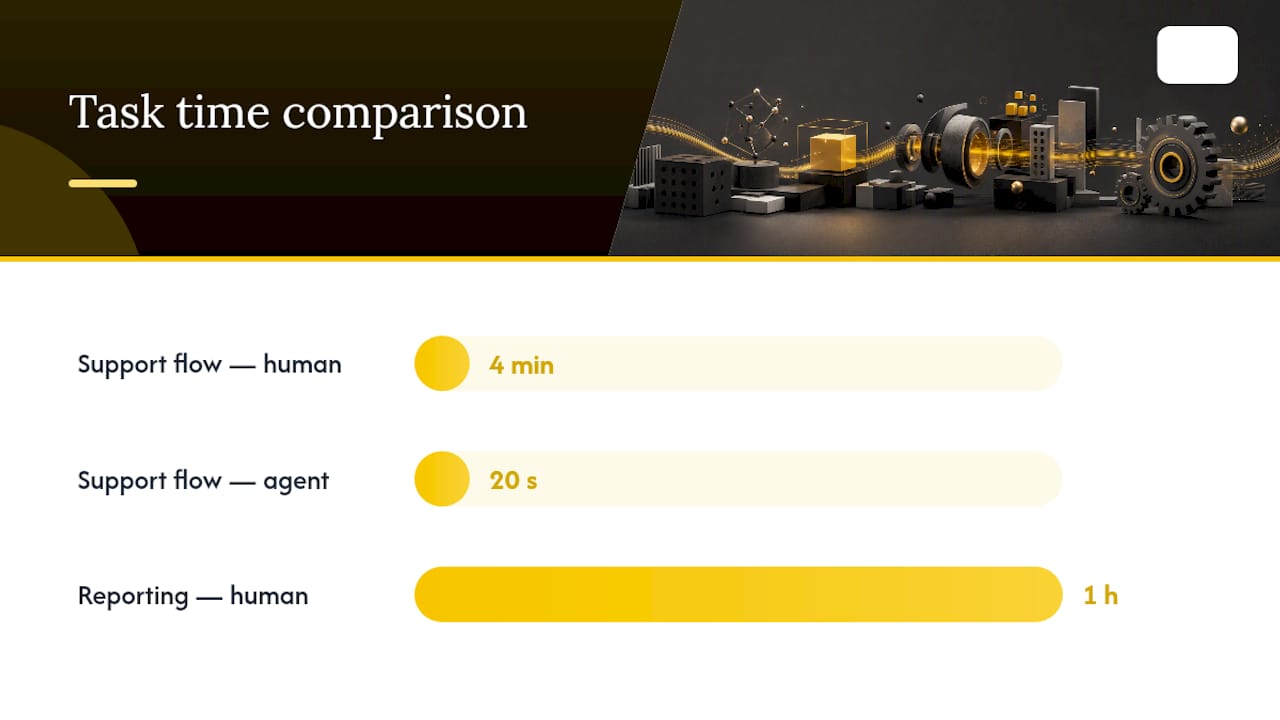
A second pattern is proactive onboarding. Instead of a static checklist, an agent watches usage signals and nudges a new account toward the feature that predicts retention, or flags a setup step the user skipped. A third is automated research and reporting: agents that pull data from a CRM, a support tool, and a product analytics platform, then produce a summary a human would otherwise spend an hour assembling manually.
Here's where I'd focus first if I were prioritizing:
- Repeatable, cross-system tasks that touch three or more tools, because that's where humans are currently the integration layer.
- High-volume support flows with a narrow set of intents, since agents get reliable fast when the input space is constrained.
- Internal reporting that currently means someone exporting three CSVs and building a slide.
- Scheduling and coordination tasks with clear rules, where "figure out the right time" is really just constraint satisfaction.
The common thread in the ones that survive contact with real usage: they're grounded in data the SaaS product already owns. An agent that only wraps a generic language model with a nice prompt is replaceable by any competitor with API access. An agent that reasons over your customer's actual usage history, your specific pricing rules, and your own support taxonomy is a lot harder to copy, because the value sits in the data, not the wrapper.
How AI Agents Change SaaS Business Models and Pricing
Seat-based pricing was built on a simple assumption: a human logs in, does work, and the number of humans roughly tracks the value delivered. Agents break that assumption directly. When an agent handles the ticket, drafts the report, or runs the reconciliation, there's no seat to bill. Charging per user stops correlating with the value the software is producing, and customers notice the mismatch fast.
Deloitte projects that at least 40% of enterprise SaaS spend could shift to usage, agent, or outcome-based pricing models by 2030. That's not a niche experiment. It's a structural rewrite of how software gets billed, and it's coming from the buyer side as much as the vendor side, since procurement teams are already asking why they're paying per seat for something a machine does unattended.
The alternatives being tested right now break into a few clear categories:
- Usage-based pricing: billed on tokens, API calls, or actions taken, which requires real-time metering infrastructure most SaaS billing stacks weren't built for.
- Agent-based pricing: a flat or tiered fee per deployed agent, regardless of how many humans touch it, which shifts the sales conversation from headcount to workflows automated.
- Outcome-based pricing: billed on resolved tickets, closed deals, or hours saved, which sounds attractive to buyers but demands a rock-solid way to attribute outcomes when three agents and two humans touched the same deal.
Each model asks engineering and finance to solve a problem they've mostly ignored: metering has to become granular and near real time, and it has to hold up when a customer disputes an invoice. Multi-agent attribution is the harder problem. If an onboarding agent, a support agent, and a human account manager all contributed to a renewal, deciding what to bill and to whom takes real instrumentation, not a spreadsheet at quarter end. For a broader look at how these models play out in contracts, see this breakdown of revenue model examples for SaaS.
Integration Patterns for Adding Agents to a SaaS Product
There are three broad ways to put an agent inside an existing SaaS product, and picking the wrong one is the single most common architecture mistake I see.
- Embedded conversational UI. The agent lives inside your product as a chat panel, reading and writing through your existing APIs. This is the fastest to ship and the easiest to constrain, because the agent's blast radius is limited to what your UI already exposes.
- Headless agent control plane. The agent runs as a background service, triggered by events rather than a chat window, and calls internal services directly. This fits automation-heavy use cases like reconciliation or proactive alerts, where there's no human waiting on a reply.
- External orchestration. The agent lives outside your product entirely, in a tool like a browser agent or a third-party orchestration layer, and interacts with your product the way a user would. This is the riskiest pattern, since you have the least control over what it does and when.
For most SaaS teams, pattern one or two is the right starting point. Pattern three should be treated as something you monitor and defend against, not something you build toward.
On tooling, keep model choice loosely coupled to your product. Platforms like Stream's chat infrastructure are built specifically so you can swap the underlying model without rewriting your UI layer, and that flexibility matters more than picking the "best" model today, because the best model changes every few months.
Retrieval and memory are where most agent projects quietly fail. An agent without grounded retrieval hallucinates confidently. An agent with retrieval but no memory forgets context between turns and frustrates users who assumed it was tracking the conversation. Get both right before you worry about anything fancier.
Identity propagation is the piece teams skip and then regret. When an agent calls your API on a user's behalf, that call needs to carry the user's actual permissions, not a blanket service-account token. OpenAI's ChatKit documentation is explicit about this: session handling and client secrets need the same rigor you'd apply to any authenticated API client, because an agent with over-broad access is a bigger liability than a human with over-broad access, simply because it acts faster and doesn't second-guess itself.
The deeper fix is schema-first API design. Technical guides on building agents show that giving an agent a typed, well-documented CRUD interface, instead of a loose natural-language wrapper around your database, cuts hallucination and authorization errors substantially, because the agent has a constrained, legible contract to work against instead of guessing at your data model.

Pro Tip: Give the agent a narrower API than your internal admin tools ever get. If a human engineer wouldn't get unscoped write access to a table, don't give an agent that access either, no matter how convincing its prompt sounds.
Governance, Security, and Observability Checklist for Agentic SaaS
Governance isn't a compliance afterthought here. It's the difference between an agent that saves you money and one that quietly racks up a five-figure API bill or deletes records nobody can trace back to a decision.
Start with identity. Every agent needs to show up in the same inventory as your human users and service accounts, not live in a separate shadow system nobody audits. That means:
- A registered identity per agent, tied to a specific owner and purpose, not a shared credential three teams reuse.
- Scoped tokens with real expiration, following least-privilege by default rather than "grant broad access and restrict later."
- Periodic access reviews that include agents, the same way you'd review a departing employee's permissions.
Cost control is the second pillar, and it's the one that surprises founders fastest. An agent stuck in a retry loop, or one that starts fanning out into recursive tool calls, can burn through a token budget in hours. Set hard spend caps per agent, not just per account, and wire in real-time alerts, because a monthly invoice review is too slow to catch a runaway process. This is one area where continuous discovery and token-level visibility matter more than a quarterly audit ever could.
Third: build for the incident you hope never happens. Immutable audit logs, a clear rollback path for any action an agent takes, and a written incident playbook someone can follow at 2 a.m. without you on the phone. A broader baseline for this kind of operational hygiene is in this SaaS security checklist for B2B teams.
| Governance area | What to check | Why it matters |
|---|---|---|
| Identity | Every agent has a unique, owned credential | Prevents untraceable actions and shared-token sprawl |
| Access | Least-privilege scopes, reviewed on a schedule | Limits damage from a compromised or misbehaving agent |
| Cost | Per-agent spend caps with real-time alerts | Stops a runaway loop from becoming a budget crisis |
| Auditability | Immutable logs and a defined rollback path | Turns an incident into a fixable event, not a mystery |
A CTO's Adoption Roadmap for Scaling Agents
Skip the ambition trap. The teams that get agents into production successfully start absurdly small, and the teams that struggle usually started with the flashiest use case instead of the safest one.
- Pick a pilot that's cross-system, measurable, and repeatable. A task that already has a clear before-and-after metric, like average ticket resolution time, is far easier to evaluate than something fuzzy like "improve customer satisfaction."
- Constrain the pilot to reversible actions. Have the agent draft, flag, or suggest before you ever let it commit, send, or delete anything on its own. If the model's reliability under real load hasn't been proven yet, irreversible actions are the wrong place to find that out.
- Set safety gates and a rollback trigger before launch, not after. Decide up front what error rate or cost overrun kills the pilot, so nobody has to make that call emotionally in the middle of an incident.
- Run a fixed evaluation cadence. Weekly for the first month, then monthly, checking accuracy, cost per action, and the rate of human override, since override rate tells you more about trust than almost any other number.
- Scale governance before you scale agents. Automate the identity, token, and cost checks from the earlier checklist so adding a fifth or tenth agent doesn't mean manually redoing that work each time.
- Decide build versus buy deliberately. A marketplace agent might get you to a pilot faster, but an in-house agent grounded in your own data is usually the one that survives a second year of production use.
The teams that skip step three are the ones I hear from later, after an agent did something irreversible in a production database and nobody could explain why. For architecture decisions that need to hold up past the pilot stage, this guide to planning SaaS architecture is a useful companion to this roadmap.
What I've Built and How I Approach Agentic Features
The failures I run into building these systems are rarely about the model. They're about the plumbing around it. The most common one: an agent gets write access to an API that was never designed with authorization checks in mind, because the API was built assuming only a trusted internal service would ever call it. Add an agent on top, and suddenly every endpoint is a potential authorization gap nobody scoped for.
The second most common: CRUD APIs that were never meant to be called by anything other than a specific frontend, so they return inconsistent shapes, skip validation, or silently accept bad input. An agent will happily exploit that sloppiness in ways a human developer wouldn't.
My delivery pattern for this work starts with a Prototype Audit: I go through the existing code, flag exactly where authorization, data ownership, and API design will break under an agent, and hand over a concrete plan. From there it's a short, fixed-scope build sprint, typically two to four weeks, with docs and tests included at handover, because the prototype is the spec and the client owns the code from the first commit.
If your team can iterate on the product side safely, do that. Bring in a senior engineer for fixed-price, single-owner delivery when the parts that have to be right, logins, payments, and authorization are the parts currently breaking.
Perspective: Where Vendors and CTOs Get It Wrong
The mistake I see most often is treating agents as a UI upgrade: a nicer chat window bolted onto the same product. That framing misses what's actually happening. Agents reprice the underlying work itself, pushing value toward whoever owns the execution and the data, which is why software valuations got re-rated hard the moment investors realized workflow-layer tools were exposed.
The second mistake is sequencing: bolting agents onto production first and figuring out governance later. That order guarantees expensive automation debt, the same way skipping tests guarantees expensive bugs, just with a bigger blast radius. Vendors sitting on genuine systems of record can afford some of that sloppiness. A workflow mediator can't. If you're a CTO deciding where to spend next quarter, audit your own vendor stack by that same defensibility test before you audit anyone else's.
— Hanad Kubat
How I Can Help: Fixed-Price Prototype Audit and Agent Integration
If your team is staring at a prototype that validated the idea but can't survive contact with real users, or a pilot agent that works in a demo but nobody trusts in production, that's exactly the gap I close. I run a fixed-price Prototype Audit, three to five days, and it's credited against the build if you move forward, so the audit isn't a sunk cost, it's the first milestone. Builds start at fixed prices, and rescue rebuilds of stalled prototypes are priced to reflect direct delivery without overhead, project-management layers, or offshore markup. It's one name on the contract, every line written by me, no juniors, and delivery is yours milestone by milestone, weeks, not months. If a pricing shift toward usage or agent-based billing is part of your roadmap, worth pairing the technical audit with a look at your revenue model options early. If you're ready to see exactly where your prototype or pilot will break under real load, Hanadkubat.
Sources
The market-level claims in this piece lean on Deloitte's forecast on SaaS and AI agents, which projects a substantial pricing shift by 2030, and on Reuters' coverage of the 2026 software stock re-rating, which shows investors already pricing in that disruption. For engineering specifics, OpenAI's ChatKit documentation covers session and authentication patterns for agentic chat, and the ZenStack guide to building agents walks through schema-first API design as a defense against hallucination. Together they cover the market forecast, the risk framing, and the integration mechanics a CTO actually needs.
- SaaS meets AI agents: Transforming budgets, customer experience, and workforce dynamics — Deloitte Insights
- ChatKit — OpenAI developer documentation
- How to build AI agents to enhance SaaS with minimal code — ZenStack
FAQ
What are the seven kinds of AI agents?
Common taxonomies group agents into categories like simple reflex, model-based reflex, goal-based, utility-based, learning, hierarchical, and multi-agent systems, though definitions vary across sources and most production SaaS agents combine several of these traits rather than fitting one category cleanly.
Which AI tool is best for SaaS?
There's no single best tool. The right choice depends on whether you need an embedded chat UI, a headless automation layer, or full orchestration, and on how tightly you need to control model swapping and identity propagation.
What are the top AI agent frameworks to compare?
Frameworks like LangGraph and CrewAI approach multi-agent orchestration differently: LangGraph favors explicit, graph-based control flow for predictable pipelines, while CrewAI leans toward role-based agent teams for looser, collaborative tasks, and the right pick depends on how much deterministic control your workflow needs.
What will AI agents do to SaaS?
Agents will keep shifting value away from interfaces and seat-based pricing toward execution and data ownership, with Deloitte projecting that at least 40% of enterprise SaaS spend could move to usage, agent, or outcome-based pricing by 2030.
How do I know if my SaaS product is defensible against agents?
Products that own proprietary data, regulated processes, or a genuine system of record tend to stay defensible, while tools that mainly coordinate work between other systems are the most exposed to replacement.