

Computational linguists in the US typically earn varying salaries depending on the data source, generally clustering within a moderate range around the mid five-figure to low six-figure bracket. That spread isn't noise. It reflects real differences in what each salary source measures.
- Indeed: average of $124,588, with a reported range of $94,589 to $164,102 (updated May 2026)
- Comparably: self-reported average of $98,745, with an unusually wide range of $45,878 to $416,830
- PayScale (via University of Washington): median around $101,000, topping out near $126,000
- BLS/CRA (related research roles): median of $140,910 for computer and information research scientists, a useful ceiling reference
The practical verdict: entry-level computational linguists tend to land near $70,000 to $85,000, mid-career professionals sit around $95,000 to $125,000, and senior specialists who move into applied engineering roles can clear $140,000 to $165,000 in the US. UK figures run lower in absolute terms but follow the same shape, with the biggest jumps tied to the same skill shifts described below.
Key Takeaways
Computational linguistics salary in the US ranges roughly from $95,000 to $165,000, with pay driven far more by job title and production skills than by the "computational linguist" label itself.
| Point | Details |
|---|---|
| Sources disagree for a reason | Indeed reflects job postings, Comparably is self-reported, and PayScale (via UW) smooths both into a stable median. |
| Title changes the offer | Applied Scientist and Research Engineer roles routinely command more than "Computational Linguist" for similar work. |
| Employer type matters | Large tech firms, search/ads companies, and voice product teams typically outpay academic and nonprofit research roles. |
| Production skills pay the premium | Evaluation, reproducibility, and multilingual testing skills separate senior pay bands from mid-career pay. |
| Check the data's fine print | Always confirm sample size, date range, and whether a figure includes equity before trusting it in a negotiation. |
Why These Numbers, and What to Prioritize Next
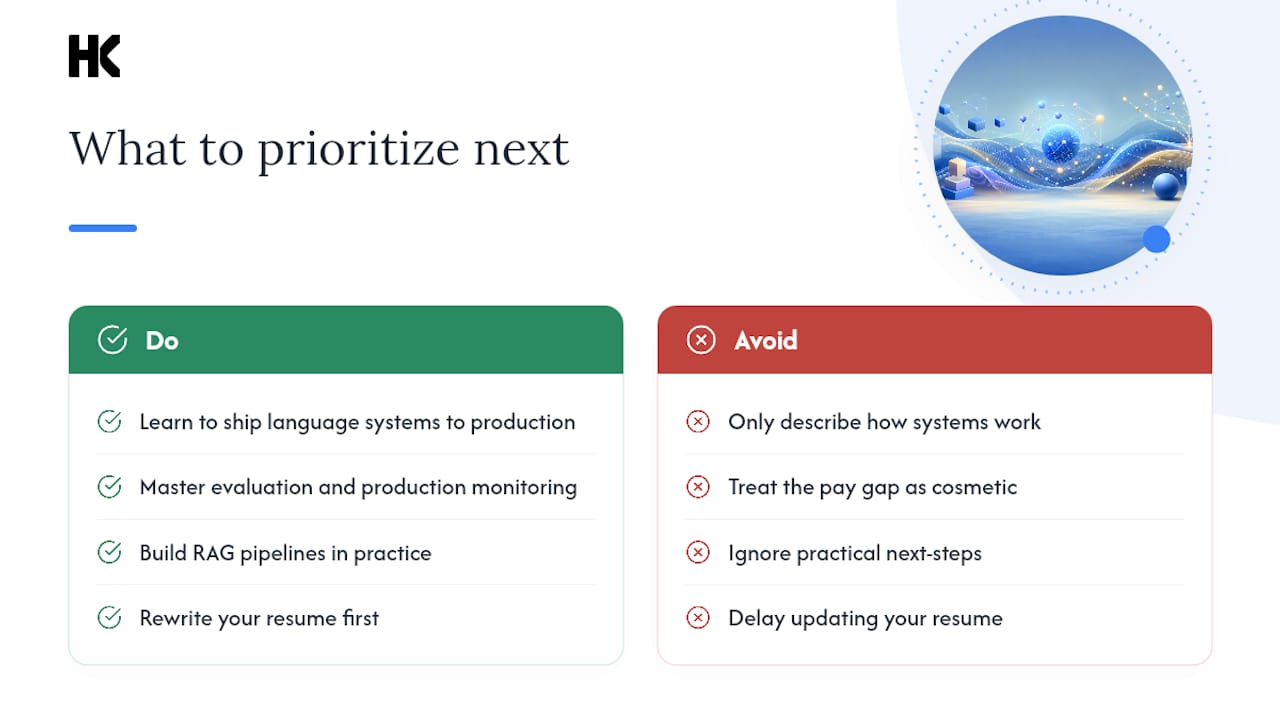
The pay gap between "Computational Linguist" and "Applied Scientist" isn't cosmetic. It reflects what companies are actually willing to fund: engineers who can ship and evaluate language systems in production, not just describe how they work. That's the same skill set behind every AI integration project Hanadkubat has delivered, from RAG pipelines to production monitoring, and it's the clearest lever available to anyone trying to move up the pay bands in this piece. If you're deciding what to learn next, go back to the practical next-steps section and start with the resume rewrite. It's the fastest change with the highest return.
Table of Contents
- Computational Linguistics Salary by Data Source: Why the Numbers Disagree
- How Does Salary Change by Experience and Job Title?
- Which Industries Pay the Most for Linguistics Skills?
- How Reliable Is Salary Data, and What Should You Watch For?
- Which Skills Move You Into Higher-Paid Roles?
- What Should You Do This Week to Raise Your Offer?
- Getting AI Features Built Right the First Time
- Sources
- FAQ
Computational Linguistics Salary by Data Source: Why the Numbers Disagree
Ask three salary sites for a computational linguistics salary and you'll get three different answers, and none of them is wrong. They're measuring different things.
Indeed aggregates active job postings and reported salaries tied to real listings, which skews toward what employers are advertising right now. Comparably relies on self-reported entries from site visitors, a method that pulls in outliers on both ends, which is exactly why its range balloons to $416,830 at the top. PayScale, as cited by the University of Washington, blends survey data with job-title matching, landing closer to the middle of the pack.

| Source | Metric reported | Data snapshot | Main caveat |
|---|---|---|---|
| Indeed | Average and range from job postings | May 2026 | Skews toward advertised roles, not total comp |
| Comparably | Self-reported average and range | June 2026 | Small, self-selected sample; wide variance |
| PayScale (via UW) | Median and top-end salary | 2025 | Survey-based; may lag current market by a year |
If you're evaluating a job offer, Indeed's job-post data reflects what employers are actually paying right now. If you want a sanity check on total compensation claims from a recruiter, Comparably's self-reported figures show how much variance exists once bonuses and equity enter the picture. PayScale's median, as UW reports it, works best as a stable middle benchmark rather than a ceiling or floor.
How Does Salary Change by Experience and Job Title?
Pay in this field climbs steeply once you leave entry-level linguistics work and start touching production systems.
- Entry level ($65,000–$85,000): typically a research assistant or junior NLP analyst role, often paired with a master's degree
- Mid-career ($90,000–$125,000): computational linguist or NLP specialist roles at established tech companies, usually 3 to 7 years in
- Senior ($130,000–$165,000+): roles that blend linguistics with engineering leadership, often at companies building large-scale language products
Title matters as much as tenure. Job titles that consistently pay more than "Computational Linguist" for comparable work include:
- Applied Scientist
- Research Engineer
- NLP Engineer
- Speech/ASR Engineer
- Search Engineer
The Computing Research Association's data puts the median for computer and information research scientists at $140,910, and the insight behind that number is straightforward: professionals who move into Applied Scientist or Research Engineer roles command a premium because those jobs bridge research and production engineering.
Which Industries Pay the Most for Linguistics Skills?
Employer type moves the needle on computational linguist salary as much as job title does. The highest payers tend to be:
- Large tech firms building consumer-facing language products
- Search and ads companies that depend on ranking and query understanding
- Speech and voice product teams working on ASR and text-to-speech
- Finance and enterprise AI teams applying NLP to structured, high-stakes data
- Well-funded startups with dedicated ML infrastructure budgets
Companies like Google, Apple, and Amazon regularly recruit for roles that touch computational linguistics, from search relevance to voice assistants, though they're far from the only path into well-paid work. Academic research positions and small nonprofit research centers tend to pay less, largely because grant funding and university pay scales cap compensation well below what production teams at scale can offer.
How Reliable Is Salary Data, and What Should You Watch For?
Every salary figure comes from one of a few collection methods, and each has blind spots worth knowing before you trust a number.
- Employer-posted job ads (Indeed's core method) show advertised pay but often miss equity and bonus structures
- Self-reported surveys (Comparably) capture total comp claims but suffer from small, self-selected samples
- University-cited aggregator data (PayScale via UW) smooths outliers but can lag the current market by a year or more
- Government occupational stats (BLS, summarized by the CRA) cover broad job categories that don't map perfectly onto niche titles like "computational linguist"
Pro Tip: Before you anchor a negotiation to any salary figure, check three things: the sample size, the date range of the data, and whether the number includes equity or bonus. A 2025 median missing equity data will understate what a 2026 offer with stock actually pays.
Which Skills Move You Into Higher-Paid Roles?
The fastest way to raise your computational linguistics salary isn't a new degree. It's demonstrable production skill.
Hiring teams pay premiums for specific, provable capabilities:
- Production ML engineering: shipping models that run in live systems, not just notebooks
- Large-model evaluation: designing benchmarks that catch failure modes before users do
- Reproducibility frameworks: making sure results hold up when someone else reruns your pipeline
- Data-pipeline engineering: building the plumbing that feeds models clean, labeled data
- Multilingual evaluation: testing model behavior across languages, not just English
- Safety and robustness testing: probing models for bias, jailbreaks, and edge-case failures
Retitling matters too. A candidate with identical skills often gets a stronger offer band under "NLP Engineer" or "Applied Scientist" than under "Computational Linguist," simply because hiring managers associate those titles with more production experience. On a resume, lead with shipped systems and evaluation metrics, not coursework.
Deep linguistics knowledge paired with systems engineering and evaluation skills is what separates the highest-paid people in this field from everyone else applying for the same jobs.
This tracks with broader hiring trends: as automation lowers the value of repetitive annotation and training tasks, the roles that pay well concentrate on evaluation, safety, and reproducible measurement, work that's harder to automate away. Coursework from programs like Coursera's NLP specialization can help build the technical vocabulary, but what actually moves an offer is shipped, measurable work. For a broader look at how these engineering skills interact with AI product decisions, see this breakdown of engineering trends CTOs are watching in 2026.
What Should You Do This Week to Raise Your Offer?
- Research your market rate: filter Indeed, Comparably, and PayScale by your city and target title, then track five recent job postings to see what's actually being offered right now.
- Ask peers directly: a handful of real conversations with people in similar roles often reveals more than any aggregator.
- Separate base from equity in any offer, and ask specifically what performance metrics trigger a raise or promotion.
- Anchor to the median, not the average: a median filters out the outliers that skew self-reported data like Comparably's.
- Rewrite your resume around engineering impact: list production metrics, evaluation frameworks you built, and systems you shipped, not just linguistic theory you studied. For ideas on how to frame systems-level work for hiring managers, this guide on presenting full-stack engineering experience applies directly to linguists pivoting toward engineering titles.
Getting AI Features Built Right the First Time
Salary data only tells half the story. The other half is what companies actually need from the linguists and NLP engineers they're hiring, and that's shifted hard toward production AI systems that work reliably at scale. Hanadkubat builds exactly that: production-ready AI features shipped in two-week sprints for €4,500, AI audits with a prioritized roadmap for €1,500, and full multi-feature integration projects starting at €9,500. The work draws on the same skills this article flags as pay drivers, RAG systems, agentic patterns, LLM cost optimization, and production evaluation, built with EU AI Act compliance and GDPR-aware architecture from the start. If your team is trying to hire for these skills instead of build them, see how the engagements work.
Sources
- Computational linguist salary in United States, 2026
- Computing Researcher Jobs in Natural Language Processing: Roles, Pay, Day-to-Day | Computing Research Association
- Careers | UW Computational Linguistics Master's Degree
- Computational Linguist Salary - June 2026
FAQ
What Does a Computational Linguist Do?
A computational linguist builds and studies systems that process human language, work that spans everything from speech recognition to machine translation and text analysis, drawing on both linguistic theory and software engineering.
Is Computational Linguistics a Good Career Field?
Yes, particularly for people willing to build production engineering skills alongside linguistic knowledge. The Computing Research Association projects strong growth in related research and applied roles, and demand is shifting toward professionals who combine both skill sets.
What Type of Linguist Gets Paid the Most?
Linguists who move into Applied Scientist or Research Engineer roles tend to earn the most, since those positions combine linguistic expertise with production ML engineering, a combination that consistently commands a pay premium over traditional research-only linguistics roles.