
TL;DR:
- AI-driven productivity and platform engineering are transforming 2026’s engineering landscape, with AI becoming a baseline skill for hiring. Companies are measuring AI tool impact through observability and ROI metrics, shifting focus from adoption to value. Additionally, sustainability and interdisciplinary skills now command higher salaries and influence engineering workforce strategies.
The defining engineering trends in 2026 are AI-driven productivity gains, mainstream platform engineering, IBM's sub-1 nanometer semiconductor breakthrough, and a workforce shift that makes AI proficiency a baseline hiring requirement. These are not predictions. They are already reshaping budgets, hiring pipelines, and architecture decisions at B2B SaaS companies across the DACH region and beyond. Engineering leaders who treat these as future concerns will find themselves reacting to changes their competitors already built into their roadmaps.
What are the top engineering trends in 2026?
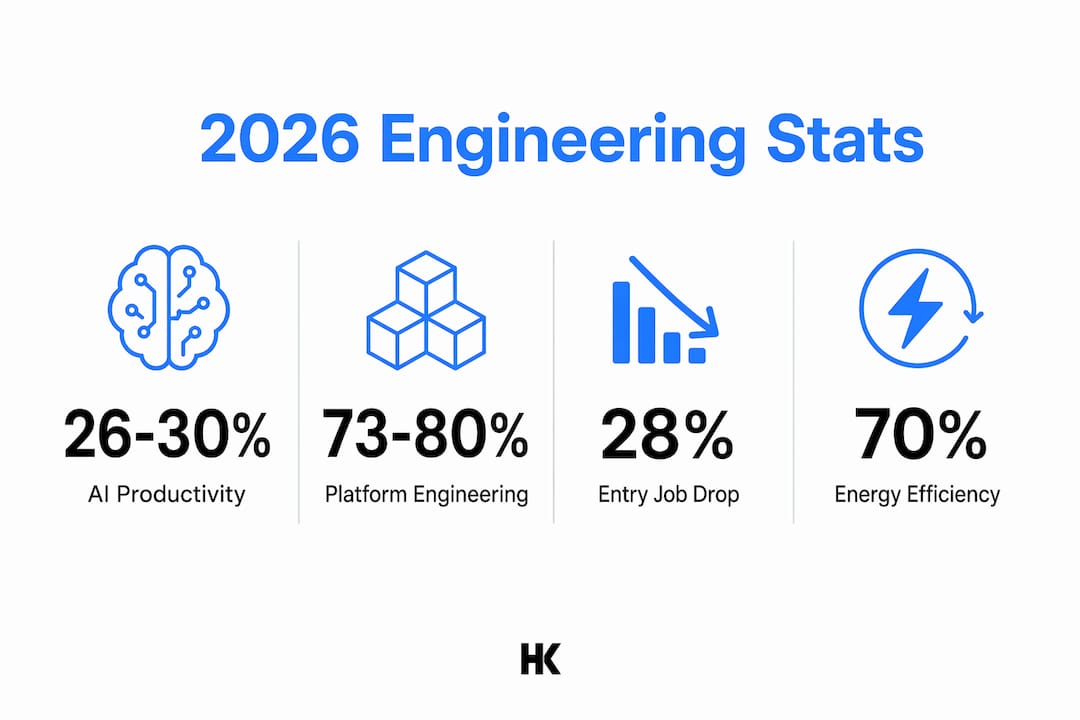
AI and machine learning now improve engineering productivity by 26–30% across organizations that have moved past the pilot phase. That number sounds clean, but the reality underneath it is messier. 84% of developers use AI coding tools, yet fewer than 20% fully delegate any task to them. The gap between adoption and trust is the defining tension in engineering organizations right now.

Platform engineering has crossed from early adopter territory into standard practice. 73–80% of platform teams now integrate AI assistants directly into their internal developer platforms. That adoption rate means the question is no longer whether to build a platform team, but how to measure what it produces.
IBM's nanostack chip architecture delivers nearly 100 billion transistors on a fingernail-sized chip, with 50% more work capacity and 70% higher energy efficiency than prior state-of-the-art designs. That single hardware advance changes the cost curve for running large AI models in production, which matters directly to any CTO paying cloud inference bills today.
How are AI tools and platform engineering changing developer workflows?
AI coding assistants have moved well past autocomplete. Multi-agent AI orchestration now handles complex engineering tasks, including jet engine simulation workflows at MIT, where AI copilots coordinate across multiple specialized agents to run and verify results. The key word is "verify." Every multi-agent workflow requires human checkpoints, or errors compound silently across the pipeline.
The practical challenge for engineering leaders is not adoption. It is trust and measurement. Consider what is actually happening inside most teams:
- AI tools write code that passes review but accumulates technical debt invisibly
- Platform teams standardize infrastructure and accelerate deployments, but struggle to attribute specific velocity gains to specific investments
- 25% of AI investments are deferred because CFOs demand provable ROI before releasing budget
- Code-level observability is the missing layer in most AI-assisted workflows
The ROI pressure is real. CFOs across DACH and EU organizations are no longer accepting "developer experience" as a success metric. They want deployment frequency, defect rates, and time-to-production numbers that tie directly to AI tool spend.
Pro Tip: Treat your AI coding tools as part of your product platform, not as individual developer utilities. Add observability at the code generation layer: track which AI-suggested code gets accepted, modified, or rejected. That data tells you where the tools add value and where they create review overhead.
For teams building toward this level of measurement, the engineering best practices for software teams that support AI tool integration and platform productivity are worth reviewing before committing to a toolchain.
How is the 2026 job market shifting for engineering teams?
The workforce signal is unambiguous. Entry-level engineering job postings dropped 28% in 2026, driven directly by automation gains at the junior task level. That contraction is not a temporary dip. It reflects a structural change in what junior engineers are hired to do.
At the same time, 42% of all engineering job listings now require AI proficiency as a mandatory filter, not a nice-to-have. Recruiters are adapting their screening criteria, and senior engineers are being evaluated on architecture judgment and system design rather than raw coding speed.
The practical implications for engineering leaders:
- Senior engineers who cannot articulate AI tool tradeoffs are losing ground in compensation negotiations
- Teams that upskill existing engineers outperform teams that hire new AI-native graduates, because domain knowledge compounds
- The IT engineer role in 2026 has shifted toward AI integration, system oversight, and cross-domain collaboration
Pro Tip: Before your next hiring cycle, audit your existing team's AI proficiency gaps. A targeted 6-week internal training program on prompt engineering, AI output review, and agentic workflow design costs a fraction of a senior hire and retains institutional knowledge.
What does IBM's nanostack chip mean for engineering infrastructure?
IBM's nanostack architecture represents a genuine departure from prior semiconductor design. Where nanosheet technology stacks transistors horizontally, nanostack places them vertically, doubling transistor density on the same physical footprint. The result is a chip that fits 100 billion transistors into fingernail-scale silicon.
The engineering implications extend well beyond chip fabrication. The 70% energy efficiency gain changes the economics of data center AI inference. Running large language models at scale becomes cheaper per query, which directly affects the build-versus-buy calculation for any team considering on-premise or EU-resident inference for GDPR compliance.
| Feature | Nanosheet (prior) | Nanostack (IBM 2026) |
|---|---|---|
| Transistor orientation | Horizontal stacking | Vertical stacking |
| Transistor density | State-of-the-art baseline | ~2x baseline |
| Work capacity | Baseline | 50% higher |
| Energy efficiency | Baseline | 70% higher |
| Manufacturing complexity | High | Very high |
The manufacturing challenge is real. Thermal management at sub-1 nm scale requires new fabrication processes that most fabs are not yet equipped to run at volume. Broad availability is still 2–3 years out, but the architecture sets the direction for every data center and AI hardware roadmap being written today.
Quantum engineering is following a parallel path, moving from research labs toward industrial-scale systems. The primary obstacle is managing systemic complexity in large-scale qubit machines, not the underlying physics.
How are sustainability and interdisciplinary skills reshaping engineering?
Sustainability is no longer a compliance checkbox. AI-tuned infrastructure now actively reduces cloud emissions by matching compute workloads to renewable energy availability in real time. Engineering teams that instrument their infrastructure for carbon-aware scheduling are seeing measurable reductions in both emissions and cloud spend simultaneously.
Digital twin technology is widely deployed across engineering disciplines for real-time simulation and predictive maintenance. A digital twin of a hydrogen turbine, for example, can predict bearing failure 72 hours before it occurs, eliminating unplanned downtime without a single physical inspection.
The skills picture reflects this shift:
- Sustainability expertise commands premium pay, with clean energy engineering roles averaging $82,000 annually
- Hybrid engineering roles that merge mechanical, electrical, chemical, and software expertise are growing faster than any single-discipline specialty
- Perovskite solar cell research has moved from lab efficiency records into manufacturing process engineering, creating demand for materials scientists who can write Python
| Sustainability skill | Application area | Pay premium |
|---|---|---|
| Carbon-aware scheduling | Cloud infrastructure | Yes |
| Digital twin design | Manufacturing, energy | Yes |
| Hydrogen systems engineering | Turbomachinery, fuel cells | Yes |
| Perovskite process engineering | Solar manufacturing | Emerging |
The interdisciplinary trend matters for hiring strategy. The engineers who command the highest compensation in 2026 are not specialists in one domain. They are engineers who can read a mechanical stress simulation, interpret the software model driving it, and explain the energy cost of running both.
Key Takeaways
The most effective engineering leaders in 2026 treat AI tools, platform infrastructure, and sustainability as interconnected systems requiring measurement, not separate initiatives requiring enthusiasm.
| Point | Details |
|---|---|
| AI adoption gap | 84% of developers use AI tools, but fewer than 20% fully delegate tasks, so oversight structures matter more than tool selection. |
| Platform engineering ROI | 25% of AI investments are deferred pending ROI proof; instrument your platform before scaling spend. |
| Hardware cost curve | IBM's nanostack chip delivers 70% energy efficiency gains, directly lowering the cost of EU-resident AI inference. |
| Workforce restructuring | Entry-level postings dropped 28%; invest in upskilling existing engineers rather than waiting for AI-native hires. |
| Sustainability as a skill | Carbon-aware scheduling and digital twin design now command salary premiums and appear in senior engineering job requirements. |
What I've learned from watching AI hype hit engineering teams
The pattern I see repeatedly across DACH B2B SaaS clients is this: a team adopts an AI coding tool, productivity feels faster for six weeks, and then technical debt quietly accumulates in the AI-generated code that no one is reviewing carefully enough. The 29% trust figure is not surprising to me. It matches what I observe when I audit codebases that have been running AI-assisted development for six months or more.
The teams that get real, sustained productivity gains from AI tools are the ones that treat the tool as a junior engineer who needs code review, not as an oracle. They build observability into the workflow from day one. They track which suggestions get accepted unchanged versus which ones get rewritten. That data tells you whether the tool is actually helping or just generating plausible-looking code faster.
Platform engineering adoption is the other area where I see leaders underestimate the organizational work. The technology is straightforward. Getting senior engineers to contribute to a shared platform instead of building bespoke solutions for their own teams is the hard part. The teams that succeed treat the platform as a product with internal customers, not as an infrastructure project with a deadline.
My honest recommendation: before you add another AI tool to your stack, spend two weeks measuring what your current tools are actually producing. The measurement work is less exciting than the tool evaluation, but it is the only way to make a defensible investment case to a CFO who has seen three AI budget cycles come and go without clear returns.
— Hanad
How Hanadkubat helps engineering leaders act on these trends
Engineering leaders who need to move from trend awareness to shipped production systems have a specific problem: the gap between knowing what to build and having the architecture, compliance knowledge, and code to build it.
Hanadkubat works directly with B2B SaaS CTOs and technical founders across the DACH region and EU to close that gap. The AI integration track delivers production-ready features in 2-week sprints at €4,500, with EU AI Act compliance and GDPR-aware architecture built in from the start. For teams that need to scope before they build, an AI audit and roadmap at €1,500 produces a prioritized plan with concrete ROI targets, not a strategy deck. Every engagement is direct: you work with the engineer writing the code, not a project manager relaying requirements.
FAQ
What are the main engineering trends in 2026?
The main trends are AI-assisted development with 26–30% productivity gains, mainstream platform engineering with 73–80% AI integration, IBM's nanostack semiconductor breakthrough, and a workforce shift requiring AI proficiency in 42% of engineering job postings.
Why did entry-level engineering jobs drop in 2026?
Entry-level engineering job postings fell 28% because AI tools now handle many routine coding tasks previously assigned to junior engineers. Senior roles are growing, but they require AI oversight skills and architecture judgment.
How does IBM's nanostack chip affect AI infrastructure costs?
IBM's nanostack chip delivers 70% higher energy efficiency than prior designs. That directly reduces the cost of running AI inference workloads, which matters for any team evaluating EU-resident or on-premise deployment for GDPR compliance.
How should CTOs measure AI tool ROI?
Code-level observability is the most reliable method. Track AI suggestion acceptance rates, defect rates in AI-generated code, and deployment frequency before and after tool adoption. CFOs are deferring 25% of AI investments precisely because teams lack this data.
What sustainability skills matter most for engineering teams in 2026?
Carbon-aware scheduling, digital twin design, and hydrogen systems engineering command salary premiums and appear in senior engineering job requirements. Clean energy engineering roles average $82,000 annually, making sustainability expertise a concrete hiring and retention factor.